
AI-101 · Lesson 5 of 5 · 33 min
AI and society
AI is not only a technical subject. Systems that screen job applications, approve loans, recommend medical treatments, decide what news people see, generate realistic fake images or drive cars change people's lives, for better and for worse. As AI becomes more capable and more widely used, questions about fairness, privacy, truth, work, safety and power become engineering questions too, because they depend on how systems are designed, tested and deployed.
This chapter surveys the main benefits and risks of AI, shows how some of them can be measured, describes how governments are responding, and closes with what responsible practice means for the people who build and use AI. The later courses AI-430 (safety and evaluation), AI-440 (law, policy and governance) and AI-460 (fairness and privacy) go much deeper.
The promise
The benefits are real and growing. AI helps doctors read medical images and spot disease earlier, speeds up drug discovery and protein design, forecasts weather more accurately, translates between languages, captions speech for people who are deaf or hard of hearing, describes images for people who are blind, and helps programmers, writers and analysts work faster. In engineering it optimizes energy systems, predicts equipment failures and helps design structures and circuits. Many economists expect AI to raise productivity significantly, though estimates of how much and how soon vary widely.
The same capabilities create risks. A system good at writing persuasive text can write misinformation; a system good at recognizing faces can enable mass surveillance; a system that automates tasks can displace workers. Most of the difficult questions are about how AI is used, by whom, and with what safeguards.
Fairness and bias
Machine learning learns patterns from data, and data reflect the world that produced them, including its inequalities. Bias can enter at many points:
- Historical bias: if past hiring favored one group, a model trained on past hiring decisions learns to favor it too.
- Representation bias: if a face-recognition dataset contains few darker-skinned faces, the model will be less accurate on them. Studies around 2018 found commercial face-analysis systems with error rates far higher for darker-skinned women than for lighter-skinned men.
- Measurement bias: if the label is a poor proxy for what we care about (for example, using past health care spending as a proxy for health need, when some groups have had less access to care), the model optimizes the wrong thing.
- Deployment bias: a model used in a setting different from the one it was built for can fail unevenly.
Bias can be measured by comparing a model's errors across groups.
Worked problem
Measuring unequal errors
A loan-screening model is tested on 1000 past applicants whose repayment outcomes are known. Group A: 600 applicants, 400 of whom repaid; the model approved 360 of those who repaid and 40 who did not. Group B: 400 applicants, 200 of whom repaid; the model approved 140 of those who repaid and 20 who did not. Compare the true positive rate (qualified applicants approved), the false positive rate and the approval rate for each group.
Show solution
- Group A: TPR = 360/400 = 90%; FPR = 40/200 = 20%; approval rate = 400/600 = 67%.
- Group B: TPR = 140/200 = 70%; FPR = 20/200 = 10%; approval rate = 160/400 = 40%.
- A qualified applicant in group B is rejected 30% of the time, versus 10% in group A.
Answer: The model treats qualified applicants in group B much worse: three times the wrongful rejection rate. It violates equal opportunity (equal true positive rates). Investigating why, whether through the features, the training data or the labels, is the next step, and the bank would also need to check its legal obligations under human rights and lending law
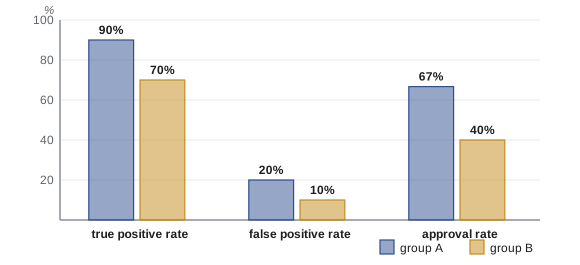
There are several mathematical definitions of fairness: equal approval rates (demographic parity), equal true positive rates (equal opportunity), equal error rates in both directions (equalized odds), or equal precision. A well-known result shows that when groups have different base rates, a model generally cannot satisfy all of these at once. Choosing which matters most is a value judgment that should involve the people affected, not only the engineers.
Privacy and surveillance
AI is hungry for data, and much of the most useful data is about people. Risks include collecting personal data without meaningful consent, using it for purposes people never agreed to, re-identifying individuals from supposedly anonymous data, and inferring sensitive facts (health, sexuality, politics) from innocent-looking data. Face recognition makes it possible to identify people in public spaces at scale.
The United States has no general federal privacy law. Personal data is protected by sector-specific federal laws (such as HIPAA for health information), by the Federal Trade Commission's power over unfair and deceptive practices, and by a growing number of state laws. Illinois's Biometric Information Privacy Act, which requires consent before collecting biometric data such as face geometry, has produced some of the largest privacy settlements in US history.
Truth, deepfakes and information
Generative AI makes it cheap to produce realistic fake text, images, audio and video. Deepfakes have been used for fraud (for example, cloned voices of executives or relatives asking for money), harassment (non-consensual intimate images), and political disinformation. Detection tools help, but they are imperfect, and their errors interact with how rare fakes are.
Worked problem
Why detectors struggle
A deepfake detector correctly flags 95% of fake videos and correctly passes 95% of real ones. On a platform where 1% of uploaded videos are deepfakes, what fraction of flagged videos are actually fake?
Show solution
- Out of 10,000 videos: 100 are fake, 9,900 real.
- Flagged fakes: 0.95 × 100 = 95. Flagged real videos: 0.05 × 9,900 = 495.
- Fraction of flags that are fake: 95/(95 + 495) = 0.161.
Answer: Only about 16% of flagged videos are fakes; most flags are false alarms, because real videos vastly outnumber fakes. This is Bayes' theorem at work (STAT-235): detection must be combined with other evidence, such as provenance information recording where content came from
Responses include labeling AI-generated content, content provenance standards that cryptographically record how a file was created and edited, platform policies and new laws.
In the United States, the TAKE IT DOWN Act, signed in May 2025, made it a federal crime to publish non-consensual intimate images, including AI-generated ones, and requires platforms to remove them within 48 hours of a valid request. Many states have also passed laws on deepfakes in elections and intimate images.
Work and the economy
AI automates tasks, not whole jobs, but as more tasks become automatable, jobs change. The International Monetary Fund estimated in 2024 that about 40% of employment worldwide, and about 60% in advanced economies, is exposed to AI, meaning a significant share of the tasks involved could be affected. Exposure does not mean job loss: in many roles AI complements workers, making them more productive, while in others it may substitute for them. Unlike earlier waves of automation that mainly affected routine manual work, AI particularly affects knowledge work: writing, coding, analysis, customer service and design.
How the gains and losses are shared depends on choices by companies and governments: retraining, education, social supports and competition policy. For individuals, the most durable skills are those that combine domain expertise with judgment, responsibility and the ability to use AI tools well.
Safety, misuse and advanced AI
As models become more capable, three kinds of risk receive attention:
- Misuse: people using AI to cause harm, for example to write malware, plan cyberattacks, run large-scale scams, or obtain knowledge that helps build biological or chemical weapons. Developers test models for such capabilities and build safeguards; governments increasingly expect them to.
- Malfunction: systems that fail in high-stakes settings, such as a medical, financial or infrastructure system making a serious error, or an agent taking an unintended harmful action.
- Loss of control: the concern, held by some leading researchers, that future AI systems much more capable than people could pursue goals that conflict with human interests in ways that are hard to correct. Others consider this unlikely or distant. The question is actively debated and studied in AI safety and alignment research (AI-430).
In January 2025, the first International AI Safety Report, written by about 100 experts from around the world and chaired by Yoshua Bengio, summarized the scientific evidence on these risks and stressed how uncertain many of them remain. Several governments have created AI safety institutes to evaluate advanced models.
In the United States, the AI Safety Institute at the National Institute of Standards and Technology (NIST) was renamed the Center for AI Standards and Innovation in 2025, with a focus on evaluating capabilities and national security risks and on developing standards.
Environmental impact
Training and running AI uses large amounts of electricity, and some data centers use substantial water for cooling. The International Energy Agency projects that global data center electricity use will more than double between 2024 and 2030, driven largely by AI. The impact depends heavily on where the electricity comes from and how efficiently it is used. At the same time, AI can help reduce emissions elsewhere, by optimizing grids, buildings and industrial processes. Engineers can measure and reduce AI's footprint with efficient models, efficient hardware and data centers (DCE-200, DCE-460), and by choosing the smallest model that does the job.
How governments are responding
Governments are trying to capture AI's benefits while managing its risks, and they have taken different approaches. Internationally, the OECD AI Principles (2019, updated 2024) set out shared values such as transparency, robustness and accountability. The European Union's AI Act, in force since August 2024, is the most comprehensive law so far: it bans some practices outright (such as social scoring by governments) from February 2025, sets obligations for general-purpose AI models from August 2025, and imposes strict requirements on high-risk systems in areas such as employment, credit and critical infrastructure. An amendment that entered into force in July 2026 postponed the high-risk requirements to December 2027 and August 2028. The EU AI Act matters outside Europe because it applies to anyone offering AI systems in the EU market.
In the United States
The United States has no comprehensive federal AI law. Federal policy has been set mainly by executive action and by applying existing laws, and it has changed with each administration:
- In January 2025, Executive Order 14179 revoked the previous administration's 2023 order on AI safety and directed agencies to remove barriers to American AI leadership. America's AI Action Plan followed in July 2025.
- Executive Order 14365 (December 2025), "Ensuring a National Policy Framework for Artificial Intelligence", set out to limit what the administration considers burdensome state AI laws; an AI Litigation Task Force was created in January 2026, and in March 2026 the White House sent Congress non-binding recommendations for a national framework that would pre-empt some state laws.
- Existing laws still apply to AI: the Federal Trade Commission acts against deceptive AI claims and unfair practices, and anti-discrimination laws in employment, housing and credit apply whether or not a decision is automated. NIST's AI Risk Management Framework (2023) is a widely used voluntary standard.
- States have been active. California's SB 53 (2025) requires developers of frontier models (trained with more than 10²⁶ FLOP) to publish safety frameworks and report critical safety incidents. Colorado replaced its 2024 AI Act in May 2026 with a narrower law on automated decision-making in areas such as employment, housing, lending and health care, expected to take effect in 2027. Many states have laws on deepfakes, chatbots and government use of AI.
AI law is changing quickly. Anyone deploying AI in a regulated area must check the current rules, and AI-440 tracks them in detail.
Responsible AI in practice
Laws set minimums. Engineers and organizations that build and deploy AI can do much more, and professional engineers have an existing duty to put public safety and welfare first. Common responsible-AI practices include:
- Define the purpose, the people affected and what could go wrong before building, and decide whether AI is the right tool at all.
- Document data sources, consent and known limitations; publish model documentation ("model cards").
- Test for performance and fairness across groups, for robustness and for misuse, before and after deployment.
- Keep meaningful human oversight for high-stakes decisions, with a way for people to contest them.
- Protect privacy by collecting only what is needed and securing it.
- Monitor in operation, report incidents and fix problems.
- Be honest about what a system can and cannot do.
Worked problem
Should this be automated?
A city wants an AI system to decide automatically which applicants receive emergency housing support. List three questions to answer before going ahead.
Show solution
- What are the consequences of errors, and for whom? A wrongful denial could leave a family without shelter.
- Does the training data reflect past decisions that may have been unfair, and how will performance be checked across groups?
- Will a human review denials, can applicants understand and appeal the decision, and which laws (privacy, human rights, administrative fairness) apply?
Answer: For a decision this consequential, a reasonable design keeps a human decision-maker, uses AI at most to help prioritize or flag information, tests fairness before and after launch, and gives applicants an explanation and an appeal. Sometimes the responsible answer is not to automate
Common mistakes
MistakeAssuming an algorithm is neutral because it is mathematical.
InsteadModels inherit patterns, including unfair ones, from their data, labels and design choices. Measure outcomes across groups.
MistakeRemoving a sensitive attribute and declaring the model fair.
InsteadOther features (postal or ZIP code, school, purchase history) can act as proxies. Test the outcomes, not just the inputs.
MistakeTrusting a detector's accuracy without considering base rates.
InsteadWhen the thing being detected is rare, most alarms can be false even for an accurate detector.
MistakeTreating AI regulation as settled.
InsteadLaws and policies are changing quickly in Canada, the US and abroad; check the current rules for each deployment.
MistakeLeaving ethics to someone else.
InsteadDesign choices made by engineers decide many of these outcomes. Professional responsibility applies to AI work.
Summary and key terms
- AI brings real benefits in health, science, accessibility, engineering and productivity, alongside risks that depend largely on how it is used.
- Bias enters through historical, representation, measurement and deployment effects; measure it by comparing error rates across groups. Different fairness definitions can conflict when base rates differ.
- Privacy risks include collection without consent, re-identification and surveillance through face recognition.
- Deepfakes enable fraud, harassment and disinformation; detectors face the base-rate problem, so provenance and law also matter.
- About 40% of global employment is exposed to AI (IMF); effects range from complementing to replacing workers.
- Safety concerns cover misuse, malfunction and loss of control; AI safety institutes and the International AI Safety Report study them.
- US: no comprehensive federal AI law; executive orders (14179, 14365), the AI Action Plan, existing FTC and anti-discrimination law, NIST's framework, and state laws such as California's SB 53 shape the rules.
- The EU AI Act is the most comprehensive AI law and reaches companies outside Europe. Responsible AI practice goes beyond legal minimums.
- Algorithmic bias
- Systematic differences in an AI system's errors or outcomes across groups of people.
- True positive rate
- The fraction of actual positives correctly identified; also called recall or sensitivity.
- Equal opportunity
- A fairness criterion requiring equal true positive rates across groups.
- Base rate
- How common the condition being predicted is in a population.
- Deepfake
- Synthetic audio, images or video that realistically depict people saying or doing things they did not.
- Automated decision system
- A system that makes or helps make decisions about people with little or no human involvement.
- EU AI Act
- The European Union's risk-based AI regulation, in force since August 2024 with obligations phased in over several years.
- AI safety institute
- A government body that evaluates the capabilities and risks of advanced AI models.
- Responsible AI
- Practices for designing, building and deploying AI that is safe, fair, transparent, accountable and respects privacy.
- NIST AI Risk Management Framework
- A voluntary US framework (2023) for identifying and managing AI risks.
- Pre-emption
- The principle that federal law can override state law in some areas.
Practice problems
Work each problem on paper first, then reveal the answer to check.
Identify the likely type of bias: a voice assistant trained mostly on recordings of one accent performs poorly on others.
Show answer
Representation bias: some groups are underrepresented in the training data.
In the loan example, compute the precision (fraction of approved applicants who repaid) for each group.
Show answer
Group A: 360/400 = 90%. Group B: 140/160 = 87.5%.
Why might a model that never sees applicants' ethnicity still produce unequal outcomes by ethnicity?
Show answer
Other features, such as neighborhood, school or name, can correlate with ethnicity and act as proxies; historical labels may also reflect past discrimination.
A fraud detector flags 2% of honest transactions and catches 90% of frauds. Fraud is 0.5% of transactions. What fraction of flags are real fraud?
Show answer
Per 100,000: fraud 500, caught 450; honest 99,500, flagged 1,990. 450/2,440 = 18.4%.
Give one example each of AI complementing a worker and AI substituting for a worker.
Show answer
Complementing: an engineer using an AI assistant to draft code that they review. Substituting: an automated system handling routine customer inquiries that people used to answer.
Distinguish misuse, malfunction and loss of control with one example each.
Show answer
Misuse: using a model to write phishing emails. Malfunction: a medical model giving a wrong recommendation. Loss of control: a hypothetical advanced system pursuing goals its developers cannot correct.
Under the EU AI Act, which kinds of obligations applied from February 2025 and August 2025?
Show answer
Prohibitions on certain practices from 2 February 2025; obligations for general-purpose AI models from 2 August 2025.
Which California law applies to frontier AI developers, and what is its compute threshold?
Show answer
SB 53, the Transparency in Frontier Artificial Intelligence Act (2025); it applies to models trained with more than 10²⁶ FLOP.
List four responsible-AI practices for a team deploying a hiring screening tool.
Show answer
For example: test outcomes across groups before and after launch; document data and limitations; keep human review of rejections with a way to contest; collect only necessary data; monitor and report incidents; check employment and human rights law.
Why can't a model usually satisfy demographic parity, equal opportunity and equal precision at the same time?
Show answer
When groups have different base rates, the mathematics forces trade-offs: equalizing one measure generally unbalances another, so a choice about which matters most is required.
Lesson quiz · 5 questions
Score 60% or more to complete this lesson.
Create a free account to save your progress, take quizzes and earn a certificate.