
BAR-242 · Lesson 5 of 12 · 19 min
Exam changes ahead: South Dakota's NextGen exam in July 2027
▶ Video coming soon A video version of this lesson is on the way.
In November 2026 the study group's chat was full of NextGen questions. Several members were sitting in states that had already switched, and one, Marcus Bell, had taken the first NextGen exam in Missouri in July 2026 and passed. Lacey asked him what it felt like. 'Different,' Marcus said. 'Fewer subjects, more skills, and the questions tell you more of the law than you expect. It was not easier. It was just different.' Marchetti added the point that mattered most for Lacey: 'You are sitting the last old exam in South Dakota. Everything in this lesson is about the exam you are trying not to need.'
This lesson covers the South Dakota Supreme Court's decision to adopt NextGen, what South Dakota has and has not announced, how the NextGen exam is built, and what a candidate sitting near the change should do.
The decision
On December 12, 2024 the South Dakota Unified Judicial System announced that the Supreme Court had adopted the NextGen bar exam developed by NCBE for applicants seeking admission to practice law in South Dakota, beginning with the July 2027 exam. The court said the new exam would test foundational lawyering skills across litigation and transactional practice, and that it would develop implementing rules and hold a rules hearing at which the public could comment. Chief Justice Steven R. Jensen described the change as part of the state's commitment to making sure new lawyers are ready to practice, and Dean Neil Fulton of the University of South Dakota Knudson School of Law said the exam's goal should be to confirm that graduates are ready to serve clients.
The Board of Bar Examiners' website now states the consequence directly: the July 2027 NextGen exam will be the first South Dakota administration, and February 2027 is the last time the MPT, MEE, Indian Law Question and MBE are given in South Dakota.
What South Dakota has announced, and what it has not
By November 2026 South Dakota had settled some questions and left others open. NCBE's chart of NextGen jurisdictions lists South Dakota's first administration as July 2027. It lists South Dakota as accepting transferred NextGen scores beginning July 2026, with a minimum transferred score of 620, and it notes that South Dakota had not yet set its own passing score. The chart lists South Dakota's minimum passing NextGen score and any jurisdiction-specific admission requirement as to be announced.
The Board's website adds that rule changes are coming for the transfer of MBE scores and for the effect of scores obtained before July 2027. That sentence matters for two groups: candidates who might want to bring a legacy MBE score into South Dakota after the change, and candidates who pass one portion of the legacy exam but fail the other.
| Question | Status in November 2026 | Source |
|---|---|---|
| First NextGen exam | July 2027 | UJS announcement; Board website; NCBE |
| Last legacy exam | February 2027 | Board website |
| South Dakota NextGen passing score | To be announced | NCBE chart |
| Transferred NextGen scores | Accepted at 620 or more from July 2026 | NCBE chart |
| Jurisdiction-specific requirement | To be announced | NCBE chart |
| Effect of pre-July 2027 scores and MBE transfers | Rule changes announced as coming | Board website |
Why the 620 transfer figure appears before the first exam
Lacey noticed an oddity: South Dakota accepted transferred NextGen scores from July 2026, a year before it gave NextGen itself. NCBE's chart does not explain the gap, but the effect is clear. A candidate who took NextGen in another jurisdiction in July 2026, such as Marcus in Missouri, could already seek to transfer a score of 620 or more into South Dakota, subject to character and fitness and any other South Dakota requirements. The 620 figure is the minimum transferred score; it is not necessarily the passing score South Dakota will set for its own NextGen administrations, which remained to be announced.
The Indian Law Question after NextGen
South Dakota's current exam includes a state-drafted essay on federal Indian law. NextGen is a uniform exam, and NCBE's chart lists South Dakota's jurisdiction-specific requirement as to be announced. Whether South Dakota will keep an Indian law component in some form, for example as a separate requirement, a course or a test, was not settled as of November 2026. A candidate planning to sit in July 2027 or later should watch for the court's implementing rules.
How NextGen is built
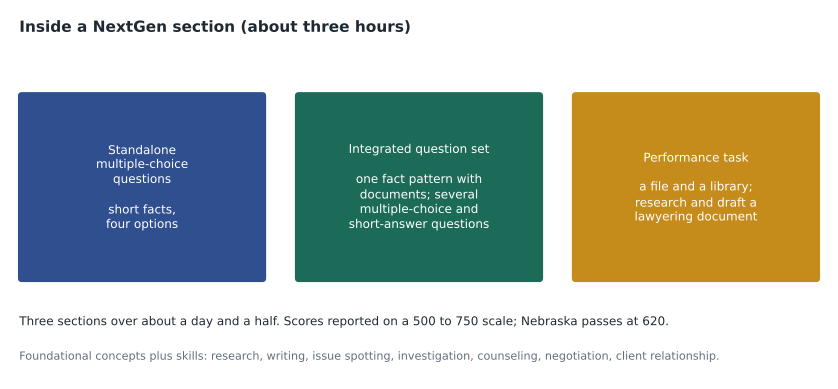
NextGen is given over a day and a half. On the first day candidates complete two three-hour sessions separated by a lunch break; on the second day they complete one three-hour session. The exam mixes three types of questions: standalone multiple-choice questions, integrated question sets built around a common fact pattern with short written answers and multiple-choice items, and performance tasks in which candidates complete a lawyering task using provided materials. Commercial summaries of NCBE's design report the weighting as about 49 percent standalone multiple-choice, 21 percent integrated question sets and 30 percent performance tasks.
Scores are reported on a single scale from 500 to 750. Each jurisdiction sets its own passing score. Neighboring jurisdictions that have announced NextGen passing scores have set them in a narrow band: NCBE's chart lists 610 for North Dakota and 620 for Nebraska, and Missouri, which gave NextGen in July 2026, set 610. South Dakota's 620 transfer minimum sits in the same range.
What NextGen tests
NextGen tests foundational concepts and principles in a narrower set of subjects than the legacy exam, together with foundational lawyering skills. The concepts cover civil procedure, contract law, evidence, torts, business associations, constitutional law, criminal law and procedure and real property, with family law joining the tested concepts in July 2028. Trusts and estates may appear in performance tasks with legal resources provided. The skills include legal research, legal writing, issue spotting and analysis, investigation and evaluation, client counseling and advising, negotiation and dispute resolution, and client relationship and management.
For candidates, the shift has two practical consequences. First, memorization of narrow black-letter rules counts for less, and applying rules to facts under time pressure counts for more. Second, many NextGen questions supply some of the law, so careful reading of the materials becomes as important as recall.
Advice for candidates sitting near the change
Marchetti gave the group three pieces of advice, each tailored to South Dakota.
First, aim to pass both portions in February 2027. Under the legacy rules a candidate can keep a passed portion for two years, but South Dakota has said rule changes are coming for scores obtained before July 2027. A candidate who passes the MBE but fails the written portion in February may find that there is no legacy written portion left to retake in South Dakota.
Second, use legacy materials for a legacy exam. As commercial courses shift toward NextGen in late 2026, a February 2027 South Dakota candidate must make sure every practice set is built for the MBE, the MEE and the MPT. A NextGen practice set may test a format that does not appear on the legacy exam. Older MEE practice sets have the opposite problem: they include conflict of laws, family law, trusts and estates and secured transactions, which left the MEE in July 2026, so Lacey skips those essays.
Third, have a NextGen plan in reserve. If Lacey's February result were a failure, she would need to decide quickly whether to sit South Dakota's first NextGen exam in July 2027 or another jurisdiction's NextGen exam and transfer the score. The May 1, 2027 deadline would come soon after February results.
Worked problem
A candidate near the change
Lacey's classmate Tanner Hollenbeck sat the July 2026 South Dakota exam. He passed the MBE with 136 but wrote a 72 percent average. He plans to sit in February 2027. What should he consider?
Show solution
- Under the legacy rules Tanner may retake only the written portion, and his MBE pass remains valid for two years.
- February 2027 is the last legacy administration, so this is his only chance to retake the legacy written portion in South Dakota.
- If he fails the written portion again in February, the Board has said rule changes are coming for scores obtained before July 2027. He cannot assume his July 2026 MBE pass will combine with a NextGen attempt.
- He should file by November 1, 2026, focus his study on the MEE, MPT and Indian Law Question, and ask the Board in writing how his MBE score would be treated if he needs to sit after July 2027.
Answer: Tanner should retake only the written portion in February 2027 and get written guidance from the Board on the transition, because February is his last legacy opportunity.
Common mistakes
MistakeSouth Dakota's NextGen passing score is 620.
InsteadSouth Dakota accepts transferred NextGen scores of 620 or more; its own passing score was still to be announced in November 2026.
MistakeThe Indian Law Question will continue unchanged after NextGen.
InsteadNCBE lists South Dakota's jurisdiction-specific requirement as to be announced.
MistakeA legacy pass on one portion will combine with a later NextGen attempt.
InsteadThe Board has announced coming rule changes for scores earned before July 2027; candidates should not assume it.
MistakeNextGen tests the same subjects as the MEE did before 2026.
InsteadNextGen tests a narrower set of concepts plus lawyering skills; family law joins in July 2028.
Why jurisdictions are changing
Marchetti spent a few minutes on why so many jurisdictions, South Dakota among them, have adopted NextGen. NCBE designed the new exam after a multi-year study of what newly licensed lawyers actually do, which concluded that the bar exam should test a narrower set of legal concepts in greater depth and should measure lawyering skills directly. The legacy exam rewarded memorizing a large body of black-letter rules; NextGen asks candidates to apply fewer rules to realistic tasks, sometimes with legal materials supplied. Supporters argue that the change better reflects early practice. Critics have raised concerns about the cost of the transition, the risk to candidates sitting near the change and uncertainty about how passing scores will be set.
For South Dakota, the court's announcement emphasized readiness for practice. The state's single law school, its small bar and its need for lawyers in rural communities and public service roles make the question of what a licensing exam should measure especially practical. The Public Service Pathway pilot, adopted only two months after the NextGen announcement, reflects the same concern from a different direction.
What the transition means for studying
Lacey asked whether anything she was learning for February would be wasted if she had to sit NextGen later. Marchetti said no. The core subjects overlap heavily: civil procedure, contracts, evidence, torts, constitutional law, criminal law and procedure, real property and business associations appear on both exams. Essay and MPT practice builds the writing and analysis skills NextGen tests. What would change is the format and timing, the mix of question types and the weight given to skills such as client counseling and negotiation, which the legacy exam tested only indirectly.
A candidate switching from legacy to NextGen preparation should start by taking a full NextGen practice exam under timed conditions, then compare the results with legacy diagnostics to see which skills need new attention. Integrated question sets in particular take practice, because they combine reading, short written answers and multiple-choice items around one set of facts.
Watching for the implementing rules
The court said it would develop rules for NextGen and hold a hearing at which the public could comment. Several important details depend on those rules: the passing score for South Dakota's own NextGen administrations, any South Dakota-specific requirement such as an Indian law component, the treatment of legacy scores earned before July 2027 and the future of MBE score transfers. A candidate affected by any of these should check the Board's website and the court's published rules and orders regularly, and should not hesitate to ask the Board for written guidance on an individual situation.
Marchetti's last word on the subject was practical. 'Uncertainty is not a reason to panic,' she said. 'It is a reason to pass in February.'
A decision tree for a February result
Marchetti helped Lacey write a short decision tree for the day results arrived. If she passed both portions, she would complete the admission steps. If she passed the MBE but not the written portion, she would contact the Board at once about her options after the last legacy exam, review her failed answers in Pierre within the window Regulation 4.2 allows, and decide between South Dakota's first NextGen exam and another jurisdiction's NextGen exam with a score transfer. If she passed the written portion but not the MBE, she would ask the same questions about the MBE. If she failed both, she would begin NextGen preparation immediately for July 2027. Writing the tree in November, Marchetti said, meant she would not have to think clearly on the worst day.
Summary and key terms
- The Supreme Court announced the adoption of NextGen on December 12, 2024, beginning July 2027.
- February 2027 is the last legacy South Dakota exam.
- South Dakota accepts transferred NextGen scores of 620 or more from July 2026; its own passing score and any local requirement were to be announced.
- The Board has said rule changes are coming for MBE transfers and for scores obtained before July 2027.
- NextGen runs a day and a half, mixes standalone questions, integrated sets and performance tasks, and reports scores from 500 to 750.
- Candidates near the change should aim to pass both portions in February 2027 and keep a NextGen plan in reserve.
- 0
- NextGen UBE
- 1
- integrated question set
- 2
- performance task
- 3
- foundational skills
- 4
- transferred score
- 5
- legacy exam
Practice problems
Work each problem on paper first, then reveal the answer to check.
When did South Dakota announce its adoption of NextGen?
Show answer
December 12, 2024.
What is the last legacy South Dakota exam?
Show answer
February 2027.
What minimum transferred NextGen score does South Dakota accept?
Show answer
620, from July 2026.
On what scale are NextGen scores reported?
Show answer
500 to 750.
Lesson quiz · 5 questions
Score 60% or more to complete this lesson.
Create a free account to save your progress, take quizzes and earn a certificate.