
BIOC-200 · Lesson 11 of 12 · 24 min
The citric acid cycle and oxidative phosphorylation
▶ Video coming soon A video version of this lesson is on the way.
Glycolysis releases only a small part of the energy in glucose. The rest is still locked in the two molecules of pyruvate and in the NADH made along the way. In cells with mitochondria and a supply of oxygen, that energy is extracted in three linked stages. Pyruvate is converted to acetyl-CoA. The acetyl group is oxidized completely to carbon dioxide in the citric acid cycle, which captures the energy in reduced electron carriers. Finally, the respiratory chain passes electrons from those carriers to oxygen and uses the energy released to make ATP, a process called oxidative phosphorylation. Together these stages make roughly fifteen times as much ATP from glucose as glycolysis alone. This lesson gives an overview of each stage; BIOC-330 and BIOC-331 treat them in detail.
The mitochondrion
Mitochondria are organelles about the size of a bacterium, and they almost certainly descend from bacteria that were engulfed by an ancestral cell more than 1.5 billion years ago. They still carry their own small circular DNA, which in humans encodes 13 proteins, all of them parts of the respiratory chain. A mitochondrion has two membranes. The outer membrane is porous to small molecules. The inner membrane is folded into ridges called cristae, which greatly enlarge its area, and it is impermeable to almost everything, including protons; it holds the respiratory chain and the ATP synthase. The space inside the inner membrane, the matrix, contains the enzymes of the citric acid cycle and of fatty acid oxidation.
From pyruvate to acetyl-CoA
Pyruvate made in the cytosol is carried into the matrix by a transporter in the inner membrane. There the pyruvate dehydrogenase complex, a huge assembly of three enzymes with many copies of each, converts it to acetyl-CoA. The reaction removes the carboxyl group of pyruvate as carbon dioxide, oxidizes the remaining two-carbon unit and attaches it to coenzyme A, reducing NAD⁺ to NADH:
The complex uses five coenzymes: thiamine pyrophosphate, lipoic acid, coenzyme A, FAD and NAD⁺, made from four different vitamins between them. A lack of thiamine, common in severe alcoholism, cripples pyruvate dehydrogenase and causes the nerve and heart damage of beriberi and Wernicke encephalopathy, because the brain depends so heavily on glucose oxidation. The reaction is irreversible, which matters later: animals cannot turn acetyl-CoA back into pyruvate, and so they cannot make glucose from fatty acids.
The citric acid cycle
The citric acid cycle, also called the Krebs cycle or the tricarboxylic acid cycle, was worked out by Hans Krebs in 1937 from experiments on minced pigeon breast muscle; he shared the 1953 Nobel Prize in Physiology or Medicine. It is a cycle because its final step regenerates its starting molecule. In each turn, a two-carbon acetyl group joins a four-carbon molecule, oxaloacetate, to form six-carbon citrate. Over seven further steps, two carbons are removed as carbon dioxide and oxaloacetate is regenerated, ready to accept the next acetyl group. The energy released is captured in three NADH, one FADH₂ and one GTP (or ATP).
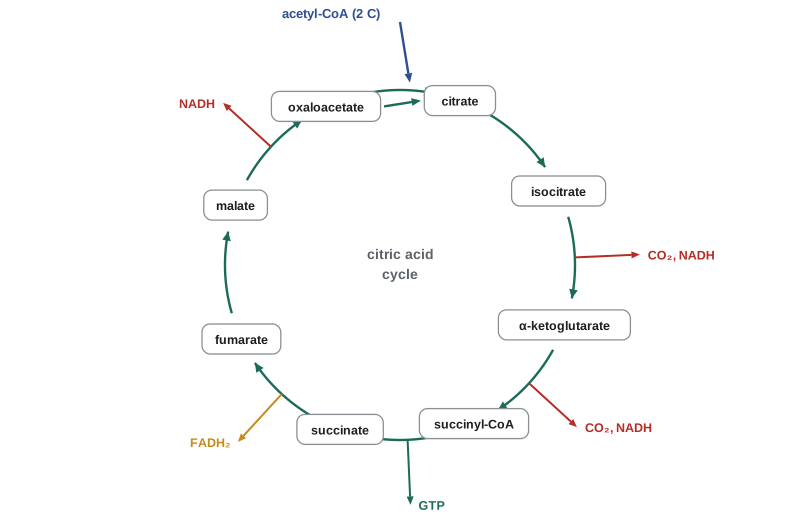
The steps, in outline, are these. Citrate synthase joins acetyl-CoA to oxaloacetate to form citrate, a strongly favorable reaction that pulls the cycle forward. Aconitase rearranges citrate to isocitrate. Isocitrate dehydrogenase oxidizes isocitrate and removes a carbon dioxide, giving the five-carbon alpha-ketoglutarate and the first NADH. The alpha-ketoglutarate dehydrogenase complex, a close relative of pyruvate dehydrogenase, removes the second carbon dioxide and attaches the remaining four-carbon unit to coenzyme A as succinyl-CoA, making the second NADH. Succinyl-CoA synthetase uses the energy of the thioester bond to make GTP, which is readily converted to ATP; this is the only substrate-level phosphorylation in the cycle. Succinate dehydrogenase oxidizes succinate to fumarate, passing electrons to FAD; this enzyme is embedded in the inner membrane and is also part of the respiratory chain. Fumarase adds water to make malate, and malate dehydrogenase oxidizes malate back to oxaloacetate, making the third NADH.
The overall reaction for one turn is:
Two features are worth noticing. First, the cycle itself uses no oxygen, yet it stops within seconds without it, because it needs a supply of NAD⁺ and FAD that only the respiratory chain can regenerate. Second, the two carbons released as carbon dioxide in a given turn are not the two carbons that entered as acetyl in that turn; the carbons are scrambled by the cycle, and the acetyl carbons leave in later turns.
The citric acid cycle is also a hub for biosynthesis. Several of its intermediates are drawn off to make other molecules: citrate is exported to the cytosol to provide acetyl-CoA for fatty acid synthesis, alpha-ketoglutarate and oxaloacetate are converted into the amino acids glutamate and aspartate, and succinyl-CoA is used to make heme. Whenever intermediates are drawn off, they must be replaced, or the cycle would run down. The most important replenishing reaction is pyruvate carboxylase, which adds carbon dioxide to pyruvate to form oxaloacetate. Reactions that replace intermediates are called anaplerotic, from the Greek for filling up.
The cycle is controlled mainly at the steps that are far from equilibrium: citrate synthase, isocitrate dehydrogenase and alpha-ketoglutarate dehydrogenase, together with pyruvate dehydrogenase at the entrance. High levels of NADH and ATP inhibit these enzymes, signaling that the cell has energy to spare; ADP and calcium, which rises in contracting muscle, activate them.
The respiratory chain
The NADH and FADH₂ made in the citric acid cycle, and the NADH from glycolysis, carry electrons to the respiratory chain, also called the electron transport chain, in the inner mitochondrial membrane. The chain consists of four large protein complexes and two mobile carriers. Complex I, NADH dehydrogenase, accepts two electrons from NADH and passes them to ubiquinone, a small lipid-soluble carrier, also called coenzyme Q, that moves within the membrane. Complex II, which is succinate dehydrogenase, passes electrons from FADH₂ to ubiquinone too, but by a separate route. Complex III takes electrons from reduced ubiquinone and passes them to cytochrome c, a small protein on the outer face of the inner membrane. Complex IV, cytochrome c oxidase, collects four electrons from four molecules of cytochrome c and uses them to reduce one molecule of oxygen to two molecules of water.
The carriers are arranged in order of increasing reduction potential, from NADH at −0.32 V to oxygen at +0.82 V, so electrons flow down the chain spontaneously, releasing energy at each step. As Lesson 9 calculated, the whole fall from NADH to oxygen releases about 220 kJ per pair of electrons. Many poisons act on the chain. Cyanide and carbon monoxide bind to the iron of complex IV and stop electron flow, so cells cannot use oxygen even when plenty is present; rotenone, once used to kill fish, blocks complex I.
Chemiosmosis: how the chain makes ATP
For years biochemists searched for a high-energy chemical intermediate linking electron flow to ATP synthesis, and found none. In 1961 Peter Mitchell proposed a radically different answer, the chemiosmotic hypothesis, for which he received the 1978 Nobel Prize in Chemistry. As complexes I, III and IV pass electrons along, they pump protons from the matrix across the inner membrane into the intermembrane space. Because the inner membrane is impermeable to protons, a gradient builds up, with a higher concentration of protons outside and a positive charge outside relative to the matrix. This proton-motive force stores the energy released by electron transport, just as water stored behind a dam stores the energy of a river. In a typical mitochondrion it is equivalent to about 0.2 V, made up mostly of the electrical potential with a smaller contribution from the difference in pH.
Protons flow back into the matrix through a remarkable enzyme, ATP synthase, and their flow drives the synthesis of ATP from ADP and phosphate. ATP synthase is a rotary motor. Its membrane part, called Fo, contains a ring of subunits that turns as protons pass through it, and a central stalk attached to the ring rotates inside the catalytic head, called F1, which projects into the matrix. The F1 head has three catalytic sites, and the rotation forces each in turn through three states: one that binds ADP and phosphate, one that joins them into ATP, and one that releases the ATP. Paul Boyer proposed this binding-change mechanism, John Walker solved the structure of F1 in 1994, and they shared the 1997 Nobel Prize in Chemistry. In 1997 Hiroyuki Noji and Masasuke Yoshida attached a fluorescent filament to a single F1 head and watched it spin under a microscope.
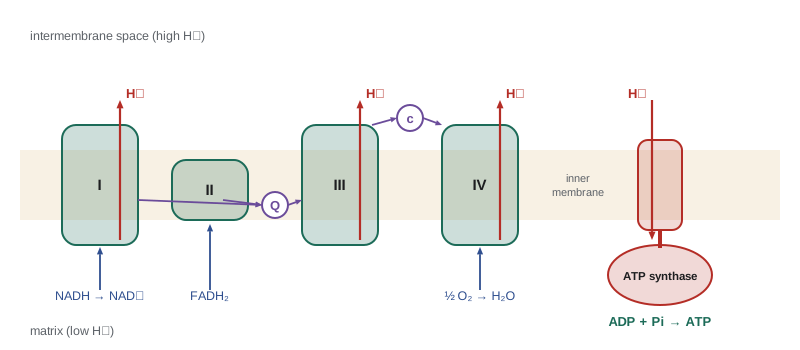
Because ATP synthesis is driven by the gradient rather than by electron transport directly, the two can be separated, or uncoupled. Molecules that carry protons across the inner membrane, such as 2,4-dinitrophenol, let the gradient leak away without making ATP; electron transport then speeds up but the energy is released as heat. Dinitrophenol was once sold as a weight-loss drug in the 1930s and caused deaths from uncontrolled fever. Nature uses the same principle deliberately. Brown fat, abundant in newborn babies and hibernating mammals, contains a protein called thermogenin, or uncoupling protein 1, which lets protons back into the matrix to generate heat.
The balance sheet
How much ATP does the complete oxidation of glucose make? The answer depends on how many protons the chain pumps and how many ATP synthase needs. Current estimates are that the chain pumps about 10 protons for each NADH and 6 for each FADH₂, and that about 4 protons are needed for each ATP made and exported to the cytosol. That gives about 2.5 ATP per NADH and 1.5 ATP per FADH₂, numbers called P/O ratios because they also give the ATP made per oxygen atom reduced. Older textbooks quoted 3 and 2, and a total of 36 to 38 ATP per glucose, but those whole numbers came from assuming a tight chemical coupling that does not exist.
Adding up: glycolysis gives 2 ATP and 2 NADH; pyruvate dehydrogenase, 2 NADH; two turns of the citric acid cycle, 2 GTP, 6 NADH and 2 FADH₂. The NADH made in the cytosol by glycolysis cannot cross the inner membrane, and the shuttles that carry its electrons in deliver them either as NADH or as FADH₂, depending on the tissue, so cytosolic NADH is worth 1.5 or 2.5 ATP. The total comes to about 30 to 32 ATP per glucose. The worked example and program below set out the arithmetic.
A worked example: counting ATP
Worked problem
ATP from one glucose
Using 2.5 ATP per mitochondrial NADH and 1.5 ATP per FADH₂, calculate the ATP made from the complete oxidation of one glucose, assuming cytosolic NADH from glycolysis enters the mitochondria through the malate-aspartate shuttle (worth 2.5 ATP each), as in the heart and liver.
Show solution
- Glycolysis: 2 ATP directly, plus 2 NADH × 2.5 = 5 ATP. Subtotal 7.
- Pyruvate dehydrogenase (2 pyruvate): 2 NADH × 2.5 = 5 ATP. Running total 12.
- Citric acid cycle (2 turns): 2 GTP = 2 ATP; 6 NADH × 2.5 = 15 ATP; 2 FADH₂ × 1.5 = 3 ATP. That is 20 ATP. Running total 32.
- With the glycerol 3-phosphate shuttle used in skeletal muscle and brain, the 2 cytosolic NADH are worth only 1.5 ATP each, which lowers the total by 2, to 30.
Answer: About 32 ATP per glucose with the malate-aspartate shuttle and 30 with the glycerol 3-phosphate shuttle.
A program: the ATP balance sheet
The program tallies the ATP made from one glucose under both shuttles, then estimates the efficiency of the whole process: the free energy captured in ATP under cellular conditions compared with the free energy released by burning glucose. Finally it calculates the proton-motive force from typical values of the membrane potential and pH difference.
import math

def atp_per_glucose(cytosolic_nadh_value, nadh=2.5, fadh2=1.5):
    glycolysis = 2 + 2 * cytosolic_nadh_value
    pdh = 2 * nadh
    cycle = 2 * 1 + 6 * nadh + 2 * fadh2        # GTP, NADH, FADH2 from two turns
    return glycolysis, pdh, cycle, glycolysis + pdh + cycle

for shuttle, value in (("malate-aspartate", 2.5), ("glycerol 3-phosphate", 1.5)):
    g, p, c, total = atp_per_glucose(value)
    print(f"{shuttle:22s} glycolysis {g:4.1f}  PDH {p:4.1f}  cycle {c:4.1f}  total {total:4.1f} ATP")

# Efficiency: glucose + 6 O2 -> 6 CO2 + 6 H2O releases about 2870 kJ/mol
for dg_atp in (30.5, 50.0):
    eff = 32 * dg_atp / 2870
    print(f"capturing {dg_atp} kJ per ATP: efficiency {eff:.0%}")

# Proton-motive force: delta p = delta psi - (2.303 RT / F) * delta pH  (in volts)
R, T, F = 8.314, 310.0, 96485.0
dpsi = 0.150      # membrane potential, matrix negative (V)
dph = 0.75        # matrix pH minus intermembrane pH
dp = dpsi + 2.303 * R * T / F * dph
print()
print(f"proton-motive force = {dpsi:.3f} V (electrical) + {2.303 * R * T / F * dph:.3f} V (pH) = {dp:.3f} V")
print(f"free energy per proton moved into the matrix: {-F * dp / 1000:.1f} kJ/mol")malate-aspartate glycolysis 7.0 PDH 5.0 cycle 20.0 total 32.0 ATP glycerol 3-phosphate glycolysis 5.0 PDH 5.0 cycle 20.0 total 30.0 ATP capturing 30.5 kJ per ATP: efficiency 34% capturing 50.0 kJ per ATP: efficiency 56% proton-motive force = 0.150 V (electrical) + 0.046 V (pH) = 0.196 V free energy per proton moved into the matrix: -18.9 kJ/mol
The tally confirms 32 and 30 ATP for the two shuttles, with the great majority of the ATP coming from the mitochondria rather than from glycolysis. At cellular free energies of about 50 kJ per ATP, more than half of the free energy of glucose is captured, a better efficiency than most engines achieve. Each proton flowing back into the matrix releases about 19 kJ/mol, so the roughly four protons needed per ATP supply around 75 kJ, comfortably more than the 50 kJ or so needed to make it.
Common mistakes
MistakeThe citric acid cycle uses oxygen directly.
InsteadIt uses none, but it stops without oxygen because the respiratory chain is needed to regenerate NAD⁺ and FAD.
MistakeComplete oxidation of glucose yields exactly 36 or 38 ATP.
InsteadCoupling is not a whole-number chemical ratio; current estimates are about 2.5 ATP per NADH and 1.5 per FADH₂, giving about 30 to 32 ATP.
MistakeElectron transport makes ATP directly at each complex.
InsteadElectron transport pumps protons; ATP synthase uses the proton gradient to make ATP.
MistakeThe carbons that enter the cycle as acetyl leave as CO₂ in the same turn.
InsteadThe two CO₂ of each turn come from carbons that entered in earlier turns.
MistakeUncouplers stop electron transport.
InsteadThey let protons leak back, so electron transport speeds up while ATP synthesis falls and heat is released.
MistakeAnimals can make glucose from fatty acids through acetyl-CoA.
InsteadPyruvate dehydrogenase is irreversible and the cycle releases both acetyl carbons as CO₂, so there is no net conversion of acetyl-CoA to glucose.
Summary and key terms
- Pyruvate dehydrogenase converts pyruvate to acetyl-CoA, CO₂ and NADH in the mitochondrial matrix, irreversibly.
- Each turn of the citric acid cycle oxidizes an acetyl group to two CO₂ and yields 3 NADH, 1 FADH₂ and 1 GTP; its intermediates also supply biosynthesis.
- The respiratory chain passes electrons from NADH and FADH₂ through complexes I to IV to oxygen, pumping protons out of the matrix.
- By chemiosmosis, the proton-motive force drives the rotary ATP synthase; uncouplers dissipate it as heat.
- Complete oxidation of glucose yields about 30 to 32 ATP, most of it from oxidative phosphorylation.
- Acetyl-CoA
- The two-carbon acetyl group carried by coenzyme A; the fuel of the citric acid cycle.
- Citric acid cycle
- The cycle of eight reactions that oxidizes acetyl groups to CO₂ in the mitochondrial matrix.
- Anaplerotic reaction
- A reaction that replenishes intermediates of the citric acid cycle.
- Respiratory chain
- The series of membrane complexes and carriers that pass electrons from NADH and FADH₂ to oxygen.
- Chemiosmotic hypothesis
- Mitchell's theory that a proton gradient across a membrane links electron transport to ATP synthesis.
- ATP synthase
- The rotary enzyme that uses the flow of protons to make ATP from ADP and phosphate.
- Uncoupler
- A molecule that lets protons cross the inner membrane without making ATP.
Practice problems
Work each problem on paper first, then reveal the answer to check.
How many molecules of CO₂ are released from one glucose in pyruvate dehydrogenase and the citric acid cycle together?
Show answer
Six: two from pyruvate dehydrogenase and four from two turns of the cycle.
Which enzyme of the citric acid cycle is also part of the respiratory chain?
Show answer
Succinate dehydrogenase, complex II.
How many ATP are made from one acetyl-CoA by the cycle and oxidative phosphorylation?
Show answer
1 GTP + 3 NADH × 2.5 + 1 FADH₂ × 1.5 = 1 + 7.5 + 1.5 = 10 ATP.
Why is cyanide so rapidly lethal?
Show answer
It binds complex IV, stopping electron transport to oxygen, so ATP production by oxidative phosphorylation stops.
What does an uncoupler do to oxygen consumption and to ATP synthesis?
Show answer
Oxygen consumption rises because electron transport speeds up; ATP synthesis falls.
Why does a lack of thiamine harm the brain particularly?
Show answer
Thiamine pyrophosphate is a coenzyme of pyruvate dehydrogenase, and the brain depends on oxidizing glucose.
Lesson quiz · 5 questions
Score 60% or more to complete this lesson.
Create a free account to save your progress, take quizzes and earn a certificate.