
CHEM-103 · Lesson 4 of 5 · 37 min
Chemical equilibrium
Stoichiometry tells you how much product a reaction could make if it went to completion. Many reactions never do. They run until the forward and reverse reactions balance, and then the composition stops changing. Ammonia synthesis, methanol production, the dissolving of minerals in boiler water, the acidity of process streams and the chemistry of blood all settle into this state, called chemical equilibrium.
Engineers care because equilibrium sets the limit on what a process can achieve, no matter how good the reactor. This chapter explains what equilibrium is, how the equilibrium constant describes it, how to calculate equilibrium compositions, and how changing concentration, pressure or temperature shifts it. It then applies the same ideas to acids, bases, pH, buffers and solubility.
Dynamic equilibrium
Consider dinitrogen tetroxide, a colourless gas that splits into brown nitrogen dioxide: N₂O₄ ⇌ 2 NO₂. Seal some N₂O₄ in a flask and it starts to decompose. As NO₂ builds up, the reverse reaction (two NO₂ molecules combining) speeds up. Eventually the two rates are equal and the color stops changing.
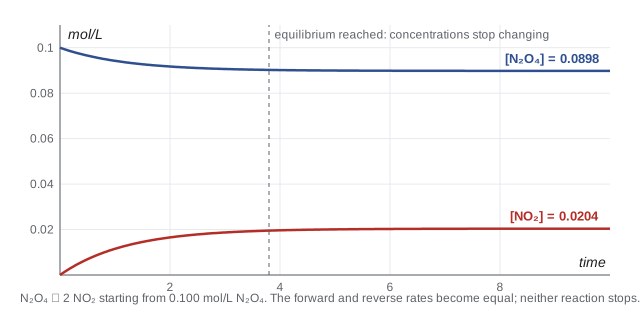
Equilibrium is dynamic: molecules are still reacting in both directions, just at equal rates. You reach the same equilibrium whether you start from pure N₂O₄, pure NO₂ or any mixture, as long as the total amount of material and the temperature are the same.
The equilibrium constant
For a general reaction \(a\text{A} + b\text{B} \rightleftharpoons c\text{C} + d\text{D}\), the concentrations at equilibrium always satisfy
where square brackets mean molar concentration at equilibrium. This is the law of mass action. \(K_c\) depends only on the reaction and the temperature. Pure solids and pure liquids (including water as a solvent) are left out of the expression, because their concentrations do not change.
For gases, the same idea is often written with partial pressures (in bar or atm) as \(K_p\). The two are related by \(K_p = K_c(RT)^{\Delta n}\), where \(\Delta n\) is the change in moles of gas (products minus reactants) and \(R = 0.08206\) L·atm/(mol·K).
The size of \(K\) tells you where the equilibrium lies:
- \(K \gg 1\) (say above \(10^3\)): products dominate; the reaction goes nearly to completion.
- \(K \ll 1\) (below \(10^{-3}\)): reactants dominate; very little product forms.
- \(K\) near 1: significant amounts of both.
Two manipulation rules are useful. Reversing a reaction inverts \(K\). Multiplying the equation by a factor \(n\) raises \(K\) to the power \(n\).
The reaction quotient
The reaction quotient \(Q\) has the same form as \(K\) but uses the current concentrations, which may not be at equilibrium. Comparing \(Q\) with \(K\) tells you which way the reaction will go:
- \(Q < K\): too few products; the reaction runs forward.
- \(Q > K\): too many products; the reaction runs in reverse.
- \(Q = K\): at equilibrium.
Worked problem
Which way will it go?
For N₂O₄ ⇌ 2 NO₂, \(K_c = 4.63 \times 10^{-3}\) at 25 °C. A flask contains 0.050 M N₂O₄ and 0.030 M NO₂. Is it at equilibrium? If not, which way does it shift?
Show solution
- \(Q = [\text{NO}_2]^2/[\text{N}_2\text{O}_4] = (0.030)^2/0.050 = 0.018\).
- \(Q = 0.018 > K = 0.00463\).
Answer: Not at equilibrium. Q > K, so NO₂ combines to form N₂O₄ until Q falls to K
Calculating equilibrium compositions
The standard tool is an ICE table: Initial concentrations, Change (in terms of an unknown \(x\), using the stoichiometry), and Equilibrium concentrations. Substitute the equilibrium row into the \(K\) expression and solve for \(x\).
Worked problem
An ICE table
A flask initially contains 0.100 M N₂O₄ and no NO₂ at 25 °C (\(K_c = 4.63 \times 10^{-3}\)). Find the equilibrium concentrations and the fraction of N₂O₄ that dissociates.
Show solution
- Initial: [N₂O₄] = 0.100, [NO₂] = 0. Change: \(-x\) and \(+2x\). Equilibrium: \(0.100 - x\) and \(2x\).
- \[\frac{(2x)^2}{0.100 - x} = 4.63 \times 10^{-3} \;\Rightarrow\; 4x^2 + 4.63 \times 10^{-3}x - 4.63 \times 10^{-4} = 0\]
- Quadratic formula (positive root): \(x = 0.0102\).
- [N₂O₄] = 0.0898 M; [NO₂] = 0.0204 M. Check: \(0.0204^2/0.0898 = 4.63 \times 10^{-3}\).
Answer: [N₂O₄] = 0.0898 M, [NO₂] = 0.0204 M; about 10% of the N₂O₄ dissociates
Le Chatelier's principle
If a system at equilibrium is disturbed, it shifts in the direction that partly counteracts the disturbance. This qualitative rule, Le Chatelier's principle, follows from comparing \(Q\) with \(K\), and it is how chemical engineers push reactions toward the products they want.
- Concentration: adding a reactant (or removing a product) makes \(Q < K\), so the reaction runs forward. Ammonia plants condense NH₃ out of the loop and recycle the unreacted gas for exactly this reason.
- Pressure: compressing a gas mixture favors the side with fewer moles of gas. For N₂ + 3 H₂ ⇌ 2 NH₃, four moles of gas become two, so high pressure (150 to 300 bar in practice) favors ammonia. Reactions with equal moles of gas on both sides are unaffected.
- Temperature: unlike the others, temperature changes \(K\) itself. Raising the temperature favors the endothermic direction. The Haber process is exothermic (\(\Delta H = -92\) kJ), so higher temperature lowers the equilibrium yield.
- Catalysts: speed up both directions equally. They help a system reach equilibrium faster but do not change where it ends up.
How much does temperature change K?
The van 't Hoff equation gives the change in \(K\) between two temperatures, assuming \(\Delta H\) stays roughly constant:
Worked problem
Heating nitrogen dioxide
For N₂O₄ ⇌ 2 NO₂, \(\Delta H^\circ = +57.2\) kJ and \(K = 4.63 \times 10^{-3}\) at 25 °C. Estimate K at 100 °C.
Show solution
- \(\ln(K_2/K_1) = -(57\,200/8.314)(1/373.15 - 1/298.15) = -(6880)(-6.74 \times 10^{-4}) = 4.64\).
- \(K_2/K_1 = e^{4.64} = 103\), so \(K_2 \approx 0.48\).
Answer: K rises about a hundredfold. The reaction is endothermic, so heating shifts it toward brown NO₂: a sealed tube of the gas visibly darkens when warmed
The engineer's compromise
The Haber process shows the trade-off between equilibrium and rate. Low temperature gives a high equilibrium yield of ammonia, but the reaction is then far too slow. Industrial converters run at about 400 to 500 °C with an iron catalyst: the equilibrium yield per pass is lower, but equilibrium is reached quickly, and recycling the unreacted gas makes up the difference. Designing that compromise is a classic chemical engineering problem.
Worked problem
Converting K_c to K_p
At 500 °C, \(K_c = 6.0 \times 10^{-2}\) for N₂ + 3 H₂ ⇌ 2 NH₃ (concentrations in mol/L). Find \(K_p\) with pressures in atm.
Show solution
- \(\Delta n = 2 - 4 = -2\); \(T = 773\) K.
- \(K_p = K_c(RT)^{-2} = (6.0 \times 10^{-2})(0.08206 \times 773)^{-2} = (6.0 \times 10^{-2})/(63.4)^2\).
Answer: K_p ≈ 1.5 × 10⁻⁵. The small value is why such high pressures are needed to get a useful yield
Acids, bases and pH
Acid–base reactions are equilibria too, and they matter everywhere in engineering: water treatment, corrosion control, boiler chemistry, mining effluents, concrete durability and food processing. In water, an acid donates H⁺ (as hydronium, H₃O⁺) and a base accepts it.
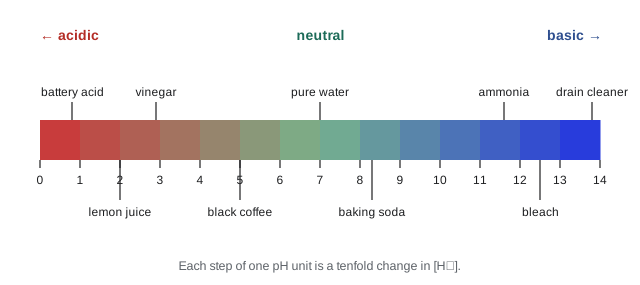
Water itself ionizes slightly: H₂O ⇌ H⁺ + OH⁻, with \(K_w = [\text{H}^+][\text{OH}^-] = 1.0 \times 10^{-14}\) at 25 °C. In pure water both are \(10^{-7}\) M. Because these numbers span many orders of magnitude, we use a logarithmic scale:
pH 7 is neutral; below 7 is acidic and above 7 is basic. Each unit is a factor of ten: pH 3 is ten times more acidic than pH 4 and a thousand times more than pH 6.
Strong and weak acids
A strong acid such as HCl, HNO₃ or H₂SO₄ (first proton) ionizes completely, so [H⁺] equals the acid concentration: 0.010 M HCl has pH 2.00. A weak acid ionizes only partly, and its equilibrium constant \(K_a\) tells you how much. Acetic acid (vinegar) has \(K_a = 1.8 \times 10^{-5}\).
Worked problem
pH of a weak acid
Find the pH of 0.10 M acetic acid, and the fraction ionized.
Show solution
- CH₃COOH ⇌ H⁺ + CH₃COO⁻. Equilibrium: \(0.10 - x\), \(x\), \(x\).
- \(x^2/(0.10 - x) = 1.8 \times 10^{-5}\). Since \(K_a\) is small, try \(x^2 \approx 1.8 \times 10^{-6}\), so \(x = 1.34 \times 10^{-3}\).
- Check: \(x\) is 1.3% of 0.10, so the approximation holds. pH \(= -\log(1.34 \times 10^{-3}) = 2.87\).
Answer: pH ≈ 2.9, with only 1.3% of the molecules ionized. A 0.10 M strong acid would have pH 1.0
Buffers
A buffer is a mixture of a weak acid and its conjugate base (or a weak base and its conjugate acid). It resists changes in pH because it can neutralize both added acid and added base. The pH of a buffer is given by the Henderson–Hasselbalch equation:
Worked problem
A buffer solution
Find the pH of a solution that is 0.10 M acetic acid and 0.15 M sodium acetate.
Show solution
- \(\text{p}K_a = -\log(1.8 \times 10^{-5}) = 4.74\).
- \(\text{pH} = 4.74 + \log(0.15/0.10) = 4.74 + 0.18 = 4.92\).
Answer: pH 4.92
Natural buffers keep blood at pH 7.4, and the carbonate buffer in lakes protects them from acid rain. Engineers add buffering chemicals to control pH in fermentation, electroplating baths and drinking-water treatment.
Solubility equilibria
A sparingly soluble salt in contact with its solution reaches an equilibrium described by the solubility product \(K_{sp}\). For calcium carbonate, CaCO₃(s) ⇌ Ca²⁺ + CO₃²⁻ and \(K_{sp} = [\text{Ca}^{2+}][\text{CO}_3^{2-}]\). The solid is left out because it is a pure solid.
Worked problem
How soluble is limestone?
With \(K_{sp} = 3.4 \times 10^{-9}\) for calcite at 25 °C, find the solubility of CaCO₃ in pure water, in mol/L and mg/L.
Show solution
- If \(s\) mol/L dissolves, \([\text{Ca}^{2+}] = [\text{CO}_3^{2-}] = s\), so \(s^2 = 3.4 \times 10^{-9}\).
- \(s = 5.8 \times 10^{-5}\) M; times 100.09 g/mol gives 5.8 mg/L.
Answer: About 6 mg/L in pure water. Natural water carrying dissolved CO₂ dissolves much more, which is how hard water picks up calcium
Solubility equilibria explain scale. When hard water is heated, dissolved CO₂ escapes and CaCO₃ becomes less soluble, so it precipitates as scale on kettle elements, boiler tubes and heat exchangers. A layer only a millimeter thick can cut heat transfer noticeably and raise fuel use, so plants soften feed water, add scale inhibitors or control pH to stay below saturation.
Common mistakes
MistakeThinking reactions stop at equilibrium.
InsteadEquilibrium is dynamic: forward and reverse rates are equal, not zero.
MistakeIncluding pure solids, pure liquids or solvent water in K.
InsteadLeave them out; their concentrations are constant.
MistakeForgetting to raise concentrations to the power of their coefficients.
InsteadFor 2 NO₂, write [NO₂]².
MistakeBelieving a catalyst increases the equilibrium yield.
InsteadA catalyst only speeds up reaching equilibrium; K is unchanged.
MistakeSaying pressure or concentration changes K.
InsteadOnly temperature changes K. Pressure and concentration change Q, and the system shifts to restore Q = K.
MistakeAssuming a weak acid of 0.10 M has pH 1.
InsteadOnly strong acids ionize completely. Use Ka to find [H⁺].
Summary and key terms
- At equilibrium, forward and reverse rates are equal and the composition stays constant.
- K = [products]^coefficients / [reactants]^coefficients, omitting pure solids and liquids; K depends only on temperature.
- Compare Q with K to predict the direction of change.
- ICE tables turn K into equilibrium concentrations.
- Le Chatelier: a system shifts to oppose a disturbance. Temperature changes K; catalysts do not.
- pH = −log[H⁺]; strong acids ionize fully, weak acids partly (Ka).
- Buffers resist pH change: pH = pKa + log([A⁻]/[HA]).
- Ksp describes the solubility of sparingly soluble salts and explains scale formation.
- Dynamic equilibrium
- A state in which opposing reactions proceed at equal rates.
- Equilibrium constant
- K, the ratio of product to reactant concentrations at equilibrium.
- Reaction quotient
- Q, the same ratio using current concentrations.
- ICE table
- A table of Initial, Change and Equilibrium concentrations.
- Le Chatelier's principle
- A disturbed equilibrium shifts to partly counteract the disturbance.
- pH
- −log₁₀ of the hydrogen ion concentration.
- Ka
- The acid dissociation constant of a weak acid.
- Buffer
- A weak acid and its conjugate base that resist pH change.
- Solubility product
- Ksp, the equilibrium constant for dissolving a sparingly soluble salt.
Practice problems
Work each problem on paper first, then reveal the answer to check.
Write Kc for 2 SO₂(g) + O₂(g) ⇌ 2 SO₃(g).
Show answer
Kc = [SO₃]²/([SO₂]²[O₂]).
Write the K expression for CaCO₃(s) ⇌ CaO(s) + CO₂(g).
Show answer
K = [CO₂] (or Kp = P_CO₂). The solids are omitted.
For H₂ + I₂ ⇌ 2 HI, Kc = 50 at 450 °C. What is Kc for 2 HI ⇌ H₂ + I₂?
Show answer
1/50 = 0.020.
For the reaction in the previous question, a vessel has [H₂] = [I₂] = 0.10 M and [HI] = 0.50 M. Which way does it shift?
Show answer
Q = 0.25/0.01 = 25 < 50, so it shifts forward, making more HI.
H₂ and I₂ each start at 0.20 M (Kc = 50). Find the equilibrium [HI].
Show answer
(2x)²/(0.20 − x)² = 50, so 2x/(0.20 − x) = 7.07, x = 0.156. [HI] = 0.312 M.
For N₂ + 3 H₂ ⇌ 2 NH₃ (exothermic), state the effect on the ammonia yield of (a) raising pressure, (b) raising temperature, (c) adding a catalyst, (d) removing NH₃.
Show answer
(a) increases; (b) decreases; (c) no change in yield, faster approach; (d) increases.
Find the pH of 0.0050 M HNO₃ and of 0.0020 M NaOH.
Show answer
HNO₃: pH = −log(0.0050) = 2.30. NaOH: pOH = 2.70, pH = 11.30.
A lake goes from pH 6.5 to pH 5.5. By what factor has [H⁺] changed?
Show answer
It has increased tenfold.
Find the pH of 0.20 M formic acid (Ka = 1.8 × 10⁻⁴).
Show answer
x ≈ √(3.6 × 10⁻⁵) = 6.0 × 10⁻³ (3% of 0.20, so the approximation holds). pH = 2.22.
What ratio of acetate to acetic acid gives a buffer at pH 5.00?
Show answer
5.00 = 4.74 + log(ratio), so ratio = 10^0.26 = 1.8.
Lesson quiz · 5 questions
Score 60% or more to complete this lesson.
Create a free account to save your progress, take quizzes and earn a certificate.