
CHEM-271 · Lesson 10 of 12 · 25 min
Mixtures and solutions: Raoult's and Henry's laws, colligative properties
▶ Video coming soon A video version of this lesson is on the way.
Most of the substances chemists handle are mixtures: air, seawater, blood, petrol, alloys, reaction mixtures. The thermodynamics of mixtures rests on the chemical potential of each component, and on how that chemical potential depends on composition. For ideal solutions the dependence is the simple logarithm already met for gases, and it leads to Raoult's law for the vapor pressure of a solvent and Henry's law for the solubility of a gas. From the same starting point come the colligative properties, which depend on the number of dissolved particles but not on what they are: the lowering of vapor pressure, the depression of the freezing point, the elevation of the boiling point and osmotic pressure. This lesson develops each in turn and applies them to distillation, carbonated drinks, road salt and desalination.
Partial molar quantities
When two liquids are mixed, the volume of the mixture is not in general the sum of their separate volumes. Mixing 50 mL of ethanol with 50 mL of water gives only about 96 mL of solution, because the water and ethanol molecules pack more closely together than either does alone. The useful quantity is the partial molar volume, \(V_i = (\partial V/\partial n_i)_{T,P,n_j}\), the increase in volume when one mole of component i is added to a large amount of the mixture. The total volume is \(V = \sum_i n_iV_i\), and the partial molar volumes depend on the composition. The chemical potential is the corresponding partial molar Gibbs energy, and every other extensive property has a partial molar counterpart defined the same way.
Ideal solutions
In an ideal solution, the molecules of the different components interact with one another exactly as they do with their own kind. Mixtures of very similar molecules, such as benzene and toluene, or hexane and heptane, come close. For each component of an ideal liquid solution, the chemical potential is
\[\mu_i(\mathrm{l}) = \mu_i^{*}(\mathrm{l}) + RT\ln x_i,\]
where \(\mu_i^{*}\) is the chemical potential of the pure liquid and \(x_i\) its mole fraction. Because \(\ln x_i < 0\), dissolving lowers the chemical potential of each component. The Gibbs energy of mixing is \(\Delta_\mathrm{mix}G = nRT\sum_i x_i\ln x_i\), which is always negative, so ideal liquids mix spontaneously in all proportions. Differentiating with respect to temperature and pressure shows that \(\Delta_\mathrm{mix}S = -nR\sum_i x_i\ln x_i\), the same as for ideal gases, while \(\Delta_\mathrm{mix}H = 0\) and \(\Delta_\mathrm{mix}V = 0\). Ideal mixing is driven entirely by entropy.
Raoult's law
François-Marie Raoult, working at Grenoble, measured the vapor pressures of many solutions in the 1880s and published his law in 1887: the partial vapor pressure of a component above an ideal solution is proportional to its mole fraction in the liquid,
\[p_i = x_i\,p_i^{*},\]
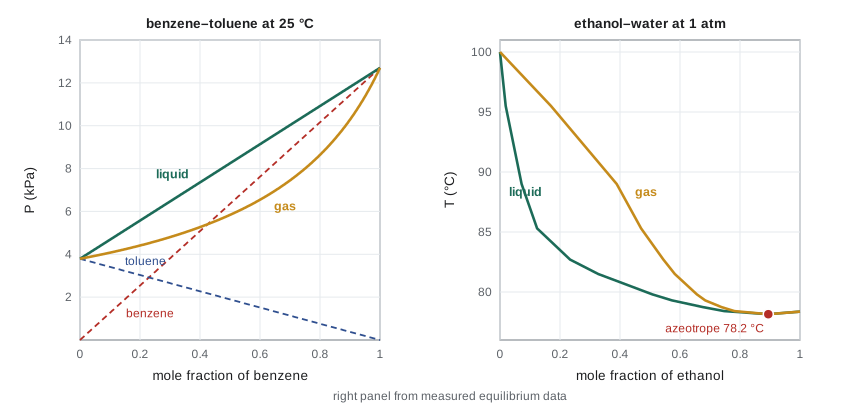
where \(p_i^{*}\) is the vapor pressure of the pure component. The law follows directly from equating the chemical potential of i in the liquid with that in the vapor. For a mixture of benzene and toluene at 25 °C, with \(p^{*} = 12.7\ \mathrm{kPa}\) for benzene and 3.79 kPa for toluene, the total pressure varies linearly with composition between these values. The vapor is richer than the liquid in the more volatile component: an equimolar liquid has partial pressures of 6.35 and 1.90 kPa, so the vapor has a benzene mole fraction of 6.35/8.25 = 0.77. This enrichment is the basis of fractional distillation. In a distillation column each tray acts as one vaporization–condensation stage, and enough stages separate the components almost completely.
Real solutions and azeotropes
Most solutions deviate from Raoult's law. If the molecules of the two components attract each other less strongly than they attract their own kind, each escapes into the vapor more readily than in an ideal solution, and the vapor pressures lie above the Raoult lines: a positive deviation. Ethanol and water, acetone and carbon disulfide, and most mixtures of a polar and a nonpolar liquid behave this way, and their mixing is usually endothermic. If the components attract each other more strongly, as acetone and chloroform do through a hydrogen bond, the vapor pressures fall below the lines: a negative deviation, usually with exothermic mixing. Lewis introduced in 1907 the activity \(a_i = \gamma_i x_i\) to keep the form of the ideal expression, \(\mu_i = \mu_i^{*} + RT\ln a_i\), with the activity coefficient \(\gamma_i\) measuring the deviation.
Large deviations produce azeotropes, mixtures that boil without change of composition because the liquid and vapor have the same composition. Ethanol and water form a minimum-boiling azeotrope at 1 atm, boiling at 78.2 °C with a mole fraction of ethanol of 0.89, which is 95.6 g of ethanol per 100 g of mixture. No amount of simple distillation can take ethanol beyond this composition; pure ethanol for fuel blending is made by adding a third component, or by drying the azeotrope with molecular sieves that adsorb water. Hydrochloric acid and water form a maximum-boiling azeotrope near 108.6 °C with about 20 g of HCl per 100 g of solution, so boiling a dilute solution concentrates it toward that composition.
Henry's law
In a dilute solution the solvent obeys Raoult's law, but the solute does not; it obeys a different linear law. William Henry found in 1803 that the amount of a gas dissolved in a liquid is proportional to its partial pressure. In terms of mole fraction, \(p_\mathrm{B} = K_\mathrm{B}x_\mathrm{B}\), where the Henry's law constant \(K_\mathrm{B}\) depends on the solute, the solvent and the temperature. It differs from \(p_\mathrm{B}^{*}\) because a solute molecule in a dilute solution is surrounded by solvent, not by its own kind. In practice the law is often written in terms of concentration, \(c_\mathrm{B} = k_\mathrm{H}p_\mathrm{B}\). At 25 °C, \(k_\mathrm{H}\) is about \(1.3 \times 10^{-3}\ \mathrm{mol\,L^{-1}\,atm^{-1}}\) for oxygen, \(6.4 \times 10^{-4}\) for nitrogen and \(3.4 \times 10^{-2}\) for carbon dioxide, which is far more soluble because it reacts slightly with water.
Henry's law explains a great deal. A bottle of soda is carbonated at several atmospheres of CO₂; when it is opened, the partial pressure falls to that in air, and the excess gas comes out of solution as bubbles. Fish depend on the oxygen dissolved from air, about 8 mg per liter at 25 °C, and less in warm water, because gas solubility falls with rising temperature. Divers breathing compressed air dissolve extra nitrogen in their blood and tissues; if they surface too quickly, the nitrogen forms bubbles, causing decompression sickness. Mixtures of helium and oxygen are used for deep dives partly because helium is much less soluble in body fluids.
Colligative properties
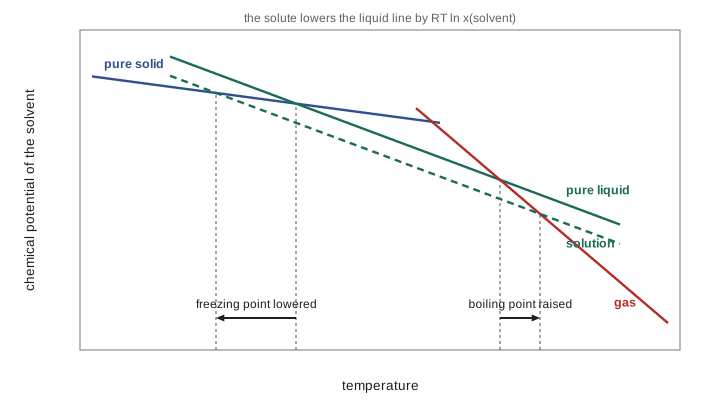
Adding a nonvolatile solute to a solvent lowers the chemical potential of the solvent by \(RT\ln x_\mathrm{A}\), where \(x_\mathrm{A}\) is the mole fraction of solvent. The solid and vapor phases of the solvent are pure, so their chemical potentials are unchanged. On a plot of chemical potential against temperature, the liquid line moves down; it now crosses the solid line at a lower temperature and the vapor line at a higher one. The solute depresses the freezing point and elevates the boiling point. Because the effect depends only on \(x_\mathrm{A}\), it depends on the number of solute particles, not their identity; these are the colligative properties, from the Latin for bound together.
For dilute solutions, the equilibrium conditions reduce to simple formulas in terms of the molality b of solute particles: \(\Delta T_\mathrm{f} = K_\mathrm{f}b\) and \(\Delta T_\mathrm{b} = K_\mathrm{b}b\), with \(K_\mathrm{f} = RT_\mathrm{f}^{*2}M_\mathrm{A}/\Delta_\mathrm{fus}H\) and \(K_\mathrm{b} = RT_\mathrm{b}^{*2}M_\mathrm{A}/\Delta_\mathrm{vap}H\), where \(M_\mathrm{A}\) is the molar mass of the solvent. For water, \(K_\mathrm{f} = 1.86\ \mathrm{K\,kg\,mol^{-1}}\) and \(K_\mathrm{b} = 0.51\ \mathrm{K\,kg\,mol^{-1}}\); the freezing-point constant is larger because the enthalpy of fusion is smaller than that of vaporization. For an electrolyte, the molality counts every ion, so a 1 mol/kg solution of sodium chloride contains about 2 mol/kg of particles. Jacobus van 't Hoff introduced the factor i, the number of particles per formula unit, to account for this. In real electrolyte solutions, ion pairing and interionic attraction make the effective factor a little less than the ideal value; 1.00 mol/kg NaCl freezes at about −3.4 °C, not the −3.7 °C the ideal formula gives.
Road salt
Every winter American states and cities spread well over ten million tons of road salt, nearly all of it sodium chloride, and the thermodynamics of freezing-point depression explains both why it works and where it stops working. Salt dissolves in the thin film of water on ice, and the brine has a lower freezing point than pure water, so more ice melts into it until the brine is diluted to the point where it freezes at the air temperature. The lowest temperature at which any sodium chloride brine stays liquid is the eutectic temperature, −21.1 °C, reached at 23.3 g of NaCl per 100 g of brine. In practice salt melts ice too slowly to be useful below about −10 °C. For colder weather, highway crews switch to calcium chloride or magnesium chloride, whose brines stay liquid to much lower temperatures, near −50 °C for calcium chloride, and which release heat as they dissolve; sand or grit is used to give traction when it is too cold for any salt.
Osmotic pressure
If a solution is separated from pure solvent by a membrane that lets solvent through but not solute, solvent flows into the solution, driven by its lower chemical potential there. The flow can be stopped by applying an extra pressure Π to the solution, the osmotic pressure, which raises the solvent's chemical potential back to that of the pure solvent. Wilhelm Pfeffer measured osmotic pressures with copper ferrocyanide membranes in 1877, and van 't Hoff showed in 1886 that for dilute solutions they obey a law of the same form as the ideal gas law:
\[\Pi = [\mathrm{B}]RT,\]
where [B] is the molar concentration of solute particles. Osmotic pressures are large. A 0.10 mol/L solution of sucrose at 25 °C has Π = 2.5 bar, which would support a column of water about 25 m high. Because they are so large, osmotic pressures are used to measure the molar masses of polymers and proteins, which give colligative effects too small to measure as freezing-point changes. Living cells must keep their internal solutions close to the osmotic pressure of their surroundings; red blood cells swell and burst in pure water and shrivel in concentrated brine. Seawater, with about 1.1 mol/L of ions, has an osmotic pressure of about 27 bar. Reverse osmosis desalination plants push seawater through membranes at 55 to 80 bar, well above that, so that fresh water flows out of the brine. Van 't Hoff received the first Nobel Prize in Chemistry, in 1901, for his work on chemical dynamics and osmotic pressure.
A worked example: freezing and boiling a sugar solution
Worked problem
Colligative properties of a sucrose solution
A solution contains 34.2 g of sucrose (M = 342.3 g/mol) in 500 g of water. Find its freezing point, its boiling point at 1 atm, and its osmotic pressure at 25 °C, taking its volume as 0.521 L.
Show solution
- Moles of sucrose: 34.2/342.3 = 0.0999 mol. Molality: 0.0999/0.500 = 0.200 mol/kg.
- Freezing point: ΔTf = 1.86 × 0.200 = 0.372 K, so the solution freezes at −0.37 °C.
- Boiling point: ΔTb = 0.51 × 0.200 = 0.102 K, so it boils at 100.10 °C.
- Concentration: 0.0999/0.521 = 0.192 mol/L. Osmotic pressure: Π = 0.192 × 0.08314 × 298.15 = 4.75 bar.
Answer: Freezing point −0.37 °C, boiling point 100.10 °C, osmotic pressure about 4.8 bar.
The osmotic pressure is the easiest of these to measure precisely: 4.75 bar is a large pressure, while 0.37 K and 0.10 K are small temperature changes. That contrast is why osmometry is the colligative method of choice for large molecules.
A program: Raoult, Henry and road salt
The program computes the liquid and vapor compositions of benzene–toluene mixtures at 25 °C from Raoult's law, the dissolved oxygen in water in equilibrium with air from Henry's law, and the freezing points of sodium chloride brines, comparing the dilute-solution formula with the exact ideal-solution result ln x_A = −(ΔfusH/R)(1/T − 1/T*). It ends with the amount of salt needed to keep a film of water liquid on a cold road.
import math

R = 8.314462618
pB, pT = 12.7, 3.79           # kPa at 25 C, benzene and toluene
print(' x(benzene)  P (kPa)  y(benzene)')
for x in (0.0, 0.2, 0.4, 0.5, 0.6, 0.8, 1.0):
    P = x * pB + (1 - x) * pT
    print(f'{x:10.1f} {P:8.2f} {x * pB / P:10.3f}')

kH_O2 = 1.3e-3                # mol/(L atm) at 25 C
c = kH_O2 * 0.2095            # air at 1 atm
print(f'\ndissolved O2 from air at 25 C: {c * 1e3:.3f} mmol/L = {c * 32.00e3:.1f} mg/L')

# freezing point of NaCl brine (ideal, i = 2)
Hf, Tf, M = 6010.0, 273.15, 0.018015
Kf = R * Tf ** 2 * M / Hf
print(f'\nKf of water from thermodynamic data = {Kf:.3f} K kg/mol')
print(' g NaCl per kg water   dilute-solution  ideal-solution  (freezing point, C)')
for g in (10, 30, 60, 100):
    b = 2 * g / 58.44                       # mol of ions per kg water
    xA = (1 / M) / (1 / M + b)
    T = 1 / (1 / Tf - R * math.log(xA) / Hf)
    print(f'{g:20d} {-Kf * b:16.2f} {T - Tf:15.2f}')

# salt needed to keep 1 kg of water film liquid at the coldest road temperature
place, t_road = 'Minneapolis, January night', -15.0
b_need = -t_road / Kf / 2                   # mol NaCl per kg water, dilute formula
xA = 1 / (1 + 2 * b_need * M)              # check the same brine with the ideal-solution formula
T = 1 / (1 / Tf - R * math.log(xA) / Hf)
print(f'\n{place} at {t_road:.0f} C: about {b_need * 58.44:.0f} g NaCl per kg of water by the dilute formula')
print(f'that brine would freeze at {T - Tf:.1f} C by the ideal-solution formula') x(benzene) P (kPa) y(benzene)
0.0 3.79 0.000
0.2 5.57 0.456
0.4 7.35 0.691
0.5 8.24 0.770
0.6 9.14 0.834
0.8 10.92 0.931
1.0 12.70 1.000
dissolved O2 from air at 25 C: 0.272 mmol/L = 8.7 mg/L
Kf of water from thermodynamic data = 1.860 K kg/mol
g NaCl per kg water dilute-solution ideal-solution (freezing point, C)
10 -0.64 -0.63
30 -1.91 -1.88
60 -3.82 -3.70
100 -6.36 -6.04
Minneapolis, January night at -15 C: about 236 g NaCl per kg of water by the dilute formula
that brine would freeze at -13.3 C by the ideal-solution formulaRaoult's law shows how strongly the vapor is enriched in benzene: a liquid with only 0.2 mole fraction of benzene gives a vapor with nearly half. The dissolved oxygen, about 8.7 mg/L, is close to the measured saturation value. The thermodynamic formula reproduces the familiar Kf of 1.86, and the two freezing-point formulas agree for dilute brines but diverge as the brine becomes concentrated. The dilute formula calls for about 236 g of salt per kilogram of water to keep a road wet at −15 °C, but by the ideal-solution formula that brine would freeze at only −13.3 °C. Real brines do a little better than either ideal estimate, because hydration of the ions ties up water molecules: measured data put the brine that freezes at −15 °C near 225 g of NaCl per kilogram of water. At these concentrations ideal formulas are a guide, not a substitute for data.
Common mistakes
MistakeVolumes of liquids always add on mixing.
InsteadPartial molar volumes depend on composition; 50 mL of ethanol plus 50 mL of water gives about 96 mL.
MistakeRaoult's law applies to the solute in a dilute solution.
InsteadThe solvent obeys Raoult's law; the dilute solute obeys Henry's law with a different constant.
MistakeDistillation can always separate a mixture completely.
InsteadAzeotropes boil without change in composition; ethanol cannot be distilled past 95.6 g per 100 g.
MistakeColligative properties depend on the identity of the solute.
InsteadThey depend only on the number of dissolved particles.
MistakeSalt melts ice at any temperature.
InsteadNo NaCl brine is liquid below the eutectic, −21.1 °C, and salt acts too slowly below about −10 °C.
MistakeGases dissolve better in warm water.
InsteadMost gases are less soluble at higher temperature, which is why warm water holds less oxygen.
Summary and key terms
- In an ideal solution μᵢ = μᵢ* + RT ln xᵢ; ideal mixing has ΔmixH = 0 and ΔmixG = nRTΣx ln x < 0.
- Raoult's law (1887): pᵢ = xᵢpᵢ*; the vapor is enriched in the more volatile component, the basis of distillation.
- Deviations from Raoult's law are described by activities aᵢ = γᵢxᵢ; large deviations give azeotropes.
- Henry's law (1803): the solubility of a gas is proportional to its partial pressure.
- Colligative properties: ΔTf = Kf b, ΔTb = Kb b and Π = [B]RT (van 't Hoff, 1886), counting all particles.
- Road salt works down to the NaCl eutectic, −21.1 °C; reverse osmosis must exceed the osmotic pressure of seawater, about 27 bar.
- Partial molar volume
- The increase in volume when one mole of a component is added to a large amount of mixture.
- Ideal solution
- A solution in which every component obeys Raoult's law over the whole composition range.
- Raoult's law
- pᵢ = xᵢpᵢ*, the vapor pressure of a component of an ideal solution.
- Henry's law
- The partial pressure of a dilute solute is proportional to its mole fraction, pB = KBxB.
- Azeotrope
- A mixture that boils without change of composition.
- Colligative property
- A property that depends only on the number of solute particles.
- Osmotic pressure
- The pressure needed to stop the flow of solvent through a semipermeable membrane into a solution.
Practice problems
Work each problem on paper first, then reveal the answer to check.
A liquid mixture of benzene (x = 0.30) and toluene at 25 °C obeys Raoult's law. Find the total vapor pressure and the vapor composition.
Show answer
P = 0.30(12.7) + 0.70(3.79) = 6.46 kPa; y(benzene) = 3.81/6.46 = 0.59.
How much CO₂ dissolves in water at 25 °C under 4.0 atm of CO₂?
Show answer
c = 3.4 × 10⁻² × 4.0 = 0.14 mol/L.
Find the freezing point of a solution of 0.100 mol of glucose in 250 g of water.
Show answer
b = 0.400 mol/kg; ΔTf = 0.744 K; −0.74 °C.
Estimate the osmotic pressure of 0.15 mol/L NaCl at 37 °C, assuming complete dissociation.
Show answer
Π = 0.30 × 0.08314 × 310.15 = 7.7 bar.
Why is Kf for water larger than Kb?
Show answer
Kf ∝ T²/ΔfusH and Kb ∝ T²/ΔvapH; ΔfusH is much smaller than ΔvapH.
A polymer solution of 5.0 g/L has Π = 0.0050 bar at 298 K. Estimate the molar mass of the polymer.
Show answer
[B] = Π/RT = 2.02 × 10⁻⁴ mol/L; M = 5.0/2.02 × 10⁻⁴ ≈ 25 000 g/mol.
Lesson quiz · 5 questions
Score 60% or more to complete this lesson.
Create a free account to save your progress, take quizzes and earn a certificate.