
CINE-221 · Lesson 1 of 12 · 26 min
Naturalism and motivated lighting
Audiences rarely notice good lighting. When a scene in a kitchen at dawn, a hospital corridor at night or a car on a rainy highway feels real, viewers believe the world of the story and attend to the characters. Yet almost none of that light is what it appears to be: the soft morning glow through the kitchen window may come from a large HMI on a lift outside, bounced through diffusion; the fluorescent tubes in the corridor may be replaced with LED tubes on dimmers; the passing headlights may be lights on a dolly swung by an electrician. Naturalistic lighting is the craft of making constructed light feel inevitable. CINE-220 introduced fixtures, control, grip and the basics of lighting people. This course builds on that foundation to cover motivated and naturalistic lighting: the logic of sources, studying real light, sun and sky, day exteriors and interiors, practicals, night, dusk and continuity, large spaces, effects, and designing a lighting style for a whole film. This first lesson defines naturalism and motivation and introduces the reasoning that the rest of the course applies.
What naturalism means
Naturalistic lighting aims to look as if it comes from the sources that exist in the world of the scene: the sun, the sky, windows, lamps, streetlights, screens, fire. It does not mean using only available light, although some films do; it means that the direction, quality, color and intensity of the light are consistent with those sources, so that the audience accepts them without question. A naturalistic image can still be beautiful, dramatic and highly controlled. In fact, achieving the look of real light usually requires more control than overtly stylized lighting, because the eye is very sensitive to light that behaves unnaturally: a shadow pointing the wrong way, a face lit brighter than the window behind it with no apparent reason, a color that no lamp could produce.
Naturalism is a style, not a rule. Many films mix naturalistic scenes with expressive, theatrical or stylized lighting, and some genres, such as musicals, horror and fantasy, deliberately depart from it. Understanding naturalism gives cinematographers a baseline from which to depart deliberately: light that breaks the logic of sources reads as heightened, dreamlike or subjective precisely because the audience expects that logic.
Motivation and source logic
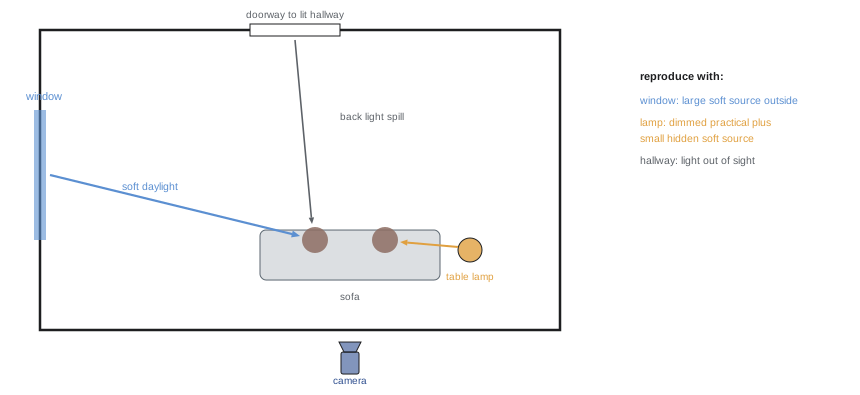
A motivated light is one whose existence is explained by a source the audience sees or can infer. A lamp on a desk motivates warm light on the face of the person beside it; a window motivates soft daylight from one side; a television motivates flickering cool light. Source logic is the set of rules that follows from the sources in a scene: where light comes from, how hard or soft it is, what color it is, how it falls off with distance, and how it changes when people or things move. Before lighting a scene, cinematographers often draw the sources on a floor plan and ask where light would fall if those sources alone lit the room. The plan then becomes a guide: the key light on an actor comes from the direction of the window or lamp; fill comes from the bounce of that light off walls and floors; back light comes from a second window, a hallway or a practical behind the actor.
Sources can be visible in frame, such as a lamp or a window, or implied, such as a window just off-screen or sunlight from a direction established in the wide shot. Implied sources give the cinematographer freedom, because their exact position is not shown, but they must remain consistent across shots: if the wide shot establishes a window on the left, close-ups should be keyed from the left.
A short history of naturalistic lighting
Early studio cinema lit sets with banks of arc lights and diffused skylights, aiming for brightness rather than realism. Through the 1920s to 1950s, classical Hollywood developed a refined, glamorous style built on three-point lighting, strong backlight and carefully modeled faces, often with little regard for the apparent sources. Film noir and German expressionism used hard, dramatic shadows for psychological effect. In the 1960s and 1970s, faster film stocks, lighter equipment and new attitudes encouraged a move toward realism. The French New Wave shot on location with available light; Néstor Almendros, notably on Days of Heaven (1978), used magic-hour daylight and bounced light to evoke natural sources; Gordon Willis, on The Godfather (1972), used overhead soft light and deep shadow motivated by the rooms' sources; Vilmos Zsigmond and László Kovács brought documentary-influenced realism. Later cinematographers, including Roger Deakins, Emmanuel Lubezki, Bradford Young and many others, have refined naturalism further, aided by fast digital sensors, LEDs and large soft sources. Canadian cinematographers working on productions from Montreal, Toronto and Vancouver have contributed to this tradition across features and television.
Why motivation matters
Motivated lighting serves the story in several ways. It supports belief: when light behaves as expected, the audience accepts the space as real. It provides continuity: light tied to sources can be repeated reliably across shots and days. It gives the cinematographer and director a shared language: "the window is our key" is easier to discuss than abstract lighting positions. It helps actors, who can play to sources and move through the space naturally. And it makes departures meaningful: when a character steps into an unmotivated pool of light, the audience feels the moment as significant. Motivation does not limit creativity; it channels it. Within the logic of a source, there are endless choices about how big, soft, bright, warm or directional it should be, and where to place the camera relative to it.
Cheating
Real sources rarely produce exactly the light a shot needs. Cinematographers therefore cheat: they keep the apparent direction and quality of a source but adjust its position, intensity or size to flatter an actor, reveal an important detail or improve composition. A window that would light an actor from slightly behind might be cheated forward so that the light reaches the eyes; a lamp too weak to light a face might be supplemented by a small soft source placed just out of frame on the same side; a streetlight overhead might be cheated toward the actor so that the face is not lost under a brow shadow. Cheating works because audiences judge light by its overall logic, not by measurement. The art is to cheat enough to make the shot work but not so much that the light no longer belongs to the source. A useful test is to imagine the audience looking around the room: would they accept that this light came from that source?
Worked problem
Cheating a desk lamp key
An actor sits at a desk with a practical lamp beside them, reading a letter. The lamp alone lights the paper brightly but leaves the actor's eyes in shadow, and the face reads about 3 stops below the paper. How can the lamp's light be cheated?
Show solution
- Keep the practical in frame and dim it so that the shade and paper do not clip.
- Place a small soft source, such as an LED panel with a diffusion frame, just out of frame on the same side as the lamp and at roughly the same height.
- Set its color to match the lamp, for example about 2,700 K, and its intensity so the face sits about 1 to 1.5 stops below the paper rather than 3.
- Flag the source off the wall behind so that the room keeps its darkness, and add a little bounce from the paper side to fill the eyes.
Answer: Supplement the lamp with a matching soft source from the same direction and height, set so the face reads about 1–1.5 stops below the paper, and flag it off the background.
Elements of source logic
When analyzing or designing a naturalistic setup, consider each of these properties of every source:
- Direction: where the light comes from relative to the actor and camera, and the angle of its shadows.
- Quality: hard or soft, depending on the apparent size of the source and any diffusion such as curtains, clouds or lampshades.
- Color: the color temperature and tint of the source, such as warm tungsten, cool skylight, green-tinged fluorescent or orange sodium streetlights.
- Intensity and fall-off: how bright the source is and how quickly its light drops with distance, which depends on its size and distance.
- Movement and change: whether the source flickers, moves, varies with clouds or changes over the scene, such as a sunset or a fire.
- Interaction: how the light bounces off surfaces, creating fill and color casts, and how people and objects block it, creating shadows.
| Property | Question to ask | Typical tools |
|---|---|---|
| Direction | Where would this source light from? | Fixture placement, flags, cheating |
| Quality | How big and diffused is the source? | Diffusion frames, bounce, book lights |
| Color | What color would it be? | Gels, LED color settings, white balance |
| Intensity | How bright relative to other sources? | Dimmers, scrims, ND gel, distance |
| Change | Does it flicker, move or shift? | Effects programming, rigs, cues |
| Interaction | What does it bounce off or cast? | Negative fill, bounce cards, set dressing |
Ambience and fill
In real spaces, light from the main sources bounces around the room, creating a general ambient level that fills shadows. White walls in a small room create high ambience and low contrast; dark wood panelling or a large warehouse creates low ambience and deep shadows. Naturalistic lighting reproduces this ambience deliberately, usually with large soft bounce or overhead sources, and controls it: adding negative fill on one side to restore contrast, or adding fill to reveal detail in dark spaces. The ambient level often determines the mood of the scene as much as the key. A common mistake is to light the key beautifully but forget the ambience, leaving the background unnaturally dark or the shadows unnaturally empty.
Camera, exposure and naturalism
Modern digital sensors with high sensitivity and wide dynamic range have made naturalistic lighting easier, because rooms can be lit at levels close to what the eye sees, and practical lamps, windows and screens can be held within range. But the camera still does not see as the eye does. The eye adapts constantly, seeing detail in a bright window and a dark corner at once; the camera records a fixed range. Naturalistic lighting therefore often involves reducing contrast where the eye would not notice it, such as darkening windows with ND gel or adding fill to deep shadows, so that the recorded image matches what a viewer would perceive in the space. CINE-202 covers exposure and dynamic range in depth.
Working with the director and production designer
Motivated lighting begins long before the shoot. The cinematographer works with the director on the emotional tone of each scene and with the production designer on the sources that will exist in the sets and locations: the number and position of windows, the practical lamps and fixtures, the colors and reflectance of walls and furnishings, and whether ceilings can be removed or rigged. A set designed with lighting in mind, with practicals placed where they will motivate useful light and windows sized and positioned for the camera, makes naturalistic lighting far easier. On location, the cinematographer and gaffer scout for sun direction, window positions, power and rigging points (Lesson 12).
Naturalism across genres
Naturalism appears in very different genres. Social realist dramas often use strict naturalism, with available light and minimal fixtures, to emphasize authenticity. Period films use naturalism to recreate the light of their era, from candles to gas lamps to early electric light, which shapes how audiences imagine the past. Thrillers and crime films often adopt a heightened naturalism, keeping sources motivated but pushing contrast and darkness for tension. Even fantasy and science fiction films frequently ground their invented worlds in motivated light, giving the impossible a convincing physical presence. In each case, the logic of sources gives the audience confidence that the world on screen obeys consistent rules.
Common mistakes
MistakeLighting faces without reference to the scene's sources.
InsteadMap sources and key from their directions.
MistakeCheating a source so far it no longer belongs to it.
InsteadKeep the apparent direction, quality and color.
MistakeChanging key direction between wide and close-up.
InsteadKeep implied sources consistent across shots.
MistakeForgetting ambient fill from bounced light.
InsteadReproduce and control room ambience deliberately.
MistakeAssuming naturalism means available light only.
InsteadUse controlled light that behaves like the sources.
Summary and key terms
- Naturalistic lighting makes constructed light feel as if it comes from the scene's sources.
- Motivated light is explained by visible or implied sources.
- Source logic covers direction, quality, color, intensity, change and interaction.
- Naturalism grew from location shooting, faster stocks and cinematographers such as Almendros and Willis.
- Cheating adjusts sources to serve the shot while keeping their logic.
- Ambient bounce and fill set much of a scene's mood.
- Collaboration with directors and designers shapes the sources before lighting begins.
- Naturalism
- Lighting that appears to come from real sources in the scene.
- Motivated light
- Light explained by a visible or implied source.
- Source logic
- The rules implied by the sources in a scene.
- Implied source
- A source not visible in frame but inferred.
- Cheating
- Adjusting a source's position or strength while keeping its logic.
- Ambience
- General light level from bounced and indirect light.
- Practical
- A light source visible in the frame.
- Fall-off
- Decrease of light with distance from a source.
- Expressionist lighting
- Stylized lighting for psychological effect.
- Magic hour
- The period of soft light around sunrise and sunset.
Practice problems
Work each problem on paper first, then reveal the answer to check.
What does naturalistic lighting aim for?
Show answer
Light consistent with the sources in the scene.
What is a motivated light?
Show answer
Light explained by a visible or implied source.
Name four properties of source logic.
Show answer
Direction, quality, color, intensity, change, interaction.
Name two cinematographers associated with naturalism.
Show answer
Néstor Almendros, Gordon Willis, Roger Deakins, Emmanuel Lubezki.
What is cheating?
Show answer
Adjusting a source's position or strength while keeping its logic.
Why keep implied sources consistent?
Show answer
So close-ups match the wide shot.
What creates ambience in a room?
Show answer
Light bouncing off walls, floors and ceilings.
Why might naturalism require ND gel on windows?
Show answer
The camera records less range than the eye sees.
Why involve the production designer early?
Show answer
To place practicals and windows that motivate useful light.
Why does departing from source logic feel significant?
Show answer
Audiences expect light to follow its sources.
Lesson quiz · 5 questions
Score 60% or more to complete this lesson.
Create a free account to save your progress, take quizzes and earn a certificate.