
CISSP-112 · Lesson 10 of 12 · 28 min
Cryptanalytic attacks and the move to post-quantum cryptography in the US
Sub-domain 3.7 asks you to understand methods of cryptanalytic attacks. The outline's list is deliberately broad: brute force, ciphertext only, known plaintext, frequency analysis, chosen ciphertext, implementation attacks, side channels, fault injection, timing, man in the middle, pass the hash, Kerberos exploitation and ransomware. Some are classic cryptanalysis; others attack the systems around the cryptography; and ransomware uses cryptography itself as the weapon. This lesson covers them all and then turns to the biggest change in cryptography for a generation: preparing for quantum computers that could break today's public key algorithms.
Attacks on the algorithm
Cryptanalysts classify attacks by what the attacker has. In a ciphertext-only attack the attacker has only encrypted messages and tries to recover plaintext or the key, often using statistical methods. Frequency analysis is the classic example: in English, the letter e is the most common, so in a simple substitution cipher the most frequent ciphertext letter probably stands for e. In a known-plaintext attack the attacker has some plaintext and its matching ciphertext; during the Second World War, Allied codebreakers working on the Enigma machine used expected phrases such as weather reports, which they called cribs. In a chosen-plaintext attack the attacker can have chosen messages encrypted and study the results, and in a chosen-ciphertext attack the attacker can have chosen ciphertexts decrypted, which has been used against flawed padding schemes in RSA and in TLS. Differential and linear cryptanalysis are more advanced statistical techniques that study how differences or linear relationships in inputs propagate through a cipher; modern ciphers such as AES were designed to resist them.
Brute force tries every possible key and is always possible in principle; the defense is a key space large enough to make it hopeless, as lesson 8 showed. A dictionary attack is a smarter form of brute force against passwords, trying likely words and variations first. A birthday attack exploits hash collisions, and a meet-in-the-middle attack, which is why double DES adds little strength over single DES, trades memory for time by working forwards from the plaintext and backwards from the ciphertext. Downgrade attacks trick systems into using older, weaker protocols or ciphers, as happened with the FREAK and Logjam attacks on TLS in 2015; disabling obsolete options removes the opportunity.
Attacks on the implementation
Most successful attacks today target implementations rather than algorithms. Implementation attacks exploit programming errors, such as the Heartbleed bug in OpenSSL, disclosed in 2014, which let attackers read chunks of a server's memory, including private keys, without breaking any cipher. Side-channel attacks extract secrets from physical effects of computation: how long an operation takes, how much power it draws, its electromagnetic emissions or even the sound it makes. Timing attacks measure small differences in processing time; for example, a password or MAC comparison that stops at the first wrong byte leaks how many bytes were right, so secure code uses constant-time comparison. Power analysis, simple or differential, can recover keys from smart cards by watching their power use during encryption. Fault injection deliberately disturbs a device with voltage glitches, clock changes, lasers or heat to make it miscalculate, and the faulty output can reveal key material. Cache-based attacks such as Spectre, covered in lesson 5, are side channels within shared processors.
Defenses include validated cryptographic libraries and modules rather than home-made code, constant-time implementations, hardware with side-channel and fault countermeasures certified to standards such as FIPS 140-3 Level 3 or 4 or Common Criteria smart card profiles, physical protection of devices, and prompt patching of cryptographic libraries.
Attacks on protocols and credentials
A man-in-the-middle, or on-path, attack places the attacker between two parties who believe they are talking directly. The attacker can read and alter traffic, or run separate key exchanges with each side, as with unauthenticated Diffie-Hellman. Defenses include authenticated key exchange with certificates, certificate validation, HTTP Strict Transport Security and mutual TLS. Replay attacks resend captured valid messages; timestamps, nonces and sequence numbers prevent them.
Pass the hash is an attack on Windows authentication. Because the NTLM protocol authenticates with a hash of the password rather than the password itself, an attacker who steals the hash from memory or a disk can use it directly to log in to other systems, without ever cracking it. Defenses include disabling NTLM where possible, limiting where privileged accounts log in, using tiered administration so domain administrators never sign in to ordinary workstations, enabling Credential Guard, and using unique local administrator passwords managed by a tool such as Windows LAPS.
Kerberos exploitation targets Active Directory's main authentication protocol. In Kerberoasting, any authenticated user requests service tickets for accounts with service principal names; part of each ticket is encrypted with the service account's password hash, which can then be cracked offline if the password is weak. Defenses are long random passwords for service accounts, preferably managed service accounts that rotate automatically, and AES rather than RC4 ticket encryption. A golden ticket attack forges ticket-granting tickets after stealing the hash of the KRBTGT account, giving the attacker effectively unlimited access to the domain; recovery requires resetting the KRBTGT password twice. A silver ticket forges a service ticket for one service. Pass the ticket reuses stolen tickets. These attacks show that the security of authentication cryptography depends heavily on how keys, passwords and privileged accounts are managed.
Ransomware
Ransomware turns cryptography against its victims. Attackers gain access, often through phishing, exposed remote desktop services or unpatched edge devices, spread through the network, steal data and then encrypt files and backups with strong algorithms, typically a symmetric key per file protected by the attacker's public key. Victims are then pressured to pay for the decryption key and, in double extortion, to stop publication of the stolen data. Because the encryption is usually sound, recovery without the key is rarely possible unless the attackers made mistakes. The defenses are architectural: offline or immutable backups that are tested regularly, segmentation, multifactor authentication on remote access, rapid patching of internet-facing systems, endpoint detection and response, least privilege and an incident response plan. Both the Canadian Center for Cyber Security and the US Cybersecurity and Infrastructure Security Agency publish ransomware guidance, and both governments discourage paying ransoms because payment funds further crime and does not guarantee recovery.
| Attack | Targets | Main defense |
|---|---|---|
| Brute force and dictionary | Keys and passwords | Large key spaces, strong passwords, rate limiting |
| Frequency analysis, known and chosen plaintext | Algorithm weaknesses | Modern, well-studied algorithms |
| Side channel and timing | Physical leakage during computation | Constant-time code, certified hardware |
| Fault injection | Induced computation errors | Tamper detection and fault countermeasures |
| Man in the middle | Unauthenticated key exchange | Certificates, validation, mutual TLS |
| Pass the hash | Stolen NTLM hashes | Disable NTLM, tiered admin, Credential Guard |
| Kerberoasting and golden tickets | Service account and KRBTGT secrets | Strong managed passwords, protect domain controllers |
| Ransomware | Data availability | Immutable backups, segmentation, MFA, patching |
Quantum computing and cryptography
A sufficiently large, fault-tolerant quantum computer would change cryptography dramatically. Shor's algorithm, published in 1994, could factor large numbers and solve discrete logarithms efficiently, breaking RSA, Diffie-Hellman and elliptic curve cryptography completely. Grover's algorithm gives a quadratic speed-up for searching, which effectively halves the strength of symmetric keys and hashes: a 128-bit key would offer about 64 bits of security against a quantum attacker, so the usual response is to use 256-bit AES keys and longer hashes, not to abandon symmetric cryptography. No quantum computer today can break real RSA keys, and estimates of when one might exist vary widely. The urgent concern is harvest now, decrypt later: adversaries may record encrypted traffic today and decrypt it once a capable machine exists, so data that must stay secret for many years is already at risk.
NIST ran an international competition from 2016 to select post-quantum algorithms, which run on ordinary computers but resist known quantum attacks. In August 2024 it published the first three standards: FIPS 203, ML-KEM, a key encapsulation mechanism based on the CRYSTALS-Kyber lattice design; FIPS 204, ML-DSA, a signature scheme based on CRYSTALS-Dilithium; and FIPS 205, SLH-DSA, a stateless hash-based signature scheme based on SPHINCS+. A further signature standard based on FALCON, to be called FN-DSA, is in development, and in March 2025 NIST selected HQC, a code-based scheme, as a backup key encapsulation mechanism built on different mathematics from ML-KEM. Stateful hash-based signatures, LMS and XMSS, are already approved for uses such as firmware signing. During the transition many systems use hybrid key exchange, combining a classical algorithm such as X25519 with ML-KEM, so the connection stays secure if either one holds; major browsers and messaging apps began deploying hybrid post-quantum key exchange in 2023 and 2024.
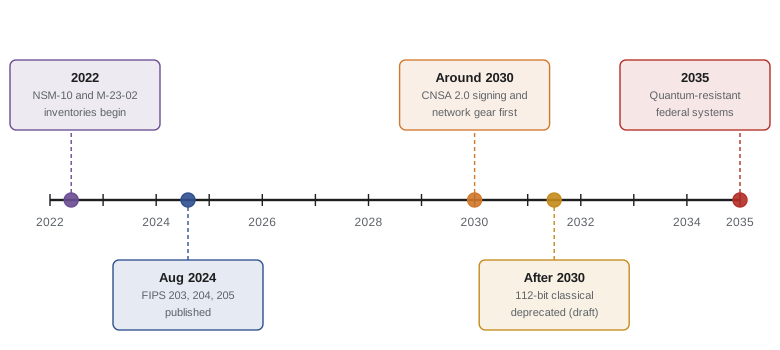
In the United States, National Security Memorandum 10, issued in 2022, set the goal of mitigating quantum risk in federal systems by 2035, and OMB memorandum M-23-02 requires agencies to inventory their cryptographic systems annually. The National Security Agency's Commercial National Security Algorithm Suite 2.0, CNSA 2.0, sets dates for national security systems to move to quantum-resistant algorithms, with software and firmware signing and network equipment expected to transition first, around 2030, and all systems by 2035. NIST has proposed in its draft report IR 8547 that classical public key algorithms at the 112-bit security level be deprecated after 2030 and disallowed after 2035. Check the current versions of these documents, because dates and details are still being refined.
Whatever the jurisdiction, the migration steps are similar: build a cryptographic inventory, identify data with long confidentiality needs and systems with long lifetimes, prioritize them, test post-quantum and hybrid algorithms, ask vendors for their roadmaps, and design for crypto agility so future changes are easier. Post-quantum keys and signatures are larger than classical ones, so protocols, certificates and constrained devices may need changes.
Worked problem
Breaking a toy cipher by frequency analysis
In a long English ciphertext produced by a simple substitution cipher, the most frequent letters are X (12.5 percent), Q (9.0 percent) and M (8.1 percent). English letter frequencies are roughly e 12.7, t 9.1 and a 8.2 percent. What are the first guesses, and why does this not work on AES?
Show solution
- Map the most frequent ciphertext letters to the most frequent English letters: X to e, Q to t and M to a.
- Test the guesses against common words such as the and and, and refine.
- Simple substitution keeps letter frequencies intact, which is its fatal weakness.
- AES applies many rounds of substitution and permutation to whole blocks, so ciphertext frequencies look random and reveal nothing.
Answer: Guess X = e, Q = t and M = a. Modern ciphers achieve diffusion, so frequency analysis fails against them.
Worked problem
Deciding what needs post-quantum protection first
Use Mosca's inequality, which says data is at risk if x + y > z, where x is how long the data must stay secret, y is how long migration will take and z is how long until a capable quantum computer exists. Assume z = 12 years and migration takes y = 5 years. Which data is at risk: (a) marketing plans secret for 1 year; (b) customer health records secret for 25 years; (c) session tokens valid for 1 hour?
Show solution
- (a) x + y = 1 + 5 = 6, which is not greater than 12: not yet at risk.
- (b) x + y = 25 + 5 = 30, which is greater than 12: already at risk from harvest now, decrypt later.
- (c) x is essentially 0, so 0 + 5 = 5, which is not greater than 12: not at risk.
Answer: Only the health records are at risk under these assumptions. Long-lived confidential data should be the first to gain post-quantum or hybrid protection.
Thinking like a manager
When an exam scenario describes stolen hashes being reused, think pass the hash and controls on privileged account use. When it describes weak service account passwords in Active Directory, think Kerberoasting. When it describes keys extracted from a smart card by measuring power, think side channels and certified hardware. For ransomware, the answer that best protects the organization is usually tested, offline or immutable backups combined with prevention, not payment. For quantum risk, the first step is a cryptographic inventory and prioritization of long-lived data, not replacing everything at once.
Common mistakes
MistakeBelieving quantum computers make all encryption useless.
InsteadShor breaks public key algorithms; Grover only halves symmetric strength, so use AES-256.
MistakeWaiting for quantum computers to appear before acting.
InsteadHarvest now, decrypt later means long-lived data needs protection now.
MistakeWriting your own cryptographic code.
InsteadUse validated libraries with constant-time implementations.
MistakeThinking pass the hash requires cracking the password.
InsteadThe stolen hash itself is used to authenticate.
MistakeRelying on paying the ransom to recover.
InsteadDepend on tested immutable backups and incident response.
Summary and key terms
- Cryptanalysis is classified by the attacker's access: ciphertext only, known plaintext, chosen plaintext or chosen ciphertext.
- Brute force, dictionary, birthday, meet-in-the-middle and downgrade attacks exploit weak keys and options.
- Implementation, side-channel, timing and fault injection attacks target code and hardware rather than mathematics.
- Pass the hash and Kerberos attacks abuse how authentication secrets are stored and managed.
- Ransomware uses strong encryption against victims; immutable backups and segmentation are key defenses.
- Shor's algorithm would break RSA and ECC; Grover halves symmetric strength; harvest now, decrypt later is the immediate risk.
- NIST published ML-KEM, ML-DSA and SLH-DSA in 2024; Canada and the US have set migration timelines to 2035.
- Ciphertext-only attack
- Cryptanalysis using only encrypted messages.
- Known-plaintext attack
- Cryptanalysis using matched plaintext and ciphertext.
- Chosen-ciphertext attack
- Cryptanalysis in which the attacker can have chosen ciphertexts decrypted.
- Side-channel attack
- Extracting secrets from timing, power, emissions or other physical effects.
- Fault injection
- Deliberately disturbing a device to cause revealing errors.
- Pass the hash
- Authenticating with a stolen password hash instead of the password.
- Kerberoasting
- Requesting service tickets and cracking service account passwords offline.
- Golden ticket
- A forged Kerberos ticket-granting ticket made with the KRBTGT hash.
- Harvest now, decrypt later
- Recording encrypted data today to decrypt with future quantum computers.
- ML-KEM
- The NIST post-quantum key encapsulation standard in FIPS 203.
Practice problems
Work each problem on paper first, then reveal the answer to check.
What did Allied codebreakers call known plaintext guesses against Enigma?
Show answer
Cribs.
Why does double DES add little strength?
Show answer
A meet-in-the-middle attack defeats it with modest extra effort.
What did Heartbleed expose?
Show answer
Server memory, including private keys, through an OpenSSL bug.
How does constant-time comparison help?
Show answer
It stops timing differences from revealing how many bytes matched.
What protocol weakness does pass the hash exploit?
Show answer
NTLM authenticating with a password hash.
How do you recover from a golden ticket attack?
Show answer
Reset the KRBTGT account password twice and investigate the compromise.
What is double extortion in ransomware?
Show answer
Encrypting data and also threatening to publish stolen data.
Which quantum algorithm threatens RSA?
Show answer
Shor's algorithm.
Name the three post-quantum FIPS published in August 2024.
Show answer
FIPS 203 ML-KEM, FIPS 204 ML-DSA and FIPS 205 SLH-DSA.
What is hybrid key exchange?
Show answer
Combining a classical and a post-quantum algorithm so security holds if either does.
Lesson quiz · 5 questions
Score 60% or more to complete this lesson.
Create a free account to save your progress, take quizzes and earn a certificate.