
CISSP-113 · Lesson 8 of 12 · 28 min
Converged and specialized networks
Most networks today are converged: they carry data, voice, video, storage, building systems and industrial control traffic over shared IP infrastructure. Convergence saves money and simplifies operations, but it also means that a weakness in one system can affect others that were once physically separate. This lesson covers the specialized networks a security manager is likely to meet: operational technology and industrial control systems, the Internet of Things and building systems, storage networks, content delivery networks, and converged protocols that carry one kind of traffic over another. CISSP-112 lesson 6 introduced industrial control systems as an architecture topic; here we focus on the network.
Converged protocols
Converged protocols carry traffic that once needed its own network over standard Ethernet and IP. Fiber Channel over Ethernet, FCoE, carries storage traffic over Ethernet at layer 2, relying on data center bridging enhancements for lossless delivery. Internet Small Computer Systems Interface, iSCSI, carries block storage commands over TCP/IP, so it can be routed. Voice over IP converges telephony. Multiprotocol Label Switching, MPLS, used by carriers and large enterprises, forwards packets using short labels rather than IP lookups, creating virtual circuits for different customers or classes of service; it separates traffic logically but does not encrypt it, so organizations with confidentiality requirements still encrypt across carrier MPLS. Building systems increasingly run over IP too, through protocols such as BACnet/IP for heating and ventilation.
The security consequence is shared fate. A broadcast storm, a misconfigured switch or a denial of service attack on the converged network can take down phones, storage, cameras and door controllers at the same time as email. Separation still matters: put storage, voice, building systems and management on their own VLANs or virtual routing instances, apply quality of service so that critical traffic keeps working under load, and filter traffic between these segments as strictly as between any other zones.
Operational technology and industrial control systems
Operational technology, OT, monitors and controls physical processes: power grids, water treatment, pipelines, manufacturing lines, rail signaling and building systems. Industrial control systems, ICS, include supervisory control and data acquisition, SCADA, systems that monitor geographically spread assets such as pipelines and electricity networks; distributed control systems, DCS, that run continuous processes in plants; and programmable logic controllers, PLCs, and remote terminal units, RTUs, that directly operate equipment. Human-machine interfaces give operators views and controls, and historians store process data.
OT priorities differ from IT priorities. Safety and availability come first, because a failure can injure people, damage equipment or harm the environment. Systems run for decades, often on unsupported operating systems, and cannot simply be patched and rebooted. Many industrial protocols, such as Modbus, DNP3 and older versions of EtherNet/IP and PROFINET, were designed for closed networks and authenticate nothing: any device that can reach a controller can usually send it commands. Secure versions exist, such as DNP3 Secure Authentication and Modbus Security over TLS, but deployment is slow.
Attacks on OT are no longer theoretical. Stuxnet, discovered in 2010, sabotaged uranium enrichment centrifuges by reprogramming PLCs. Attacks on Ukraine's power grid in 2015 and 2016 cut electricity to hundreds of thousands of people. The Triton malware, found in 2017, targeted safety instrumented systems at a petrochemical plant. The 2021 ransomware attack on Colonial Pipeline hit IT systems, but the company shut down pipeline operations as a precaution, showing how IT incidents can halt physical operations. Attacks on water utilities, including through internet-exposed controllers with default passwords, have prompted repeated government advisories in recent years.
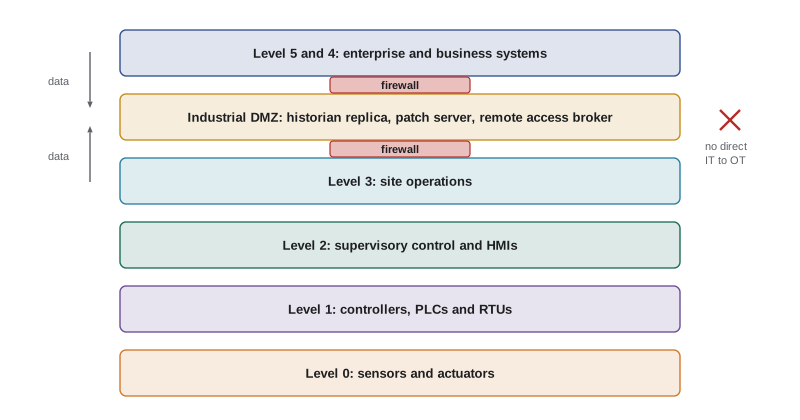
The Purdue Enterprise Reference Architecture, adapted for security in the ISA/IEC 62443 series of standards, is the usual reference for segmenting OT. It arranges systems into levels, from physical processes at level 0, through controllers at level 1, supervisory systems at level 2 and site operations at level 3, up to business systems at levels 4 and 5. An industrial DMZ, sometimes called level 3.5, sits between business and control networks, so that no traffic passes directly between them; instead, services such as historian replicas, patch servers and remote access gateways in the DMZ broker the exchange. ISA/IEC 62443 adds the concepts of zones and conduits, groups of assets with common security requirements and the controlled communication paths between them, and security levels from 1 to 4 describing the strength of attacker a zone must resist.
| Control | Purpose in OT | Caution |
|---|---|---|
| Industrial DMZ | No direct traffic between enterprise and control networks | Every exception must be documented and reviewed |
| Unidirectional gateways (data diodes) | Physically allow data out of the control network but nothing in | Limits remote management; plan maintenance access separately |
| Passive network monitoring | Detects anomalies using protocol-aware sensors on mirror ports | Avoid active scanning of fragile controllers |
| Asset inventory | Know every controller, firmware and connection | Often missing; start here |
| Secure remote access | Brokered, MFA-protected, time-limited vendor access with recording | No always-on modems or direct connections |
| Compensating controls | Allow-listing, network isolation and physical security for unpatchable systems | Patch when outages permit and vendors certify |
Monitoring in OT should be passive where possible. Active vulnerability scanning that is routine in IT can crash fragile controllers, so OT security programs rely on passive, protocol-aware monitoring of mirror ports to build asset inventories and detect anomalies, such as a new device appearing or an engineering workstation sending a program download outside a maintenance window. Changes to control logic should go through change management with engineering and safety sign-off.
In the United States, bulk electric system entities must comply with the mandatory NERC CIP standards enforced under the oversight of the Federal Energy Regulatory Commission. The Transportation Security Administration issued security directives for pipeline operators after the 2021 Colonial Pipeline attack, and CISA and the Environmental Protection Agency have issued repeated advisories for water and wastewater systems. CISA publishes cross-sector cybersecurity performance goals and maintains an ICS advisory program (checked October 2026).
Worked problem
Prioritizing an OT network project
A water utility has a flat network connecting office PCs, SCADA servers and PLCs at twelve pumping stations. Vendors connect through an always-on remote desktop tool. Rank five actions: (a) replace all PLCs, (b) remove the always-on vendor tool and broker access with MFA, (c) build an asset inventory with passive monitoring, (d) separate office and control networks with an industrial DMZ, (e) run aggressive vulnerability scans of the PLCs.
Show solution
- (b) first: always-on vendor remote access is an immediate, well-known attack path and is quick to fix.
- (c) next: you cannot segment or protect what you have not inventoried, and passive monitoring is safe.
- (d) then: separation through an industrial DMZ removes the flat path from office PCs to controllers.
- (a) later, as part of life cycle planning, when budget and outages allow.
- (e) avoid: active scanning can crash controllers; use passive methods instead.
Answer: Order: (b), (c), (d), then (a) over time; do not do (e). Quick, high-impact risk reduction comes first, then visibility, then architecture, then replacement.
The Internet of Things and building systems
The Internet of Things, IoT, covers billions of connected devices: cameras, sensors, smart meters, medical devices, televisions, voice assistants and building controllers. Common weaknesses include default or hard-coded passwords, unencrypted communication, no secure update mechanism, long life with short vendor support, and cloud dependencies that send data to third parties. The Mirai botnet of 2016 enslaved hundreds of thousands of cameras and routers with default passwords and used them for record-breaking denial of service attacks; its descendants still operate.
Network controls for IoT start with inventory and segmentation. Place IoT devices in their own segments, allow them to talk only to the controllers or cloud services they need, block lateral traffic and internet access they do not need, and monitor their behavior, which is usually very predictable, for deviations. Network access control should profile devices and put them in the right segment automatically. Buy devices that support secure updates, unique credentials and encryption, and ask vendors how long they will provide security updates. Smart building systems deserve particular care because they often link physical security, such as door access and cameras, with heating, lighting and elevators, and are frequently installed and maintained by contractors outside IT's view.
In the United States, the IoT Cybersecurity Improvement Act of 2020 requires federal agencies to buy IoT devices that meet NIST guidance, and the FCC's voluntary US Cyber Trust Mark labeling program for consumer IoT devices, based on NIST criteria, was adopted in 2024. Companies selling into Europe must also consider the EU Cyber Resilience Act, with main obligations applying from December 2027 (checked October 2026).
Storage networks
Storage area networks, SANs, give servers block-level access to shared storage. Fiber Channel SANs use their own switches and protocols; iSCSI and FCoE converge storage onto Ethernet. Network-attached storage, NAS, provides file-level access over protocols such as SMB and NFS. Storage networks hold an organization's most valuable data and its backups, so attackers who reach them can steal or encrypt everything. Controls include dedicated, isolated storage networks or VLANs; Fiber Channel zoning, which restricts which hosts can see which storage ports, and LUN masking, which restricts which logical units a host can access; CHAP authentication and IPsec for iSCSI; strong separation of storage management interfaces; and immutable or offline backups that ransomware operating with stolen administrator credentials cannot delete.
Worked problem
Protecting backups on the network
A company's backup server joins the same domain as everything else and writes to a NAS on the server VLAN. What network and architecture changes reduce the chance that ransomware destroys backups?
Show solution
- Move backup infrastructure to its own segment reachable only from backup agents on specific ports.
- Remove the backup system from the main domain or use separate, MFA-protected administrator accounts.
- Write a copy to immutable storage, such as object storage with retention lock, or to offline media.
- Monitor and alert on deletion of backup jobs or snapshots, and test restores regularly.
Answer: Segmentation, separate identity, immutability and monitoring together keep at least one backup copy out of reach of an attacker who controls the production domain.
Content delivery networks and edge services
Content delivery networks, CDNs, cache and serve content from servers distributed around the world, close to users. They improve performance and absorb traffic spikes, which makes them a key part of denial of service protection: large CDNs and DDoS mitigation providers can absorb attacks of several terabits per second that would overwhelm any single organization's links. Many CDNs also provide web application firewalls, bot management and TLS termination at the edge. The trade-offs are dependence on the provider, which becomes a single point of failure if it suffers an outage, and the provider's ability to see decrypted traffic it terminates. Origin servers should accept connections only from the CDN, so attackers cannot bypass it by connecting directly, and certificates and keys held by the CDN should be governed by contract and policy.
| Network type | Key risk | Key controls |
|---|---|---|
| OT and ICS | Unauthenticated protocols, safety impact, legacy systems | Purdue zones and industrial DMZ, passive monitoring, brokered remote access |
| IoT and building systems | Default credentials, no updates, contractor access | Segmentation, NAC profiling, procurement requirements |
| Storage networks | Mass theft or encryption of data and backups | Isolation, zoning and LUN masking, immutable backups |
| VoIP and UC | Eavesdropping, toll fraud, shared fate | SRTP, voice VLANs, session border controllers |
| CDN and edge | Provider dependence, origin bypass | Origin allow-listing, contracts, multi-provider plans |
Thinking like a manager
In specialized networks, the manager's job is to adapt security to the environment rather than force IT practice onto it. In OT, safety and availability are paramount, so changes involve engineers, testing and maintenance windows, and monitoring is passive. In IoT, procurement is a control: buying secure devices is cheaper than defending insecure ones. In storage, the crown jewels include backups, so isolate and protect them as carefully as production data. When a question asks for the first step in securing an unfamiliar specialized network, the answer is usually an inventory and an understanding of how it works, followed by segmentation.
Common mistakes
MistakeRunning routine active vulnerability scans against PLCs.
InsteadUse passive, protocol-aware monitoring and coordinate any active testing with engineers.
MistakeConnecting OT and IT networks directly to share production data.
InsteadBroker data through an industrial DMZ or use a unidirectional gateway.
MistakePutting IoT devices on the user network.
InsteadPlace them in segmented networks with only the flows they need.
MistakeAssuming MPLS provides confidentiality.
InsteadMPLS separates traffic logically but does not encrypt; encrypt sensitive traffic across it.
MistakeKeeping all backups reachable with domain administrator credentials.
InsteadIsolate backup systems, use separate identities and keep immutable or offline copies.
Summary and key terms
- Converged networks carry data, voice, storage and control traffic over shared IP infrastructure, creating shared fate.
- OT prioritizes safety and availability; many industrial protocols lack authentication.
- The Purdue model and ISA/IEC 62443 zones and conduits guide OT segmentation, with an industrial DMZ between IT and OT.
- IoT devices often have default credentials and no updates; segment them and buy secure products.
- Storage networks need isolation, zoning, LUN masking, iSCSI authentication and immutable backups.
- CDNs improve performance and absorb DDoS but create provider dependence; restrict origins to the CDN.
- Inventory and understanding come before controls in any specialized network.
- Operational technology
- Systems that monitor and control physical processes.
- SCADA
- Supervisory control and data acquisition systems for distributed physical assets.
- PLC
- Programmable logic controller that directly operates industrial equipment.
- Purdue model
- A layered reference architecture for industrial networks.
- Industrial DMZ
- A buffer zone brokering data between enterprise and control networks.
- Zones and conduits
- ISA/IEC 62443 groupings of assets and the controlled paths between them.
- Unidirectional gateway
- A device that physically allows data to flow in one direction only.
- iSCSI
- A protocol carrying block storage commands over TCP/IP.
- LUN masking
- Restricting which storage logical units each host can access.
- CDN
- A content delivery network that serves content from distributed edge servers.
Practice problems
Work each problem on paper first, then reveal the answer to check.
What is FCoE?
Show answer
Fiber Channel storage traffic carried over Ethernet.
Does MPLS encrypt traffic?
Show answer
No; it separates traffic logically but does not provide confidentiality.
What are OT's top priorities?
Show answer
Safety and availability.
Name two industrial protocols that traditionally lack authentication.
Show answer
Modbus and DNP3.
What sits between enterprise and control networks in the Purdue model?
Show answer
An industrial DMZ.
Which standards series defines zones and conduits?
Show answer
ISA/IEC 62443.
Why avoid active scanning of PLCs?
Show answer
It can crash fragile controllers and disrupt the process.
What did the Mirai botnet exploit?
Show answer
Default passwords on IoT devices such as cameras and routers.
What does Fiber Channel zoning do?
Show answer
Restricts which hosts can see which storage ports.
How can attackers bypass a CDN's protections, and how is this prevented?
Show answer
By connecting directly to the origin; allow only the CDN to reach the origin.
Lesson quiz · 5 questions
Score 60% or more to complete this lesson.
Create a free account to save your progress, take quizzes and earn a certificate.