
CMPUT-272 · Lesson 12 of 12 · 32 min
Capstone: proving programs correct and an introduction to graphs
This final lesson applies the whole course to two topics at the heart of computing science. The first is program correctness: using preconditions, postconditions and loop invariants to prove that code does what it should for every input, not just the inputs you tested. The second is graphs: the discrete structure that models networks, dependencies, maps and relationships of every kind. Both lead directly into CMPUT-204 (Algorithms I), where you will prove algorithms correct and analyze their running time.
Specifications: preconditions and postconditions
To prove a program correct we must first say precisely what correct means. A specification gives a precondition, a predicate that must hold before the code runs, and a postcondition, a predicate that must hold after it finishes. The program is correct with respect to the specification if, whenever it starts in a state satisfying the precondition, it terminates in a state satisfying the postcondition. This is written as a Hoare triple, named after the British computer scientist Tony Hoare.
For example, \(\{x = 5\}\; x := x + 1\; \{x = 6\}\) is a valid triple. So is \(\{x > 0\}\; x := 2x\; \{x > 0\}\). The triple \(\{\text{true}\}\; y := x \cdot x\; \{y \ge 0\}\) is valid over the integers, since squares are never negative. Observe how the predicate logic of lesson 4 supplies the language for P and Q. The triple form proves partial correctness: correct if the program stops. Total correctness adds a proof of termination.
| Statement form | Rule for reasoning about it |
|---|---|
| Assignment x := e | For postcondition Q, the precondition is Q with every x replaced by e |
| Sequence S1; S2 | Find a middle condition R with {P} S1 {R} and {R} S2 {Q} |
| if B: S1 else: S2 | Prove {P ∧ B} S1 {Q} and {P ∧ ¬B} S2 {Q} (proof by cases) |
| while B: S | Find an invariant I with {I ∧ B} S {I}; then on exit I ∧ ¬B holds |
The table shows how earlier lessons reappear. The rule for if statements is proof by cases from lesson 6. The rule for sequences is the transitivity of implication. The rule for loops, which we look at next, is induction from lesson 10.
Loop invariants
A loop invariant is a predicate about the program's variables that is true before the loop starts and remains true after every iteration. Proving a loop correct with an invariant has three parts, and they line up exactly with an induction proof on the number of iterations.
| Part | What to show | Induction counterpart |
|---|---|---|
| Initialization | The invariant holds before the first iteration | Base case |
| Maintenance | If the invariant holds before an iteration, it holds after it | Inductive step |
| Termination | When the loop ends, the invariant plus the exit condition imply the postcondition | Conclusion |
| Progress | Some non-negative integer quantity decreases every iteration, so the loop ends | Well-ordering |
Worked problem
Proving a summing loop correct
Prove that this function returns the sum of xs: total = 0; i = 0; while i < len(xs): total = total + xs[i]; i = i + 1; return total.
Show solution
- Invariant I: total = xs[0] + ... + xs[i − 1] (the sum of the first i elements), and 0 ≤ i ≤ n, where n = len(xs).
- Initialization: i = 0 and total = 0, the empty sum. I holds.
- Maintenance: assume I and i < n. After total = total + xs[i], total is the sum of the first i + 1 elements; after i = i + 1 that is again the sum of the first i elements, and i ≤ n. I holds.
- Termination: the loop exits when i ≥ n; with i ≤ n from I, i = n, so total is the sum of all n elements.
- Progress: n − i is a non-negative integer that decreases by 1 each iteration, so the loop stops.
Answer: The function returns sum(xs) for every list. The invariant turned an infinite family of test cases into one induction proof.
Choosing the invariant is the creative step. A good invariant usually describes the work done so far: the part of the list already summed, already searched or already sorted. It is often a weakened form of the postcondition, with the final value replaced by the loop variable: the postcondition says the sum of all n elements, and the invariant says the sum of the first i.
def sum_list(xs):
    total, i = 0, 0
    assert total == sum(xs[:i])                    # invariant: initialization
    while i < len(xs):
        total += xs[i]
        i += 1
        assert total == sum(xs[:i]) and 0 <= i <= len(xs)   # invariant: maintenance
    assert i == len(xs) and total == sum(xs)       # termination gives the postcondition
    return total

import random
random.seed(272)
for _ in range(1000):
    xs = [random.randint(-50, 50) for _ in range(random.randint(0, 20))]
    sum_list(xs)
print("invariant assertions held on 1000 random lists")invariant assertions held on 1000 random lists
Writing invariants as assert statements, as above, is a valuable habit even when you do not write a full proof. The assertions document why the code works, and if a later change breaks the reasoning, a test run fails at the exact line where the invariant stopped holding. Production code often disables assertions for speed, but they remain useful during development and testing.
A harder example: binary search
Binary search, which you met in CMPUT-174, is famously easy to get almost right. Jon Bentley reported that most professional programmers he asked could not write a correct version, and a bug in the Java standard library's binary search (an integer overflow in computing the midpoint) went unnoticed for about nine years before it was found in 2006. An invariant makes the reasoning precise.
Worked problem
An invariant for binary search
Given a sorted list xs and a target t, the loop keeps indices lo and hi. State an invariant and use it to argue correctness.
Show solution
- Precondition: xs is sorted in non-decreasing order. Postcondition: return an index i with xs[i] == t, or −1 if t is not in xs.
- Invariant: if t is in xs at all, it is at some index in the range lo ≤ index ≤ hi.
- Initialization: lo = 0, hi = n − 1 covers the whole list.
- Maintenance: mid = (lo + hi) // 2. If xs[mid] < t, then by sortedness t cannot be at mid or to its left, so setting lo = mid + 1 preserves the invariant. Symmetrically for xs[mid] > t with hi = mid − 1.
- Termination: if the loop exits with lo > hi, the range is empty, so by the invariant t is not in xs. Progress: hi − lo decreases every iteration.
Answer: The invariant shows binary search is correct for every sorted list. In Python the midpoint cannot overflow, but in C or Java lo + (hi − lo) / 2 avoids it.
def binary_search(xs, t):
    lo, hi = 0, len(xs) - 1
    while lo <= hi:
        mid = (lo + hi) // 2
        if xs[mid] == t:
            return mid
        if xs[mid] < t:
            lo = mid + 1
        else:
            hi = mid - 1
    return -1

import random
random.seed(1)
ok = True
for _ in range(2000):
    xs = sorted(random.sample(range(100), random.randint(0, 30)))
    t = random.randint(-5, 105)
    i = binary_search(xs, t)
    ok &= (i == -1 and t not in xs) or (i >= 0 and xs[i] == t)
print("binary search agreed with the specification on 2000 random cases:", ok)binary search agreed with the specification on 2000 random cases: True
Graphs
A graph \(G = (V, E)\) consists of a set \(V\) of vertices (or nodes) and a set \(E\) of edges, each joining two vertices. In an undirected graph, an edge is an unordered pair \(\{u, v\}\); in a directed graph, an edge is an ordered pair \((u, v)\), drawn as an arrow. A directed graph is exactly a relation on \(V\), the picture used in lesson 9. Graphs model road networks, computer networks, social networks, web links, course prerequisites, state machines and the dependency structure of a software build.
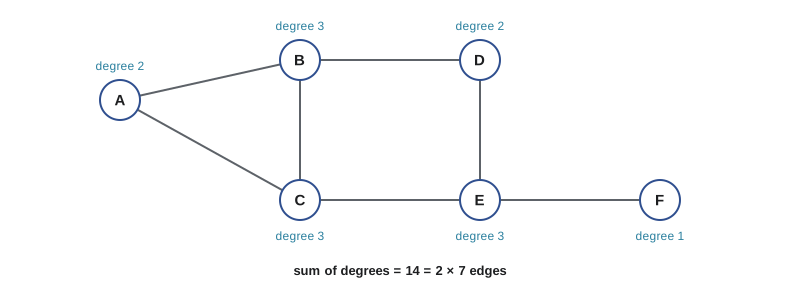
The degree of a vertex in an undirected graph is the number of edges touching it. The first theorem of graph theory, sometimes called the handshaking lemma, relates degrees to edges.
Worked problem
The handshaking lemma
Prove: in any undirected graph, the sum of the degrees of all vertices equals twice the number of edges.
Show solution
- Count the pairs (vertex, edge) where the edge touches the vertex, in two ways.
- Counting by vertex: each vertex v contributes deg(v) pairs, giving the sum of all degrees.
- Counting by edge: each edge touches exactly two vertices, giving 2|E| pairs.
- Both count the same set, so the sum of degrees is 2|E|.
Answer: Sum of degrees = 2|E|. Corollary: the number of vertices with odd degree is always even, so at a party the number of people who shook an odd number of hands is even.
edges = [("A", "B"), ("A", "C"), ("B", "C"), ("B", "D"), ("C", "E"), ("D", "E"), ("E", "F")]
adj = {}
for u, v in edges:
    adj.setdefault(u, set()).add(v)
    adj.setdefault(v, set()).add(u)
deg = {v: len(ns) for v, ns in sorted(adj.items())}
print("degrees:", deg)
print("sum of degrees =", sum(deg.values()), "  2|E| =", 2 * len(edges))
print("odd-degree vertices:", [v for v, d in deg.items() if d % 2])degrees: {'A': 2, 'B': 3, 'C': 3, 'D': 2, 'E': 3, 'F': 1}
sum of degrees = 14 2|E| = 14
odd-degree vertices: ['B', 'C', 'E', 'F']Paths, connectivity, trees and Euler paths
A path is a sequence of vertices in which consecutive vertices are joined by edges. A cycle is a path that returns to its start without repeating an edge. A graph is connected if every pair of vertices is joined by some path; connectivity in an undirected graph is an equivalence relation, and its classes are the connected components. Reachability in a directed graph is the transitive closure from lesson 9.
A tree is a connected graph with no cycles. Trees are everywhere in computing: file systems, the parse trees of compilers, the call trees of recursive functions, decision trees and the binary trees of lesson 10. A fundamental theorem says that a tree with \(n\) vertices has exactly \(n - 1\) edges; it can be proved by induction on \(n\), removing a leaf (a vertex of degree 1) in the inductive step.
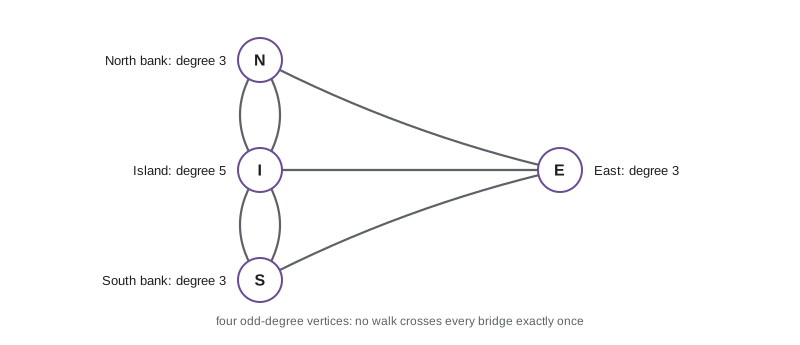
The oldest problem in graph theory comes from the city of Königsberg, whose seven bridges joined four land areas. Could a walk cross every bridge exactly once? Leonhard Euler proved in 1736 that it could not, founding graph theory. An Euler path uses every edge exactly once. Euler's theorem says a connected graph has an Euler path exactly when it has zero or two vertices of odd degree, and an Euler circuit (returning to the start) exactly when every degree is even. Königsberg's four land areas had odd degrees 3, 3, 3 and 5, so no walk exists.
def euler_status(edges):
    deg = {}
    for u, v in edges:
        deg[u] = deg.get(u, 0) + 1
        deg[v] = deg.get(v, 0) + 1
    odd = [v for v, d in deg.items() if d % 2]
    if not odd:
        return "Euler circuit exists"
    if len(odd) == 2:
        return f"Euler path exists, from {odd[0]} to {odd[1]}"
    return f"no Euler path ({len(odd)} odd vertices)"

konigsberg = [("N", "I"), ("N", "I"), ("S", "I"), ("S", "I"), ("N", "E"), ("S", "E"), ("I", "E")]
print("Konigsberg:", euler_status(konigsberg))
square = [("a", "b"), ("b", "c"), ("c", "d"), ("d", "a")]
print("square:", euler_status(square))
print("square plus diagonal:", euler_status(square + [("a", "c")]))Konigsberg: no Euler path (4 odd vertices) square: Euler circuit exists square plus diagonal: Euler path exists, from a to c
Graph algorithms, including breadth-first and depth-first search, shortest paths, minimum spanning trees and network flow, are a major part of CMPUT-204 and CMPUT-304. Their correctness proofs use the invariants and induction of this lesson, and their analysis uses the counting of lesson 11.
Capstone exercise
The following exercise combines most of the course. A university wants to verify a short program that decides whether a course plan respects prerequisites. Work through each part, using the lesson listed for help.
| Part | Task | Lessons |
|---|---|---|
| 1 | Model courses and prerequisites as a directed graph and as a relation; state which properties the transitive closure must have for a valid curriculum | 9, 12 |
| 2 | Write the specification: precondition (the plan lists each course once) and postcondition (return True exactly when every course comes after all its prerequisites), in predicate logic | 4, 12 |
| 3 | Write the checking loop and state its invariant: every course seen so far appears after all its prerequisites | 12 |
| 4 | Prove initialization, maintenance and termination for the invariant | 10, 12 |
| 5 | Count how many orders of 6 courses exist, and explain why trying them all is a poor algorithm compared with topological sorting | 9, 11 |
| 6 | Prove or disprove: if the prerequisite graph has a cycle, no valid plan exists | 6, 9 |
prereq = {"CMPUT-174": [], "CMPUT-201": ["CMPUT-174"], "CMPUT-272": ["CMPUT-174"],
          "CMPUT-204": ["CMPUT-201", "CMPUT-272"], "CMPUT-304": ["CMPUT-204"]}

def valid_plan(plan):
    assert len(set(plan)) == len(plan)                       # precondition: each course once
    seen = set()
    for k, course in enumerate(plan):
        # invariant: every course in plan[:k] comes after all of its prerequisites
        if any(p not in seen for p in prereq[course]):
            return False
        seen.add(course)
    return True

good = ["CMPUT-174", "CMPUT-272", "CMPUT-201", "CMPUT-204", "CMPUT-304"]
bad = ["CMPUT-174", "CMPUT-204", "CMPUT-201", "CMPUT-272", "CMPUT-304"]
print("good plan valid:", valid_plan(good))
print("bad plan valid: ", valid_plan(bad))
from itertools import permutations
from math import factorial
count = sum(valid_plan(list(p)) for p in permutations(prereq))
print(f"valid orders: {count} of {factorial(len(prereq))}")good plan valid: True bad plan valid: False valid orders: 2 of 120
Part 6 is a proof by contradiction: suppose a plan is valid and the graph has a cycle \(c_1 \to c_2 \to \cdots \to c_k \to c_1\). Validity forces each course on the cycle to come strictly after the previous one, so \(c_1\) comes after \(c_1\), which is impossible. Writing it out fully is a good test of the habits this course has built: precise definitions, a clear proof method, and complete sentences.
Where to go next
You now have the core vocabulary of theoretical computing science: propositions and predicates, proof techniques, sets, functions, relations, induction, counting and modular arithmetic, invariants and graphs. CMPUT-204 uses all of them to design and analyze algorithms. CMPUT-291 builds databases on relations and predicate logic. CMPUT-331 and CISSP-112 build cryptography on number theory. CMPUT-474 uses sets, functions, countability and diagonal arguments to explore what computers cannot do. Mathematics students can continue with MATH-228 (Introduction to Proofs) and MATH-260 (Discrete Mathematics).
Common mistakes
MistakeTreating a loop as correct because it passed several tests.
InsteadState an invariant and prove initialization, maintenance and termination.
MistakeChoosing an invariant that is true but useless, such as i ≥ 0.
InsteadThe invariant plus the exit condition must imply the postcondition.
MistakeForgetting to prove the loop terminates.
InsteadGive a non-negative integer measure that decreases each iteration.
MistakeWriting (lo + hi) / 2 in languages with fixed-width integers.
InsteadUse lo + (hi − lo) / 2 to avoid overflow in C or Java.
MistakeCounting each edge once when summing degrees.
InsteadEach edge contributes 2 to the degree sum, once for each end.
MistakeApplying Euler's theorem to a disconnected graph.
InsteadThe theorem requires the graph (ignoring isolated vertices) to be connected.
Summary and key terms
- A Hoare triple {P} S {Q} states that if P holds before S and S terminates, then Q holds after.
- If statements are verified by cases; sequences by a middle condition; loops by invariants.
- A loop invariant needs initialization, maintenance and termination, plus a progress measure for total correctness.
- Invariants are induction on the number of iterations, and can be written as assertions.
- A graph has vertices and edges; a directed graph is a relation on its vertices.
- The degree sum is twice the number of edges, so odd-degree vertices come in pairs.
- A connected graph has an Euler circuit if all degrees are even and an Euler path if exactly two are odd.
- Precondition
- A predicate that must hold before a piece of code runs.
- Postcondition
- A predicate that must hold after a piece of code finishes.
- Hoare triple
- The notation {P} S {Q} for a correctness claim about statement S.
- Partial correctness
- Correct whenever the program terminates.
- Total correctness
- Partial correctness together with guaranteed termination.
- Loop invariant
- A predicate true before a loop and after every iteration.
- Graph
- A set of vertices together with a set of edges joining pairs of them.
- Degree
- The number of edges incident to a vertex in an undirected graph.
- Tree
- A connected graph with no cycles.
- Euler path
- A path that uses every edge of a graph exactly once.
Practice problems
Work each problem on paper first, then reveal the answer to check.
Is {x > 3} x := x − 1 {x > 2} valid over the integers?
Show answer
Yes; if x > 3 then x − 1 > 2.
Find the weakest precondition for x := x + 2 with postcondition x ≥ 10.
Show answer
x + 2 ≥ 10, that is, x ≥ 8.
State an invariant for a loop that finds the maximum of xs by scanning left to right.
Show answer
best is the maximum of xs[0..i−1].
Give a progress measure for while lo <= hi in binary search.
Show answer
hi − lo + 1, which decreases each iteration and stays non-negative.
A graph has 10 vertices each of degree 3. How many edges does it have?
Show answer
10 × 3 / 2 = 15.
Can a graph have exactly one vertex of odd degree?
Show answer
No; the number of odd-degree vertices is even.
How many edges does a tree with 25 vertices have?
Show answer
24.
Does the complete graph on 5 vertices have an Euler circuit?
Show answer
Yes; every vertex has degree 4, which is even.
Why is connectivity in an undirected graph an equivalence relation?
Show answer
Every vertex reaches itself, paths reverse, and paths can be joined end to end.
In the capstone, why is trying all permutations a poor algorithm?
Show answer
With n courses there are n! orders; a topological sort runs in time roughly proportional to courses plus prerequisites.
Lesson quiz · 5 questions
Score 60% or more to complete this lesson.
Create a free account to save your progress, take quizzes and earn a certificate.