
CON-350 · Lesson 10 of 12 · 29 min
Subcontractor default, bonds versus SDI and claims on bonds
On a typical building project, subcontractors perform most of the work, often 70 to 90 % of the contract value. A general contractor's performance therefore depends on dozens of firms, many of them small, some with weak balance sheets and several working for other contractors on other projects at the same time. When one fails, the general contractor must finish its work, usually at higher cost and with delay, while still owing the owner the original price and completion date. CON-330 lesson 11 covers the practical steps of managing a struggling subcontractor and terminating one that defaults. This lesson covers how that risk is transferred, through subcontractor bonds or subcontractor default insurance, and how claims on bonds work for owners, contractors and unpaid subcontractors.
The cost of a subcontractor default
The direct cost of a default is the difference between what the defaulting subcontractor would have been paid to finish and what a replacement charges, plus the cost of correcting its defective work. The indirect costs are often larger: delay to other trades, acceleration, extended site overhead, liquidated damages owed to the owner, additional supervision and legal fees. A replacement subcontractor brought in mid-job, often under time pressure, rarely charges less than the original.
Worked problem
Estimating the cost of a mechanical subcontractor default
Tallgrass's mechanical subcontract at Kingfisher Wharf is $9.2 million. The subcontractor fails with $3.6 million of work remaining and $180,000 of defective work to correct. A replacement quotes $4.5 million to finish. Re-procurement and transition delay the project four weeks; Tallgrass's time-related costs are $42,000 per week and liquidated damages are $8,000 per day for 28 days. Unpaid sub-trades of the defaulting firm claim $240,000, which Tallgrass pays to keep the job moving. What is the total cost?
Show solution
- Completion cost over the remaining subcontract value: 4,500,000 − 3,600,000 = $900,000.
- Correcting defective work: $180,000.
- Time-related costs: 4 × 42,000 = $168,000.
- Liquidated damages: 28 × 8,000 = $224,000.
- Payments to unpaid sub-trades: $240,000.
- Total: 900,000 + 180,000 + 168,000 + 224,000 + 240,000 = $1,712,000.
Answer: The default costs about $1.7 million, roughly 19 % of the subcontract value and more than Tallgrass's planned profit on the whole project.
Prequalification (CON-330 lesson 3) is the first defense: checking each subcontractor's finances, backlog, safety record, references and capacity before award. But prequalification only lowers the probability of default; it cannot remove it. Contractors therefore transfer the remaining risk in one of two ways: by requiring subcontractors to provide performance and payment bonds, or by buying subcontractor default insurance (SDI) and enrolling their subcontractors in it. Some do both, bonding some trades and insuring others.
Subcontractor bonds
A subcontractor performance bond works like the general contractor's own bond, with the general contractor as obligee. If the subcontractor defaults, the general contractor calls on the surety, which may arrange completion or pay up to the penal sum. A subcontractor payment bond protects the subcontractor's own suppliers and sub-trades, which in turn protects the general contractor from lien claims and from having to pay twice to keep the job moving.
Bonds have strengths: the subcontractor pays for them (in its price), the surety prequalifies the subcontractor, and the general contractor carries no deductible. They also have weaknesses. Many small but capable subcontractors cannot obtain bonds or charge a significant premium for them, narrowing the bidder list. The surety's response to a default can be slow, because the surety investigates whether the default is genuine and whether the general contractor has met the bond's conditions, and it may dispute the claim. The surety's liability is limited to the penal sum and, depending on the bond form, may not cover the general contractor's indirect costs such as delay and liquidated damages.
Subcontractor default insurance
Subcontractor default insurance is a policy bought by the general contractor that reimburses it for the costs of a subcontractor's default, including both direct and many indirect costs, above a deductible and within the policy limits. The contractor, not an outside surety, decides when a subcontractor is in default and how to remedy it, which allows a much faster response. The product was developed in the United States in the 1990s and is now also offered in Canada; brokers' 2026 reports noted that demand for SDI was growing faster than the market had historically, with pricing broadly flat to modestly rising.
| Feature | Subcontractor bonds | Subcontractor default insurance |
|---|---|---|
| Who buys | Each subcontractor, cost passed through in its price | The general contractor, for all enrolled subcontracts |
| Who decides default | The surety investigates and responds | The general contractor, subject to policy terms |
| Speed of response | Often slow; surety investigation | Fast; contractor acts and claims afterwards |
| Costs covered | Up to the penal sum; indirect costs depend on the bond form | Direct and many indirect costs, within limits |
| Contractor retention | None | Deductible per loss and often a co-payment layer |
| Effect on bidders | Excludes subcontractors who cannot bond | Allows unbondable but qualified subcontractors to bid |
| Prequalification | Done by the surety | Done by the contractor, under a program the insurer audits |
| Typical cost | Often about 1 to 3 % of each subcontract, in the subcontractor's price | Often about 1 % or so of enrolled subcontract value, plus retained losses |
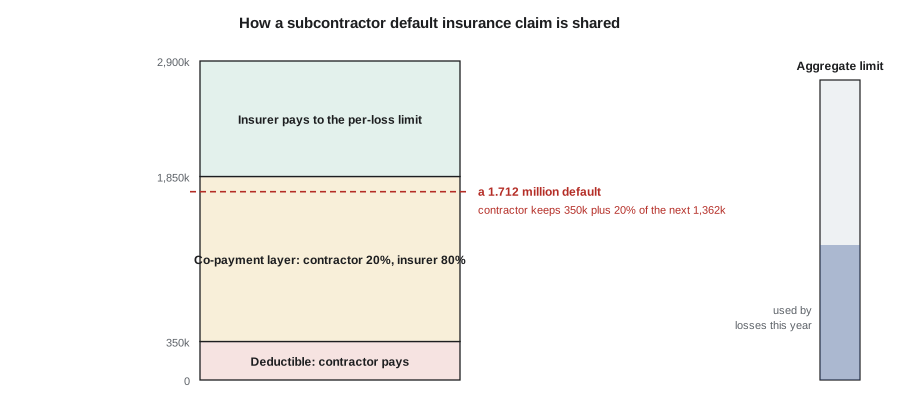
SDI policies are usually written annually for all of a contractor's projects, with a per-loss deductible, often a co-payment layer above the deductible in which the contractor pays a share, a per-loss limit and an aggregate limit. Because the contractor keeps a meaningful retention, SDI suits larger contractors with strong balance sheets and disciplined prequalification programs; the insurer will review those programs before writing the policy. Owners of large projects sometimes ask contractors with SDI to name them as beneficiaries or to provide bonds anyway, because SDI protects the contractor, not the owner directly.
# Bonds versus SDI over a portfolio of subcontracts (illustrative, seeded)
import numpy as np
rng = np.random.default_rng(10)
subs = np.array([9.2, 6.8, 4.1, 3.5, 2.9, 2.2, 1.8, 1.5, 1.2, 0.9]) * 1e6   # enrolled subcontract values
p_default = 0.02                       # annual chance each sub defaults
cost_ratio = (0.08, 0.18, 0.45)        # default cost as share of subcontract (min, mode, max)
bond_rate, sdi_rate = 0.015, 0.0095    # cost as share of subcontract value
deductible, copay_share, copay_layer = 350_000, 0.20, 1_500_000
N = 50_000
bond_cost = bond_rate * subs.sum()
sdi_premium = sdi_rate * subs.sum()
retained = np.zeros(N)
for v in subs:
    hit = rng.random(N) < p_default
    loss = hit * v * rng.triangular(*cost_ratio, N)
    above = np.clip(loss - deductible, 0, copay_layer)
    retained += np.minimum(loss, deductible) + copay_share * above
sdi_total = sdi_premium + retained
print(f"Bond premiums built into sub prices: {bond_cost:,.0f}")
print(f"SDI premium: {sdi_premium:,.0f}; mean retained losses {retained.mean():,.0f}; mean total {sdi_total.mean():,.0f}")
print(f"SDI P95 total cost: {np.percentile(sdi_total, 95):,.0f}")Bond premiums built into sub prices: 511,500 SDI premium: 323,950; mean retained losses 80,876; mean total 404,826 SDI P95 total cost: 849,277
In the illustration SDI is cheaper on average than bonding every subcontract, because the premium is lower and most years produce no default. The 95th percentile shows the price of that saving: in a bad year the contractor keeps deductibles and co-payments that can exceed the bond cost. Whether SDI makes sense depends on the contractor's ability to absorb that retention and on the quality of its prequalification. The comparison also ignores the bonds' hidden benefit, the surety's own prequalification of each subcontractor.
Claims on performance bonds
When a bonded contractor or subcontractor defaults, the obligee must follow the bond's conditions closely to preserve its rights. Courts in both countries generally enforce those conditions, and an obligee that terminates without notice, fails to give the surety a chance to act, or pays the principal amounts it should have held back may weaken or lose its claim.
| Step | Purpose |
|---|---|
| Document performance problems and give notice to the principal | Establishes the default and gives a chance to cure under the contract |
| Notify the surety early, often before terminating | Many forms require notice and a conference before default is declared |
| Declare default and terminate as the contract requires | Usually a condition of the surety's obligation |
| Stop paying the defaulting principal | Remaining contract balance must be available to the surety for completion |
| Cooperate with the surety's investigation | Surety must assess the default and its options |
| Mitigate and keep records of costs | Supports the claim and avoids disputes over amounts |
Once default is established, the surety usually has several options. It may finance the principal so it can finish, if the problem is temporary cash flow. It may arrange a completion contractor, either by tendering the remaining work and paying the difference between the new price and the contract balance, or by taking over the contract and completing it itself through a completion contractor. It may pay the obligee an agreed amount, up to the penal sum, and leave completion to the obligee. Or it may deny liability if it believes there was no default or the obligee breached the bond's conditions. The choice depends on the bond form, the amount of work remaining and the surety's view of costs.
Worked problem
Surety completion cost and the penal sum
On a $6 million subcontract with a 100 % performance bond, the subcontractor defaults with $2.2 million of contract balance unpaid. The completion contractor's price for the remaining work and corrections is $3.9 million. How much must the surety contribute, and is it within the penal sum?
Show solution
- Contract balance available: $2.2 million.
- Shortfall: 3.9 − 2.2 = $1.7 million.
- Penal sum: 1.00 × 6.0 = $6.0 million.
- The surety contributes $1.7 million, within the penal sum.
Answer: The remaining contract balance funds part of completion, and the surety pays the shortfall of $1.7 million, then seeks to recover it from the subcontractor and its indemnitors.
Claims on payment bonds
On federal projects, the Miller Act payment bond protects first-tier subcontractors and suppliers of the prime contractor, and second-tier subcontractors and suppliers who contracted with a first-tier subcontractor. A first-tier claimant can sue on the bond without prior notice once 90 days have passed since its last labor or materials; a second-tier claimant must give written notice to the prime contractor within 90 days of its last work or supply. Suit must be brought within one year after the claimant's last labor or materials, in the name of the United States, in the federal district where the work was performed. Little Miller Acts on state and local projects have their own notice and suit periods, and because liens are generally unavailable against public property, the payment bond is usually the main security for unpaid parties on public work.
# Miller Act payment bond deadlines from the date of last labor or materials (illustrative)
from datetime import date, timedelta
last_supply = date(2027, 3, 14)
print("Last supply:                     ", last_supply)
print("Second-tier notice deadline:     ", last_supply + timedelta(days=90), "(90 days)")
print("Earliest first-tier suit date:   ", last_supply + timedelta(days=90), "(after 90 days)")
print("Suit deadline (one year): ", last_supply.replace(year=last_supply.year + 1))Last supply: 2027-03-14 Second-tier notice deadline: 2027-06-12 (90 days) Earliest first-tier suit date: 2027-06-12 (after 90 days) Suit deadline (one year): 2028-03-14
Deadlines are counted from specific events defined in the bond or statute, and the difference between 'last work' and warranty or punch-list visits has been argued in many cases. Unpaid claimants should calculate their deadlines from the earliest date that could count and act well before it.
Choosing the right protection
General contractors usually match protection to the risk of each trade. Critical, high-value trades with long durations, such as mechanical, electrical, structural steel and curtain wall, carry the most default risk and the largest consequences. Small trades with short durations and many alternative suppliers may need neither bonds nor enrollment. Owners, for their part, rely on the general contractor's bonds for their own protection and generally do not need to dictate how the contractor manages its subcontractors, although some public owners require subcontractor bonds above a set value.
| Trade profile | Typical choice |
|---|---|
| Large, critical, long-duration (mechanical, electrical, steel) | Bond or SDI coverage; strong prequalification |
| Medium value, specialist (roofing, curtain wall) | Bond or SDI depending on financial strength |
| Small value, short duration, easily replaced | Prequalification and payment monitoring only |
| New or unbondable but capable firm | SDI coverage with close monitoring, or a letter of credit |
| Supplier of custom long-lead equipment | Supply bond, deposit protection or progress inspections |
Common mistakes
MistakeAssuming a subcontractor default costs only the difference in price to finish.
InsteadInclude corrections, delay, liquidated damages, supervision and payments to unpaid sub-trades.
MistakeTerminating a bonded subcontractor without notifying the surety.
InsteadFollow the bond's notice and conference conditions before declaring default.
MistakeContinuing to pay a defaulting subcontractor.
InsteadHold the remaining balance; it funds completion and protects the bond claim.
MistakeTreating SDI as risk-free.
InsteadBudget for deductibles and co-payments, which can be large in a bad year.
MistakeMissing payment bond notice periods.
InsteadCalculate deadlines from the last date of work or supply and act early.
Summary and key terms
- Subcontractor default costs include completion premiums, corrections, delay, liquidated damages and payments to unpaid sub-trades.
- Prequalification lowers the probability of default; bonds or SDI transfer the remaining financial risk.
- Subcontractor bonds are paid by the subcontractor, involve surety prequalification and have no contractor deductible, but responses can be slow.
- SDI is bought by the contractor, lets it act fast and covers direct and indirect costs, but carries deductibles and co-payments.
- Performance bond claims require careful compliance with notice, default and payment conditions; sureties may finance, complete, pay or deny.
- Payment bond claimants must meet strict notice and suit deadlines that differ between Canadian bonds, the Miller Act and state laws.
- Protection should be matched to each trade's value, duration and replaceability.
- Subcontractor default
- A subcontractor's failure to perform or pay as its subcontract requires.
- Subcontractor default insurance
- A contractor-purchased policy reimbursing costs of subcontractor defaults above a deductible.
- Co-payment layer
- A layer of loss above the deductible shared between the insured and the insurer.
- Aggregate limit
- The most an insurer will pay for all losses in a policy period.
- Completion contractor
- A contractor engaged to finish a defaulted contract.
- Takeover
- A surety option in which the surety assumes the contract and completes it.
- Tender option
- A surety option in which a new contractor is found and the surety pays the difference.
- Claimant
- A party entitled to claim on a payment bond.
- First-tier subcontractor
- A subcontractor or supplier with a direct contract with the prime contractor.
- Little Miller Act
- A state law requiring bonds on state or local public works.
Practice problems
Work each problem on paper first, then reveal the answer to check.
List four components of the cost of a subcontractor default.
Show answer
Any four of: completion premium, corrections, delay costs, liquidated damages, extra supervision, payments to unpaid sub-trades, legal fees.
A subcontract has $1.8 million remaining; a replacement charges $2.4 million. What is the completion premium?
Show answer
$600,000.
Who decides when a subcontractor is in default under SDI?
Show answer
The general contractor, subject to the policy terms.
Why might SDI let more subcontractors bid?
Show answer
Firms that cannot obtain bonds can still be enrolled.
Name three options a surety has after a default.
Show answer
Finance the principal, tender or take over completion, pay up to the penal sum, or deny liability.
Why should an obligee stop paying a defaulting principal?
Show answer
The balance funds completion and paying it away can prejudice the bond claim.
A completion price is $5.1 million and $3.4 million of contract balance remains. What does the surety contribute?
Show answer
$1.7 million, if within the penal sum.
Within what period must a second-tier Miller Act claimant give notice to the prime contractor?
Show answer
Within 90 days of its last labor or materials.
Why does SDI suit larger contractors better than small ones?
Show answer
They can absorb the deductibles and co-payments and run strong prequalification programs.
Which trades usually warrant bonds or SDI coverage?
Show answer
Large, critical, long-duration trades such as mechanical, electrical and structural steel.
Lesson quiz · 5 questions
Score 60% or more to complete this lesson.
Create a free account to save your progress, take quizzes and earn a certificate.