
CRE-201 · Lesson 11 of 12 · 25 min
Moderation, transparency and regulation
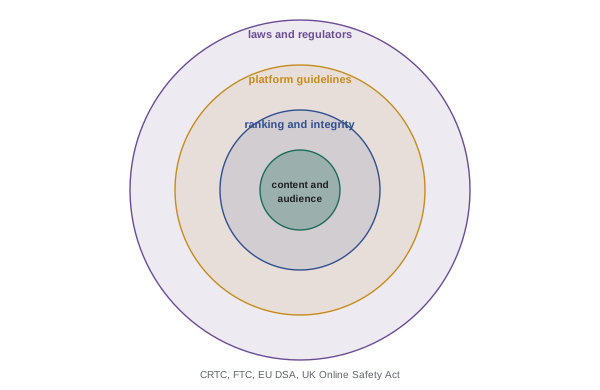
Recommendation systems do not operate in a vacuum. Platforms enforce rules about what may be posted and what may be recommended, governments increasingly regulate how platforms design and explain their systems, and public concern about misinformation, harm to young people, privacy and market power shapes how algorithms evolve. For creators, these forces determine which content can reach audiences, how restrictions are explained and appealed, and what obligations creators themselves have. This lesson covers content moderation and its relationship to recommendation, integrity and quality systems, transparency tools and research access, regulation in Canada and the United States, international rules that affect global platforms, protections for young users, and what these developments mean for creators.
Moderation and recommendation
Platforms make two related decisions about content: whether it may remain on the platform, and whether it should be recommended. Community guidelines define what is prohibited, such as hate speech, harassment, violent threats, sexual content involving minors, dangerous challenges, scams, spam and certain misinformation. Content that violates these rules may be removed, and accounts may receive strikes, temporary restrictions or bans. A broader set of recommendation guidelines defines content that may remain but will not be recommended to people who do not follow the account, such as borderline content, sensational health claims, graphic material, engagement bait or unoriginal reposts. This two-tier approach, sometimes described as "remove, reduce, inform", lets platforms limit the spread of problematic content without removing speech outright, and adds labels or context to some posts.
| Action | What happens | Typical triggers |
|---|---|---|
| Remove | Content taken down; strikes possible | Clear violations of community guidelines |
| Reduce | Not recommended or ranked lower | Borderline, low-quality, unoriginal, sensitive content |
| Inform | Labels, warnings or context added | Disputed claims, synthetic media, sensitive material |
| Restrict features | Limits on live, links, monetization | Repeated or serious violations |
| Age-restrict | Hidden from younger users | Mature themes, some sensitive topics |
Automated and human moderation
Given the scale of uploads, platforms rely heavily on automated systems to detect violations, using machine-learning classifiers for images, video, audio and text, hash matching for known illegal content such as child sexual abuse material, and spam detection. Human reviewers handle appeals, ambiguous cases and policy development. Automated systems make mistakes in both directions: they miss harmful content and wrongly flag legitimate content, for example educational material about health, art involving nudity, news footage of violence, or reclaimed language used by communities. Creators whose content is wrongly restricted should use appeal processes, which have become more available partly because of regulation. Understanding which topics are sensitive helps creators frame content carefully, for example by providing educational context and avoiding gratuitous imagery.
Integrity, quality and originality
Beyond safety, platforms adjust ranking to promote quality and integrity. They demote spam, clickbait, engagement bait, fake engagement and coordinated inauthentic behavior; they favor original creators over aggregators and reposts; they raise authoritative sources for news and health topics; and they label AI-generated or manipulated media, with many now requiring creators to disclose realistic synthetic content. Labels and disclosures for paid partnerships are also required, both by platform policy and by advertising law (CRE-320). Creators who use AI tools should understand each platform's disclosure requirements, which typically apply to realistic depictions of real people, events or places.
Transparency tools
Platforms have introduced tools that explain recommendations and restrictions: "Why am I seeing this?" explanations, account status and recommendation eligibility dashboards, notices explaining removals with appeal links, published ranking explanations and system cards, transparency reports on enforcement, and research programs that give vetted researchers access to data. Some of these tools were introduced voluntarily; many were expanded in response to regulation, particularly the European Union's Digital Services Act. For creators, transparency tools reduce the guesswork around restrictions and provide a route to correct mistakes.
Regulation in Canada and the United States
Governments are increasingly regulating online platforms, including their recommendation systems, with different approaches in Canada and the United States.
In the United States, Section 230 of the Communications Decency Act (1996) generally protects platforms from liability for user-generated content and for good-faith moderation decisions, and the First Amendment limits how far governments can dictate content and curation; in Moody v. NetChoice (2024), the Supreme Court indicated that platforms' curation of feeds can be protected expressive activity. Congress passed a law in 2024 requiring the divestiture of TikTok's US operations, leading to a US joint venture in 2026, and the TAKE IT DOWN Act (2025) requires platforms to remove non-consensual intimate images, including AI-generated ones, within 48 hours of a valid request. The Kids Online Safety Act, which would impose a duty of care on platforms toward minors, advanced in Congress in 2026; check its current status. Many states have passed laws on minors' use of social media, age verification and "addictive" algorithmic feeds, several of which have been challenged in court. The Federal Trade Commission enforces rules against deceptive practices, including undisclosed endorsements, and the Children's Online Privacy Protection Act (COPPA) governs data from children under 13.
Laws in this area are changing quickly, so creators should check current rules, particularly for content aimed at young audiences, sponsored content and AI-generated media.
International rules affecting global platforms
Because major platforms operate globally, rules in other jurisdictions affect creators everywhere. The European Union's Digital Services Act, fully applicable since 2024, requires very large online platforms to assess and mitigate systemic risks, explain their recommendation systems, offer at least one feed option not based on profiling, give users reasons for restrictions with appeal rights, and provide data access to researchers. The UK's Online Safety Act imposes duties to protect users, especially children, with enforcement by Ofcom from 2025. Australia legislated a minimum age of 16 for many social media accounts, taking effect in December 2025. These rules lead platforms to build features, such as transparency dashboards, age assurance and non-personalized feeds, that are often rolled out more widely.
Protections for young users
Concern about effects of social media on children and teenagers has driven many recent changes. Platforms have introduced teen accounts with default privacy, limits on messaging from strangers, restrictions on sensitive content in recommendations, time limits and quiet hours, and parental supervision tools; some have used age estimation technology to identify users who may be younger than they claim. Regulators in several countries require or are considering age limits, design codes and risk assessments for services used by children. For creators, these changes affect content made for or featuring young people: content aimed at children may have restricted features, such as comments disabled on YouTube content made for kids under COPPA-related rules, and creators must consider the safety and privacy of minors who appear in their content (CRE-320, CRE-350).
Worked problem
Classifying content for young audiences
A creator makes animated videos teaching basic science, aimed at children aged 6 to 10, and posts them on YouTube. What should the creator consider?
Show solution
- On YouTube, mark the videos as "made for kids" as required, because they are directed at children.
- Expect restricted features: personalized ads, comments and some notifications are disabled for made-for-kids content.
- Avoid collecting personal information from viewers and design any calls to action appropriately for children.
- Check the platform's policies and applicable laws (such as COPPA in the US and privacy law in Canada) for children's content and advertising.
Answer: Designate the videos as made for kids, accept restricted features, avoid collecting children's data, and follow children's advertising and privacy rules.
What this means for creators
Regulation and moderation affect creators in practical ways. Clear rules and appeal processes give creators more recourse when content is wrongly restricted. Requirements to label sponsored and synthetic content place obligations on creators. Protections for young users change how content involving minors is distributed and monetized. Changes forced by regulation, such as non-personalized feed options or limits on targeting, may change how audiences find content. And political debates about platforms, such as news blocking in Canada or the TikTok divestiture in the United States, can disrupt distribution suddenly. Creators who follow policy developments, read platform guidelines, keep records of their content and disclosures, and diversify their channels are best placed to adapt.
Algorithmic accountability research
Researchers, journalists and civil society organizations study recommendation systems to understand their effects, using methods such as sock-puppet accounts that simulate users, data donations from volunteers, platform-provided research data, and audits of what systems recommend for particular searches. Studies have examined topics such as whether recommendations lead users toward extreme content, how political content is distributed, and how young users' feeds differ. Findings have been mixed and often contested, partly because platforms change their systems and researchers' access to data has varied. Regulation such as the EU Digital Services Act has expanded research access, and these studies inform public debate and policy.
Creators and policy
Creators are affected by policy debates and increasingly participate in them. Creator advocacy groups, unions and industry associations comment on proposed laws, such as rules on online safety, streaming regulation, copyright and child protection, and some creators testify before legislators. Understanding how proposed rules might affect creators, such as obligations for content aimed at children or changes to how platforms recommend content, helps creators engage constructively and prepare for change.
Copyright systems and recommendation
Copyright enforcement systems interact with recommendation. YouTube's Content ID automatically matches uploads against reference files from rights holders, who can block, monetize or track matching videos; similar systems operate on Facebook, Instagram and TikTok. Content with copyright claims may be muted, blocked in some countries or demonetized, and repeated copyright strikes can lead to account termination. Fair dealing in Canada and fair use in the United States allow some uses of copyrighted material, such as criticism and commentary, but automated systems cannot judge these exceptions reliably, so creators may need to dispute claims. CRE-320 covers copyright in detail.
Election periods and civic content
During elections, platforms often adjust their systems: labeling posts from political figures and state media, restricting political advertising, adding information panels about voting, demoting misinformation about elections, and in some cases reducing the recommendation of political content overall unless users choose to see it. Creators covering politics should expect stricter enforcement and labeling during election periods, and should follow electoral rules on advertising and third-party campaigning, which differ between Canada and the United States.
Personal responsibility within the rules
Regulation and platform rules set minimum standards, but creators also have personal responsibility for the effects of their content. Content can be legal and within guidelines yet still harmful, for example by spreading unverified health claims, encouraging dangerous stunts, or exposing private individuals to harassment. Creators with large audiences have influence that brings responsibility: checking facts, considering how content might be misused or misunderstood, protecting vulnerable people, and correcting mistakes openly. Responsible practices also protect creators from reputational damage and the loss of brand partnerships when harmful content attracts criticism.
Keeping records
Creators benefit from keeping records related to moderation and regulation: copies of their content, notices of removals and restrictions, appeal outcomes, disclosures used in sponsored posts, and contracts with brands. These records help when appealing decisions, responding to brand or regulator inquiries, and demonstrating good faith if disputes arise. They also help creators notice patterns, such as particular topics or formats that trigger automated restrictions, so that they can adjust framing or seek clarification from the platform. Simple organized folders and a spreadsheet log are usually sufficient for most creators.
Staying informed about these rules, through platform policy pages, creator newsletters, reputable news sources and professional associations, is now a routine part of running a creator business responsibly in Canada, the United States and elsewhere.
Common mistakes
MistakeIgnoring recommendation guidelines.
InsteadKnow what platforms will not recommend, as well as what they remove.
MistakeAssuming automated moderation is always right.
InsteadAppeal mistaken removals and restrictions.
MistakePosting realistic AI content without disclosure.
InsteadFollow platform labeling requirements.
MistakeTreating children's content like any other content.
InsteadFollow made-for-kids rules and privacy law.
MistakeAssuming laws are settled.
InsteadCheck current rules regularly.
Summary and key terms
- Platforms remove violating content and reduce recommendations of borderline content.
- Automated moderation operates at scale but makes mistakes; appeals matter.
- Integrity systems demote spam and reposts and label synthetic and sponsored content.
- Transparency tools explain recommendations and restrictions.
- Canada and the US regulate platforms differently, and laws are changing quickly.
- The EU DSA, UK Online Safety Act and Australian age rules affect global platforms.
- Protections for young users change how children's content is distributed.
- Community guidelines
- Rules on what may be posted.
- Recommendation guidelines
- Rules on what may be suggested to non-followers.
- Remove, reduce, inform
- Approach of removing, demoting or labeling content.
- Strike
- Penalty recorded for a guideline violation.
- Hash matching
- Identifying known illegal content by digital fingerprints.
- Synthetic media
- AI-generated or manipulated content.
- Transparency report
- Published data on enforcement.
- Section 230
- US law shielding platforms from liability for user content.
- Digital Services Act
- EU law regulating online platforms.
- Made for kids
- YouTube designation for content directed at children.
Practice problems
Work each problem on paper first, then reveal the answer to check.
What two decisions do platforms make about content?
Show answer
Whether it may stay and whether it may be recommended.
What does "remove, reduce, inform" mean?
Show answer
Take down, demote or label content.
Give an example of content wrongly flagged by automation.
Show answer
Health education, art, news footage, reclaimed language.
What must creators disclose?
Show answer
Paid partnerships and realistic synthetic content.
Name two transparency tools.
Show answer
Why am I seeing this, account status, removal notices, transparency reports.
Which Canadian law led Meta to block news?
Show answer
The Online News Act.
Which US law shields platforms from liability for user content?
Show answer
Section 230.
What does the EU DSA require for feeds?
Show answer
At least one option not based on profiling.
What age minimum did Australia legislate?
Show answer
16 for many social media accounts.
What features are disabled for made-for-kids videos?
Show answer
Personalized ads, comments, some notifications.
Lesson quiz · 5 questions
Score 60% or more to complete this lesson.
Create a free account to save your progress, take quizzes and earn a certificate.