
DCE-200 · Lesson 4 of 5 · 33 min
Reliability, redundancy and tiers
Equipment fails. Breakers trip, UPS modules fault, generators refuse to start, pumps seize, chillers trip on high pressure, and a contractor drills through a cable. Equipment also needs maintenance: a transformer cannot be tested and a breaker cannot be replaced while current is flowing through it. Yet many data centers promise their customers that IT equipment will essentially never lose power or cooling.
The only way to keep that promise is redundancy: more equipment than the load strictly needs, and more than one path from source to load, arranged so that a failure or a maintenance shutdown anywhere leaves enough capacity to carry the load. Redundancy is expensive, though. A 2N electrical system roughly doubles the electrical equipment, so choosing how much redundancy to build is one of the biggest decisions on any project.
This chapter shows how reliability is measured and calculated, explains the common redundancy schemes (N, N+1, 2N and their relatives), introduces the tier classifications the industry uses to describe them, and shows how to weigh the cost of redundancy against the cost of downtime.
Reliability and availability
Two related measures describe how dependable a system is.
- Reliability \(R(t)\) is the probability that a system works without failure for a stated time. "The generator has a 98% probability of starting and running for the duration of an outage" is a reliability statement.
- Availability \(A\) is the long-run fraction of time a system is working. It depends both on how often things fail and on how quickly they are repaired.
For a repairable component, availability is expressed with the mean time between failures (MTBF) and the mean time to repair (MTTR):
Worked problem
Availability of a UPS module
A UPS module has an MTBF of 250,000 hours and an MTTR of 6 hours. What is its availability, and how much downtime would it have per year on average?
Show solution
- \(A = 250{,}000/(250{,}000 + 6) = 0.999976\).
- Unavailability = 1 − A = 0.000024; × 8760 h = 0.21 h ≈ 12.6 minutes per year.
Answer: A = 0.999976, about 12.6 minutes of downtime per year on average. That is excellent for one module, but a data center has thousands of components in its power and cooling chains
Availability is often quoted in "nines": 99.9% ("three nines") allows 8.8 hours of downtime a year; 99.99% allows 53 minutes; 99.999% ("five nines") allows about 5 minutes.
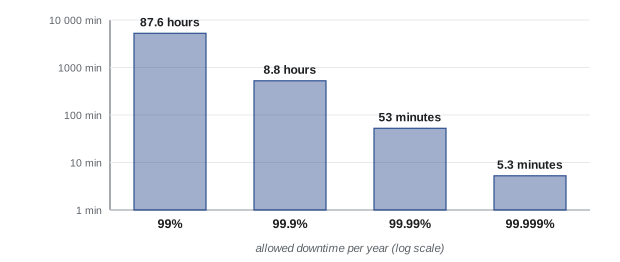
Annual averages hide something important for data centers: a single interruption of a fraction of a second can crash servers and take hours to recover from. Operators therefore care about the frequency of interruptions, not just the total minutes.
Series and parallel
Systems are built from components connected in two basic ways (STAT-235 derives these rules):
- In series, every component must work. Power passing through a transformer, then a UPS, then a PDU is a series chain: \(A_\text{series} = A_1 A_2 A_3 \cdots\). Each added component lowers availability.
- In parallel, the system works if any one path works: \(A_\text{parallel} = 1 - (1 - A_1)(1 - A_2)\). Redundant paths raise availability dramatically.
Worked problem
One path or two
A power path consists of a transformer (A = 0.9999), a UPS system (A = 0.99998) and a PDU (A = 0.99999) in series. Find the availability of one path, and of two independent paths feeding dual-corded servers.
Show solution
- One path: \(0.9999 \times 0.99998 \times 0.99999 = 0.99987\); downtime about 68 minutes a year.
- Two independent paths: \(1 - (1 - 0.99987)^2 = 0.99999998\); downtime about half a second a year.
Answer: Duplicating the path takes availability from about 0.99987 to 0.99999998. The catch is the word "independent": a fault, fire or human error that affects both paths at once defeats the arithmetic
Failures that take out redundant equipment together are called common-mode or common-cause failures: two "independent" feeders in the same trench, two UPS systems controlled by the same faulty software, both cooling loops filled from the same contaminated water, or a technician who switches off the wrong side. Much of the art of data center design is finding and removing these shared weaknesses, and above all finding single points of failure, components whose failure alone stops the load.
Redundancy schemes
Redundancy is described relative to N, the number of units needed to carry the full load.
- N: exactly enough capacity, no spare. Any failure or maintenance reduces capacity below the load.
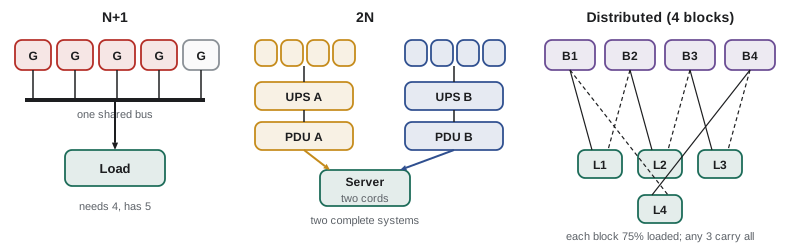
- N+1: one spare unit. If the load needs four generators, five are installed. N+2 adds two spares.
- 2N: two complete, independent systems, each able to carry the whole load. Each side is often called the A side and the B side, matching dual-corded IT equipment.
- 2(N+1): two independent systems, each with its own spare unit.
- Distributed (block) redundancy: several blocks share the load, with enough spare capacity across the blocks that any one block can fail; for example, four blocks each loaded to 75%, so three can carry the load (sometimes written 4N/3). It achieves much of the benefit of 2N with less equipment.
Worked problem
How many generators?
A load needs 4 generators. Each generator, independently, has a 98% probability of starting and running through an outage. Compare the probability that at least 4 generators run for N (4 installed), N+1 (5) and N+2 (6).
Show solution
- N: all 4 must run: \(0.98^4 = 0.922\).
- N+1: at least 4 of 5 must run: \(0.98^5 + 5(0.98^4)(0.02) = 0.9039 + 0.0922 = 0.996\).
- N+2: at least 4 of 6: adding the case of exactly 4 running, \(15(0.98^4)(0.02^2)\), gives 0.99985.
Answer: N: 92.2%; N+1: 99.6%; N+2: 99.985%. One spare unit turns an unacceptable 8% chance of losing load into 0.4%
Notice the diminishing returns, and notice what the calculation leaves out. An N+1 generator plant still shares one switchgear lineup, one fuel system and one control system. 2N protects against failures of those shared parts, and lets an entire side be shut down for maintenance. That is why 2N designs remain common in the electrical system even where N+1 would satisfy the arithmetic for the generators alone.
Worked problem
UPS modules
A load needs 3 UPS modules, each with an availability of 0.995 over the period considered. Compare N (3 modules), N+1 (4 modules on one bus) and 2N (two independent sets of 3).
Show solution
- N: \(0.995^3 = 0.98507\).
- N+1: at least 3 of 4: \(0.995^4 + 4(0.995^3)(0.005) = 0.99985\).
- 2N: either set of 3 works: \(1 - (1 - 0.98507)^2 = 0.99978\).
Answer: N+1 (0.99985) and 2N (0.99978) give similar results for module failures alone. 2N earns its cost by also protecting against failures and maintenance of the shared bus, switchgear and distribution, which this simple model ignores
Concurrent maintenance and fault tolerance
Two design goals summarize what redundancy is for.
- Concurrently maintainable: every component and every distribution path can be taken out of service for planned maintenance or replacement without shutting down IT equipment. This requires redundant components and at least two distribution paths, one of which may be idle.
- Fault tolerant: the facility continues to run through any single unplanned failure of equipment or a distribution path, with the effects contained before they reach the IT equipment. This requires two simultaneously active paths, physically separated (compartmentalized) so that a fire or flood in one cannot reach the other, and automatic response to failures.
Concurrent maintainability is about planned events; fault tolerance is about unplanned ones. A design can be concurrently maintainable but still go down from a single unplanned fault, for example if an operator must manually switch to the alternate path.
Tier classifications
The industry describes these levels with the Uptime Institute's Tier Classification System, defined in its Tier Standard: Topology.
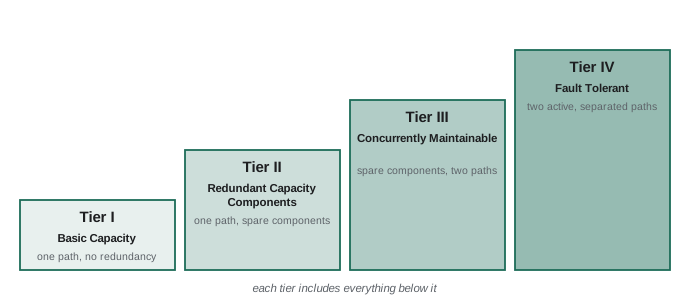
- Tier I, Basic Capacity: dedicated space for IT, a UPS, cooling that runs around the clock and an engine generator. No redundancy; maintenance requires shutdowns.
- Tier II, Redundant Capacity Components: adds redundant power and cooling components (UPS modules, chillers, pumps, generators), but still a single distribution path.
- Tier III, Concurrently Maintainable: adds a redundant distribution path, so that every component and path can be maintained without shutting down IT equipment.
- Tier IV, Fault Tolerant: adds fault tolerance and compartmentalization, so that any single equipment or path failure is contained before it affects IT operations.
Each tier includes all the requirements of the tiers below it. Uptime Institute certifies designs (Tier Certification of Design Documents) and, separately, constructed facilities (Tier Certification of Constructed Facility), which includes on-site testing such as pulling the utility power. The distinction matters: Uptime reports that many designs are not built as designed. Uptime removed expected downtime figures from its tier definitions in 2009, so the percentages sometimes quoted for each tier (such as "99.982% for Tier III") are not part of the standard.
Other systems describe similar levels: ANSI/TIA-942, the telecommunications infrastructure standard for data centers, uses Rated-1 to Rated-4 and also covers cabling and architecture; Europe's EN 50600 uses availability classes 1 to 4. Many owners skip formal certification and specify their own requirements, such as "concurrently maintainable electrical and mechanical systems, 2N UPS, N+1 generators and chillers". Most colocation and cloud facilities are designed to about the Tier III level.
Choosing a level: the cost of downtime
Higher redundancy costs more to build, more to maintain and usually more energy (equipment running at partial load is less efficient). The right level depends on what an outage costs. Uptime Institute's surveys find that outages are becoming less frequent, but about one in ten still causes serious or severe disruption, and large outages commonly cost hundreds of thousands to millions of dollars.
Worked problem
Is the extra redundancy worth it?
An operator compares two designs. Design A has an expected availability of 0.9995; design B, with more redundancy, 0.99995 but costs $8 million more to build. Downtime costs the operator about $250,000 per hour. Over a 15-year life, ignoring the time value of money (ENGG-401 adds it), is design B worth it?
Show solution
- Expected downtime A: (1 − 0.9995) × 8760 = 4.38 h/yr, costing 4.38 × $250,000 = $1.095 million per year.
- Expected downtime B: 0.438 h/yr, costing $109,500 per year.
- Savings with B = $985,500 per year; over 15 years about $14.8 million, against $8 million extra cost.
Answer: Yes, roughly: B saves about $14.8 million in expected downtime costs for $8 million. With a lower downtime cost, say $50,000 per hour, it would not pay off. Reputation, contracts with uptime guarantees and safety (for a hospital or emergency service) also weigh in
Reliability also depends on people. Industry surveys consistently find that human error, such as failing to follow procedures, plays a part in a large share of outages. Clear methods of procedure, training, labeling, and designs that make the right action easy and the wrong action hard are part of reliability engineering (Lesson 5 and DCE-450).
Common mistakes
MistakeAssuming redundant components are independent.
InsteadLook for common causes: shared switchgear, controls, fuel, trenches, rooms and procedures. They limit what redundancy can achieve.
MistakeCounting only component redundancy.
InsteadRedundant paths matter too. N+1 components on a single path cannot be concurrently maintained.
MistakeQuoting availability percentages as if they were part of the Tier Standard.
InsteadTiers are defined by topology and performance (concurrent maintainability, fault tolerance), not by predicted downtime.
MistakeEquating a certified design with a reliable facility.
InsteadConstruction, commissioning, maintenance and operating procedures decide whether the design performs as intended.
MistakeBuilding the highest level of redundancy everywhere.
InsteadMatch redundancy to the consequences of failure for the actual workload and compare costs with expected downtime costs.
Summary and key terms
- Availability \(A = \text{MTBF}/(\text{MTBF} + \text{MTTR})\); each extra nine cuts allowed downtime tenfold (99.99% ≈ 53 min/yr).
- Series: multiply availabilities. Parallel: \(1 - \prod(1 - A_i)\). Common-cause failures defeat parallel redundancy.
- N is just enough; N+1 has one spare; 2N has two complete independent systems; distributed redundancy spreads spare capacity across blocks.
- Concurrently maintainable: any component or path can be serviced without shutting down IT. Fault tolerant: any single unplanned failure is contained.
- Uptime Tiers: I Basic Capacity, II Redundant Capacity Components, III Concurrently Maintainable, IV Fault Tolerant. TIA-942 Rated-1 to 4 and EN 50600 classes are similar.
- Choose redundancy by comparing its cost with the expected cost of downtime, and remember that people and procedures are part of reliability.
- Reliability
- The probability that a system performs without failure for a stated period.
- Availability
- The long-run fraction of time a system is working.
- MTBF
- Mean time between failures.
- MTTR
- Mean time to repair (restore) after a failure.
- Single point of failure
- A component whose failure alone interrupts the load.
- Common-cause failure
- One event that causes several redundant components to fail together.
- N+1
- A redundancy level with one more unit than the load requires.
- 2N
- Two complete, independent systems, each able to carry the full load.
- Distributed redundancy
- Redundancy provided by spare capacity spread across several active blocks.
- Concurrently maintainable
- Able to have any component or path removed for planned work without affecting IT operations.
- Fault tolerant
- Able to sustain any single unplanned failure without affecting IT operations.
- Compartmentalization
- Physical separation of redundant systems so that a fire or other event cannot affect both.
Practice problems
Work each problem on paper first, then reveal the answer to check.
A pump has MTBF 40,000 h and MTTR 10 h. Find its availability and annual downtime.
Show answer
A = 40,000/40,010 = 0.99975; downtime = 0.00025 × 8760 = 2.2 h/yr.
How many minutes of downtime per year does 99.95% availability allow?
Show answer
0.0005 × 525,600 = 263 minutes (4.4 hours).
Three components in series each have A = 0.999. Find the system availability.
Show answer
0.999³ = 0.997.
Two parallel chillers each have A = 0.99, and either can carry the load. Find the system availability.
Show answer
1 − 0.01² = 0.9999.
A load needs 2 chillers. With 3 installed, each 0.97 available, find the probability at least 2 are available.
Show answer
0.97³ + 3(0.97²)(0.03) = 0.9127 + 0.0847 = 0.9974.
A facility needs 6 MW of UPS capacity from 1.5 MW modules. How many modules are needed for N, N+1 and 2N?
Show answer
N = 4, N+1 = 5, 2N = 8.
In a distributed redundant design, five blocks share a load so that any four can carry it. To what fraction of capacity is each block loaded in normal operation?
Show answer
4/5 = 80%.
A design has redundant UPS modules on a single output bus feeding the PDUs. Which tier does it most resemble, and why not the next one up?
Show answer
Tier II: it has redundant capacity components, but a single distribution path, so the bus cannot be maintained without a shutdown (not concurrently maintainable).
Give two examples of common-cause failures that could defeat a 2N design.
Show answer
Examples: both feeders routed through one duct bank that is cut; a fire spreading between A and B rooms; one control system or software bug affecting both sides; an operator error switching off both sides.
Downtime costs $100,000 per hour. Design changes would raise availability from 0.9998 to 0.99995 for $3 million. Over 10 years, ignoring the time value of money, do they pay off?
Show answer
Downtime falls from 1.752 h/yr to 0.438 h/yr: 1.314 h × $100,000 = $131,400/yr, $1.31 million over 10 years. Less than $3 million, so not on downtime cost alone.
Lesson quiz · 5 questions
Score 60% or more to complete this lesson.
Create a free account to save your progress, take quizzes and earn a certificate.