
FILM-320 · Lesson 2 of 12 · 28 min
Reading and analyzing a script
Every directing decision starts with reading. Before a director can cast, stage or shoot a scene, they need to understand what happens in it, why it happens, what each character wants and how the scene fits into the story as a whole. Screenwriters build scripts with structure, character arcs and subtext, as FILM-210 explains from the writer's side. The director's reading is different: it is a reading for action. The question is not only "what does this scene mean?" but "what must happen in front of the camera for an audience to feel that meaning?"
This lesson gives you a practical method for analyzing a script as a director. It moves from the whole story down to the individual moment: first the spine of the film, then sequences and scenes, then beats within a scene, and finally the objectives, obstacles and tactics that drive each character from moment to moment. It ends with subtext and with the difference between analysis that helps actors and analysis that gets in their way.
Several readings, several purposes
Experienced directors read a script many times, each time looking for something different. The first reading should be as close as possible to an audience's experience: straight through, without stopping to take notes, paying attention to where you are moved, bored, confused or surprised. Those first reactions are valuable because you will never have them again. Write them down immediately after finishing.
Later readings are analytical. One reading may follow a single character through the whole script, noting what they want in each scene and how they change. Another may track the story's information: what the audience knows, what each character knows and when secrets are revealed. A practical reading notes every location, time of day, prop, stunt, effect, animal, child and vehicle, because each has consequences for budget and schedule. A final reading before rehearsal focuses on the emotional journey of each scene.
| Reading | Question it answers | Notes to keep |
|---|---|---|
| First, uninterrupted | How does the story feel to an audience? | Gut reactions, confusions, favorite and weakest moments |
| Spine and structure | What is the film about and how is it built? | One-sentence spine, act breaks, turning points |
| Character | What does each person want and how do they change? | Objectives by scene, arc, relationships |
| Information | Who knows what, and when? | Reveals, secrets, dramatic irony |
| Practical | What will each scene need? | Locations, cast, props, effects, safety concerns |
| Performance | What happens emotionally, moment to moment? | Beats, transitions, subtext |
Finding the spine
The spine, sometimes called the through-line or controlling idea, is a short statement of what the film is about at its deepest level. It is not a plot summary. "A woman returns home for her father's funeral and fights with her sister over the house" describes events. "A woman learns that she cannot reclaim her childhood by holding on to the place where it happened" describes meaning. The second version gives the director something to measure every choice against: does this scene, this shot, this performance serve that idea?
The spine often emerges from the protagonist's arc. Ask what the main character wants at the start, what they need, which is often different, and what they understand or fail to understand by the end. Ask what the ending says about the world. A spine should be specific enough to exclude possibilities; "a film about family" includes almost everything and therefore guides nothing.
Many directors also find the film's central image or question. In one film it might be the house itself, slowly emptied of furniture. In another it might be a question the audience asks throughout: will she forgive him? These anchors help when decisions become difficult in the edit months later.
Scenes, units and beats
A scene in a screenplay is defined by place and time: a new slug line marks a new scene. For directing purposes it helps to break scenes into smaller units. Stanislavski, whose system underlies much modern actor training, called these units "bits", which, the story goes, American students heard as "beats" in his Russian-accented English. Whatever the origin, a beat is now understood as a unit of action in which one thing is being pursued. When the pursuit changes, because a character wins, loses or changes approach, a new beat begins.
Beats are useful because they give the director and actors a shared map of the scene. A four-page scene might contain eight beats. Naming them, for example "Maya tries to make peace", "Maya provokes her sister", "the sisters remember", "the truth comes out", turns a long block of text into a sequence of events, each with its own purpose and energy. Transitions between beats, the moments where something shifts, are often where the most interesting acting and staging happen.
Directors differ in how much they share this analysis with actors. Some write detailed beat breakdowns and discuss them in rehearsal. Others keep their analysis private and use it to guide their notes without imposing a structure. Either way, the director should know where the beats fall, because it affects staging, coverage and editing.
An original scene for analysis
The following short scene was written for this course. It is used throughout this lesson and returns in later lessons.
INT. MOTHER'S KITCHEN — NIGHT. The day after the funeral. Casserole dishes cover every surface. DANA (40s) scrubs a roasting pan at the sink. Her younger sister MAYA (30s) enters, still in her coat, carrying a cardboard box.
MAYA: I took the photo albums. Before anyone else could.
DANA (not turning): Anyone else being me.
MAYA: You've got the house. I thought I could have the pictures of it.
Dana stops scrubbing. She looks at the box, then at Maya.
DANA: Mom asked me to look after things. You weren't here to ask.
MAYA: I was here every Christmas.
DANA: For two days. With your phone.
Silence. Maya sets the box on the table, opens it, takes out an album, and turns a page. She laughs despite herself.
MAYA: Look at your hair.
Dana dries her hands slowly. She crosses to the table and looks.
DANA: She cut it herself. With the kitchen scissors.
MAYA: She was terrible at it.
DANA: She was terrible at a lot of things. She was still here.
Maya closes the album. She pushes the box across the table to Dana.
MAYA: Keep them. I'll take copies.
Dana pushes it back. Neither speaks.
Breaking the scene into beats
Worked problem
Beat breakdown of the kitchen scene
Divide the scene above into beats and give each beat a short active title from the point of view of the character driving it.
Show solution
- Beat 1, from Maya's entrance to "pictures of it": Maya stakes her claim. She has come prepared for a fight and moves first.
- Beat 2, from Dana stopping to "With your phone": Dana counter-attacks. She shifts the argument from the albums to Maya's absence.
- Beat 3, the silence and the album: Maya retreats into memory, partly to escape, partly to reach out. The laugh is the turning point.
- Beat 4, from "Look at your hair" to "She was terrible at it": the sisters share a memory. For a moment they are on the same side.
- Beat 5, Dana's line "She was still here": Dana names the real wound, which is not the albums but being left alone with their mother.
- Beat 6, the box pushed across and back: both try to give, and neither can accept. The scene ends unresolved.
Answer: Six beats, each with a clear driver and a change at its end. The turn in beat 3 and the wound in beat 5 are the key transitions to stage and cover carefully.
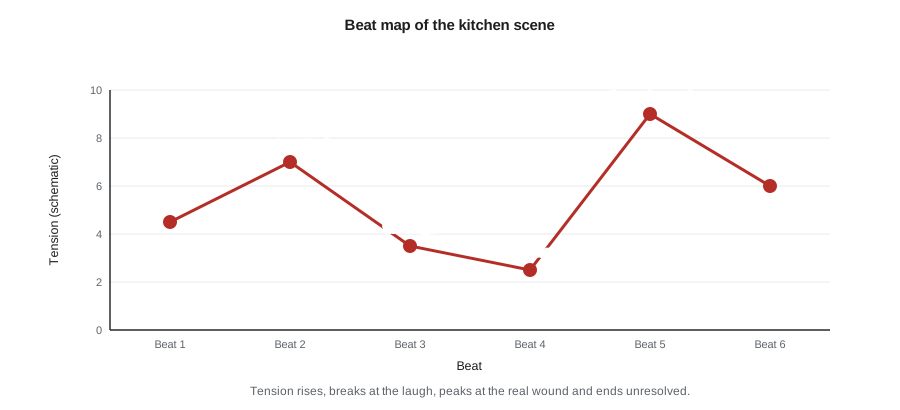
Look at what the breakdown reveals. The scene's surface subject is a box of photo albums, but its real subject is Dana's resentment at carrying their mother's care alone and Maya's guilt at having left. The albums are a battlefield for a deeper argument. The final gesture, pushing the box back and forth, is wordless and depends entirely on staging and performance.
Objectives, obstacles, tactics and stakes
A beat breakdown tells you where the scene changes. To know why, you need the characters' objectives. An objective is what a character wants from another character in the scene, expressed as something they could achieve. Strong objectives are active and directed at the other person: "to make Dana admit she needs me", "to make Maya feel the cost of leaving". Weak objectives are states of being, such as "to be sad", which an actor cannot play because there is nothing to pursue.
An obstacle is what stands in the way, whether the other character, circumstances or the character's own fears. Tactics are the means a character uses to pursue the objective, and they change from beat to beat: accuse, charm, guilt, joke, withdraw, confess. Stakes are what the character stands to gain or lose. The higher and more personal the stakes, the more urgently the character pursues the objective, and the more alive the scene feels.
| Character | Scene objective | Main obstacle | Tactics used | Stakes |
|---|---|---|---|---|
| Maya | To be accepted back into the family | Dana's resentment and her own guilt | Claim, defend, reminisce, offer | Losing her last connection to home and to her sister |
| Dana | To make Maya acknowledge what Dana carried | Maya's defensiveness and Dana's pride | Ignore, accuse, correct, refuse | Being alone with her grief and her anger |
The objectives are related but not opposite. Each sister wants something from the other, and each blocks the other while pursuing it. That is the engine of the scene. If the director and actors agree on these objectives, many staging and performance choices follow naturally. Maya enters carrying the box because she is claiming something. Dana keeps her back turned because ignoring is a tactic. The laugh breaks through because memory momentarily overrides both tactics.
Given circumstances and backstory
Stanislavski's term "given circumstances" refers to everything the script tells us, or implies, about the world of the scene: where and when it happens, what has just happened, who the characters are and what their relationships have been. In the kitchen scene, the given circumstances include the funeral the day before, the casserole dishes brought by neighbors, the house that Dana has inherited, and years of Maya's absence.
Directors and actors often go beyond what the script states, building backstory: when Maya left, why, how often she called, what the mother's last months were like. Backstory is useful when it gives the actors specific memories to draw on and when it is consistent between them. It becomes a problem when it is so elaborate that it competes with the scene, or when the director imposes backstory that the actor finds unhelpful. A good rule is to develop backstory that directly affects what the characters want and fear in the scenes you are shooting.
Subtext and what is not said
Subtext is the meaning beneath the words: what characters think and feel but do not say. Good screenplays rely heavily on it. When Dana says "For two days. With your phone", the text is about Maya's visits; the subtext is "you abandoned me." When Maya says "Look at your hair", the text is a joke; the subtext is "remember when we were close?"
Directing subtext is a matter of balance. If actors play the subtext too openly, the scene becomes heavy and obvious, because the characters seem to be announcing their feelings. If they ignore it, the scene becomes flat. The usual goal is for characters to pursue their objectives through the surface action, with the subtext leaking through in timing, glances, pauses and physical behavior. Much of this is a matter of what the actors are thinking and doing while not speaking, which is why the director's attention to silences matters so much.
Turning analysis into directing tools
Analysis is useful only if it becomes something you can use in rehearsal and on set. Directors commonly produce a few working documents from their script work: a list of beats for each scene with active titles, a note of each character's objective and stakes, a list of key moments that must be captured in coverage, and questions to discuss with the actors.
Key moments deserve particular attention. In the kitchen scene they are Maya's entrance with the box, Dana stopping work, the laugh, Dana's "She was still here" and the final push of the box. Each needs to be visible to the audience in the right size of shot at the right time. Lesson 3 shows how these moments become a shot plan, and lesson 7 shows how staging supports them.
Analysis also prepares you for the edit. When you know the beats and turning points, you can protect them in coverage and recognize them in the cutting room. Editors often say that the director's clearest notes come from knowing what each scene is for.
Analysis that helps actors and analysis that does not
The purpose of script analysis is to help the film, and in particular the performances. It can harm both if it is used badly. The most common problem is giving actors conclusions instead of situations. Telling an actor "in this beat you feel betrayed" asks them to produce an emotion, which tends to produce acting rather than behavior. Telling them what their character wants, what just happened and what the other character is doing gives them something to respond to, and the feeling arises from that.
A second problem is rigidity. A beat breakdown is a hypothesis, not a law. In rehearsal an actor may find a transition somewhere else, or play a tactic you had not imagined, and it may be better. Good directors hold their analysis firmly enough to steer and loosely enough to be surprised. Lesson 5 develops the language of direction that turns analysis into playable notes.
Common mistakes
MistakeWriting a plot summary and calling it the spine
InsteadState what the film means in a specific sentence that excludes some choices.
MistakeGiving characters states of being as objectives
InsteadUse active objectives aimed at the other character, such as to make her admit something.
MistakeTelling actors what to feel
InsteadGive them objectives, circumstances and the other character's actions to respond to.
MistakeHaving actors play subtext openly
InsteadLet subtext leak through behavior while characters pursue the surface action.
MistakeTreating the beat breakdown as fixed
InsteadUse it as a working hypothesis and stay open to better discoveries in rehearsal.
Summary and key terms
- Read a script several times, each time for a different purpose, starting with an uninterrupted first reading.
- The spine is a specific statement of what the film means, used to measure every choice.
- A beat is a unit of action in which one thing is pursued; a new beat begins when the pursuit changes.
- Objectives should be active and aimed at another character; obstacles, tactics and stakes give them life.
- Given circumstances and focused backstory make scenes specific and consistent.
- Subtext is best revealed through behavior, timing and silence rather than announced.
- Turn analysis into working tools: beats, objectives, key moments and questions for actors.
- Spine
- A short statement of what a film is about at its deepest level.
- Beat
- A unit of action in a scene in which a character pursues one thing.
- Objective
- What a character wants from another character in a scene.
- Obstacle
- What stands in the way of a character's objective.
- Tactic
- The means a character uses to pursue an objective, such as charm or accusation.
- Stakes
- What a character stands to gain or lose.
- Given circumstances
- The facts of the world of a scene, stated or implied by the script.
- Subtext
- The thoughts and feelings beneath what characters say.
- Turning point
- A moment where the direction of a scene or story changes.
- Key moment
- A moment the audience must clearly see for the scene to work.
Practice problems
Work each problem on paper first, then reveal the answer to check.
Why should you write down reactions immediately after the first reading?
Show answer
Those audience-like reactions cannot be recovered once you start analyzing.
Rewrite "a film about grief" as a more useful spine.
Show answer
For example: a man learns that grief cannot be finished on schedule, only carried.
What marks the start of a new beat?
Show answer
A change in what a character is pursuing or how they pursue it.
Turn "to be angry" into a playable objective.
Show answer
For example: to make him apologize, or to make her feel what she did.
Name three tactics a character might use.
Show answer
For example: charm, accuse, joke, withdraw, beg or confess.
What are given circumstances?
Show answer
The facts of the scene's world: place, time, prior events and relationships.
When does backstory become unhelpful?
Show answer
When it is so elaborate it competes with the scene or is imposed against the actor's instincts.
In the kitchen scene, what is the subtext of "For two days. With your phone"?
Show answer
You abandoned me with our mother.
Why identify key moments before shooting?
Show answer
So coverage and staging make sure the audience sees them at the right size and time.
Why is telling an actor what to feel usually unhelpful?
Show answer
It asks for an emotion rather than giving something to pursue and respond to.
Lesson quiz · 5 questions
Score 60% or more to complete this lesson.
Create a free account to save your progress, take quizzes and earn a certificate.