
HSE-393 · Lesson 6 of 12 · 22 min
Personal safety, alarms and room setup
▶ Video coming soon A video version of this lesson is on the way.
When de-escalation fails, what matters most is whether the worker can get away and whether help arrives quickly. Both depend on decisions made long before the incident: how rooms are laid out, what is in them, whether staff carry an alarm that works everywhere they go, and whether someone actually responds when it sounds. This lesson covers the engineering controls and personal habits that protect staff when violence happens anyway. In the hierarchy of controls, they are more reliable than any amount of training, because they work even when the worker is tired, new or caught off guard.
Summoning help
Minnesota's section 144.566 requires the plan to include procedures for obtaining help from security, police or social services on every shift, and OSHA's guidelines list alarm systems and panic buttons among the main engineering controls. Whatever the device, it must work in every place where workers might face violence, be reliable, and be understood by every worker. A phone at the nursing station does not help a nurse who is trapped in a patient's bathroom.
Hospitals use several kinds of alarm, often in combination:
| Type | How it works | Strengths | Limits |
|---|---|---|---|
| Wearable personal alarm | A badge or pendant with a button or pull cord that sends an alert and the worker's location | Goes with the worker everywhere; shows location | Needs charging, location tracking infrastructure and a reliable response |
| Fixed panic button | A button under the desk or on the wall that alerts security or a station | Simple, always in the same place | Only helps if the worker can reach it |
| Duress function on a staff phone | A key or app that sends an alarm with location | No extra device | Phone must be on the worker and charged; can be slow to use |
| Overhead code | A call to switchboard that pages a code and location | Brings a trained team | Depends on reaching a phone; slower |
| Staff call and bathroom pull cords | Patient call system used by staff for help | Already installed in rooms | May not be distinguished from routine calls |
A personal alarm is only as good as the response it brings. Northbridge learned this the hard way. In HSE-390, the safety walk on 4 West found that the staff alarms had failed because the chargers were faulty, and nobody had noticed for weeks because the alarms were never tested. An alarm system needs:
- Coverage everywhere staff work, including bathrooms, stairwells, the parking garage and outdoor areas, confirmed by testing in each location.
- A defined response: who goes, how fast, and what they do on arrival. At Northbridge, an alarm on an inpatient unit goes to security, to all staff on the unit and to the neighboring unit's charge nurse.
- Routine testing: each worker tests their alarm at the start of each shift, and the system is tested monthly in every area.
- Maintenance: spare charged devices at each station, a log of faults, and a named person responsible.
- Drills: timed exercises to check that help actually arrives.
After the walk, Tom Bergstrom and the safety committee ran timed drills on 4 West, Birch and the emergency department. Security recorded how long it took for the first responder and for a full team to arrive after each alarm. Joanne's script summarizes the results against the hospital's targets: a first responder within 1 minute and the full team within 3.
drills = {  # area: list of (first responder, full team) in seconds
    "4 West":    [(55, 170), (80, 240), (45, 160), (70, 300)],
    "Birch":     [(40, 150), (35, 140), (60, 210), (50, 175)],
    "Emergency": [(20, 95), (30, 110), (25, 100), (15, 90)],
}
FIRST, TEAM = 60, 180
for area, runs in drills.items():
    late_first = sum(1 for f, t in runs if f > FIRST)
    late_team = sum(1 for f, t in runs if t > TEAM)
    worst = max(t for f, t in runs)
    print(f"{area:<10} first late {late_first} of {len(runs)}, "
f"team late {late_team} of {len(runs)}, slowest team {worst // 60} min {worst % 60} s")4 West first late 2 of 4, team late 2 of 4, slowest team 5 min 0 s Birch first late 0 of 4, team late 1 of 4, slowest team 3 min 30 s Emergency first late 0 of 4, team late 0 of 4, slowest team 1 min 50 s
The emergency department met its targets in every drill, because security has a post at its entrance. On 4 West, the team was late in half the drills, and in the slowest the full team took five minutes. The committee recommended that 4 West join the emergency department's response zone at night, and that the unit's alarms also alert the neighboring unit, 4 East, so that nurses there can come at once.
Room setup
The layout of a room can decide whether a worker can get out. Staff cannot redesign the hospital, but they can arrange the space they work in, every time:
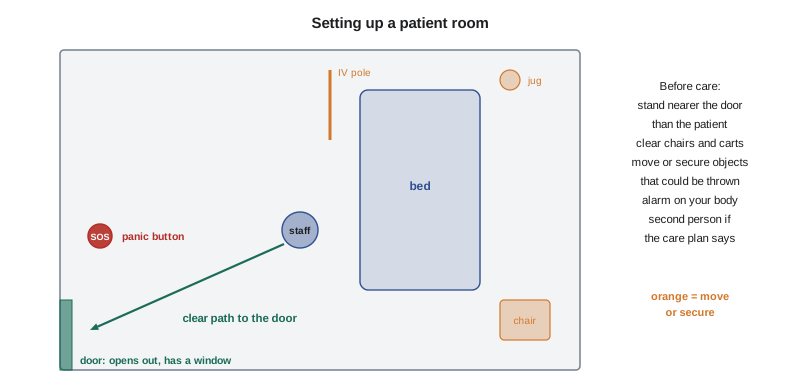
- Position yourself nearer the door than the patient, without blocking the patient's own way out. Never let a potentially violent person get between you and the only exit.
- Keep the path to the door clear: move chairs, carts and equipment out of the way before starting care.
- Leave the door open or ajar when it is safe and private enough, so that colleagues can see and hear.
- Remove or secure objects that could be thrown or used as weapons: heavy items, scissors, sharps, hot drinks, IV poles not in use.
- Know where the panic button is and keep your personal alarm on your body, not in a pocket of your jacket on the chair.
- Bring a second person for care of a flagged patient, as the care plan says.
For interview rooms, family rooms and assessment rooms, design matters more, because staff often meet people there at their most upset. Good practice includes two exits where possible, or a single exit nearest the staff member's seat; doors that open outward and cannot be locked from the inside; a window in the door; furniture that is heavy or fixed to the floor; no loose objects; good lighting; and a panic button within reach of the staff seat.
A ten-second check before going in
Most of these habits can be rolled into a quick mental check before entering the room of a flagged or agitated patient. Northbridge teaches it as four questions, which take about ten seconds and become automatic with practice:
- What do I know? Is there a flag, a recent score, a handover note? What has upset this person before, and what has helped?
- Who knows where I am? Has a colleague been told, or is a second person coming with me?
- How do I get out? Where is the door, and will anything be between me and it?
- How do I get help? Is my alarm on my body and working? Where is the panic button?
If the answer to any question is not good enough, the worker fixes it first: reads the care plan, asks a colleague to come, moves the chair, or swaps a flat alarm for a charged one. The check also works in reverse at the end of care: before leaving, the worker notices anything that changed, such as a new object in the room or a rise in agitation, and passes it on.
Working with security
Security staff are part of the care team in a hospital, not an outside force to be called only when everything else has failed. At Northbridge, security officers attend unit huddles in the emergency department, know which patients are flagged, and are trained in de-escalation and in the hospital's approach to patients with dementia and mental illness. Nurses are encouraged to ask security to stand by, out of sight but close, before a difficult conversation or procedure, rather than waiting for a crisis. Officers who know the staff and the units respond faster and more calmly, and patients are less likely to feel ambushed when security does have to step in.
Designing safer spaces
When Northbridge renovates, it applies the principles of crime prevention through environmental design, often called CPTED, which security and design professionals use to make spaces safer:
- Natural surveillance: staff can see waiting areas, corridors and entrances from where they work; glass partitions and convex mirrors cover blind corners.
- Access control: locked or badge-controlled doors to clinical areas, a single public entrance after hours, and controlled entry to the emergency department.
- Territorial reinforcement: clear signs and layouts that show where the public may and may not go.
- Maintenance: working lights, repaired doors and clean areas, which signal that the space is cared for and watched.
Comfort reduces aggression too. Waiting rooms with enough seating, calm lighting, water, working television, information about wait times and quiet areas for people in distress see fewer incidents than crowded, noisy, uninformative ones. In the emergency department, discussed in Lesson 11, these changes can make a large difference.
Personal habits
Some personal choices make it easier for someone to hurt a worker, or harder for the worker to get away:
- Lanyards and necklaces can be grabbed and used to choke. Use breakaway lanyards or clip-on badges, and avoid necklaces, long earrings and scarves on high-risk units.
- Long hair can be grabbed; tie it back.
- Pens, scissors and keys in breast pockets or around the neck can be snatched. Carry them in a closed pocket or a pouch.
- Name badges with first name and role only are used on some units, so that patients cannot easily find staff outside work.
- Footwear that allows the worker to move quickly and safely.
- Personal alarm worn on the body, tested at the start of each shift.
Getting to and from work
Some of the most serious incidents happen outside the building: in parking lots and garages, at bus stops, or when a former patient or a visitor follows a worker. Northbridge's plan includes:
- Good lighting, cameras and emergency call stations in the parking garage and on walkways.
- A security escort to the parking garage or bus stop on request, at any hour.
- Advice to staff to walk with colleagues at shift change, have keys ready, and look around before getting into the car.
- A clear way for staff to report being followed, threatened or contacted outside work by a patient or visitor, which security then follows up, including with the police where needed.
Personal protective equipment
In a few settings, such as some mental health and dementia units, staff may use items such as bite-resistant sleeves, protective vests or face shields during care of a particular patient with a history of biting or spitting. These are the last line of defense and are used only together with the other controls, never instead of them. They should be chosen with the staff who will wear them, because equipment that is hot, heavy or makes care awkward will not be used.
Worked problem
A safer interview room
The social worker on 3 East meets families in a small room at the end of the corridor. The room has one door, which opens inward; the social worker's chair is by the window, farthest from the door; there is a heavy glass vase of flowers on the table; and the only way to call for help is the phone on the wall by the door. What should change?
Show solution
- Move the furniture so that the social worker's chair is nearest the door and the family sits on the far side, without blocking anyone's way out.
- Remove the glass vase and any other heavy or sharp objects, and secure or replace light chairs that could be thrown.
- Give the social worker a wearable alarm and install a panic button within reach of her chair.
- Ask facilities to rehang the door to open outward and add a window, and to remove the inside lock.
- Agree a procedure: for meetings likely to be difficult, a colleague knows where she is and checks in after 15 minutes.
Answer: Change the layout, remove hazards, provide an alarm that can be reached from her seat, fix the door, and add a check-in for difficult meetings.
Common mistakes
MistakeKeeping the personal alarm in a bag or jacket.
InsteadWear it on your body and test it at the start of each shift.
MistakeInstalling alarms and never testing the response.
InsteadTest devices daily and run timed drills to check that help arrives quickly.
MistakeStanding on the far side of the bed from the door.
InsteadPosition yourself nearer the door, without blocking the patient's way out.
MistakeWearing a solid lanyard on a high-risk unit.
InsteadUse a breakaway lanyard or a clip-on badge.
MistakeRelying on PPE instead of other controls.
InsteadUse PPE only together with alarms, room setup, staffing and care plans.
Summary and key terms
- Every worker needs a reliable way to summon immediate help wherever they work.
- Alarm systems need coverage, a defined response, routine testing, maintenance and drills.
- Timed drills show whether help actually arrives; Northbridge found 4 West too slow and changed its response.
- Position yourself nearer the door, keep the path clear and remove objects that could be used as weapons.
- Interview rooms should have outward-opening doors with windows, fixed furniture and a panic button near the staff seat.
- CPTED principles, comfort and information make public spaces safer.
- Personal habits such as breakaway lanyards and tied-back hair reduce risk.
- Plans must cover parking areas, travel to and from work, and staff being followed or contacted outside work.
- Personal alarm
- A wearable device that sends an alert, often with the worker's location, when activated.
- Panic button
- A fixed button that summons security or other help when pressed.
- Response time
- The time from an alarm to the arrival of the first responder or full team.
- CPTED
- Crime prevention through environmental design: surveillance, access control, territorial reinforcement and maintenance.
- Breakaway lanyard
- A lanyard that comes apart when pulled, so it cannot be used to choke the wearer.
Practice problems
Work each problem on paper first, then reveal the answer to check.
What five things does an alarm system need to work?
Show answer
Coverage everywhere staff work, a defined response, routine testing, maintenance and drills.
What did the Northbridge drills show for 4 West, and what changed?
Show answer
The full team was late in half the drills; 4 West joined the emergency department response zone at night and alarms also alert 4 East.
Where should a worker stand in relation to the door when caring for a potentially violent patient?
Show answer
Nearer the door than the patient, without blocking the patient's own way out.
Name four features of a safer interview room.
Show answer
Any four of: staff seat nearest the exit, outward-opening door with a window, no inside lock, fixed or heavy furniture, no loose objects, a panic button within reach.
What are the four CPTED principles?
Show answer
Natural surveillance, access control, territorial reinforcement and maintenance.
Why are breakaway lanyards used on high-risk units?
Show answer
Because a solid lanyard can be grabbed and used to choke the wearer.
Lesson quiz · 5 questions
Score 60% or more to complete this lesson.
Create a free account to save your progress, take quizzes and earn a certificate.