
HSE-394 · Lesson 6 of 12 · 22 min
Anesthetic gases
▶ Video coming soon A video version of this lesson is on the way.
General anesthesia depends on gases and vapors that are breathed in by the patient: nitrous oxide and the halogenated agents sevoflurane, desflurane and isoflurane. Most of the gas that goes into the patient comes out again, in every breath, and some escapes into the room. The gas that leaks into the operating room, the recovery room, the dental office or the birthing room is called waste anesthetic gas. The people who breathe it receive no benefit, and over years some of them may be harmed. This lesson explains where waste gas comes from, what it can do, the exposure limits, and how scavenging, equipment checks and work practices keep exposure low.
The gases and where they are used
- Nitrous oxide (N2O) is a weak anesthetic usually combined with other agents, and is widely used on its own for pain relief: in dental offices, in labor as a 50:50 mix with oxygen, in emergency departments and for short procedures in children.
- Sevoflurane, desflurane and isoflurane are halogenated agents, liquids that are turned into vapor in a vaporizer on the anesthesia machine. Sevoflurane is the most common, especially for children because it does not irritate the airway; desflurane is used for fast wake-up; isoflurane is the oldest and cheapest of the three.
- Older agents such as halothane and enflurane are rarely used in North American hospitals now but still appear in veterinary and older literature.
Waste gas exposure is not limited to anesthesiologists. It reaches operating room nurses and technicians, recovery room nurses, dental assistants and hygienists, labor and delivery nurses, emergency and endoscopy staff, veterinary staff, and the environmental services and maintenance workers who clean and service the rooms and equipment.
Where the waste gas comes from
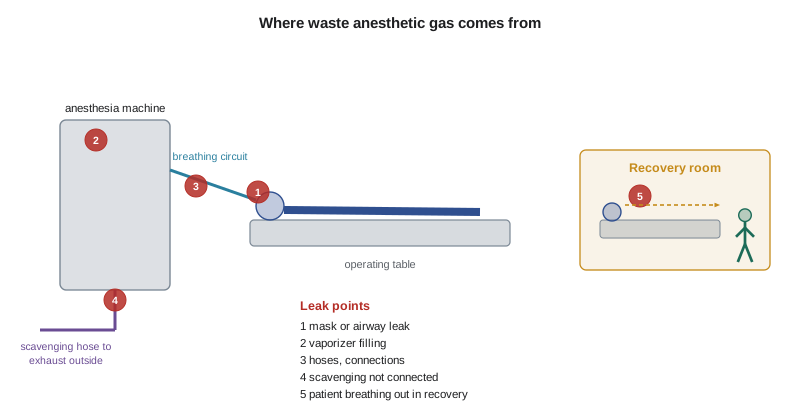
Waste gas escapes in predictable ways. The main sources are:
- Leaks from the patient's breathing circuit, especially around a poorly fitting face mask or an uncuffed airway tube, or when a mask is lifted off the face with the gas still flowing.
- Turning on the gas before the mask is on the patient's face, or leaving it on after the mask is removed.
- Filling vaporizers, when liquid agent can spill or evaporate.
- Leaks in the anesthesia machine, hoses, connectors and seals, which grow as equipment ages.
- A scavenging system that is not connected, not turned on or not working.
- Exhaled breath of patients in the recovery room. A patient continues to breathe out anesthetic for some time after surgery, and the recovery nurse works close to the patient's face.
Health effects
At the levels found in modern, well-run operating rooms, most workers have no symptoms. At higher levels, which still occur in recovery rooms, dental offices without scavenging, and rooms with leaking equipment, workers report headaches, fatigue, irritability, nausea, dizziness and difficulty concentrating.
Longer-term concerns come mainly from studies done before scavenging was common, and from studies of nitrous oxide in dental offices. Nitrous oxide interferes with vitamin B12 and with the body's ability to make DNA, and studies of dental assistants exposed to high levels of unscavenged nitrous oxide found reduced fertility. Older studies of operating room staff found higher rates of miscarriage, which led health agencies to set exposure limits in the 1970s. The evidence for harm at today's lower levels is weaker, but because the effects involve reproduction, the aim is to keep exposure as low as reasonably achievable.
Exposure limits
OSHA has no permissible exposure limit for waste anesthetic gases, but its guidelines for workplace exposures describe the hazards and controls, and OSHA can use the General Duty Clause where exposures are serious. NIOSH recommends a limit of 25 ppm of nitrous oxide averaged over the time the anesthetic is given, and a ceiling of 2 ppm for halogenated agents used alone, or 0.5 ppm when used with nitrous oxide. Hospitals use these recommendations as their working limits.
These limits are low. A single leaking mask can push the concentration at the anesthesiologist's breathing zone above them for minutes at a time. Meeting them depends on scavenging, good equipment and careful technique all working together.
Scavenging and ventilation
A scavenging system collects excess gas from the breathing circuit at the anesthesia machine and carries it away through a dedicated hose to an exhaust outside the building. Without scavenging, every liter of excess gas goes into the room. With scavenging connected and working, the main remaining sources are leaks and the patient's exhaled breath after the circuit is disconnected.
General ventilation then dilutes and removes whatever escapes. Operating rooms are designed with many air changes per hour, and the air is usually not recirculated to other areas. Recovery rooms often have fewer air changes, which is one reason recovery nurses can have higher exposures than operating room staff, even though no anesthetic is given there.
Dental offices and labor rooms need their own controls. For nitrous oxide in dentistry, a scavenging nasal hood with an exhaust flow matched to the gas flow captures most of the exhaled gas; without it, levels in the office can be many times the limit. For labor, demand-valve systems release gas only when the patient breathes in, and the exhaled gas is captured by a scavenging mouthpiece or the room ventilation.
Equipment checks and work practices
- The anesthesia machine is checked at the start of each day and between patients, including a leak test of the breathing circuit.
- The scavenging system is connected and turned on before the gas is.
- The gas is turned on only after the mask is on the patient's face, and turned off before the mask is removed.
- Masks are chosen to fit, and cuffed airway tubes are used when appropriate.
- Vaporizers are filled with key-filling systems that reduce spills, ideally before the patient arrives, and with the room ventilation running.
- At the end of a case, the patient breathes oxygen through the circuit for a short time to wash out gas into the scavenging system before the circuit is disconnected.
- Biomedical engineering services the machines on a set schedule, replacing seals and hoses before they leak.
- Spilled liquid agent is cleaned up promptly with absorbent material, and the room is ventilated.
In the recovery room, practices that reduce exposure include keeping patients on scavenged oxygen delivery until they are awake, positioning the nurse to the side rather than in front of the patient's face when possible, and making sure the room's ventilation is working as designed.
Monitoring at Northbridge
After recovery room nurses at Northbridge reported headaches near the end of busy shifts, Joanne arranged personal air sampling. Each nurse wore a small sampler near the collar for a full shift, and the results were combined into shift averages for sevoflurane, the main agent used.
# Personal air sampling in the recovery room: sevoflurane, in ppm
# each sample: (minutes sampled, average concentration in that period)
shifts = {
    "Nurse A, day": [(120, 0.9), (180, 2.4), (180, 1.1)],
    "Nurse B, day": [(150, 0.6), (150, 1.8), (180, 0.7)],
    "Nurse C, eve": [(240, 0.4), (240, 0.5)],
    "Nurse D, day": [(120, 1.5), (210, 3.1), (150, 1.2)],
}
CEILING = 2.0   # NIOSH ceiling for a halogenated agent used alone

def twa(samples):
    minutes = sum(m for m, _ in samples)
    return sum(m * c for m, c in samples) / minutes

print(f"{'shift':16}{'TWA ppm':>9}{'highest period':>16}")
for name, samples in shifts.items():
    top = max(c for _, c in samples)
    flag = "  over ceiling" if top > CEILING else ""
print(f"{name:16}{twa(samples):9.2f}{top:16.1f}{flag}")shift TWA ppm highest period Nurse A, day 1.54 2.4 over ceiling Nurse B, day 1.01 1.8 Nurse C, eve 0.45 0.5 Nurse D, day 2.11 3.1 over ceiling
The shift averages looked moderate, but two day-shift nurses had periods above the 2 ppm ceiling, both during the late-morning rush when several patients arrived from the operating rooms at once. A ceiling is meant never to be exceeded, so these periods mattered more than the averages. Because the samplers averaged over hours, the true short peaks were probably higher still.
The committee and the anesthesia department found three causes: the recovery room ventilation had been turned down in a building energy-saving project, some patients arrived still breathing out a lot of agent because the oxygen washout at the end of cases had been shortened, and the oxygen masks used in recovery had no scavenging. Restoring the ventilation, a standard washout time and scavenged masks for the first half hour after arrival brought repeat samples well under the ceiling.
Gases and the climate
Anesthetic gases are also powerful greenhouse gases, and desflurane and nitrous oxide are the strongest of them. Many hospitals in Canada and the United States have reduced or stopped using desflurane, reduced nitrous oxide use, and fixed leaks in central nitrous oxide piping, which in some hospitals was found to lose more gas than was ever given to patients. These changes help workers too: less gas used and less gas leaked means less gas to breathe.
Worked problem
The dental clinic in Maple Court
Maple Court has a small dental room where a visiting dental team treats residents, sometimes using nitrous oxide for anxious residents. Lina Santos, who helps residents in and out of the chair, mentions that she often feels light-headed and gets headaches on dental days. What should be checked?
Show solution
- Check whether the nitrous oxide unit has a scavenging nasal hood, and whether the hood and its exhaust are connected and working; a hood without suction does nothing.
- Check the room: it is a small converted office with one supply vent and no exhaust. Without good ventilation, any leaked gas stays in the room.
- Check practice: whether the gas is turned on only after the hood is in place, and whether residents are given oxygen at the end to wash out the gas.
- Arrange short-term air sampling for nitrous oxide during a dental session, at Lina's and the dentist's breathing zones.
- Until the problem is fixed, limit nitrous oxide use, and allow Lina to step out of the room while the gas is flowing; she is not needed at the chair once the resident is settled.
Answer: Likely causes are missing or ineffective scavenging and poor ventilation; check equipment, room and practice, measure the exposure, and fix the controls before relying on distance.
A waste gas program
One round of sampling answers one question at one time. A hospital that uses anesthetic gases every day needs an ongoing program, and Northbridge's now has five parts.
- A written policy, agreed by anesthesia, nursing, biomedical engineering, facilities and the safety committee, that names who is responsible for each control.
- Equipment care: daily machine checks recorded by the anesthesia team, scheduled preventive maintenance and leak testing by biomedical engineering, and a yearly check by facilities that the scavenging exhaust and the room ventilation in every operating room, recovery room and procedure room meet their design values.
- Monitoring: personal or area sampling in a sample of rooms each year, after any change in equipment, ventilation or agents, and whenever staff report symptoms. Results are posted for staff and reviewed by the committee.
- Training: every new operating room, recovery, dental and labor worker learns where waste gas comes from and what practices reduce it, and anesthesia staff review technique, such as mask fit and washout, at departmental meetings.
- Health concerns and pregnancy: staff with symptoms report them to the Employee Health and Safety office. Workers who are pregnant or planning a pregnancy can discuss their exposure in confidence; where monitoring shows good control, most can continue their usual work, and the policy allows a change of duties on request.
The program is cheap compared with its benefits. The most expensive change in the first year was restoring the recovery room ventilation, and even that was a matter of resetting controls that had been changed without anyone asking what the room was used for. The lesson the committee drew was broader: any change to the ventilation of a clinical area should be reviewed by someone who knows what hazards the ventilation is there to control.
Common mistakes
MistakeTurning on the gas before the mask is on the patient.
InsteadTurn on the gas only after the mask is on, and off before it comes off.
MistakeAssuming recovery room staff are not exposed because no anesthetic is given there.
InsteadRemember patients breathe out anesthetic for some time after surgery.
MistakeUsing nitrous oxide in a dental room without a working scavenging hood.
InsteadUse scavenging matched to the gas flow, and good room ventilation.
MistakeJudging exposure only by shift averages.
InsteadCheck peaks against ceiling limits for halogenated agents.
MistakeFilling vaporizers during a case with the room ventilation turned down.
InsteadFill with key-filling systems before the case, with ventilation running.
Summary and key terms
- Waste anesthetic gas is gas that escapes from patients and equipment into the room.
- It comes from mask leaks, gas turned on too early, vaporizer filling, equipment leaks, scavenging failures and patients breathing out in recovery.
- High exposures cause headaches and fatigue; nitrous oxide at high levels can harm fertility.
- NIOSH recommends 25 ppm for nitrous oxide and a 2 ppm ceiling for halogenated agents alone.
- Scavenging, ventilation, equipment checks and careful technique keep exposure low.
- Recovery rooms, dental offices and labor rooms need specific attention.
- Reducing anesthetic gas use and leaks helps both workers and the climate.
- Waste anesthetic gas
- Anesthetic gas or vapor that escapes into the work area.
- Halogenated agent
- An anesthetic vapor such as sevoflurane, desflurane or isoflurane.
- Scavenging system
- Equipment that collects excess anesthetic gas and carries it to an outside exhaust.
- Vaporizer
- The device on an anesthesia machine that turns liquid anesthetic into vapor.
- Washout
- Breathing oxygen at the end of a case to clear anesthetic gas into the scavenging system.
- Personal air sampling
- Measuring a chemical in the air of a worker's breathing zone with a sampler worn during work.
Practice problems
Work each problem on paper first, then reveal the answer to check.
Name four sources of waste anesthetic gas.
Show answer
Any four of mask leaks, gas on before the mask, vaporizer filling, equipment leaks, scavenging failure, exhaled breath in recovery.
Why can recovery nurses have higher exposures than operating room staff?
Show answer
Patients breathe out anesthetic, nurses work close to their faces, and recovery rooms often have less ventilation and no scavenging.
What does NIOSH recommend for halogenated agents used alone?
Show answer
A ceiling of 2 ppm.
What three causes did Northbridge find for the recovery room exposures?
Show answer
Reduced ventilation, shortened washout at the end of cases, and unscavenged oxygen masks.
What health effect has been found in dental assistants exposed to high levels of nitrous oxide?
Show answer
Reduced fertility.
Why are hospitals reducing desflurane use?
Show answer
It is a powerful greenhouse gas, and less use also means less exposure.
Lesson quiz · 5 questions
Score 60% or more to complete this lesson.
Create a free account to save your progress, take quizzes and earn a certificate.