
ITIL-101 · Lesson 8 of 12 · 29 min
Choosing a path by role
The ITIL scheme offers many possible routes, and the right one depends on who you are, what you do now and where you want to go. A service desk analyst, a change manager, a product owner, a chief information officer and a consultant would each benefit from different modules, and some would benefit more from a different certification altogether. This lesson provides a method for choosing a certification path: start from your role and goals, map them to designations and modules, consider alternatives and complements outside ITIL, and estimate the time, cost and expected return. It works through examples for common roles in Canada and the United States, using approximate costs at the time of writing (October 2026). The aim is not to prescribe a single answer but to help you reason about your own situation.
A four-step method
Choosing a path works well as a short, structured exercise.
- Step 1, describe your role and goal: what you do now, the role you want in two to five years, and what employers in that role ask for.
- Step 2, map to the scheme: identify which designation, if any, fits the goal, and which modules it needs given what you already hold.
- Step 3, consider alternatives and complements: check whether another certification (such as a project management, agile, security or cloud credential) would serve the goal better or alongside ITIL.
- Step 4, estimate time, cost and return: add up study hours, fees and expected benefits, and decide on order and pace.
Job postings are a good source for step 1. Search for your target role in your city or region and note how often ITIL is mentioned, at what level, and alongside which other credentials.
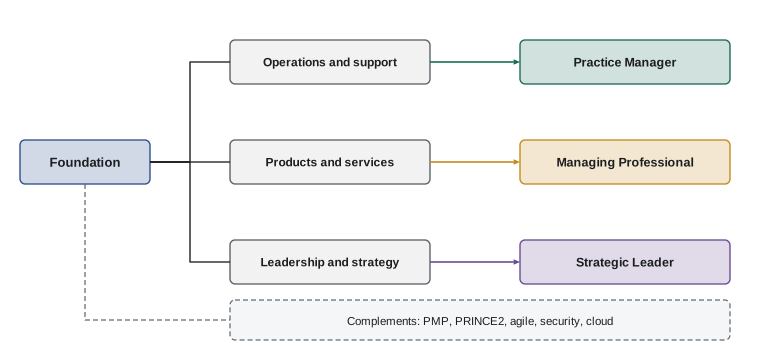
Paths for operations and support roles
Service desk analysts, technical support staff and operations engineers usually benefit most from Foundation, which gives a shared vocabulary and an understanding of how their work fits into the bigger picture. Team leaders and managers of operational practices, such as incident, problem, request or monitoring, are the main audience for the Practice Manager designation, particularly the Monitor, Support and Fulfill specialization. For many analysts, Foundation is enough for several years; the next step comes with a move into a lead or manager role.
Paths for change, release and configuration roles
Change managers, release managers, configuration managers and people in IT governance roles fit the Plan, Implement and Control specialization toward Practice Manager. In regulated industries such as banking, insurance, health care and government, where change control and audit matter, this path can be especially valued. Complements include IT audit or governance credentials.
Paths for product and service management roles
Service owners, product owners and managers, and IT managers responsible for delivering digital products and services fit the Managing Professional designation. Because it requires four modules after Foundation, it is a significant commitment, typically spread over a year or more. Complements include product management and agile certifications.
Paths for leaders and strategists
Senior IT leaders, enterprise architects and management consultants fit the Strategic Leader designation, which requires only two modules after Foundation. For leaders, the value lies less in the certificate and more in a shared language with teams and in structured thinking about strategy and transformation. Leaders often combine Strategic Leader with business or executive education.
Paths for consultants and trainers
Consultants who advise organizations on IT service management often pursue several designations, sometimes up to ITIL Master, because breadth of certification signals expertise to clients. Those who want to train others must also meet PeopleCert's trainer accreditation requirements, which typically include holding the relevant certificate and passing trainer assessments.
| Role | Suggested ITIL path | Possible complements |
|---|---|---|
| Service desk analyst | Foundation | Vendor or technical certifications |
| Incident or problem manager | Foundation, PM (Monitor, Support and Fulfill) | Problem-solving or Lean training |
| Change or release manager | Foundation, PM (Plan, Implement and Control) | IT audit or governance credentials |
| Service or product owner | Foundation, Managing Professional | Agile or product management |
| IT director or CIO | Foundation, Strategic Leader | Executive or business education |
| Project manager in IT | Foundation | PMP or PRINCE2 |
| Security professional | Foundation (optional) | CISSP or other security credentials |
When ITIL is not the main answer
For some roles, ITIL is useful but not central. Project managers usually gain more from PMP or PRINCE2, with ITIL Foundation as a helpful complement when they work on IT service projects. Security professionals typically prioritize security credentials such as CISSP, though ITIL helps them work with operations teams. Software developers in DevOps teams may prefer cloud or DevOps credentials. A clear-eyed look at your target role prevents spending heavily on an advanced ITIL designation that employers in your field do not value.
Estimating time and cost
Rough estimates help decide order and pace. At the time of writing, Foundation self-study bundles were reported at roughly US$536, with accredited Foundation courses ranging from roughly US$1,000 to US$2,000 or the Canadian equivalent. Advanced modules with mandatory training typically cost more per module, often in the range of one to three thousand dollars each depending on provider and format. These figures are illustrative; check current prices from PeopleCert and accredited training organizations in your currency.
Worked problem
Comparing two paths
Jordan, an incident manager in Toronto, holds ITIL 4 Foundation. He is considering (a) Practice Manager via Monitor, Support and Fulfill plus Transformation, or (b) Managing Professional via Product, Service, Experience and Transformation. Assume each advanced module costs about CA$2,500 including training and exam, and requires about 40 hours of training and study. Compare the paths.
Show solution
- Path (a): 2 modules × CA$2,500 = CA$5,000; 2 × 40 = 80 hours.
- Path (b): 4 modules × CA$2,500 = CA$10,000; 4 × 40 = 160 hours.
- Path (a) matches his current role and a next step to a practice lead or operations manager.
- Path (b) suits a move to service ownership; it costs twice as much and takes twice as long.
- Because Transformation is shared, choosing (a) first and (b) later would add only 3 more modules (CA$7,500, 120 hours).
Answer: Path (a) is cheaper and fits his current role; if he later moves into service ownership, he can add Managing Professional with three more modules.
Estimating return on investment
Return on investment combines costs with expected benefits, such as a salary increase, a promotion, a new job or reduced time to competence. The benefits are uncertain, so it helps to think in terms of expected value and payback period.
Worked problem
ROI and payback period
A service desk team lead in Ohio estimates that Practice Manager (two modules) will cost US$4,000 and 80 hours. She estimates a 40 % chance that it helps her win a promotion worth US$7,000 a year within a year. What is the expected first-year benefit and the payback period if the promotion happens?
Show solution
- Expected first-year benefit: 0.40 × US$7,000 = US$2,800.
- This is less than the US$4,000 cost in year one, so the expected first-year return is negative: US$2,800 − US$4,000 = −US$1,200.
- If the promotion happens, the payback period is US$4,000 ÷ US$7,000 per year ≈ 0.57 years, about 7 months.
- Over three years, the expected benefit is 0.40 × US$21,000 = US$8,400, about twice the cost.
- If her employer pays, her personal cost is only the 80 hours, making the decision much easier.
Answer: The expected first-year value is about US$2,800 against a US$4,000 cost, but over three years it is about US$8,400; employer sponsorship changes the picture entirely.
Such estimates are rough, and the probability is a judgment. Their value is in making assumptions explicit and in comparing options consistently.
Talking to your employer
Many employers pay for ITIL training, especially when it supports the organization's service management goals. A short proposal improves your chances: explain how the module relates to your role, what you will apply at work, the cost and schedule, and how you will share what you learn with your team. Ask about any obligation to stay with the employer for a period after the training.
Paths for people changing careers
Career changers, such as people moving from customer service, administration, teaching or the military into IT, often ask whether ITIL Foundation helps. It can, especially for service desk and support roles, because it shows an understanding of how IT services are organized and uses language that hiring managers recognize. It is not a substitute for technical skills or experience, though. A sensible plan pairs Foundation with an entry-level technical credential or practical experience, such as volunteering for IT support at a community organization, and emphasizes transferable skills such as handling customers and following procedures.
Paths for students and recent graduates
Students in IT, business or engineering programs sometimes take Foundation before graduating to stand out in job applications. The cost is modest compared with advanced modules, and the vocabulary helps in internships. However, advanced modules usually make more sense after a few years of work, when you can relate the material to experience and when an employer may pay. For students, Foundation plus one or two practical projects is often the best combination.
Paths for people in non-IT functions
ITIL Version 5's broader focus on digital products and services across organizations means that people outside IT, such as human resources, facilities or finance teams that run digital services, may also benefit. For them, Foundation provides a common language for working with IT, and the Experience module may be relevant to those responsible for employee or customer experience. Before pursuing advanced modules, such candidates should check whether their organization recognizes ITIL outside IT.
Revisiting your path each year
Roles and goals change, and so does the scheme. Revisit your path once a year: check whether your target role is still the same, whether the modules you planned still exist in the same form, whether your employer's priorities have shifted and whether a different credential has become more valuable. Adjusting your path is a sign of good planning, not failure.
| Situation | Sensible first step |
|---|---|
| Career changer into support | Foundation plus an entry-level technical credential |
| Student | Foundation plus practical projects |
| Non-IT digital service owner | Foundation, then consider Experience |
| Experienced manager new to ITIL | Foundation, then the designation that fits the role |
A worked example: reading job postings
Worked problem
Counting credentials in postings
Farah wants to become a service delivery manager in Montreal. She reviews 20 recent job postings and counts: ITIL Foundation mentioned in 14, ITIL Managing Professional or higher in 3, PMP in 6, an agile credential in 5, and bilingual French and English required in 16. What should she conclude?
Show solution
- ITIL Foundation appears in 14 of 20, or 70 %, so it is clearly valued.
- Higher ITIL designations appear in only 3 of 20, or 15 %, so they are a differentiator rather than a requirement.
- PMP appears in 30 % and agile in 25 %, suggesting project and agile skills also matter.
- Bilingualism appears in 80 %, more than any certification, so language skills may matter most.
Answer: Foundation is a near-requirement; higher ITIL designations and PMP or agile credentials are useful extras; and strengthening bilingual skills may give the best return of all.
This kind of quick count is often more informative than general advice, because it reflects the actual market where you want to work.
Weighing time as well as money
Many path decisions turn on time rather than money, especially when an employer pays. Eighty hours of study for two modules is about two working weeks. Ask what else you could do with that time: a technical course, a project at work, or rest. A certification is worthwhile when it is the best use of your limited learning time, not merely when someone else pays the fee.
Discussing your path with a mentor
A mentor who already works in your target role can test your thinking quickly. Ask which credentials helped them, which they would skip, and what experience mattered most. Their answers reflect one career only, but combined with job-posting research they give a realistic picture of what employers value in your field and region.
Common mistakes
MistakeChoosing a designation because it sounds senior.
InsteadMatch the path to your role and goal.
MistakeIgnoring certifications outside ITIL.
InsteadCheck whether PMP, PRINCE2, CISSP or others fit better.
MistakeForgetting that Transformation is shared.
InsteadAccount for shared modules when sequencing designations.
MistakeTreating uncertain benefits as certain.
InsteadUse probabilities and payback periods.
MistakePaying yourself without asking.
InsteadPropose employer sponsorship first.
Summary and key terms
- Choose a path by role, goal, alternatives and cost.
- Operations and support roles fit Foundation and Practice Manager.
- Change and release roles fit the Plan, Implement and Control specialization.
- Product and service owners fit Managing Professional.
- Leaders fit Strategic Leader; consultants may aim for Master.
- For some roles, other certifications are more central.
- Estimate return with expected value and payback period.
- Certification path
- Planned sequence of certifications.
- Target role
- The role you aim to reach.
- Complementary credential
- Certification that adds to ITIL.
- Expected value
- Probability times benefit.
- Payback period
- Time for benefits to repay costs.
- Return on investment
- Benefit relative to cost.
- Employer sponsorship
- Employer paying for training.
- Trainer accreditation
- Approval to deliver accredited training.
- Job posting analysis
- Reviewing postings for required credentials.
- Regulated industry
- Sector with strong compliance requirements.
Practice problems
Work each problem on paper first, then reveal the answer to check.
Name the four steps of the method.
Show answer
Role and goal, map to scheme, alternatives, time-cost-return.
Which path suits an incident manager?
Show answer
Practice Manager via Monitor, Support and Fulfill.
Which path suits a change manager?
Show answer
Practice Manager via Plan, Implement and Control.
Which path suits a service owner?
Show answer
Managing Professional.
Which path suits a CIO?
Show answer
Strategic Leader.
What is often more central than ITIL for project managers?
Show answer
PMP or PRINCE2.
Compute 0.4 × 7,000.
Show answer
2,800.
Compute payback for 4,000 cost and 7,000 per year.
Show answer
About 0.57 years.
How many more modules does PM need after MP?
Show answer
One specialization.
What should an employer proposal include?
Show answer
Relevance, application, cost, schedule, sharing.
Lesson quiz · 5 questions
Score 60% or more to complete this lesson.
Create a free account to save your progress, take quizzes and earn a certificate.