
ITIL-120 · Lesson 4 of 12 · 30 min
Progress iteratively with feedback
Large changes delivered in one piece are risky. By the time they arrive, needs may have changed, problems may have been built in from the start, and the investment may be too large to abandon even when it is clearly failing. The third guiding principle offers an alternative: break work into smaller pieces that can be completed in a short time, deliver each one, gather feedback and use it to steer the next. This lesson explains how iteration and feedback work together, how to size iterations, how to design useful feedback loops and how to avoid the trap of iterating without learning.
What the principle asks
Progress iteratively with feedback means: resist the temptation to do everything at once. Even huge initiatives must be accomplished iteratively. Organizing work into smaller, manageable sections that can be executed and completed in a timely manner keeps the focus sharper on each effort. Feedback before, during and after each iteration ensures that actions are focused and appropriate, even when circumstances change.
Applying the principle involves:
- Comprehending the whole, but doing something: understanding the overall goal without waiting for a perfect plan before starting.
- Recognizing that the ecosystem is constantly changing, so feedback is essential to stay on course.
- Understanding that fast does not mean incomplete: each iteration should deliver something usable.
- Designing feedback loops so that information returns quickly to the people who can act on it.
Iterations and feedback loops
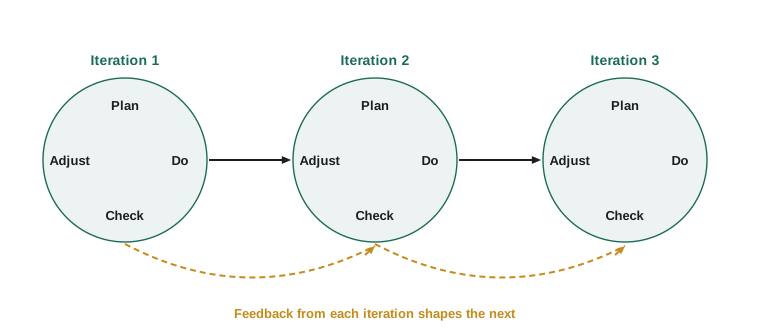
An iteration is a set of activities designed to produce a specific, valuable result in a fixed period. Iterations can exist at many levels. A whole program can be broken into phases; each phase into releases; each release into sprints or work items. At each level, the pattern is the same: plan a little, do it, check the result and adjust.
A feedback loop is a situation in which part of the output of an activity is used as new input. Feedback can come from consumers (do they find the change useful?), from operations (does it run reliably?), from data (did the measure move?) and from the team itself (what slowed us down?). The shorter the loop, the sooner the organization learns and the cheaper it is to correct mistakes.
Why iteration reduces risk
Iteration reduces risk in several ways. Problems are found earlier, when they are cheaper to fix. Value is delivered sooner, so the organization benefits even if later iterations are canceled. Plans can change as understanding improves, rather than being locked in at the start. And the organization can stop an initiative that is not working after a small investment rather than a large one.
Worked problem
Value delivered sooner
A self-service portal will save $10,000 a month when complete. A big-bang plan delivers everything at the end of month 6. An iterative plan delivers 40 % of the savings at the end of month 2, 70 % at month 4 and 100 % at month 6. Compare the savings achieved in the first 6 months.
Show solution
- Big bang: no savings until the end of month 6, so 0 within the first 6 months.
- Iterative: months 3 and 4 at 40 % = 2 × $4,000 = $8,000.
- Months 5 and 6 at 70 % = 2 × $7,000 = $14,000.
- Total iterative savings in 6 months: $8,000 + $14,000 = $22,000.
Answer: The iterative plan delivers about $22,000 of savings in the first six months, against none for the big-bang plan, and gives two chances to adjust course.
How big should an iteration be?
There is no single answer. Iterations should be large enough to produce something useful and small enough that feedback arrives while it can still shape the next step. Factors to weigh include the cost of each release (if every release needs lengthy testing, very small iterations may be uneconomic), the pace at which the environment changes, and how quickly consumers can give meaningful feedback.
| Factor | Pushes toward smaller iterations | Pushes toward larger iterations |
|---|---|---|
| Uncertainty about needs | High uncertainty | Well-understood needs |
| Cost of each release | Low, highly automated | High, manual testing and approval |
| Rate of environmental change | Fast-changing | Stable |
| Risk of each change | High risk, so limit exposure | Low risk |
| Consumer availability for feedback | Readily available | Available only occasionally |
Prioritizing what goes into each iteration
If work is delivered in pieces, the order matters. A common technique is to prioritize by value relative to effort, or by Weighted Shortest Job First (WSJF), a method from the Scaled Agile Framework. WSJF divides the cost of delay of each item by its job size, so items that deliver much value quickly come first.
Worked problem
WSJF prioritization
A team scores four backlog items. Cost of delay is the sum of business value, time criticality and risk reduction, each on a 1–10 scale; job size is also scored 1–10. Item A: value 8, time 5, risk 3, size 8. Item B: value 5, time 8, risk 2, size 3. Item C: value 3, time 2, risk 8, size 2. Item D: value 9, time 3, risk 3, size 10. Rank them by WSJF.
Show solution
- Cost of delay: A = 8 + 5 + 3 = 16; B = 5 + 8 + 2 = 15; C = 3 + 2 + 8 = 13; D = 9 + 3 + 3 = 15.
- WSJF = cost of delay ÷ job size: A = 16 ÷ 8 = 2.0; B = 15 ÷ 3 = 5.0; C = 13 ÷ 2 = 6.5; D = 15 ÷ 10 = 1.5.
- Rank by highest WSJF: C (6.5), B (5.0), A (2.0), D (1.5).
- Item D has the highest business value but comes last because it is large; it may be worth splitting into smaller pieces.
Answer: Order: C, B, A, D. Splitting D would let part of its value be delivered sooner.
The formula is \( \text{WSJF} = \dfrac{\text{cost of delay}}{\text{job size}} \). It is a heuristic, not a law: scores are judgments, and the method works best when the people scoring discuss and agree on them.
Designing good feedback
Feedback is only useful if it is timely, relevant and acted on. Some practical guidelines:
- Decide before each iteration what feedback you will collect and how you will judge success.
- Collect feedback from the people affected, not only from those who requested the work.
- Shorten the delay between action and feedback; a monthly report is too slow for a weekly iteration.
- Make sure feedback reaches the people who can act on it, and that they have the authority to change course.
- Close the loop: tell those who gave feedback what was done with it, so they keep giving it.
Worked problem
Measuring an iteration against a target
A team aims to cut average time to resolve password incidents from 45 minutes to 15 minutes over three iterations. After iteration 1 the average is 33 minutes; after iteration 2 it is 24 minutes. What share of the target improvement has been achieved, and is the team on track?
Show solution
- Target improvement: 45 − 15 = 30 minutes.
- Achieved after iteration 2: 45 − 24 = 21 minutes.
- Share achieved: 21 ÷ 30 = 70 %.
- To reach the target in iteration 3, the team needs a further 9-minute reduction. Iterations so far gave 12 and 9 minutes, so the pace is slowing; feedback should check whether a new approach, such as self-service, is needed.
Answer: About 70 % of the target improvement is achieved. The team may reach it, but the slowing gains are a signal to review the approach.
Iterating without learning
Iteration is not valuable in itself. A team that runs two-week sprints but never reviews the results, never changes direction and never talks to consumers is merely dividing work into chunks. The value comes from the feedback. Typical signs of trouble include retrospectives that produce the same actions every time, feedback collected but never read, and plans that never change despite new information.
There is also an opposite trap: changing direction so often that nothing is completed. The principle says "fast does not mean incomplete". Each iteration should finish something usable before the next begins, so that value accumulates.
Links to Agile, DevOps and Lean
This principle is closely aligned with Agile methods, such as Scrum, which deliver work in short sprints with reviews and retrospectives; with DevOps, which uses automation and monitoring to shorten feedback loops from production; and with Lean, which emphasizes small batch sizes and rapid learning. The continual improvement model in lesson 11 is itself iterative: each improvement is one turn of a loop that the organization repeats over time.
Iteration in operations, not only projects
The principle is often associated with software development, but it applies just as well to operational work. A service desk can introduce a new knowledge article format for one category of incidents, check whether first-contact resolution improves, and then extend it. A change management team can trial delegated approval for one type of low-risk change for a month before widening it. A supplier relationship can be improved through quarterly reviews, each agreeing one or two improvements rather than renegotiating everything at once.
In each case the pattern is the same: a small, reversible step, a clear measure of success decided in advance, a short period of operation and a review that decides whether to continue, adjust or stop. Small operational experiments like these carry little risk, build confidence and generate evidence that makes larger decisions easier.
Worked problem
Limiting exposure with a pilot
A new automated triage rule is expected to route incidents correctly 90 % of the time, but there is a risk it routes only 70 % correctly. The desk receives 8,000 incidents a month, and each misrouted incident costs about 25 minutes of rework. Compare the worst-case monthly rework if the rule is rolled out to all incidents with a pilot on 10 % of incidents.
Show solution
- Full rollout, worst case: 30 % of 8,000 = 2,400 misrouted incidents; 2,400 × 25 = 60,000 minutes, or 1,000 hours.
- Pilot, worst case: 10 % of 8,000 = 800 incidents; 30 % misrouted = 240; 240 × 25 = 6,000 minutes, or 100 hours.
- The pilot limits worst-case rework to one tenth while still producing evidence about real accuracy.
Answer: A 10 % pilot limits worst-case rework to about 100 hours a month, against 1,000 hours for a full rollout, while still testing the rule on real work.
Common mistakes
MistakeWaiting for a complete plan before doing anything.
InsteadUnderstand the whole, then start with a small, useful piece of work.
MistakeTreating iterations as a way to deliver incomplete work quickly.
InsteadMake each iteration deliver something usable; fast does not mean incomplete.
MistakeCollecting feedback that nobody acts on.
InsteadRoute feedback to people who can act and close the loop with those who gave it.
MistakePrioritizing only by business value.
InsteadWeigh value against effort or job size, for example with WSJF.
MistakeChanging direction every iteration so nothing is finished.
InsteadComplete each iteration's goal, then adjust using what was learned.
Summary and key terms
- Break work into smaller pieces that can be completed and evaluated in a short time.
- Feedback before, during and after each iteration keeps work focused even as circumstances change.
- Iteration reduces risk, delivers value sooner and allows failing work to be stopped early.
- Iteration size depends on uncertainty, release cost, rate of change, risk and feedback availability.
- Prioritization methods such as WSJF order work by value relative to size.
- Good feedback is timely, relevant, reaches people who can act and is acknowledged.
- Iterating without learning, or changing direction constantly, defeats the purpose.
- Iteration
- A set of activities designed to produce a specific, valuable result in a fixed period.
- Feedback loop
- A situation in which part of the output of an activity is used as new input.
- Big-bang delivery
- Delivering an entire change at once at the end of a project.
- Backlog
- An ordered list of work items waiting to be done.
- Cost of delay
- The value lost by delaying delivery of an item.
- WSJF
- Weighted Shortest Job First; priority calculated as cost of delay divided by job size.
- Retrospective
- A team review at the end of an iteration to identify improvements to how it works.
- Minimum viable product
- The smallest version of a product that delivers value and allows learning.
- Batch size
- The amount of work moved through a process at one time.
- Close the loop
- Telling those who gave feedback what action was taken.
Practice problems
Work each problem on paper first, then reveal the answer to check.
What does "comprehend the whole, but do something" mean?
Show answer
Understand the overall goal, but start delivering rather than waiting for a perfect plan.
Give three ways iteration reduces risk.
Show answer
Problems are found earlier; value arrives sooner; failing work can be stopped after a small investment.
What does "fast does not mean incomplete" mean?
Show answer
Each iteration should deliver something usable, not half-finished work.
Calculate WSJF for an item with cost of delay 18 and job size 6.
Show answer
18 ÷ 6 = 3.0.
Why might a high-value item rank low on WSJF?
Show answer
Because it is large; splitting it can deliver value sooner.
Name two factors that push toward smaller iterations.
Show answer
High uncertainty and low release cost.
A target is to cut 60 minutes to 20 minutes; current is 36 minutes. What share is achieved?
Show answer
(60 − 36) ÷ 40 = 60 %.
What is a sign of iterating without learning?
Show answer
Retrospectives that produce the same actions each time, or plans that never change.
Why close the feedback loop?
Show answer
So people know their feedback mattered and continue to give it.
Which practice areas outside ITIL share this principle?
Show answer
Agile, DevOps and Lean.
Lesson quiz · 5 questions
Score 60% or more to complete this lesson.
Create a free account to save your progress, take quizzes and earn a certificate.