
LES-111 · Lesson 6 of 12 · 19 min
Seizures of persons: stops, detentions and arrests
▶ Video coming soon A video version of this lesson is on the way.
Desjardins asks Marco DiSanto to stand at the front of the room, then walks up to him and says, in a friendly voice, 'Hey, how's it going? Live around here?' He asks the class whether Marco is detained. Most say no. Desjardins steps closer, puts a hand on his duty belt and says, 'I need to see some ID.' Most now say yes. He then asks the harder question: at what exact moment did the conversation become a detention, and what changed? The answer matters because the moment a person is seized, the Fourth Amendment requires that the seizure be reasonable, which usually means the officer needs reasonable suspicion or probable cause.
When is a person seized?
In United States v. Mendenhall in 1980, the Supreme Court said a person is seized when, in view of all the circumstances, a reasonable person would have believed they were not free to leave. In Florida v. Bostick in 1991, it refined the test for places like a bus where leaving is not practical: the question is whether a reasonable person would feel free to decline the officers' requests or otherwise terminate the encounter. A seizure can also happen through physical force; in Torres v. Madrid in 2021 the Court held that shooting a person who kept driving was a seizure even though she got away. And when police stop a car, both the driver and the passengers are seized, as Brendlin v. California held in 2007.
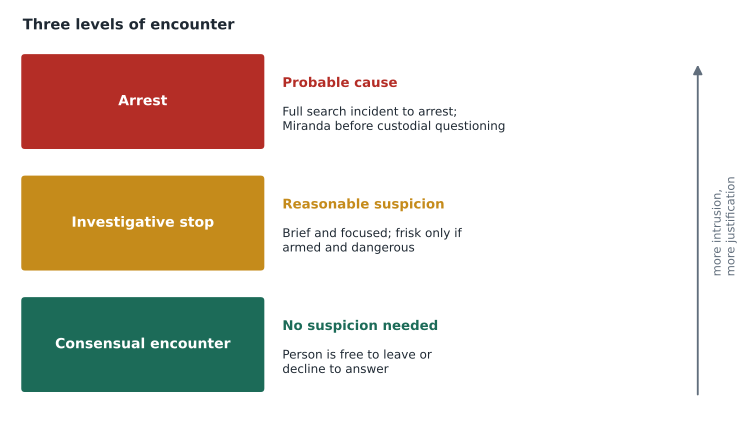
Courts treat several types of encounter differently. A consensual encounter, in which officers ask questions of a person who is free to leave, is not a seizure and needs no justification. An investigative stop, often called a Terry stop, is a brief seizure that requires reasonable suspicion. An arrest is a full seizure that requires probable cause. The same encounter can move through all three, and officers must be able to say which one they were in at each moment.
Investigative stops and reasonable suspicion
Terry v. Ohio allows an officer to stop a person briefly when the officer has reasonable suspicion, based on specific and articulable facts, that criminal activity is afoot, and to frisk the person's outer clothing for weapons if the officer reasonably believes they are armed and dangerous. Reasonable suspicion is less than probable cause, but more than a hunch. Courts look at the totality of the circumstances. In Illinois v. Wardlow in 2000, the Court held that unprovoked flight on seeing police in a high-crime area could support reasonable suspicion. In Navarette v. California in 2014, it held that a detailed 911 call reporting a vehicle running a caller off the road was reliable enough to justify a stop. And in Kansas v. Glover in 2020, it held that an officer could stop a car on the inference that the registered owner, whose license was revoked, was driving.
The scope and length of a stop matter as much as its start. In Rodriguez v. United States in 2015, the Court held that police may not extend a completed traffic stop, even briefly, to conduct a dog sniff without reasonable suspicion of another crime. The tolerable duration of a stop is determined by its mission: addressing the traffic violation and attending to related safety concerns. Desjardins tells the class that the best protection is to know the purpose of the stop, pursue it diligently, and end the stop when it is done unless new facts give new grounds.
In Ontario, a person who is not driving is generally not required to identify themselves to police during an investigative detention, although drivers must produce a license and documents under the Highway Traffic Act. Ontario's street check regulation, O. Reg. 58/16, which took effect in 2017, restricts officers from collecting identifying information in arbitrary or discriminatory ways and requires officers to tell people that they do not have to provide information and why it is being sought, in situations covered by the rule. Desjardins notes the irony that the US class lives under a stricter identification rule than the Canadian class.
Arrest
An officer may arrest a person in public without a warrant on probable cause that the person committed a felony, or a misdemeanor committed in the officer's presence, with state law adding other situations; in Ohio the main warrantless arrest authority is Revised Code 2935.03. In Atwater v. City of Lago Vista in 2001, the Supreme Court held that the Fourth Amendment allows a custodial arrest even for a minor offense punishable only by a fine, such as a seatbelt violation. In Whren v. United States in 1996, it held that an officer's subjective motive does not make a stop unreasonable if there was probable cause for a traffic violation, so pretext stops are lawful under the Fourth Amendment, though they may raise equal protection concerns covered in Lesson 10. Entering a home to arrest requires a warrant unless there is consent or an exigency.
Amara Okafor asks why an officer would choose not to arrest when the law allows it. Desjardins answers with numbers from his own career: every arrest takes an officer off the street for hours, exposes the person to the stress and risks of custody, and can cost them a job even if the charge is later dropped. Many agencies, and Ohio law for minor misdemeanors under Revised Code 2935.26, require citation rather than arrest in many situations. Arrest is a tool, not a reflex, and the fact that an arrest would be lawful does not mean it is wise.
Telling people why they are stopped
The federal Constitution does not require officers to explain a stop at its start, and the Miranda warnings apply only to custodial interrogation, covered in Lesson 7. But the Sixth Amendment guarantees notice of the charge once proceedings begin, many state laws and agency policies require officers to tell people why they are stopped or arrested, and procedural justice research shows that explaining the reason is one of the most effective ways to gain cooperation. In Ohio, Revised Code 2935.07 requires an officer making an arrest without a warrant to inform the person of the cause of the arrest, unless the person is taken while committing the crime or in flight.
Measuring detention practice in Port Ardent
Haddad reviews 200 investigative detentions from the past quarter, recorded on the service's detention form. For each, she checks whether the officer wrote down specific facts supporting the suspicion and how long the detention lasted. The program summarizes the records and flags long detentions without recorded grounds, the cases most likely to be found arbitrary.
# 200 Port Ardent investigative detentions: (grounds recorded?, minutes) grouped into counts
records = [
    # (grounds recorded, duration band in minutes, count)
    (True, "under 10", 96), (True, "10 to 20", 41), (True, "over 20", 13),
    (False, "under 10", 27), (False, "10 to 20", 15), (False, "over 20", 8),
]
total = sum(r[2] for r in records)
with_grounds = sum(r[2] for r in records if r[0])
print("detentions reviewed:", total)
print("with specific grounds recorded:", with_grounds, round(with_grounds / total, 2))
long_no_grounds = sum(r[2] for r in records if not r[0] and r[1] == "over 20")
long_all = sum(r[2] for r in records if r[1] == "over 20")
print("over 20 minutes:", long_all, "of which no grounds recorded:", long_no_grounds)detentions reviewed: 200 with specific grounds recorded: 150 0.75 over 20 minutes: 21 of which no grounds recorded: 8
Three detentions in four had specific grounds recorded, but 50 did not, and 8 of those lasted more than twenty minutes. Haddad tells the class that each of those eight is a case where the officer would struggle to explain in court why the person was held at all, let alone for so long. Her next step is coaching, not discipline: most of the officers involved had reasons but did not write them down.
Traffic stops and passengers
Traffic stops are the most common way police detain people, and they raise their own rules. Police may stop a car when they have probable cause or reasonable suspicion of a traffic violation or crime. Once a car is stopped, officers may order the driver and passengers out of the vehicle for safety, as Pennsylvania v. Mimms in 1977 and Maryland v. Wilson in 1997 held, and may frisk occupants if they reasonably suspect a person is armed and dangerous. Passengers are seized for the duration of the stop, so they can challenge an unlawful stop, but they are generally not required to identify themselves unless the officer reasonably suspects them of a crime under a stop-and-identify law such as Ohio's.
Desjardins tells the class that the most important habit at a traffic stop is clarity: telling the driver the reason at the start, keeping the stop focused on that reason, and ending it promptly when the purpose is done. A driver who is told 'I stopped you because your brake light is out' and receives a warning in four minutes has very little to complain about. A driver held for twenty minutes while officers ask about their travel plans and wait for a dog, without new reasonable suspicion, has a strong Rodriguez argument.
Detention and mental health calls
Not every detention is a criminal one. Officers often detain people who appear to be in a mental health crisis and at risk of harming themselves or others. In Ohio, Revised Code 5122.10 allows a police officer to take a person into custody and transport them to a hospital for examination when the officer has reason to believe the person is mentally ill and represents a substantial risk of physical harm to themselves or others. The Fourth Amendment still applies: courts generally require probable cause that the criteria are met, and the person must be treated with dignity and taken promptly to care. Many services now pair officers with mental health clinicians for these calls, which the program studies in later courses.
Worked problem
Was Kyle Brandt detained before he was arrested?
At 02:22:30 dispatch broadcast a description of the Lakeshore Hardware suspect: a thin man, short dark hair, limping, carrying a black backpack, heading east. At 02:29:15, about three blocks east, Officer Patel saw Kyle Brandt, who matched the description, walking on Pine Street with a backpack. Patel stopped his cruiser beside him and said, 'Stop right there, I need to talk to you about a break-in.' At 02:29:40, after the unit 12 officers arrived and saw drills sticking out of the backpack, Brandt was arrested.
Show solution
- Decide when Brandt was detained: when Patel told him to stop and said why, a reasonable person would not feel free to leave. Detention began at 02:29:15.
- Ask whether Patel had reasonable suspicion: a fresh report, a specific description, proximity in time and place, and a matching backpack together give specific and articulable facts.
- Check the scope: the stop was brief and focused on the break-in. No questioning about the crime should happen in custody before Miranda warnings.
- Ask whether there were grounds to arrest at 02:29:40: the drills in plain view in the backpack, together with the description and location, gave grounds to believe Brandt committed the break-in.
- Record the timeline precisely, because a court will compare the times.
Answer: The stop was supported by reasonable suspicion and the arrest by probable cause. Any questioning would require Miranda warnings first, which Lesson 7 examines.
Common mistakes
MistakeA person is only detained once handcuffed.
InsteadPsychological detention, when a reasonable person would feel they have no choice but to comply, is enough. Words, tone and positioning can create it.
MistakeBeing in a high-crime area is enough for a stop.
InsteadLocation can be one factor, but courts require specific and articulable facts about the person, as Wardlow's combination of flight and area showed.
MistakeIf the arrest would be lawful, the officer should always arrest.
InsteadMany states and agencies require citations instead of arrest for minor offenses, and arrest carries real costs.
MistakeA detention can continue as long as the officer needs to look for something.
InsteadUnder Rodriguez, a stop cannot be extended beyond its mission without new reasonable suspicion.
Summary and key terms
- A seizure occurs when a reasonable person would not feel free to leave or terminate the encounter, or when police apply physical force.
- A Terry stop requires reasonable suspicion; a frisk requires reason to believe the person is armed and dangerous.
- Reasonable suspicion must rest on objective facts, not hunches or generalized profiles.
- Arrest requires probable cause; Atwater allows custodial arrest for minor offenses, and Whren makes pretext irrelevant under the Fourth Amendment.
- Explaining the reason for a stop or arrest is required by many state laws and policies and builds cooperation.
- Recording grounds and timing protects both the person and the case.
- Seizure of a person
- Restraining a person's freedom so that a reasonable person would not feel free to leave, or by physical force.
- Consensual encounter
- Questioning of a person who is free to leave; not a seizure.
- Terry stop
- A brief investigative stop based on reasonable suspicion.
- Reasonable suspicion
- Specific and articulable facts suggesting criminal activity is afoot; more than a hunch.
- Frisk
- A pat-down of outer clothing for weapons when the person is reasonably believed armed and dangerous.
- Pretext stop
- A stop justified by a traffic violation but motivated by another purpose; allowed by Whren.
Practice problems
Work each problem on paper first, then reveal the answer to check.
What is the test for whether a person has been seized?
Show answer
Whether a reasonable person would believe they were not free to leave or to terminate the encounter, or whether physical force was applied.
What does Terry v. Ohio allow?
Show answer
A brief stop on reasonable suspicion and a frisk if the person is reasonably believed armed and dangerous.
In Haddad's review, how many detentions lacked recorded grounds?
Show answer
27 + 15 + 8 = 50.
When did Kyle Brandt's detention begin, and why?
Show answer
At 02:29:15, when Patel told him to stop and said why; a reasonable person would not have felt free to leave.
Lesson quiz · 5 questions
Score 60% or more to complete this lesson.
Create a free account to save your progress, take quizzes and earn a certificate.