
MATH-201 · Lesson 3 of 5 · 33 min
Mechanical and electrical oscillators
A car rolling over a bump, a building swaying in wind, a machine shaking its foundation, a pedestrian bridge bouncing under footsteps, a radio tuning to a station: all are oscillators, and nearly all are described by the same second-order equation. This chapter applies Lesson 2 to the mass-spring-damper and its electrical twin, the RLC circuit. The goal is engineering fluency: given a system, find its natural frequency and damping ratio, predict how it responds to a disturbance, and predict how it responds to a steady vibration, including at resonance.
These are the fundamentals of vibration engineering, suspension design, earthquake engineering, vibration isolation and filter design, and the vocabulary here (natural frequency, damping ratio, resonance, amplification) is shared across mechanical, civil and electrical engineering.
The mass-spring-damper
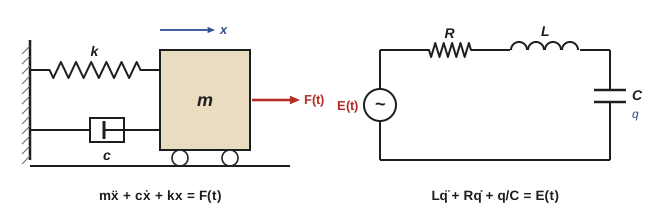
A mass m on a spring of stiffness k, with a viscous damper of coefficient c, driven by a force F(t), obeys Newton's second law:
The spring pushes back in proportion to displacement; the damper resists in proportion to velocity. This "single degree of freedom" model is a surprisingly good description of many real systems: a car body on its suspension (the quarter-car model), a water tower swaying, a machine on rubber mounts, the first mode of a building.
Dividing by m puts the equation in the standard form used throughout vibration engineering:
- \(\omega_n\) is the undamped natural frequency, in rad/s. In hertz, \(f_n = \omega_n/2\pi\); the period is \(T_n = 2\pi/\omega_n\).
- \(\zeta\) (zeta) is the damping ratio, the actual damping divided by the critical damping \(c_c = 2\sqrt{km}\).
Two numbers characterize the whole system, which is what makes this form so useful.
Free vibration
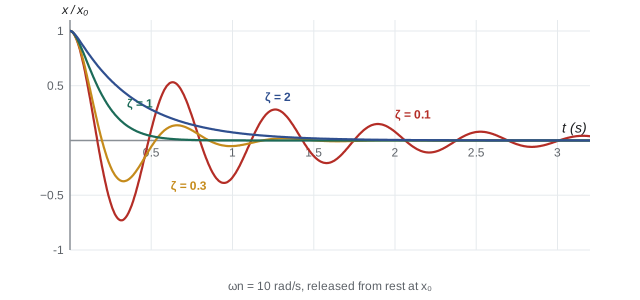
With \(F = 0\), the characteristic equation is \(r^2 + 2\zeta\omega_nr + \omega_n^2 = 0\), with roots \(r = -\zeta\omega_n \pm \omega_n\sqrt{\zeta^2 - 1}\). The three cases of Lesson 2 become three kinds of physical behavior:
- Underdamped, \(\zeta < 1\): complex roots; the system oscillates at the damped natural frequency \(\omega_d = \omega_n\sqrt{1 - \zeta^2}\) with amplitude decaying as \(e^{-\zeta\omega_nt}\). Almost all structures and most machines are in this range, often with \(\zeta\) of only 0.01 to 0.05.
- Critically damped, \(\zeta = 1\): a repeated root; the fastest return to rest without overshoot.
- Overdamped, \(\zeta > 1\): two real roots; a slow, sluggish return without oscillation.
Worked problem
A quarter-car suspension
A quarter of a car body has a mass of 300 kg on a suspension spring of stiffness 30 kN/m. Find the natural frequency in rad/s and Hz, and the damper coefficient that gives a damping ratio of 0.3.
Show solution
- \(\omega_n = \sqrt{30\,000/300} = 10.0\) rad/s; \(f_n = 10/2\pi = 1.59\) Hz; period 0.63 s.
- Critical damping: \(c_c = 2\sqrt{km} = 2\sqrt{30\,000 \times 300} = 6000\) N·s/m.
- For \(\zeta = 0.3\): \(c = 0.3 \times 6000 = 1800\) N·s/m.
- Damped frequency: \(\omega_d = 10\sqrt{1 - 0.09} = 9.54\) rad/s.
Answer: ωn = 10 rad/s (1.6 Hz); c = 1800 N·s/m. Car body frequencies of roughly 1 to 1.5 Hz and damping ratios around 0.2 to 0.4 are typical: soft enough for comfort, damped enough to settle within a cycle or two
Measuring damping: the logarithmic decrement
Damping is hard to calculate but easy to measure. Give the system a tap and record the free vibration. Successive peaks decay by a constant ratio, and the natural log of that ratio is the logarithmic decrement:
Worked problem
Damping from a tap test
An impact test on a floor slab records successive peak accelerations of 0.120, 0.103 and 0.089 m/s². Estimate the damping ratio.
Show solution
- \(\ln(0.120/0.103) = 0.153\); \(\ln(0.103/0.089) = 0.146\). Average \(\delta \approx 0.150\).
- \(\zeta \approx \delta/2\pi = 0.150/6.283 = 0.024\).
Answer: About 2.4% of critical, typical of a concrete floor. Using peaks several cycles apart, δ = (1/N) ln(x₀/x_N), reduces the effect of measurement noise
Worked problem
How fast does a suspension settle?
For the quarter-car (ζ = 0.3, ωn = 10 rad/s), by what factor does the amplitude shrink each cycle, and what is left of a 20 mm initial displacement after three cycles?
Show solution
- \(\delta = 2\pi(0.3)/\sqrt{0.91} = 1.976\); each cycle multiplies the amplitude by \(e^{-1.976} = 0.139\).
- After three cycles: \(20 \times 0.139^3 = 0.053\) mm.
Answer: Each peak is about 14% of the previous one, so after three cycles (about 2 s) only 0.05 mm remains. A worn damper with ζ = 0.05 would still have 7.8 mm left: the car would wallow
Forced vibration
Now apply a steady harmonic force \(F(t) = F_0\cos\omega t\), from an unbalanced rotating machine, wind gusts, footsteps or road roughness. After the transient dies away, the steady-state response is a cosine at the forcing frequency, with amplitude X and a phase lag. Writing the frequency ratio \(r = \omega/\omega_n\) and the static deflection \(X_{st} = F_0/k\):
This dynamic amplification factor is the most important curve in vibration engineering.
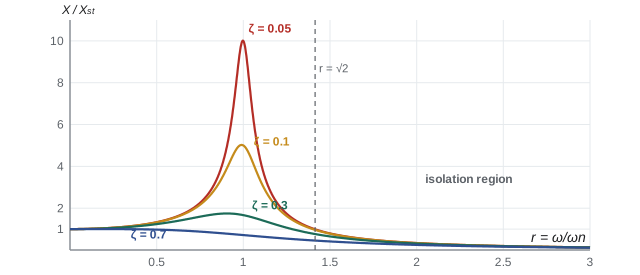
Three regions matter:
- \(r \ll 1\) (slow forcing): \(X \approx X_{st}\). The system follows the force as if it were static.
- \(r \approx 1\) (resonance): \(X \approx X_{st}/(2\zeta)\). With \(\zeta = 0.02\), the response is 25 times the static deflection. This is why lightly damped structures must not be excited near their natural frequencies.
- \(r \gg 1\) (fast forcing): \(X\) becomes small; the mass cannot keep up. This is the basis of vibration isolation: mount a machine on springs soft enough that its running frequency is well above the mounting's natural frequency.
Worked problem
Response across frequencies
For the quarter-car with ζ = 0.3, find the amplification factor at r = 0.5, 1, 2 and 3.
Show solution
- r = 0.5: \(1/\sqrt{(0.75)^2 + (0.3)^2} = 1.24\).
- r = 1: \(1/(2 \times 0.3) = 1.67\).
- r = 2: \(1/\sqrt{9 + 1.44} = 0.31\).
- r = 3: \(1/\sqrt{64 + 3.24} = 0.12\).
Answer: 1.24, 1.67, 0.31 and 0.12. With damping of 0.3 the resonance peak is modest; above resonance the suspension filters out road vibration effectively
Worked problem
Isolating a machine
A 500 kg compressor runs at 1200 rpm. It is to be mounted on springs so that its running speed is three times the natural frequency of the mounting. Find the total spring stiffness needed and, for a damping ratio of 0.05, the fraction of the shaking force transmitted to the floor. The transmissibility is \(TR = \sqrt{1 + (2\zeta r)^2}/\sqrt{(1 - r^2)^2 + (2\zeta r)^2}\).
Show solution
- Running speed: \(\omega = 1200 \times 2\pi/60 = 125.7\) rad/s. Target \(\omega_n = 125.7/3 = 41.9\) rad/s.
- \(k = m\omega_n^2 = 500 \times 41.9^2 = 877\) kN/m in total (for example four mounts of about 219 kN/m).
- With r = 3, ζ = 0.05: \(TR = \sqrt{1 + 0.09}/\sqrt{64 + 0.09} = 1.044/8.006 = 0.13\).
Answer: About 877 kN/m, transmitting 13% of the force: an 87% reduction. Isolation only works above r = √2; mounts that are too stiff (r near 1) amplify the vibration instead
Resonance in the real world
Two well-known bridges illustrate how seriously engineers take dynamics. When London's Millennium Bridge opened in June 2000, it swayed sideways under crowds. Pedestrians unconsciously adjusted their steps to the sway, synchronizing with the bridge's lateral natural frequency and feeding energy into it. The bridge was closed two days after opening and reopened in 2002 after dampers were installed to raise its damping. The 1940 collapse of the Tacoma Narrows Bridge is often described as resonance, but it was a more complex aeroelastic instability (flutter), in which the wind and the bridge's twisting motion fed each other. Both cases led to permanent changes in how long, light structures are designed and checked for dynamic behavior.
The RLC circuit
A series circuit with an inductor L, a resistor R and a capacitor C, driven by a voltage E(t), obeys Kirchhoff's voltage law for the charge q on the capacitor:
This is the same equation as the mass-spring-damper, with \(L \leftrightarrow m\), \(R \leftrightarrow c\), \(1/C \leftrightarrow k\). So everything above carries over directly:
Worked problem
A tuned circuit
A series RLC circuit has L = 0.10 H, C = 100 μF and R = 10 Ω. Find its natural frequency, damping ratio, and the resistance for critical damping.
Show solution
- \(\omega_n = 1/\sqrt{0.10 \times 10^{-4}} = 316\) rad/s (50.3 Hz).
- \(\zeta = \tfrac{10}{2}\sqrt{10^{-4}/0.10} = 5 \times 0.0316 = 0.158\).
- \(R_{crit} = 2\sqrt{0.10/10^{-4}} = 63.2\) Ω.
Answer: ωn = 316 rad/s, ζ = 0.16 (underdamped: switching it on gives a ringing response), and 63 Ω for critical damping. Radio tuners use very low-resistance (high-Q) circuits so that the resonance peak picks out one frequency; power electronics often add resistance or snubbers to damp unwanted ringing
The analogy is more than a curiosity. Engineers once built electrical circuits to simulate mechanical systems (analog computers), and today the same transfer-function mathematics (Lesson 4) is used to analyze and control both.
Common mistakes
MistakeConfusing ωn (rad/s) with fₙ (Hz).
Insteadfₙ = ωn/2π. A 10 rad/s system vibrates at 1.59 Hz.
MistakeUsing the damped frequency formula when ζ ≥ 1.
Insteadω_d = ωn√(1 − ζ²) exists only for ζ < 1; critically and overdamped systems do not oscillate.
MistakeAssuming more stiffness always reduces vibration.
InsteadStiffness changes ωn; if it moves ωn toward the forcing frequency, the response grows. Check r.
MistakeMounting a machine on springs with r between 0 and √2.
InsteadIsolation needs r > √2, ideally 3 or more; otherwise mounts amplify the force.
MistakeTaking the log decrement from a single noisy pair of peaks.
InsteadUse peaks N cycles apart: δ = (1/N) ln(x₀/x_N).
MistakeForgetting that damping, not stiffness, limits resonant amplitude.
InsteadAt r = 1, X/X_st = 1/(2ζ); add damping to control resonance.
Summary and key terms
- mẍ + cẋ + kx = F(t), or ẍ + 2ζωnẋ + ωn²x = F/m, with ωn = √(k/m) and ζ = c/(2√(km)).
- Free vibration is underdamped (ζ < 1, oscillates at ω_d = ωn√(1 − ζ²)), critically damped (ζ = 1) or overdamped (ζ > 1).
- The logarithmic decrement δ = ln(xₙ/xₙ₊₁) ≈ 2πζ measures damping from a free-vibration record.
- Harmonic forcing gives a steady amplitude X/X_st = 1/√((1 − r²)² + (2ζr)²), with r = ω/ωn.
- Resonance (r ≈ 1) amplifies by about 1/(2ζ); isolation requires r > √2.
- The series RLC circuit is the electrical analogue: ωn = 1/√(LC), ζ = (R/2)√(C/L).
- Natural frequency
- ωn = √(k/m), the frequency of undamped free vibration.
- Damping ratio
- ζ = c/c_c, the damping relative to critical damping.
- Critical damping
- c_c = 2√(km), the least damping that prevents oscillation.
- Underdamped
- ζ < 1: the free response oscillates with decaying amplitude.
- Overdamped
- ζ > 1: the free response returns slowly without oscillating.
- Logarithmic decrement
- The natural log of the ratio of successive peak amplitudes.
- Frequency ratio
- r = ω/ωn, forcing frequency over natural frequency.
- Dynamic amplification factor
- Steady amplitude divided by the static deflection.
- Transmissibility
- The fraction of force (or motion) passed through mounts to the support.
- RLC circuit
- A circuit with resistance, inductance and capacitance, the electrical oscillator.
Practice problems
Work each problem on paper first, then reveal the answer to check.
A 2 kg mass on a spring of stiffness 800 N/m. Find ωn, fₙ and the period.
Show answer
ωn = 20 rad/s; fₙ = 3.18 Hz; T = 0.314 s.
For the system in the previous problem, what damping coefficient makes it critically damped?
Show answer
c_c = 2√(800 × 2) = 80 N·s/m.
Classify mẍ + cẋ + kx = 0 with m = 1, c = 6, k = 5.
Show answer
ζ = 6/(2√5) = 1.34 > 1: overdamped (roots −1 and −5).
Successive peaks of a free vibration are 10.0 mm and 8.0 mm. Estimate ζ.
Show answer
δ = ln 1.25 = 0.223; ζ ≈ 0.223/(2π) = 0.036.
A structure has ζ = 0.02. What is its approximate amplification at resonance?
Show answer
1/(2 × 0.02) = 25.
A water tower modeled as m = 50 t with k = 2.0 MN/m. A wind gust excites it at 0.9 Hz. Find r and the amplification for ζ = 0.05.
Show answer
ωn = √(2×10⁶/5×10⁴) = 6.32 rad/s (1.007 Hz). r = 0.894. X/X_st = 1/√((1 − 0.8)² + (0.0894)²) = 1/√(0.04 + 0.008) = 4.56.
A fan of 80 kg runs at 900 rpm. What maximum total mounting stiffness gives r = 3?
Show answer
ω = 94.2 rad/s; ωn = 31.4 rad/s; k = 80 × 31.4² = 78.9 kN/m.
Why should the natural frequency of a footbridge avoid roughly 1.6–2.4 Hz vertically?
Show answer
That range covers typical walking pace (about 2 steps per second); matching it would cause resonance under pedestrian loading.
An RLC circuit has L = 20 mH and C = 0.5 μF. Find fₙ and the critical resistance.
Show answer
ωn = 1/√(10⁻⁸) = 10 000 rad/s, fₙ = 1.59 kHz. R_crit = 2√(0.02/5×10⁻⁷) = 400 Ω.
State the mechanical analogues of L, R, 1/C and charge q.
Show answer
Mass m, damping c, stiffness k and displacement x.
Lesson quiz · 5 questions
Score 60% or more to complete this lesson.
Create a free account to save your progress, take quizzes and earn a certificate.