
MATH-209 · Lesson 3 of 5 · 44 min
Double and triple integrals
A single integral adds up a quantity along a line: the area under a curve, the work done by a varying force, the volume of fluid passed by a pump. Many engineering totals are spread over an area or a volume instead: the mass of a plate whose density varies, the total load of snow on a roof, the stiffness of a beam cross-section, the volume of a tank. Double and triple integrals add up quantities over two- and three-dimensional regions.
This chapter defines double integrals, shows how to evaluate them as repeated single integrals, handles regions with curved boundaries and changes of order, switches to polar coordinates for round regions, and applies the results to volumes, mass, centroids and the second moment of area that governs beam bending. It then extends everything to triple integrals, with cylindrical and spherical coordinates for tanks, pipes and domes.
The double integral
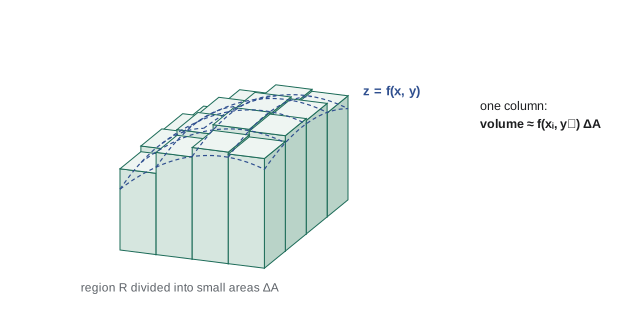
Divide a region \(R\) of the xy-plane into small rectangles of area \(\Delta A\), evaluate \(f\) at a point in each, multiply by the area, and add. As the rectangles shrink, the sum approaches the double integral:
If \(f \ge 0\), each term is the volume of a thin column under the surface, so the double integral is the volume between the surface \(z = f(x, y)\) and the region. If \(f\) is a density (mass per area, load per area), the integral is the total mass or load. If \(f = 1\), it is simply the area of \(R\).
Iterated integrals over rectangles
You never evaluate double integrals from the limit definition. Fubini's theorem says that over a rectangle \(a \le x \le b\), \(c \le y \le d\), the double integral equals an iterated integral: integrate with respect to one variable (treating the other as constant), then the other. The order does not matter.
Worked problem
An iterated integral
Evaluate \(\iint_R (x + 2y)\,dA\) over \(R = [0, 2] \times [0, 3]\).
Show solution
- Inner integral (y from 0 to 3, x constant): \(\int_0^3 (x + 2y)\,dy = [xy + y^2]_0^3 = 3x + 9\).
- Outer integral: \(\int_0^2 (3x + 9)\,dx = [1.5x^2 + 9x]_0^2 = 6 + 18 = 24\).
Answer: 24. Integrating in the other order, ∫₀³∫₀² (x + 2y) dx dy = ∫₀³ (2 + 4y) dy = 6 + 18 = 24, as Fubini promises
Worked problem
Volume under a dome
Find the volume under \(z = 100 - x^2 - 2y^2\) over the square \(-1 \le x \le 1\), \(-1 \le y \le 1\).
Show solution
- Split the integrand: \(\iint 100\,dA - \iint x^2\,dA - \iint 2y^2\,dA\).
- \(\iint 100\,dA = 100 \times \text{area} = 400\).
- \(\iint x^2\,dA = \int_{-1}^{1}\int_{-1}^{1} x^2\,dy\,dx = 2\int_{-1}^{1} x^2\,dx = 2 \times \tfrac{2}{3} = \tfrac{4}{3}\).
- Similarly \(\iint 2y^2\,dA = 2 \times \tfrac{4}{3} = \tfrac{8}{3}\).
- Volume \(= 400 - \tfrac{4}{3} - \tfrac{8}{3} = 396\).
Answer: 396 cubic units
General regions
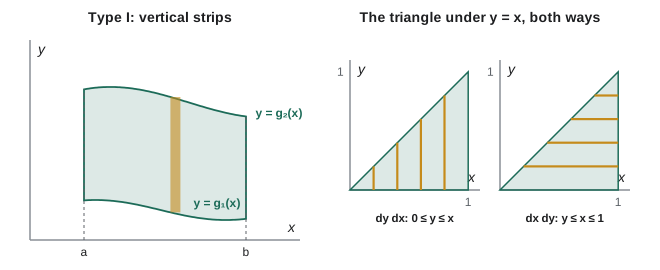
Most regions are not rectangles. For a region bounded on the left and right by vertical lines and above and below by curves (a "type I" region, \(a \le x \le b\), \(g_1(x) \le y \le g_2(x)\)), integrate in y first with variable limits:
For a "type II" region bounded by curves on the left and right, integrate in x first. Always sketch the region before setting limits: draw a typical strip, see where it enters and leaves the region (the inner limits), then see how far the strips range (the outer limits).
Worked problem
A triangular region
Evaluate \(\iint_R xy\,dA\) where R is the triangle with vertices (0, 0), (1, 0) and (1, 1).
Show solution
- The triangle lies under the line \(y = x\), for \(0 \le x \le 1\). Vertical strips run from \(y = 0\) to \(y = x\).
- \[\int_0^1 \int_0^x xy\,dy\,dx = \int_0^1 x \cdot \frac{x^2}{2}\,dx = \int_0^1 \frac{x^3}{2}\,dx = \frac{1}{8}\]
Answer: 1/8
Worked problem
Reversing the order
Evaluate \(\displaystyle\int_0^1 \int_x^1 e^{y^2}\,dy\,dx\).
Show solution
- The inner integral \(\int e^{y^2}\,dy\) has no elementary antiderivative, so reverse the order.
- The region is \(0 \le x \le 1\), \(x \le y \le 1\): the triangle above \(y = x\). Described the other way, it is \(0 \le y \le 1\), \(0 \le x \le y\).
- \[\int_0^1 \int_0^y e^{y^2}\,dx\,dy = \int_0^1 y\,e^{y^2}\,dy = \left[\tfrac{1}{2}e^{y^2}\right]_0^1 = \frac{e - 1}{2}\]
Answer: (e − 1)/2 ≈ 0.859. Changing the order of integration can turn an impossible integral into an easy one; it always starts with a sketch of the region
Polar coordinates
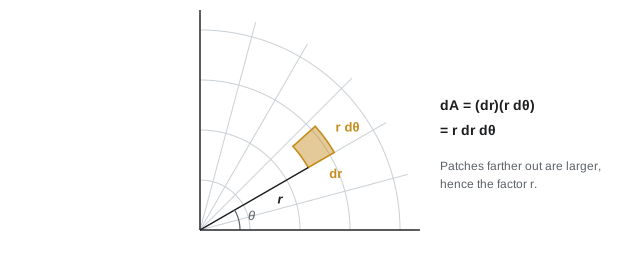
For disks, rings, sectors and anything round, polar coordinates \(x = r\cos\theta\), \(y = r\sin\theta\) make the limits constant. The key is the area element: a small polar patch with sides \(dr\) and \(r\,d\theta\) has area
The extra factor \(r\) is essential: patches farther from the origin are larger. Forgetting it is the most common error with polar integrals.
Worked problem
A Gaussian over a disk
Evaluate \(\iint_D e^{-(x^2 + y^2)}\,dA\) over the disk \(x^2 + y^2 \le 4\).
Show solution
- In polar form, \(x^2 + y^2 = r^2\), and the disk is \(0 \le r \le 2\), \(0 \le \theta \le 2\pi\).
- \[\int_0^{2\pi}\int_0^2 e^{-r^2}\,r\,dr\,d\theta = 2\pi\left[-\tfrac{1}{2}e^{-r^2}\right]_0^2 = \pi\left(1 - e^{-4}\right)\]
Answer: π(1 − e⁻⁴) ≈ 3.084. In Cartesian coordinates this integral cannot be done in elementary terms; the factor r from dA is exactly what makes it work. Letting the radius go to infinity gives π, the result behind the normal distribution in STAT-235
Applications: mass, centroids and moments
For a thin plate (a lamina) occupying region R with density \(\rho(x, y)\) in kg/m²:
With uniform density, \((\bar{x}, \bar{y})\) is the centroid of the region, a purely geometric property you met in MATH-101.
Worked problem
A plate with varying thickness
A steel plate occupies \(0 \le x \le 2\), \(0 \le y \le 1\) (meters). It is tapered, so its mass per unit area is \(\rho = 20 + 10x\) kg/m². Find its mass and the x-coordinate of its center of mass.
Show solution
- \(m = \int_0^2\int_0^1 (20 + 10x)\,dy\,dx = \int_0^2 (20 + 10x)\,dx = 40 + 20 = 60\) kg.
- \(\iint x\rho\,dA = \int_0^2 (20x + 10x^2)\,dx = 40 + \tfrac{80}{3} = 66.67\) kg·m.
- \(\bar{x} = 66.67/60 = 1.11\) m.
Answer: 60 kg, with its center of mass 1.11 m from the thin edge, shifted toward the heavier, thicker end from the geometric center at 1.0 m
The second moment of area
The stiffness of a beam in bending depends on how its cross-sectional area is distributed about the neutral axis, measured by the second moment of area:
where \(y\) is the distance from the neutral axis (through the centroid). Area far from the axis counts heavily because of the \(y^2\), which is why I-beams put most of their material in the flanges. For shafts in torsion, the polar moment \(J = \iint (x^2 + y^2)\,dA = \iint r^2\,dA\) plays the same role.
Worked problem
Second moments of a rectangle and a circle
Find (a) \(I_x\) for a rectangle of width b and height h about its horizontal centroidal axis; (b) \(J\) and \(I_x\) for a solid circular shaft of radius R.
Show solution
- (a) \(I_x = \int_{-b/2}^{b/2}\int_{-h/2}^{h/2} y^2\,dy\,dx = b\left[\tfrac{y^3}{3}\right]_{-h/2}^{h/2} = b \cdot \tfrac{h^3}{12}\).
- (b) In polar coordinates: \(J = \int_0^{2\pi}\int_0^R r^2 \cdot r\,dr\,d\theta = 2\pi \cdot \tfrac{R^4}{4} = \tfrac{\pi R^4}{2}\).
- By symmetry \(I_x = I_y\), and \(I_x + I_y = J\), so \(I_x = \tfrac{\pi R^4}{4}\).
Answer: I = bh³/12 for a rectangle, the formula used for the timber beams in ENCM-100; J = πR⁴/2 and I = πR⁴/4 for a circle. For the 100 × 300 mm beam, I = 0.1 × 0.3³/12 = 2.25 × 10⁻⁴ m⁴
The \(h^3\) is worth noticing: doubling a beam's depth makes it eight times stiffer, but doubling its width only doubles the stiffness. That single fact, which comes straight out of this integral, explains why floor joists are deep and narrow.
Triple integrals
A triple integral \(\iiint_E f(x, y, z)\,dV\) adds up a quantity over a solid region E. With \(f = 1\) it gives volume; with a density it gives mass; it also gives centers of mass and moments of inertia of solid bodies. It is evaluated as three nested single integrals, with limits found by projecting the solid onto a coordinate plane.
Worked problem
Volume of a tetrahedron
Find the volume of the solid bounded by the coordinate planes and the plane \(x + y + z = 1\).
Show solution
- For each \((x, y)\) in the triangle \(x \ge 0, y \ge 0, x + y \le 1\), z runs from 0 to \(1 - x - y\).
- \[V = \int_0^1 \int_0^{1-x} \int_0^{1-x-y} dz\,dy\,dx = \int_0^1 \int_0^{1-x} (1 - x - y)\,dy\,dx = \int_0^1 \frac{(1 - x)^2}{2}\,dx = \frac{1}{6}\]
Answer: 1/6, which matches the pyramid formula ⅓ × base area × height = ⅓ × ½ × 1 = 1/6
Cylindrical coordinates
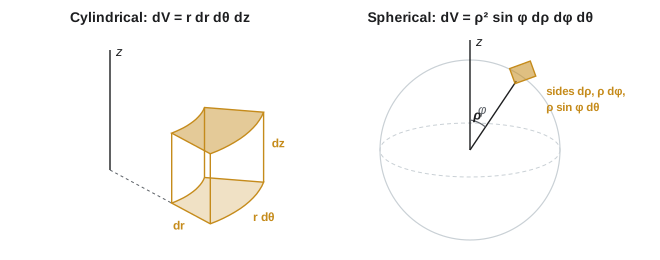
For solids with an axis of symmetry (tanks, pipes, shafts, cones), cylindrical coordinates \((r, \theta, z)\) are natural: polar coordinates in the plane plus the height z. The volume element is
Worked problem
A paraboloid tank
A tank is shaped like the region between the paraboloid \(z = r^2\) and the plane \(z = 4\) (meters). Find its volume.
Show solution
- For each \(r\) from 0 to 2 (where \(r^2 = 4\)), z runs from \(r^2\) to 4.
- \[V = \int_0^{2\pi}\int_0^2\int_{r^2}^{4} r\,dz\,dr\,d\theta = 2\pi\int_0^2 (4 - r^2)\,r\,dr = 2\pi\left[2r^2 - \frac{r^4}{4}\right]_0^2 = 2\pi(8 - 4) = 8\pi\]
Answer: 8π ≈ 25.1 m³, exactly half the volume of the 2 m radius, 4 m tall cylinder around it (16π), a classical result of Archimedes
Spherical coordinates
For spheres, domes and anything centered on a point, spherical coordinates \((\rho, \phi, \theta)\) use the distance \(\rho\) from the origin, the angle \(\phi\) down from the positive z-axis, and the polar angle \(\theta\). The volume element is
Worked problem
Air volume in a dome
A hemispherical sports dome has a radius of 10 m. Find the volume of air it encloses.
Show solution
- The hemisphere is \(0 \le \rho \le 10\), \(0 \le \phi \le \pi/2\), \(0 \le \theta \le 2\pi\).
- \[V = \int_0^{2\pi}\int_0^{\pi/2}\int_0^{10} \rho^2\sin\phi\,d\rho\,d\phi\,d\theta = 2\pi \cdot [-\cos\phi]_0^{\pi/2} \cdot \frac{10^3}{3} = 2\pi \cdot 1 \cdot \frac{1000}{3}\]
Answer: 2000π/3 ≈ 2094 m³, half of (4/3)πR³. The air volume sets the size of the ventilation and heating systems
In general, a change of variables \(x = x(u, v)\), \(y = y(u, v)\) multiplies the area element by the absolute value of the Jacobian determinant \(\partial(x, y)/\partial(u, v)\). The factors \(r\) and \(\rho^2\sin\phi\) are the Jacobians of the polar, cylindrical and spherical transformations. Finite element software uses the same idea to map distorted elements onto a standard square or cube.
Common mistakes
MistakeForgetting the factor r in polar or cylindrical integrals, or ρ² sin φ in spherical ones.
InsteaddA = r dr dθ; dV = r dr dθ dz; dV = ρ² sin φ dρ dφ dθ.
MistakeSetting limits without sketching the region.
InsteadSketch it, draw a typical strip, read the inner limits from where the strip enters and leaves, then the outer limits.
MistakePutting variables in the outer limits.
InsteadOuter limits must be constants; inner limits may depend on the outer variables.
MistakeReversing the order of integration by just swapping the limits.
InsteadRedescribe the region with the other variable outermost; the new limits are usually different functions.
MistakeMeasuring y from the base, not the centroid, when computing a beam's I.
InsteadThe bending second moment is about the centroidal (neutral) axis; use the parallel axis theorem to shift if needed.
MistakeConfusing area with volume: using a double integral of 1 for a volume.
Instead∬1 dA is an area; volume needs ∬f dA (height f) or ∭1 dV.
Summary and key terms
- A double integral adds f dA over a region: volume under a surface, total mass or load, or area when f = 1.
- Fubini: over rectangles, evaluate as iterated integrals in either order.
- For general regions, sketch, then integrate with variable inner limits; reversing the order can make hard integrals easy.
- Polar coordinates use dA = r dr dθ and suit circular regions.
- Mass, center of mass and centroid follow from integrals of ρ, xρ and yρ; the second moment I = ∬y² dA governs beam stiffness, giving bh³/12 and πR⁴/4.
- Triple integrals add over solids; cylindrical (dV = r dr dθ dz) and spherical (dV = ρ² sin φ dρ dφ dθ) coordinates suit symmetric shapes.
- The scale factors are Jacobians of the coordinate change.
- Double integral
- The limit of sums of f ΔA over a region of the plane.
- Iterated integral
- A double or triple integral evaluated as nested single integrals.
- Fubini's theorem
- Over a rectangle, a double integral equals the iterated integral in either order.
- Type I region
- A region between two curves y = g₁(x) and y = g₂(x) for a ≤ x ≤ b.
- Polar area element
- dA = r dr dθ.
- Lamina
- A thin plate, modeled as a two-dimensional region with area density.
- Centroid
- The geometric center of a region; the center of mass for uniform density.
- Second moment of area
- I = ∬y² dA, the measure of a cross-section's resistance to bending.
- Polar moment of area
- J = ∬r² dA, the measure of a section's resistance to torsion.
- Triple integral
- The integral of a function over a solid region.
- Jacobian
- The determinant that scales area or volume under a change of variables.
Practice problems
Work each problem on paper first, then reveal the answer to check.
Evaluate \(\int_0^1\int_0^2 (x^2 + y)\,dx\,dy\).
Show answer
Inner: [x³/3 + xy]₀² = 8/3 + 2y. Outer: ∫₀¹ (8/3 + 2y) dy = 8/3 + 1 = 11/3.
Find the area of the region between \(y = x^2\) and \(y = x\) using a double integral.
Show answer
∫₀¹∫_{x²}^{x} dy dx = ∫₀¹ (x − x²) dx = 1/6.
Evaluate \(\iint_R y\,dA\) over the triangle with vertices (0, 0), (2, 0), (0, 2).
Show answer
Region y ≤ 2 − x: ∫₀²∫₀^{2−x} y dy dx = ∫₀² (2 − x)²/2 dx = 4/3.
Reverse the order: \(\int_0^4\int_{\sqrt{x}}^{2} f\,dy\,dx\).
Show answer
The region is 0 ≤ y ≤ 2, 0 ≤ x ≤ y²: ∫₀²∫₀^{y²} f dx dy.
Find the area of a ring between radii 1 and 3 using polar coordinates.
Show answer
∫₀^{2π}∫₁³ r dr dθ = 2π(9 − 1)/2 = 8π.
A semicircular plate of radius 0.4 m (y ≥ 0) has uniform density. Find ȳ using polar coordinates.
Show answer
Area πR²/2. ∬y dA = ∫₀^π∫₀^R r sin θ · r dr dθ = 2R³/3. ȳ = (2R³/3)/(πR²/2) = 4R/(3π) = 0.170 m.
Find I about the centroidal axis for a hollow circular tube with outer radius 50 mm and inner radius 40 mm.
Show answer
I = π(R⁴ − r⁴)/4 = π(6.25 × 10⁶ − 2.56 × 10⁶)/4 = 2.90 × 10⁶ mm⁴.
How much stiffer is a 50 × 200 mm joist on edge than the same joist laid flat?
Show answer
On edge I = 50 × 200³/12; flat I = 200 × 50³/12. Ratio = (200/50)² = 16 times stiffer.
Find the volume under \(z = 4 - x^2 - y^2\) and above the xy-plane.
Show answer
Polar: ∫₀^{2π}∫₀² (4 − r²) r dr dθ = 2π(8 − 4) = 8π.
Find the mass of a solid sphere of radius 1 m whose density is \(\rho = 1000(2 - r)\) kg/m³, where r is the distance from the center.
Show answer
m = ∫₀^{2π}∫₀^π∫₀¹ 1000(2 − ρ)ρ² sin φ dρ dφ dθ = 4π × 1000 × (2/3 − 1/4) = 4π × 1000 × 5/12 = 5236 kg.
Lesson quiz · 5 questions
Score 60% or more to complete this lesson.
Create a free account to save your progress, take quizzes and earn a certificate.