
MEC-230 · Lesson 11 of 12 · 27 min
Entropy and isentropic efficiency
The second law, as stated in Lesson 10, applies to cycles. To apply it to single processes, such as the expansion in one turbine or the heat transfer in one exchanger, we need a property that measures irreversibility the way energy measures quantity. That property is entropy. It is less intuitive than energy, but it is just as useful: it tells us which processes are possible, how far a real device falls short of the ideal, and where in a plant the potential for work is being thrown away. At Northgate, entropy analysis showed Elena that the pressure-reducing valve wastes four times as much work potential as the turbine it bypasses, a result no energy balance could reveal.
The Clausius inequality and entropy
Clausius showed that for any cycle, the cyclic integral of \(\delta Q/T\), where \(T\) is the absolute temperature at the boundary where the heat crosses, is never positive:
The equality holds for internally reversible cycles and the inequality for irreversible ones. For a reversible cycle, then, the integral of \(\delta Q/T\) around the cycle is zero, which means that \(\delta Q/T\) integrated between two states does not depend on the path, as long as the path is internally reversible. A quantity whose change depends only on the end states is a property. Clausius named it entropy, \(S\), and defined it by
Entropy has units of kJ/K, and specific entropy \(s\) units of kJ/(kg·K). Because it is a property, its change between two states is the same for any process, reversible or not. The integral of \(\delta Q/T\) gives that change only along a reversible path; for an irreversible process, we evaluate \(\Delta S\) from tables or relations, using any convenient reversible path between the same states. For an internally reversible isothermal process, the integral is simply \(\Delta S = Q/T\).
The increase of entropy principle
Applying the Clausius inequality to a cycle made of an irreversible process from 1 to 2 and a reversible process back gives the entropy balance for a closed system:
The entropy of a closed system changes for two reasons: entropy transfer with heat, \(\delta Q/T\), which can be positive or negative; and entropy generation \(S_{\text{gen}}\) by irreversibilities inside the system, which is zero for a reversible process and positive for an irreversible one, but never negative. Work transfers no entropy. For an isolated system, which has no heat transfer, the entropy can only increase or stay the same: \(\Delta S_{\text{isolated}} = S_{\text{gen}} \ge 0\). This is the increase of entropy principle. Any system plus its surroundings forms an isolated system, so the total entropy of the universe increases in every real process.
The principle answers the question the first law could not. A cup of coffee cooling in a room: the coffee loses entropy, the room gains more, and the total increases, so the process goes. The coffee warming by drawing heat from the room would decrease the total entropy, so it does not happen. A process is possible if and only if it generates non-negative entropy. And the amount generated measures how irreversible the process is: the larger \(S_{\text{gen}}\), the more work potential has been destroyed.
For a control volume, entropy is also carried by mass crossing the boundary, at \(s\) per unit mass. In steady flow, the entropy balance becomes
For a single-stream adiabatic device, \(\dot{S}_{\text{gen}} = \dot{m}(s_2 - s_1) \ge 0\): the entropy of the fluid can only increase as it passes through an adiabatic turbine, compressor, pump, nozzle or valve. It stays constant only if the device is reversible.
Entropy of pure substances
Steam tables list entropy alongside enthalpy, relative to the same triple-point reference, and the quality relation \(s = s_f + x\,s_{fg}\) applies under the dome. A temperature-entropy (T-s) diagram is especially useful, because the area under an internally reversible process curve equals the heat transferred: \(Q = \int T\,dS\). On a T-s diagram, an isothermal process is horizontal, a reversible adiabatic process is vertical, and the vaporization lines under the dome are horizontal lines of constant temperature and pressure.
A process during which the entropy stays constant is called isentropic. A reversible adiabatic process is isentropic, since it has neither heat transfer nor entropy generation. An adiabatic process with irreversibilities is not; its entropy increases. The ideal versions of turbines, compressors, pumps and nozzles are isentropic, and they serve as the benchmarks against which real ones are measured.
Entropy of liquids, solids and ideal gases
Two relations derived from the first law for a simple compressible substance, called the Gibbs equations, connect entropy to measurable properties:
For an incompressible substance, \(dv = 0\) and \(du = c\,dT\), so \(ds = c\,dT/T\), giving \(s_2 - s_1 = c_{\text{avg}}\ln(T_2/T_1)\). For an ideal gas, substituting \(dh = c_p\,dT\) and \(v = RT/P\) into the second Gibbs equation and integrating with constant specific heats gives
Setting \(s_2 = s_1\) gives the isentropic relations for an ideal gas with constant specific heats, which also show that a reversible adiabatic process follows \(Pv^k = \text{constant}\), the polytropic process with \(n = k\) mentioned in Lesson 2:
Isentropic efficiencies
Real turbines, compressors, pumps and nozzles are nearly adiabatic but not reversible, so their exit entropy is higher than their inlet entropy. Their performance is measured by comparing the actual work (or exit kinetic energy) with what an isentropic device would achieve between the same inlet state and the same exit pressure. For a turbine, which produces less work than the ideal, and a compressor or pump, which needs more,
where \(h_{2s}\) is the enthalpy at the exit pressure with the inlet entropy. Large steam turbines reach isentropic efficiencies of 85 to 92 percent; small single-stage back-pressure turbines like Northgate's are typically 60 to 80 percent; centrifugal compressors 75 to 85 percent; pumps 60 to 85 percent; nozzles above 95 percent. For a pump, the isentropic work is \(v\Delta P\), which is why Lesson 8's pump calculation divided \(v\Delta P\) by an efficiency.
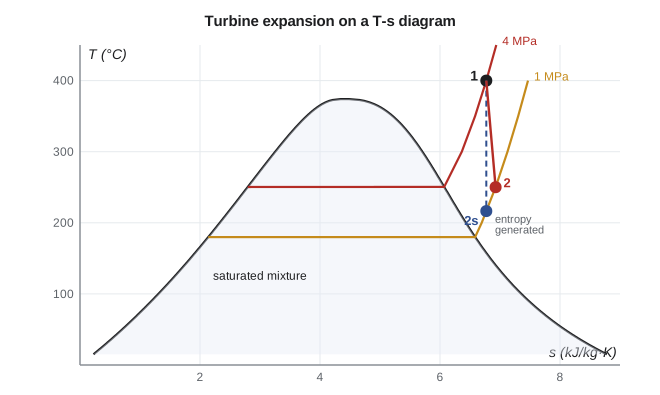
Worked problem
Isentropic efficiency of the Northgate turbine
The turbine takes steam at 4 MPa and 400 °C (\(h_1 = 3214.5\ \text{kJ/kg}\), \(s_1 = 6.7714\ \text{kJ/kg·K}\)) and exhausts at 1 MPa and 250 °C (\(h_2 = 2943.1\)). Find its isentropic efficiency. At 1 MPa: \(s = 6.6955\) and \(h = 2828.3\) at 200 °C; \(s = 6.9265\) and \(h = 2943.1\) at 250 °C.
Show solution
- Isentropic exit: \(s_{2s} = 6.7714\) at 1 MPa. Since \(s_g\) at 1 MPa is 6.5850, the state is superheated, between 200 °C and 250 °C.
- Interpolation fraction: \((6.7714 - 6.6955)/(6.9265 - 6.6955) = 0.3286\). So \(T_{2s} = 216.4\ °\text{C}\) and \(h_{2s} = 2828.3 + 0.3286(114.8) = 2866.0\ \text{kJ/kg}\).
- \[\eta_T = \frac{3214.5 - 2943.1}{3214.5 - 2866.0} = \frac{271.4}{348.5} = 0.779\]
Answer: The turbine achieves about 78 percent of the ideal work. An isentropic turbine would produce 348.5 kJ/kg, or 4.18 MW at full flow, instead of 3.26 MW. The missing 0.92 MW is not lost from the plant: it stays in the steam as extra enthalpy, so the steam enters the main hotter, at 250 °C instead of 216 °C, and the buildings receive it as heat. In a back-pressure turbine, irreversibility shifts energy from electricity to heat rather than wasting it, which is one reason small, simple turbines make economic sense in district plants.
Worked problem
Isentropic efficiency of an air compressor
An uncooled test compressor takes air at 100 kPa (14.5 psia) and 20 °C (68 °F) and delivers it at 900 kPa (130.5 psia) and 320 °C (608 °F). Find the isentropic exit temperature and the isentropic efficiency, with \(k = 1.4\) and constant specific heats.
Show solution
- \[T_{2s} = T_1\Big(\frac{P_2}{P_1}\Big)^{(k-1)/k} = 293.15(9)^{0.2857} = 549.2\ \text{K} = 276.1\ °\text{C}\]
- \[\eta_C = \frac{T_{2s} - T_1}{T_2 - T_1} = \frac{549.2 - 293.15}{593.15 - 293.15} = 0.854\]
Answer: About 85 percent. The isentropic exit temperature is 529 °F against an actual 608 °F; the extra rise represents the extra work needed to overcome friction and turbulence inside the machine.
Where the work potential goes
Entropy generation pinpoints where irreversibilities occur. The program below calculates the entropy generated per second in four places: the turbine, the pressure-reducing valve that can replace it, the hospital's heat exchanger, and the compressor. Multiplying \(\dot{S}_{\text{gen}}\) by the temperature of the surroundings, about 288 K, gives the rate at which work potential is destroyed, a quantity called exergy destruction that a later course develops fully.
# Entropy at work in the plant: isentropic efficiency and entropy generation
import math
def lerp(x, x0, x1, y0, y1):
    return y0 + (x - x0) / (x1 - x0) * (y1 - y0)

# 1. Turbine: 4 MPa 400 C -> 1 MPa, actual exit 250 C
h1, s1 = 3214.5, 6.7714
h2 = 2943.1
# isentropic exit at 1 MPa with s = s1: superheated, between 200 C (2828.3, 6.6955) and 250 C (2943.1, 6.9265)
T2s = lerp(s1, 6.6955, 6.9265, 200, 250)
h2s = lerp(s1, 6.6955, 6.9265, 2828.3, 2943.1)
eta_t = (h1 - h2) / (h1 - h2s)
print(f"turbine: T2s = {T2s:.1f} C, h2s = {h2s:.1f} kJ/kg, isentropic efficiency = {eta_t:.3f}")
s2 = 6.9265
print(f"         entropy generated = {12 * (s2 - s1):.2f} kW/K (adiabatic turbine, 12 kg/s)")

# 2. Pressure-reducing valve: same inlet, throttled to 1 MPa at h = 3214.5 (T = 376.5 C)
s_prv = lerp(3214.5, 3158.2, 3264.5, 7.3029, 7.4670)
print(f"valve:   s2 = {s_prv:.4f}, entropy generated = {12 * (s_prv - s1):.2f} kW/K")

# 3. Hospital heat exchanger: steam 1 MPa 250 C -> liquid 85 C; water 60 -> 85 C, 1.8 MW
m_s = 1800 / (2943.1 - 356.0)
m_w = 1800 / (4.18 * 25)
dS_steam = m_s * (1.1346 - 6.9265)
dS_water = m_w * 4.18 * math.log((85 + 273.15) / (60 + 273.15))
print(f"heat exchanger: steam {dS_steam:.3f} kW/K, water {dS_water:+.3f} kW/K, "
      f"generated {dS_steam + dS_water:.3f} kW/K")

# 4. Air compressor, adiabatic: 100 kPa 20 C -> 900 kPa, actual exit 320 C, k = 1.4
T1, r, k = 293.15, 9.0, 1.4
T2s_c = T1 * r**((k - 1) / k)
eta_c = (T2s_c - T1) / (320 + 273.15 - T1)
print(f"compressor: T2s = {T2s_c - 273.15:.1f} C, isentropic efficiency = {eta_c:.3f}")turbine: T2s = 216.4 C, h2s = 2866.0 kJ/kg, isentropic efficiency = 0.779
entropy generated = 1.86 kW/K (adiabatic turbine, 12 kg/s)
valve: s2 = 7.3898, entropy generated = 7.42 kW/K
heat exchanger: steam -4.030 kW/K, water +5.210 kW/K, generated 1.180 kW/K
compressor: T2s = 276.1 C, isentropic efficiency = 0.854The numbers are striking. The turbine generates 1.86 kW/K. The valve, handling the same steam between the same pressures, generates 7.42 kW/K, four times as much, because it produces no work at all: every bit of the steam's work potential above the 1 MPa level is destroyed. Multiplying by 288 K, the valve destroys about 2.1 MW of work potential and the turbine about 0.54 MW. The hospital heat exchanger, transferring 1.8 MW across a large temperature difference, generates 1.18 kW/K, about 0.34 MW of work potential destroyed in a single building. Summed over forty buildings, the heat exchangers destroy more work potential than anything else in the system.
Worked problem
Entropy generated in the hospital heat exchanger
The hospital exchanger condenses 0.696 kg/s of steam from 1 MPa and 250 °C (\(s = 6.9265\)) to liquid at 85 °C (\(s = 1.1346\ \text{kJ/kg·K}\)), heating 17.22 kg/s of water from 60 °C to 85 °C (\(c = 4.18\)). Find the rate of entropy generation, assuming the exchanger is well insulated.
Show solution
- Steam side: \(\dot{m}_s(s_2 - s_1) = 0.696(1.1346 - 6.9265) = -4.030\ \text{kW/K}\).
- Water side: \(\dot{m}_wc\ln(T_2/T_1) = 17.22(4.18)\ln(358.15/333.15) = +5.210\ \text{kW/K}\).
- Total, with no heat lost to the surroundings: \(\dot{S}_{\text{gen}} = -4.030 + 5.210 = 1.180\ \text{kW/K}\).
Answer: The entropy of the steam falls, but the water's rises by more, so the total increases as the second law requires. If the steam condensed at 90 °C instead of 180 °C, as it would in a low-temperature hot-water system feeding the same building, the entropy generated would drop sharply. This calculation is the thermodynamic case, in one line, for lower distribution temperatures.
Reducing entropy generation
Engineers reduce entropy generation by reducing irreversibilities: smaller temperature differences in heat exchangers (bigger exchangers), better blade and nozzle profiles in turbines and compressors, lower velocities and smoother passages to cut friction, avoiding throttling where a turbine or expander could recover work, and avoiding mixing of streams at very different temperatures. Each improvement usually costs money, so the design question is economic: how much equipment is worth buying to avoid destroying a given amount of work potential? Entropy analysis does not answer that question, but it shows where the opportunities lie and how large they are.
Common mistakes
MistakeThinking entropy is conserved like energy.
InsteadEntropy is generated in every irreversible process; only reversible processes conserve it.
MistakeAssuming the entropy of a system can never decrease.
InsteadA system's entropy can fall if it rejects heat; only the total for an isolated system cannot.
MistakeUsing the actual exit state to find h₂s.
Insteadh₂s is at the exit pressure and the inlet entropy.
MistakeInverting the compressor efficiency formula.
InsteadCompressors: η = w_s/w_actual; turbines: η = w_actual/w_s.
MistakeUsing Celsius temperatures in ln(T₂/T₁).
InsteadUse absolute temperatures in all entropy relations.
Summary and key terms
- Entropy is defined by dS = (δQ/T)_int rev and is a property.
- Closed system: ΔS = ∫δQ/T + S_gen, with S_gen ≥ 0; the entropy of an isolated system never decreases.
- Steady flow: Ṡ_gen = Σṁs_out − Σṁs_in − ΣQ̇/T ≥ 0.
- On a T-s diagram the area under a reversible process is the heat transferred; isentropic processes are vertical.
- Incompressible substances: Δs = c ln(T₂/T₁); ideal gases: Δs = c_p ln(T₂/T₁) − R ln(P₂/P₁).
- Isentropic ideal gas: T₂/T₁ = (P₂/P₁)^((k−1)/k).
- Turbine efficiency η_T = (h₁ − h₂)/(h₁ − h₂s); compressor efficiency η_C = (h₂s − h₁)/(h₂ − h₁).
- Entropy generation locates and measures the destruction of work potential.
- Entropy
- A property defined by dS = (δQ/T) for internally reversible processes; a measure of irreversibility.
- Clausius inequality
- The cyclic integral of δQ/T is never positive.
- Entropy generation
- Entropy produced inside a system by irreversibilities; always zero or positive.
- Increase of entropy principle
- The entropy of an isolated system never decreases.
- Isentropic process
- A process at constant entropy, such as a reversible adiabatic process.
- T-s diagram
- A temperature-entropy diagram, on which areas under reversible processes represent heat.
- Gibbs equations
- T ds = du + P dv and T ds = dh − v dP.
- Isentropic efficiency
- The ratio of actual to isentropic performance of a turbine, compressor, pump or nozzle.
- Exergy destruction
- Work potential destroyed by irreversibility, equal to the surroundings temperature times entropy generated.
Practice problems
Work each problem on paper first, then reveal the answer to check.
1 kg of water is heated from 20 °C to 80 °C. Find Δs with c = 4.18 kJ/(kg·K).
Show answer
0.778 kJ/K.
Air is compressed from 100 kPa, 300 K to 500 kPa, 450 K. Find Δs.
Show answer
−0.0544 kJ/(kg·K).
Air expands isentropically from 800 kPa and 500 K to 100 kPa. Find T₂ (k = 1.4).
Show answer
276 K.
A turbine has h₁ = 3400, h₂s = 2600 and h₂ = 2720 kJ/kg. Find its isentropic efficiency.
Show answer
0.85.
Saturated steam at 1 MPa condenses to saturated liquid at constant pressure. Find Δs (s_g = 6.5850, s_f = 2.1381).
Show answer
−4.447 kJ/(kg·K).
In the program, raise the turbine exhaust temperature to 260 °C (h₂ ≈ 2965.0). What efficiency results?
Show answer
About 0.716.
Lesson quiz · 5 questions
Score 60% or more to complete this lesson.
Create a free account to save your progress, take quizzes and earn a certificate.