
MELU-102 · Lesson 8 of 12 · 29 min
Restaurants, schools and farms
▶ Video coming soon A video version of this lesson is on the way.
Three kinds of occupancy get special treatment in Article 220 because their loads behave in ways the general rules do not capture. Commercial kitchens are full of large heating appliances, but the cooks never run every fryer, oven and griddle at full heat at once. Schools with electric heat and air conditioning have very large connected loads spread over large floor areas. Farms have buildings scattered across a property, each with its own feeder and its own pattern of use. This lesson covers the kitchen equipment demand factors of 220.56, the optional method for new restaurants in 220.88, the optional method for schools in 220.86 and the farm load rules of 220.102 and 220.103, using the Copper Kettle, a Harlow elementary school and a farm outside town.
Commercial kitchen equipment
Section 220.56 lets you apply a demand factor to commercial electric cooking equipment, dishwasher booster heaters, water heaters and other kitchen equipment. Table 220.56 gives the factor by the number of units: the more units, the lower the factor, down to a floor once you reach a certain count. Two limits keep the reduction honest. The demand load can never be less than the sum of the two largest kitchen loads, and the factors do not apply to space heating, ventilating or air-conditioning equipment, which are counted separately.
The Copper Kettle's kitchen has eight pieces of equipment that qualify: the 15 kW range, an 11.5 kW convection oven, two 14 kW fryers, a 6.3 kW griddle, a 2 kW booster heater, a 1.2 kW hot-holding cabinet and a 0.8 kW conveyor toaster. This course's example uses 65% as the Table 220.56 factor for six or more units; confirm it in your edition.
Worked problem
The Copper Kettle's kitchen equipment
Find the demand load of the eight kitchen units.
Show solution
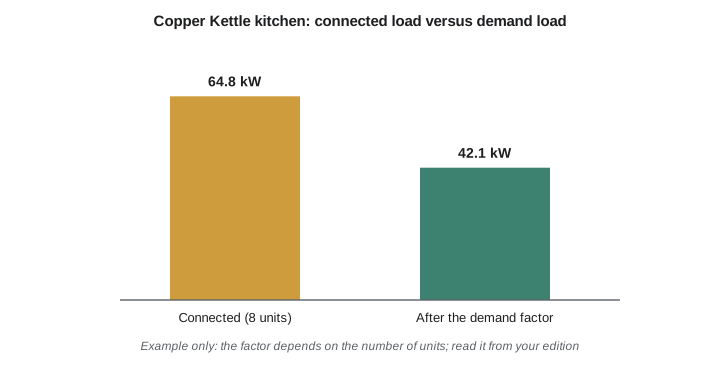
- Connected: 15 + 11.5 + 14 + 14 + 6.3 + 2 + 1.2 + 0.8 = 64.8 kW.
- Demand: 0.65 × 64.8 = 42.12 kW.
- Check the floor: the two largest loads are 15 + 14 = 29 kW. The demand of 42.12 kW is larger, so it stands.
Answer: 42.12 kW, or 42,120 VA.
The two-largest-loads check matters for small kitchens. If a coffee shop has three units of 12 kW, 1 kW and 1 kW, a demand factor applied to 14 kW might give less than 13 kW, the sum of the two largest, and the check sets the minimum at 13 kW.
The restaurant by the standard rules
With the kitchen demand in hand, the rest of the restaurant is calculated like any commercial occupancy. The Copper Kettle is 2,800 square feet. This course's example uses 1.5 VA per square foot as the restaurant unit load from Table 220.12. It has 30 general-use receptacles, an 18,000 VA rooftop unit whose largest motor is 10,000 VA, a 6,000 VA walk-in cooler system and one sign outlet.
Worked problem
The Copper Kettle's feeder
Find the restaurant's feeder load and current at 208Y/120 V three phase.
Show solution
- Lighting: 2,800 × 1.5 = 4,200 VA; continuous: 4,200 × 1.25 = 5,250 VA.
- Receptacles: 30 × 180 = 5,400 VA (under 10 kVA, no reduction).
- Rooftop unit: 18,000 + 0.25 × 10,000 = 20,500 VA.
- Walk-in cooler: 6,000 VA.
- Kitchen equipment: 42,120 VA.
- Sign: 1,200 × 1.25 = 1,500 VA.
- Total: 5,250 + 5,400 + 20,500 + 6,000 + 42,120 + 1,500 = 80,770 VA.
- Current: 80,770 ÷ 360.3 = 224.2 A.
Answer: About 224.2 A.
The optional method for new restaurants
Section 220.88 offers an optional calculation for a new restaurant's service or feeder. You total the connected load of everything, including heating, air conditioning and the kitchen at nameplate, with no 125% factors and no separate demand factors, and then apply the factor from Table 220.88 for that size of connected load. The table has two columns, one for all-electric restaurants and one for restaurants that are not all electric, and the factors step down as the connected load grows. This course's example uses 80% for an all-electric restaurant with a connected load of not more than 200 kVA.
Worked problem
The Copper Kettle by 220.88
Treat the Copper Kettle as all electric. Find its load by the optional method.
Show solution
- Connected load: lighting 4,200 + receptacles 5,400 + rooftop unit 18,000 + walk-in 6,000 + kitchen 64,800 + sign 1,200 = 99,600 VA.
- Optional demand: 0.80 × 99,600 = 79,680 VA.
- Current: 79,680 ÷ 360.3 = 221.2 A.
Answer: About 221.2 A.
For this restaurant, both methods land close together. The optional method is most useful for larger restaurants, where the Table 220.88 factors fall further, and its simplicity makes it a favorite exam question. The section says the method applies to new restaurants; for an existing restaurant, use the standard rules or 220.87's measured demand method in Lesson 11.
The optional method for schools
Section 220.86 provides an optional calculation for the feeder or service of a school equipped with electric space heating, air conditioning or both. You divide the total connected load by the floor area to get volt-amperes per square foot, then apply Table 220.86, which takes the first few volt-amperes per square foot at 100%, a middle band at a reduced value and anything above that at a lower value again. The result per square foot times the floor area is the demand load. Feeders inside the building, and some specific loads such as the cooking equipment of a school kitchen, are calculated by the standard rules instead; read the section's conditions carefully.
This course's example uses Table 220.86 bands of 3 VA per square foot at 100%, the portion from 3 to 20 VA per square foot at 75%, and any portion over 20 VA per square foot at 25%; confirm them in your edition.
Worked problem
Harlow's Ridgeview Elementary
A new all-electric elementary school is 40,000 sq ft with a total connected load of 600,000 VA, served at 480Y/277 V. Find its service load by the optional method.
Show solution
- Connected load per square foot: 600,000 ÷ 40,000 = 15 VA per sq ft.
- First 3 VA per sq ft at 100%: 3.
- The next 12 VA per sq ft (from 3 to 15) at 75%: 9.
- Demand: 3 + 9 = 12 VA per sq ft; 12 × 40,000 = 480,000 VA.
- Current: 480,000 ÷ 831.4 = 577.3 A.
Answer: About 577.3 A.
Without the optional method, the school's heating, cooling and lighting would be counted mostly at 100% plus the 125% factor on continuous loads, and the result would be far larger. The optional method reflects measured school demand, where classrooms are not all heated, lit and running computers at full load at the same moment.
Farm loads
Farms appear on master exams in states with a lot of agriculture, and the rules in Part V of Article 220 are compact. Section 220.102 covers the feeder to each farm building other than the dwelling. Loads expected to operate without diversity, such as a grain dryer or ventilation fans that all run together, are taken at 100%, but not less than 125% of the largest motor's full-load current and not less than the first 60 amperes of the building's load. The next 60 amperes are taken at 50%, and the remainder at 25%. The dwelling is calculated by the dwelling methods.
Worked problem
A machine shed feeder
The Kowalczyk farm's machine shed has 45 A of load that operates without diversity and 110 A of other load, all at 240 V, for a total of 155 A. Find the feeder demand using 220.102's structure.
Show solution
- The without-diversity load (45 A) is less than 60 A, so the first 60 A of the total is taken at 100%: 60 A.
- Next 60 A at 50%: 30 A.
- Remainder: 155 − 120 = 35 A at 25%: 8.75 A.
- Total: 60 + 30 + 8.75 = 98.75 A.
Answer: About 98.8 A.
Section 220.103 then combines the farm buildings for a common service. The largest calculated building load is taken at 100%, the second largest at a reduced value, the third at a lower value, and the rest at a lower value still. This course's example uses 100%, 75%, 65% and 50%; check Table 220.103 in your edition, and check how it treats the farm dwelling, which is calculated by the dwelling methods.
Worked problem
Combining the farm buildings
The farm's calculated building loads are 140 A for the grain dryer building, 98.75 A for the machine shed and 60 A for the barn. Find their combined load for the service.
Show solution
- Largest: 140 × 1.00 = 140 A.
- Second: 98.75 × 0.75 = 74.06 A.
- Third: 60 × 0.65 = 39 A.
- Total: 140 + 74.06 + 39 = 253.06 A, before the dwelling.
Answer: About 253 A, plus the dwelling as calculated by its own method.
| Occupancy | Section | Main idea |
|---|---|---|
| Commercial kitchen equipment | 220.56 | Demand factor by number of units; never less than the two largest |
| New restaurant (optional) | 220.88 | Total connected load times a factor by size; all-electric column |
| School with electric heat or A/C (optional) | 220.86 | Banded factors on VA per square foot |
| Farm building (not dwelling) | 220.102 | First 60 A at 100%, next 60 A at 50%, rest at 25% |
| Farm service | 220.103 | Largest building load at 100%, then reduced factors |
def kitchen_demand(kw_list, factor):
    return max(sum(kw_list) * factor, sum(sorted(kw_list)[-2:]))

def school_va_per_sqft(connected_va, sqft):
    d = connected_va / sqft
    return min(d, 3) + 0.75 * max(min(d, 20) - 3, 0) + 0.25 * max(d - 20, 0)

def farm_building(total_a, no_diversity_a):
    first = max(60, no_diversity_a)
    a = min(total_a, first)
    b = min(max(total_a - first, 0), 60) * 0.5
    c = max(total_a - first - 60, 0) * 0.25
    return a + b + c

print("Kitchen:", round(kitchen_demand([15, 11.5, 14, 14, 6.3, 2, 1.2, 0.8], 0.65), 2), "kW")
print("School:", school_va_per_sqft(600000, 40000), "VA per sq ft")
print("Machine shed:", farm_building(155, 45), "A")Kitchen: 42.12 kW School: 12.0 VA per sq ft Machine shed: 98.75 A
Telling the methods apart under exam pressure
These five rules are easy to confuse because each one reduces a load with a short list of factors. The fastest way to keep them straight is to remember what each one counts. The kitchen rule counts pieces of equipment. The restaurant optional method counts kilovolt-amperes of connected load. The school optional method counts volt-amperes per square foot. The farm building rule counts amperes, in blocks of 60. The farm service rule ranks whole buildings. If a question gives you a number of appliances, it is pointing you at 220.56; if it gives a floor area and a connected load for a school, it is pointing at 220.86.
Each optional method also has conditions. The restaurant method is for new restaurants, and the factor depends on whether the restaurant is all electric, which usually means electric cooking and electric heating. The school method requires electric space heating, air conditioning or both, and it covers the service or main feeder rather than every feeder inside the building. Exam questions sometimes describe a restaurant with gas cooking or a school with no air conditioning and electric heat only in one wing, and the details decide which column or which method applies.
Finally, notice that the commercial kitchen factor in 220.56 and the restaurant optional method in 220.88 are alternatives, not steps to combine. The standard calculation applies the kitchen factor to the cooking equipment and adds the other loads with their own rules; the optional calculation takes everything at connected value and applies one factor to the whole. Applying the kitchen factor first and then the restaurant factor double counts the diversity, produces a load that is too small, and is a common wrong answer.
Common mistakes
MistakeApplying the kitchen demand factor to the rooftop unit or exhaust fans.
InsteadTable 220.56 applies to cooking and kitchen equipment, not to heating, ventilating or air conditioning.
MistakeLetting the kitchen demand fall below the two largest loads.
InsteadThe demand may never be less than the sum of the two largest kitchen loads.
MistakeUsing 220.88 for an existing restaurant.
InsteadThe section is for new restaurants; existing ones use the standard rules or measured demand.
MistakeApplying the school bands to total VA instead of VA per square foot.
InsteadDivide by floor area first, apply the bands per square foot, then multiply back.
MistakeApplying farm combining factors in the order buildings are listed.
InsteadThe largest calculated load gets 100%, the second largest the next factor, and so on.
Summary and key terms
- Commercial kitchen equipment gets a demand factor by number of units from Table 220.56, but never less than the two largest loads.
- The optional method for new restaurants in 220.88 takes total connected load times a factor from Table 220.88, with separate all-electric values.
- The optional method for schools in 220.86 applies banded factors to connected volt-amperes per square foot.
- A farm building feeder under 220.102 takes the first 60 A (or more) at 100%, the next 60 A at 50% and the rest at 25%.
- A farm service under 220.103 combines building loads by rank, with the largest at 100% and reduced factors after it.
- Heating, ventilating and air-conditioning loads are counted by their own rules, not by the kitchen factor.
- Commercial cooking equipment
- Ranges, ovens, fryers and similar appliances in a commercial kitchen.
- Booster heater
- A water heater that raises dish machine rinse water to sanitizing temperature.
- All-electric restaurant
- A restaurant whose cooking and heating are electric, for the Table 220.88 column.
- Without diversity
- Loads expected to run at the same time, such as a grain dryer's fans and heaters.
- Farm dwelling
- The farmhouse, calculated by the dwelling methods, not the farm building rules.
- Connected load
- The total of the ratings of all equipment connected, before demand factors.
Practice problems
Work each problem on paper first, then reveal the answer to check.
Seven kitchen units total 50 kW, and the two largest are 12 kW and 10 kW. Using 65%, find the demand.
Show answer
0.65 × 50 = 32.5 kW, larger than 22 kW, so 32.5 kW.
Three kitchen units are 12 kW, 1 kW and 1 kW. Using a factor of 90%, what demand applies?
Show answer
0.9 × 14 = 12.6 kW, less than 13 kW, so 13 kW.
A school has 20 VA per square foot of connected load. Find its demand per square foot with the example bands.
Show answer
3 + 0.75 × 17 = 15.75 VA per sq ft.
A farm building totals 90 A with 30 A operating without diversity. Find its feeder demand.
Show answer
60 + 0.5 × 30 = 75 A.
Farm buildings calculate at 80 A, 120 A and 50 A. Combine them with the example factors.
Show answer
120 + 0.75 × 80 + 0.65 × 50 = 120 + 60 + 32.5 = 212.5 A.
Lesson quiz · 5 questions
Score 60% or more to complete this lesson.
Create a free account to save your progress, take quizzes and earn a certificate.