
MELU-310 · Lesson 7 of 12 · 19 min
Duties and responsibilities of the Electrical Contractor License holder
▶ Video coming soon A video version of this lesson is on the way.
In April, two weeks after Keisha passed both exams and her license was assigned to Stillwater, Dale took her to lunch at a diner near the shop. He had held the company's license for thirty-five years, and he wanted to explain what it really meant. "When the board looks at a job we did, they don't look at the company first," he said. "They look at the person whose license is on it. From now on, that's you. Every permit, every crew, every change order. If something goes wrong, the first question is whether you were supervising." Keisha had read section 4740.07 the night before, and she knew he was describing the law almost word for word.
This lesson covers what Ohio law expects from the individual whose electrical contractor license is assigned to a company: supervision, active engagement and availability, the one-company rule, the effect of leaving or dying, reporting duties, and the conduct that can lead to discipline. It is based on Chapter 4740 and the board's rules as of late 2026; read the statute and rules for the exact wording.
Licenses are issued to individuals
Section 4740.07 says the board issues licenses in the name of the individual who qualifies, and the individual requests, at the time of application, that the license be assigned to the individual's employer. The company that receives the assignment is the contracting company that may contract for electrical work under the license. The license certificate identifies both the individual and the company. A company cannot hold an electrical contractor license in its own right; it can only use a license assigned to it by a licensed individual.
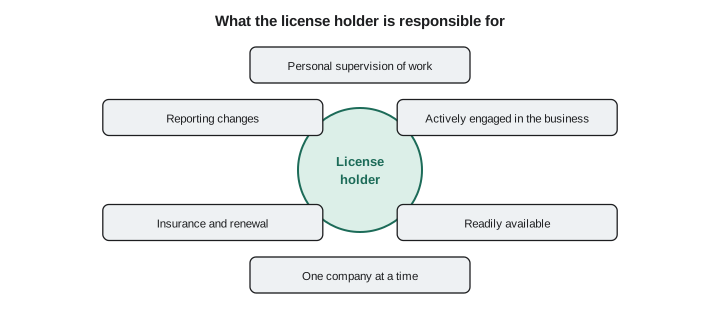
That arrangement puts real responsibility on the individual. The statute provides that work done under an assigned license is deemed to be done under the personal supervision of the individual named on the license, and it requires that individual to be actively engaged in the business and readily available for consultation with the contracting company. The law does not allow a license holder to lend a name to a company and stay away from the work.
Personal supervision in practice
Personal supervision does not mean the license holder must stand beside every electrician on every job. A company with nineteen electricians on five sites at once could not work that way. It means the license holder controls how the company performs electrical work: who is assigned to each job, how work is planned and checked, how code questions are answered, how inspections are prepared for and how corrections are made. The license holder should be able to show that systems exist for each of these things and that the license holder actually runs them.
Keisha set up three habits in her first month. Every Monday she reviewed the week's permits, inspections and crew assignments with the foremen. Every job had a written pre-inspection checklist that the foreman signed before calling for an inspection. And any code question that a foreman could not answer from the approved plans came to her by phone, with the answer written into the job file. None of these habits is required by name in the statute, but together they are good evidence of personal supervision if the board ever asks.
Active engagement and availability
The requirement that the license holder be actively engaged in the business and readily available for consultation means the license holder must actually work for the company in a role that allows supervision. A license holder who has moved out of state, works full time for another employer, or cannot be reached during working hours may not meet this requirement. Questions about availability often arise when an owner retires: if Dale had moved to Florida and stayed on as the license holder, the company would have had a problem long before the board noticed.
One company at a time
Section 4740.07 allows a license to be assigned to only one contracting company at a time, and the individual may not assign the same type of license to another company until the first assignment is no longer valid. A license holder who wants to work for a different company must end the first assignment before starting the second. This rule prevents one license from being used by several companies, which would make real supervision impossible.
| Event | What happens to the assignment | Practical step |
|---|---|---|
| License holder dies | Assignment becomes invalid 90 days later | Company has 90 days to arrange a new license holder |
| License holder changes companies | Assignment becomes invalid 90 days after the change form, or sooner by agreement | File the board's change form; plan the transition |
| License not assigned to any company | License is placed in inactive status | Reactivate by assigning it to a company with insurance |
| License holder retires but keeps license | Assignment continues only if the holder stays actively engaged | Transfer responsibility to a new license holder |
Leaving the company or dying
The statute gives a company time to adjust when its license holder leaves. An assignment becomes invalid ninety days after the license holder's death, or ninety days after a change-of-company form is completed, or earlier if the parties agree. During that period the company may finish work and arrange for another licensed individual to assign a license to it. A license that is not assigned to any company is placed in inactive status, and the individual can reactivate it by assigning it to a new company and meeting the insurance and renewal requirements.
For a family business, the ninety days can be a lifeline, but it is also a deadline. Dale's plan was to let Keisha's license replace his, then keep his own license active but unassigned in case he ever wanted to consult. Stillwater's attorney recommended putting the plan in writing, with dates, so that no permit would ever be pulled under a license that was no longer assigned to the company.
# Ninety-day assignment window after a change (study aid)
from datetime import date, timedelta
events = [
    ("change-of-company form filed", date(2027, 6, 1)),
    ("license holder's death", date(2027, 9, 15)),
]
for event, d in events:
    ends = d + timedelta(days=90)
print(f"{event} on {d.isoformat()} -> assignment invalid after {ends.isoformat()}")change-of-company form filed on 2027-06-01 -> assignment invalid after 2027-08-30 license holder's death on 2027-09-15 -> assignment invalid after 2027-12-14
Keeping the license in good standing
The license holder is responsible for keeping the license current. That includes renewing every year with the fee and continuing education described in Lesson 11, maintaining at least 500,000 dollars of contractor liability insurance under the assigned company, and keeping the board informed of changes such as a new company, a new address or a change in the company's legal form. A license that lapses because renewal was missed means the company cannot legally contract for licensed electrical work until it is reinstated, and building departments may refuse permits in the meantime.
Conduct that can lead to discipline
Chapter 4740 authorizes the board's sections to discipline license holders. Possible actions include reprimands, fines, required education, probation, and suspension or revocation of the license. The grounds include violating the chapter or the board's rules; obtaining or renewing a license by fraud, misrepresentation or deception; using fraud or deception in conducting business; failing to maintain the required insurance; and allowing the license to be used by a company the holder does not supervise. Building departments and customers can file complaints, and the division investigates them. A license holder facing a complaint has the right to notice and a hearing under the Ohio administrative procedure law.
Most discipline cases begin with something ordinary: a job started without a permit, a customer who was not paid back after a deposit, a lapse in insurance, or a license that was used by a company after its holder left. The best protection is the set of habits Keisha built in her first month and a calendar that never lets renewal or insurance slip.
Worked problem
A license used after its holder left
Marcus held the electrical license assigned to a small contractor in Springfield. He left in March and filed the change-of-company form on March 10. In July, the contractor pulled a commercial permit using Marcus's license number. Who has a problem?
Show solution
- Ninety days after March 10 is June 8; the assignment became invalid then, if not sooner by agreement.
- In July the contractor had no valid license assignment, so it was contracting without a license.
- Marcus could also face questions if he knew the license was still being used and did nothing.
- The building department may revoke the permit, and the board may act on complaints against the company and, potentially, the license holder.
Answer: The contractor was unlicensed after June 8; Marcus should confirm in writing that his license is no longer assigned and report misuse.
Supervision across several job sites
Stillwater runs five or six jobs at a time, and Keisha cannot be at all of them. Her supervision system has four parts. Each job has a foreman she has trained and trusts, with a written list of decisions the foreman may make and decisions that must come to her. Each job has a weekly plan reviewed at the Monday meeting. Each inspection is preceded by the signed checklist from Lesson 6. And each code question that is not answered by the approved plans comes to her, with the answer recorded in the job file. She also visits every active job at least once a week, more often at critical stages such as service installation and energizing.
This system is not required by name in the statute, but it gives meaning to the statutory phrase personal supervision. If a complaint ever reached the board, Keisha could show the meeting notes, the checklists, the job files and her visit log. That record is the difference between a license holder who supervises and one who only signs.
Advertising and representations
A license holder should also make sure the company describes its license accurately. Advertising, bids, contracts and vehicle signs should not claim licenses the company does not hold, and they should not suggest that someone other than the license holder holds the license. Many contractors show the license number on contracts and bids so customers and building departments can verify it. When a license holder leaves, the company should update its materials promptly so they do not suggest a license that is no longer assigned to it.
Customers sometimes ask whether Stillwater is licensed for residential work. Keisha's answer is accurate: the state license covers commercial work, and the company holds the local registrations required for residential work in the jurisdictions where it works. Being precise about what a license covers is part of conducting business honestly, which the statute requires.
When the license holder is away
Vacations, illness and training days are normal, and the duty to be readily available does not mean a license holder can never leave. It does mean planning. Before a planned absence, Keisha tells the foremen which decisions can wait, which can go to Ray, and how to reach her for anything that cannot wait. She avoids scheduling service changes, energizing or major inspections during her absences. A license holder who is away for long stretches with no plan for supervision risks the question the statute asks: was the work actually under that person's supervision?
Common mistakes
MistakeTreating the license holder as a name on paper.
InsteadThe holder must personally supervise the company's electrical work and be actively engaged and available.
MistakeAssigning one license to two companies.
InsteadA license may be assigned to only one contracting company at a time.
MistakeIgnoring the ninety-day window after a holder leaves.
InsteadThe assignment becomes invalid after ninety days; arrange a new license holder before then.
MistakeLetting insurance lapse between renewals.
InsteadRequired insurance must be maintained continuously, and a lapse is a ground for discipline.
Summary and key terms
- Ohio licenses are issued to individuals and assigned to one contracting company at a time.
- Work done under an assigned license is deemed to be under the holder's personal supervision, and the holder must be actively engaged and readily available.
- An assignment becomes invalid ninety days after the holder's death or a change-of-company form, or sooner by agreement; unassigned licenses go inactive.
- The holder must keep the license renewed, insured and up to date with the board.
- The board may reprimand, fine, suspend or revoke for violations, fraud, insurance failures and license misuse.
- Assigned license
- An individual's license designated for use by one contracting company.
- Personal supervision
- The legal presumption that work under an assigned license is supervised by the named individual.
- Inactive status
- The status of a license that is not assigned to any company.
- Change-of-company form
- The board form that starts the ninety-day end of an assignment.
- Discipline
- Board actions such as reprimand, fine, probation, suspension or revocation.
Practice problems
Work each problem on paper first, then reveal the answer to check.
Can a company hold an Ohio electrical contractor license in its own name?
Show answer
No. Licenses are issued to individuals and assigned to companies.
How long after a license holder's death does the assignment remain valid?
Show answer
Ninety days.
What happens to a license that is not assigned to any company?
Show answer
It is placed in inactive status.
Name two grounds for discipline.
Show answer
Any two of: violating the chapter or rules, fraud in licensing or business, failing to keep required insurance, or allowing license misuse.
Lesson quiz · 5 questions
Score 60% or more to complete this lesson.
Create a free account to save your progress, take quizzes and earn a certificate.