
MELU-321 · Lesson 2 of 12 · 19 min
Eligibility for the Master Electrician License
▶ Video coming soon A video version of this lesson is on the way.
Angela's first question after the conversation with Hal was the obvious one: was she even eligible? She had heard three different answers from three different people at the supply house counter. One said you needed four years as a journeyman. Another said you needed a degree or a long list of classroom hours. A third said the rules had just changed. The third person was the closest to right. Virginia reorganized the qualification sections of the individual license regulations in a set of amendments that took effect on April 1, 2025, and the experience routes to the master license are now set out in a single section, 18VAC50-30-39, which covers the qualifications for examination approval for tradesman licenses.
This lesson works through that section as it applies to electricians. It covers the journeyman routes, because most master candidates arrive by way of a journeyman license, the master routes, how experience is counted and documented, what happens with experience gained in other states, and how the universal license recognition process works for people who already hold a license elsewhere. It closes with a short look at the character and disclosure questions on the application, which trip up more applicants than the experience questions do.
The journeyman routes
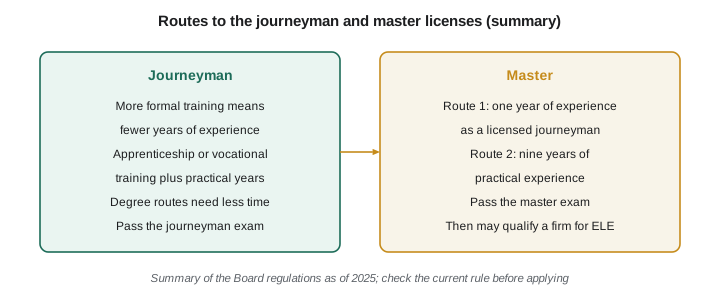
Because the most common route to a master license runs through the journeyman license, it helps to know how the journeyman license itself is earned. Under 18VAC50-30-39 a journeyman electrician applicant combines formal training with practical experience in the trade, and the more formal training you have, the less experience you need. A bachelor's degree in an engineering curriculum related to the trade is paired with one year of practical experience. An associate degree or a two-year certificate in a tradesman-related field is paired with two years. Vocational training is counted in hours: 240 hours of training with four years of experience, 160 hours with five years, 80 hours with six years, and 40 hours with seven years.
An applicant with no formal training at all can still qualify for the journeyman exam with eight years of practical experience in the trade. That route exists for electricians who learned on the job, which describes a large share of the trade in rural Virginia. Angela's path was typical of apprentices: her registered apprenticeship included classroom instruction that more than covered the top training tier, and she had more than four years of practical experience when she applied, so she qualified for and passed the journeyman exam in 2019.
| Formal training | Practical experience needed (journeyman) |
|---|---|
| Bachelor's degree in a related engineering curriculum | 1 year |
| Associate degree or two-year certificate in a related field | 2 years |
| 240 hours of vocational training | 4 years |
| 160 hours | 5 years |
| 80 hours | 6 years |
| 40 hours | 7 years |
| No formal training | 8 years |
The master routes
For the master license the regulation offers different routes, and for electricians two of them matter. The first, and by far the most common, is to have held a valid journeyman license in the trade for at least one year. The second is nine years of practical experience in the trade, with no requirement to have held a journeyman license first. A third route in the same section, based on three years of holding a residential tradesman license, applies to trades that have residential licenses, such as HVAC and plumbing; it is not a route for electricians, so do not let an exam question lure you into applying it.
Angela had held her journeyman license since 2019, so she cleared the one-year route with years to spare. Kenny Cho, the Mill Mountain electrician who had never sat for the journeyman exam, was the person for whom the nine-year route was written. He had worked in the trade for nine years and two months, first for a small residential contractor in Bedford County and then for Mill Mountain, and he wanted to know whether he could skip the journeyman exam entirely. The answer under the current regulation is that he may apply directly for approval to sit the master exam, provided he can document nine years of practical experience in the electrical trade.
Kenny still had a decision to make. The master exam is longer and harder than the journeyman exam, and a candidate who has never taken the journeyman exam has never practiced the open-book lookup skills it builds. Hal suggested that Kenny think about taking the journeyman exam first and then the master exam a year later, even though he did not strictly need to. Many experienced electricians make the same choice. The regulation gives you the right to apply; it does not promise the exam will be easy.
What counts as practical experience
Practical experience means work in the trade itself: installing, altering, repairing and maintaining electrical systems under the conditions the license is meant to cover. Experience is generally counted in years of full-time work, and part-time work is prorated. Time spent in unrelated work, even for an electrical company, does not count. Estimating, sales, warehouse work and office management may be valuable, but they are not practical experience in the trade. Denise Whitlock, who had run the Mill Mountain office for twenty years and knew more about permits than anyone in the company, could not count any of that time toward an electrician license.
Experience must be verified. DPOR's application uses an experience verification form signed by a person who can attest to the work, normally a supervisor or employer, and the Board may ask for more evidence, such as tax records, pay records or a list of projects. Military experience in an electrical rating can count, as can experience gained in another state, provided it is practical experience in the trade. Keep a running log of employers, dates, hours and the kind of work performed. Kenny had changed employers once and had worked a few months for a contractor that later closed, so he spent an evening collecting old pay stubs and a written statement from his former supervisor before he applied.
# Does Kenny's documented experience reach the master threshold? (study aid)
# Each entry: employer, years of full-time-equivalent work in the trade
history = [
    ("Bedford County residential contractor", 3.5),
    ("Contractor that closed (part-time, 20 h per week for 1 year)", 0.5),
    ("Mill Mountain Electric", 5.25),
]
total = sum(years for _, years in history)
print(f"Documented practical experience: {total:.2f} years")
print("Meets the nine-year master route" if total >= 9 else "Short of the nine-year route")

# Angela: journeyman license held since mid-2019
journeyman_years = 2026.8 - 2019.5
print(f"Angela has held a journeyman license for about {journeyman_years:.1f} years")
print("Meets the one-year journeyman route" if journeyman_years >= 1 else "Not yet")Documented practical experience: 9.25 years Meets the nine-year master route Angela has held a journeyman license for about 7.3 years Meets the one-year journeyman route
The calculation shows the arithmetic of proration. Kenny's part-time year at twenty hours a week counted as half a year, which brought his total to nine and a quarter years. Had he worked fewer hours, he could have fallen short and needed another few months before applying. The Board, not the applicant, decides how experience is counted, so treat any self-calculation as a planning tool and give the Board complete records.
Licenses and experience from other states
Virginia has a universal license recognition process for people who already hold a license elsewhere. Under the DPOR application for universal license recognition, an applicant generally must hold a current license from another state that has been held for at least one year, and the other state must have required an examination and education, training or experience to obtain it. An applicant from a state that does not regulate the profession may qualify with at least three years of work in that state. Letters of good standing must come directly from each state board, and DPOR may require an examination on Virginia laws and regulations.
Recognition is not automatic, and the details matter. A license from another state must correspond to the Virginia license sought, so a person holding only a residential electrician license elsewhere should not expect recognition as a Virginia master. Applicants must also disclose disciplinary actions and certain criminal convictions. For candidates who do not qualify for recognition, experience gained in another state can still count toward the experience routes in 18VAC50-30-39 if it is properly documented. Marcus Reid, who had moved to Roanoke from North Carolina, used his out-of-state years toward his Virginia journeyman application rather than seeking recognition, because his North Carolina credential did not match a Virginia license class.
Character and disclosure questions
Every DPOR application asks about criminal convictions, disciplinary actions by other boards, and pending complaints. Applicants must disclose felony convictions and certain misdemeanor convictions, and changes that occur after the application is filed must be reported before a license is issued. A conviction is not an automatic bar; the Board considers the nature of the offense, how long ago it occurred and evidence of rehabilitation. What causes real trouble is failing to disclose something the Board later finds. Honest disclosure with supporting documents is almost always the right approach, and an applicant with a complicated history should talk to a lawyer before filing.
Applicants must also be at least eighteen years old, provide a mailing address and keep DPOR informed of address changes. Fees are not refundable, so check the form carefully before paying. The 2026 application forms list a fee of 171.75 dollars for a tradesman license application, with an added technology fee under 2026 legislation; Lesson 3 covers fees and timing in more detail.
Planning the timeline
Eligibility is only the first date on a calendar. Once you know you qualify, work backward from the date you want to hold the license. Allow time to gather experience records and letters, time for DPOR to review the application, time to book an exam seat, and a realistic study period, which for most working electricians is ten to fourteen weeks of steady evening and weekend study. Angela and Hal sat down with a wall calendar and blocked out each step: two weeks for paperwork, a few weeks for review, and a twelve-week study plan ending in a February exam date, well before the spring when Mill Mountain's apartment work would pick up.
Kenny's calendar looked different. Because he was applying on the nine-year route without a journeyman license, he expected more questions from DPOR about his experience and allowed extra time for them. He also built in a longer study period, since he had never taken a Virginia licensing exam and wanted to practice open-book lookups from scratch. Both plans shared one rule Hal insisted on: never schedule the exam during the busiest month of the year at work. A candidate who is tired and distracted by job pressures loses the careful reading that open-book exams reward.
Worked problem
Checking eligibility
Eli Frazier, the Mill Mountain apprentice, will finish a registered apprenticeship in 2028 with more than 240 hours of classroom training and four years of experience. He asks how soon he could become a master electrician if everything goes to plan. What is the shortest path under the current regulation?
Show solution
- With 240 hours of training and four years of experience, Eli qualifies to apply for the journeyman exam.
- If he passes and is licensed as a journeyman in 2028, he then needs one year of holding that journeyman license.
- The nine-year route would take far longer, since he would need nine years of practical experience.
- The shortest path is journeyman licensure in 2028, then the master exam once he has held the journeyman license for one year.
Answer: Journeyman first, then the master exam after one year as a licensed journeyman, so 2029 at the earliest if all goes to plan.
Common mistakes
MistakeApplying the old rule of four years as a journeyman.
InsteadUnder the 2025 regulations the master route is one year holding a journeyman license, or nine years of practical experience.
MistakeUsing the residential-license route for an electrician.
InsteadThat route is for trades with residential licenses, such as HVAC and plumbing.
MistakeCounting office, sales or warehouse time as practical experience.
InsteadOnly work in the trade itself counts, and part-time work is prorated.
MistakeLeaving a conviction off the application because it was long ago.
InsteadDisclose it as the form requires; nondisclosure causes far more trouble than the conviction itself.
Summary and key terms
- Eligibility for the master exam is set by 18VAC50-30-39, effective April 1, 2025.
- Journeyman routes trade formal training against experience, from one year with an engineering degree to eight years with no training.
- Master routes for electricians: at least one year holding a journeyman license, or nine years of practical experience.
- Experience must be in the trade, documented on DPOR's forms, and prorated for part-time work.
- Universal license recognition is available for people licensed in another state for at least one year, subject to DPOR's conditions.
- Practical experience
- Work in the electrical trade itself, counted in full-time-equivalent years.
- Journeyman route
- The master route requiring at least one year of holding a valid journeyman license.
- Nine-year route
- The master route based on nine years of practical experience without a journeyman license.
- Universal license recognition
- DPOR's process for recognizing a license held in another state for at least one year.
- Experience verification form
- The DPOR form on which a supervisor or employer verifies an applicant's experience.
Practice problems
Work each problem on paper first, then reveal the answer to check.
A journeyman licensed in March 2025 asks whether he may apply for the master exam in May 2026. Does he meet the journeyman route?
Show answer
Yes. He has held a journeyman license for more than one year by May 2026.
An electrician has eight and a half years of documented practical experience and no license. Can she apply for the master exam?
Show answer
Not yet under the nine-year route; she needs another half year, or she can take the journeyman route first.
Which master route applies only to trades with residential licenses?
Show answer
The route based on three years of holding a residential tradesman license.
Lesson quiz · 5 questions
Score 60% or more to complete this lesson.
Create a free account to save your progress, take quizzes and earn a certificate.