
PHOT-311 · Lesson 5 of 12 · 27 min
Sun, weather and timing
An architectural photographer cannot move the building, but can choose when to photograph it. The sun's position, the weather and the season decide which faces are lit, how long and how dark the shadows are, how textured materials look and what the sky contributes. This lesson explains how the sun moves, how to predict its position and the length of shadows, how golden hour and blue hour work, and how weather and seasons affect architectural images.
How the sun moves
The sun rises roughly in the east and sets roughly in the west, but the exact directions and its height change through the year. At the equinoxes, around 20 March and 22 September, the sun rises due east and sets due west everywhere, and is above the horizon for about 12 hours. In the northern summer it rises north of east, swings high across the southern sky (for observers north of the tropics) and sets north of west, giving long days. In winter it rises south of east, stays low in the south and sets south of west.
This has direct consequences. In the northern hemisphere, south-facing facades receive sun for most of the day year-round. East facades are lit in the morning and west facades in the afternoon. North facades receive direct sun only early and late on summer days, and are in shade otherwise; they are often best photographed under bright overcast or at twilight.
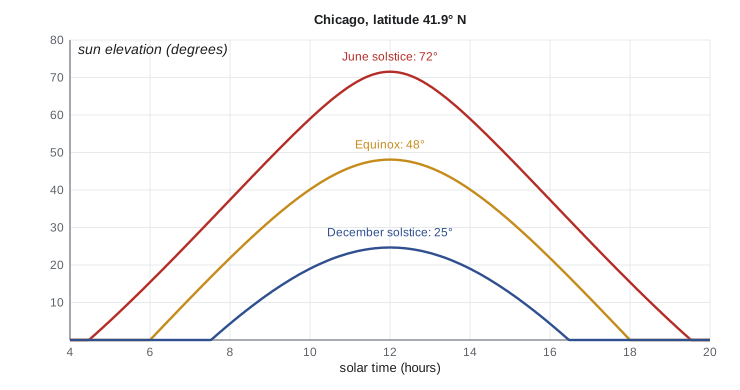
Sun elevation at noon
The sun's angle above the horizon at solar noon, when it is highest, depends on latitude \( \varphi \) and the solar declination \( \delta \), which varies from about +23.4° at the June solstice to −23.4° at the December solstice:
Solar noon is not the same as 12:00 on the clock. It depends on longitude within the time zone, daylight saving time and a small seasonal correction called the equation of time; in much of North America during daylight saving time, solar noon falls between about 12:45 and 13:45.
Worked problem
Noon sun and shadow length
In Chicago (latitude 41.9° N), how high is the sun at solar noon on the June and December solstices, and how long is the shadow of a 30 ft wall on level ground at each?
Show solution
- June: h = 90 − 41.9 + 23.4 = 71.5°.
- December: h = 90 − 41.9 − 23.4 = 24.7°.
- Shadow length L = height / tan(h).
- June: 30 / tan(71.5°) = 30 / 2.99 ≈ 10 ft. December: 30 / tan(24.7°) = 30 / 0.46 ≈ 65 ft.
Answer: About 71.5° in June with a 10 ft shadow, and about 25° in December with a shadow of about 65 ft. Winter noon light is low and raking, with long shadows that can fill courtyards and streets.
Azimuth and planning tools
The sun's compass direction is its azimuth, measured clockwise from north. At solar noon in the northern hemisphere outside the tropics, the azimuth is 180° (due south). Sunrise and sunset azimuths shift north in summer and south in winter; at mid-northern latitudes near the June solstice, the sun rises around 55° to 60° and sets around 300° to 305°, so it can light north-facing facades early and late.
Photographers no longer need to calculate these by hand. Planning apps and websites show the sun's path over a map for any date and location, the times of sunrise, sunset and twilight, and the direction and length of shadows. Many show the sun's position through the phone's camera in augmented reality. Use them during the recce: stand at each planned vantage point and note when the main facade will be lit, when shadows from neighboring buildings or trees will cross it, and when the facade will be in even shade.
Neighboring buildings matter in cities. A facade may be technically south-facing but in shadow from a tower across the street for most of the day. Only a site visit or a 3-D planning tool reveals this.
Choosing the light for exteriors
Different lighting conditions suit different buildings and purposes.
- Side light, with the sun at about 30° to 60° to the facade, models depth: mullions, balconies, fins and textures cast shadows that reveal form. It is the classic choice for most facades.
- Front light, with the sun behind the camera, shows color and detail evenly but flattens form, and the photographer's own shadow can enter the frame.
- Back light, with the facade in shade and the sun behind the building, often silhouettes it; useful for dramatic skylines but rarely for design work, unless the facade is glass and reflects a bright sky.
- Oblique corner light puts one face in sun and the adjacent face in shade, giving the strongest sense of volume.
- Bright overcast gives soft, even light with no hard shadows. It suits north facades, interiors near windows, complex buildings where shadows would confuse, and real estate exteriors where the sky can be replaced later (with disclosure where required, see lesson 11).
- Midday summer sun from high above gives short, deep shadows under overhangs and makes facades look flat. Many photographers avoid it except for courtyards and spaces that are only lit at midday.
Golden hour and blue hour
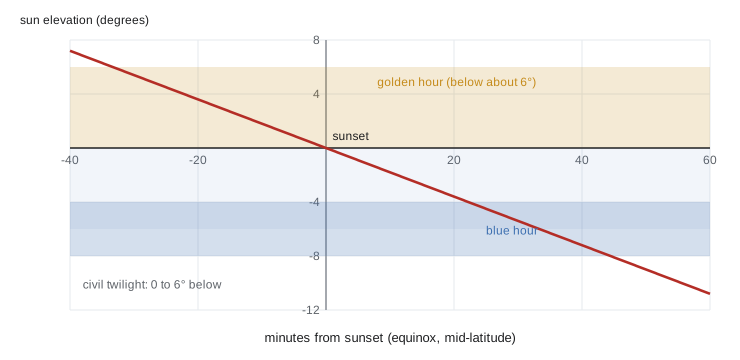
Golden hour is the period just after sunrise and before sunset when the sun is low, roughly below 6° of elevation. Its light is warm, directional and soft, with long shadows. It flatters materials such as stone, brick and wood, and it is popular for residential and landscape-oriented architecture.
Blue hour is the period of twilight after sunset (and before sunrise) when the sun is between about 4° and 8° below the horizon. The sky turns deep blue, and interior and exterior artificial lights balance with the sky. This is the classic time for twilight exteriors, covered in lesson 6.
How long these periods last depends on latitude and season, because the sun crosses the horizon at a steeper angle near the equator and a shallower angle at high latitudes. At the equinox, the sun's elevation changes near the horizon at a rate of about 15° per hour multiplied by the cosine of the latitude.
Worked problem
How long is blue hour?
At the equinox in Chicago (latitude 41.9° N), roughly how long does the sun take to drop from 4° to 8° below the horizon? Compare with Anchorage (61.2° N).
Show solution
- Rate near the horizon ≈ 15° × cos(41.9°) ≈ 15 × 0.744 ≈ 11.2° per hour.
- Time for 4°: 4 / 11.2 ≈ 0.36 hours ≈ 21 minutes.
- Anchorage: 15 × cos(61.2°) ≈ 7.2° per hour; 4 / 7.2 ≈ 0.55 hours ≈ 33 minutes.
Answer: About 21 minutes in Chicago and about 33 minutes in Anchorage at the equinox. Near the solstices the periods are longer at high latitudes, and in midsummer Alaska may have twilight all night.
The practical lesson is that the best twilight window is short. Arrive early, set up while there is still daylight and be ready to shoot the moment the sky and interior lights balance.
Weather
Weather can make or ruin a shoot, so check forecasts and build flexibility into the schedule and the contract. Clear skies give strong, predictable light and blue skies that suit modern buildings. Scattered cumulus clouds add interest but can cast moving shadows across a facade; photographers wait for the facade to be in sun. Thin high cloud softens the sun and is excellent for many buildings. Heavy overcast gives flat light and gray skies, which suit some subjects, especially interiors, but disappoint many clients for exteriors.
Rain and wet surfaces can be beautiful at twilight, with reflections on pavement and glowing windows, but protect equipment and watch for drops on the lens. Snow can transform a building but hides landscaping and site features. Fog can isolate a building against a soft background.
Most architectural contracts include a weather clause: the photographer and client agree on what conditions are acceptable and what happens if the shoot is postponed, such as rescheduling without charge or a reduced postponement fee.
Seasons and landscaping
The season affects more than the sun. New buildings often have immature landscaping, bare soil or temporary fencing. Deciduous trees hide facades in summer and look bleak in winter. Many architects prefer late spring or early autumn, when trees are in leaf but not dense and the sun is at a moderate angle. In northern regions, winter brings very short days and low sun that can be beautiful but limits the number of exterior views per day; snow cover can be either a bonus or a problem.
Schedule exterior shoots for when the landscaping is established, the site is clean and any construction fencing is gone, even if this means returning a second time for exteriors.
| Condition | Effect | Good for |
|---|---|---|
| Side light | Models depth and texture | Most facades |
| Front light | Even color, flat form | Color-critical facades |
| Corner light | One face lit, one in shade | Showing volume |
| Bright overcast | Soft, shadowless | North facades, complex forms, interiors |
| Golden hour | Warm, low, long shadows | Stone, brick, wood, residential |
| Blue hour | Sky balances with artificial light | Twilight exteriors |
| Midday summer sun | Short, deep shadows | Courtyards, some modern forms |
Working with neighboring buildings and trees
In cities and suburbs, the shadows that matter most often come from neighboring buildings and trees rather than from the building itself. A glass tower across the street may reflect a bright patch of sunlight onto a shaded facade at a particular time of day, which can be a gift or a nuisance. Tall trees can throw dappled shadows that look attractive on a house but confusing on a modern facade. Record these effects during the recce and note the times when the facade is clean.
Interiors and the sun
The sun's path affects interiors as much as exteriors. Low winter sun reaches deep into rooms through south windows, creating long patches of light on floors and walls; high summer sun may barely enter past an overhang. Architects often design overhangs, louvers and window depths precisely to control this, admitting winter sun and blocking summer sun, and a photograph that shows the effect can be valuable to them. Note these times on the shot list alongside exterior views.
Building flexibility into the schedule
Because light and weather are uncertain, experienced photographers plan the shoot with alternatives. If the morning is overcast, they photograph interiors first and move exteriors to the afternoon. If a front comes through, they reschedule the twilight image for another evening. Clients appreciate a photographer who explains these choices in advance and agrees on a plan for bad weather. For large projects, many photographers book an extra half day as a reserve.
Recording what you learn
Keep notes for every building you photograph: the best times for each facade in each season, problems with access or neighboring shadows, and where the best vantage points were. Architects often commission the same photographer for later phases or similar projects, and these notes make the next shoot faster and better.
Light at higher latitudes
Photographers in northern Canada and Alaska work with extremes. In midwinter, the sun may barely rise, giving hours of low, golden light and long blue twilight but very little time for conventional daylight views. In midsummer, the sun stays up late, sets in the northwest and twilight can last most of the night, so a twilight exterior may have to be shot near midnight. Planning tools are essential, and schedules must account for these unusual conditions.
Common mistakes
MistakeArriving at a facade when it is in shade.
InsteadPlan with a sun app during the recce and schedule each facade for its light.
MistakeAssuming solar noon is 12:00.
InsteadCheck solar noon for the location and date, allowing for daylight saving time.
MistakeIgnoring shadows from neighboring buildings.
InsteadCheck shadows on site or with a 3-D planning tool.
MistakeSetting up for twilight at sunset.
InsteadArrive in daylight; the balance window lasts only about 20 to 35 minutes.
MistakeLeaving weather out of the contract.
InsteadAgree on acceptable conditions and postponement terms in writing.
Summary and key terms
- The sun's rising and setting directions and height change with the seasons.
- South facades get sun most of the day in the northern hemisphere; north facades rarely do.
- Noon elevation is \( 90^\circ - \varphi + \delta \); shadow length is height divided by tan(elevation).
- Planning apps show sun paths, twilight times and shadows for any date and place.
- Side light and corner light reveal form; overcast light suits complex forms and interiors.
- Golden hour and blue hour are defined by sun elevation, and their length depends on latitude.
- Weather and seasons affect skies, landscaping and scheduling, so contracts include weather clauses.
Practice problems
Work each problem on paper first, then reveal the answer to check.
Which facade gets sun most of the day in the northern hemisphere?
Show answer
The south facade.
Noon sun elevation at 50° N on the June solstice?
Show answer
90 − 50 + 23.4 = 63.4°.
Noon sun elevation at 50° N on the December solstice?
Show answer
90 − 50 − 23.4 = 16.6°.
Shadow of a 12 m building with the sun at 30°?
Show answer
12 / tan 30° ≈ 20.8 m.
Where does the sun rise at the equinox?
Show answer
Due east.
What sun elevations define blue hour?
Show answer
About 4° to 8° below the horizon.
Why is blue hour longer at high latitudes?
Show answer
The sun crosses the horizon at a shallower angle.
Which light best models balconies and fins on a facade?
Show answer
Side light at about 30° to 60°.
When might bright overcast be preferred?
Show answer
North facades, complex forms and interiors.
Why include a weather clause?
Show answer
To agree on acceptable conditions and postponement terms.
Lesson quiz · 5 questions
Score 60% or more to complete this lesson.
Create a free account to save your progress, take quizzes and earn a certificate.