
PHYS-130 · Lesson 1 of 5 · 38 min
Kinematics in one and two dimensions
Kinematics is the description of motion: where something is, how fast it is going and how quickly that is changing, without yet asking why. It is the language that the rest of mechanics is written in. Stopping distances on highways, the trajectory of water from a fire hose, the timing of a conveyor system and the path a drone must fly to hold position in a crosswind are all kinematics problems.
This chapter defines position, velocity and acceleration precisely, connects them through calculus and graphs, develops the constant-acceleration equations and applies them to braking, free fall and projectiles. It finishes with relative velocity, which you need whenever motion is measured from something that is itself moving.
Position, displacement and distance
To describe motion along a straight line, choose an origin and a positive direction. The position \(x\) is the signed distance from the origin. Displacement is the change in position, \(\Delta x = x_2 - x_1\). It can be negative, and it depends only on where you start and finish.
Distance traveled is different: it is the total length of path covered, always positive. A delivery van that drives 8 km east and then 3 km west has traveled 11 km but has a displacement of only 5 km east. Engineers need both. Fuel use and tire wear depend on distance; where the van ends up depends on displacement.
Velocity and speed
Average velocity is displacement divided by elapsed time, \(\bar{v} = \Delta x/\Delta t\). Average speed is distance divided by time. They differ whenever the motion reverses direction.
Instantaneous velocity is the limit of the average velocity over a shorter and shorter interval, which is exactly the derivative from Calculus I:
On a graph of position against time, the velocity at any instant is the slope of the tangent line. A steep upward slope means fast motion in the positive direction; a flat graph means the object is momentarily at rest. Speed is the magnitude of velocity.
Worked problem
Average velocity and average speed
A train accelerates from rest to 20 m/s in 40 s, cruises at 20 m/s for 120 s, then brakes to rest in 20 s. Each phase has constant acceleration. Find the distance traveled and the average velocity.
Show solution
- Sketch velocity against time: a trapezoid. Distance is the area under it.
- Accelerating: triangle \(\tfrac12(40)(20) = 400\) m. Cruising: rectangle \(120 \times 20 = 2400\) m. Braking: triangle \(\tfrac12(20)(20) = 200\) m.
- Total distance: 3000 m. The train never reverses, so displacement is also 3000 m.
- Average velocity: \(3000/180 = 16.7\) m/s.
Answer: 3000 m; 16.7 m/s. Note that this is not the average of 0 and 20
Acceleration
Acceleration is the rate of change of velocity, the slope of the velocity–time graph:
Its unit is meters per second per second, m/s². Acceleration has a sign, and the sign is about direction, not about "speeding up". A car moving in the positive direction and braking has negative acceleration. A car moving in the negative direction and braking has positive acceleration. An object speeds up when its velocity and acceleration have the same sign, and slows down when they have opposite signs.
Running the calculus backward, velocity is the integral of acceleration and position is the integral of velocity. Graphically, the area under the acceleration–time graph is the change in velocity, and the area under the velocity–time graph is the displacement.
Worked problem
Motion from a varying acceleration
A test sled starts at \(x = 0\) with velocity 2 m/s, and its acceleration is \(a(t) = 6t\) m/s². Find its velocity and position at \(t = 2\) s.
Show solution
- Integrate acceleration: \(v(t) = v_0 + \int_0^t 6s\,ds = 2 + 3t^2\).
- Integrate velocity: \(x(t) = \int_0^t (2 + 3s^2)\,ds = 2t + t^3\).
- At \(t = 2\): \(v = 2 + 12 = 14\) m/s and \(x = 4 + 8 = 12\) m.
Answer: v = 14 m/s, x = 12 m. The constant-acceleration formulas below would give the wrong answer here, because a is not constant
Motion with constant acceleration
Many practical situations have acceleration that is constant, or close enough: a vehicle braking hard, an object falling over short distances, a load on a steadily accelerating hoist. Integrating \(a\) = constant gives four equations that relate the five quantities \(x - x_0\), \(v_0\), \(v\), \(a\) and \(t\):
Each equation leaves out one quantity. The working method: list the three quantities you know and the one you want, then pick the equation that contains exactly those four. The third equation, which has no \(t\), is the one to use for stopping distances.
Worked problem
Highway stopping distance
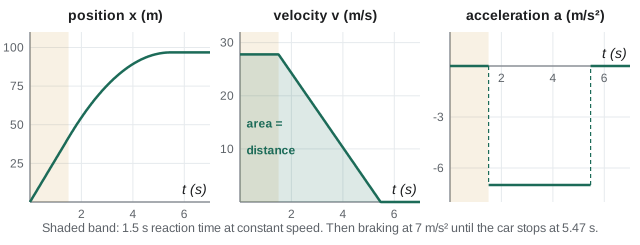
A driver traveling at 100 km/h sees a hazard. Her reaction time is 1.5 s, and the car then brakes at 7.0 m/s². How far does the car travel before stopping?
Show solution
- Convert: \(100 \text{ km/h} = 100/3.6 = 27.78\) m/s.
- Reaction phase (constant speed): \(27.78 \times 1.5 = 41.7\) m.
- Braking phase: \(v = 0\), \(v_0 = 27.78\), \(a = -7.0\). Use \(v^2 = v_0^2 + 2a\Delta x\):
- \[\Delta x = \frac{0 - 27.78^2}{2(-7.0)} = 55.1 \text{ m}\]
- Total: \(41.7 + 55.1 = 96.8\) m. Braking takes \(27.78/7.0 = 3.97\) s, so the car stops 5.47 s after the hazard appears.
Answer: About 97 m, of which 42 m is covered before the brakes are even applied
Because braking distance grows with \(v^2\), doubling speed quadruples it. At 120 km/h the braking distance in the example becomes 79 m, not 66 m. This is the physics behind speed limits in work zones and school areas.
Free fall
Near the Earth's surface, and when air resistance is small, every object falls with the same constant acceleration \(g = 9.81\) m/s², directed downward. With upward taken as positive, \(a = -g\). The constant-acceleration equations apply directly.
Worked problem
A ball thrown upward from a roof
A ball is thrown straight up at 15 m/s from the edge of a roof 20 m above the ground. Find its maximum height above the roof, the time it takes to reach the ground and its speed on impact.
Show solution
- Take up as positive, origin at the roof. \(v_0 = 15\), \(a = -9.81\).
- At the top \(v = 0\): \(\Delta y = \dfrac{0 - 15^2}{2(-9.81)} = 11.5\) m above the roof, reached after \(15/9.81 = 1.53\) s.
- Ground is at \(y = -20\): \(-20 = 15t - 4.905t^2\), so \(4.905t^2 - 15t - 20 = 0\).
- \[t = \frac{15 + \sqrt{15^2 + 4(4.905)(20)}}{2(4.905)} = \frac{15 + 24.85}{9.81} = 4.06 \text{ s}\]
- Impact velocity: \(v = 15 - 9.81(4.06) = -24.8\) m/s, so 24.8 m/s downward.
Answer: 11.5 m above the roof; 4.06 s; 24.8 m/s. The negative root of the quadratic is a time before the throw and is discarded
Notice that the ball passes the roof on the way down at 15 m/s, the same speed it was thrown up with. Without air resistance, motion under gravity is symmetric in time.
Motion in two dimensions
In a plane, position, velocity and acceleration are vectors: \(\mathbf{r} = (x, y)\), \(\mathbf{v} = d\mathbf{r}/dt\), \(\mathbf{a} = d\mathbf{v}/dt\). The key simplification is that the \(x\) and \(y\) motions are independent. Each component obeys its own one-dimensional equations, linked only by the shared time \(t\).
Projectile motion
A projectile moves under gravity alone. Its horizontal acceleration is zero and its vertical acceleration is \(-g\). So the horizontal motion is uniform and the vertical motion is free fall:
Eliminating \(t\) shows that the path is a parabola. For a launch and landing at the same height, three useful results follow:
for the time of flight, maximum height and range. The range is greatest at \(\theta = 45^\circ\), and complementary angles (such as 30° and 60°) give the same range.
Worked problem
A projectile on level ground
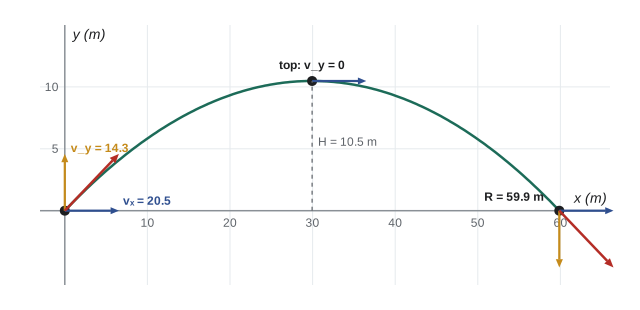
A ball is launched at 25 m/s, 35° above horizontal, from ground level. Find the time of flight, maximum height and range.
Show solution
- Components: \(v_x = 25\cos 35^\circ = 20.48\) m/s, \(v_y = 25\sin 35^\circ = 14.34\) m/s.
- Time of flight: \(T = 2(14.34)/9.81 = 2.92\) s.
- Maximum height: \(H = 14.34^2/(2 \times 9.81) = 10.5\) m.
- Range: \(R = v_x T = 20.48 \times 2.92 = 59.9\) m. Check: \(25^2\sin 70^\circ/9.81 = 59.9\) m.
Answer: T = 2.92 s, H = 10.5 m, R = 59.9 m. At 45° the range would be 63.7 m
The level-ground formulas do not apply when launch and landing heights differ. Then go back to the component equations.
Worked problem
A supply drop
An aircraft flying level at 50 m/s, 120 m above flat ground, releases a supply package. How long does it fall, how far ahead of the release point does it land, and how fast is it moving on impact (ignoring air resistance)?
Show solution
- The package starts with the aircraft's velocity: \(v_x = 50\), \(v_y = 0\).
- Vertical: \(-120 = -\tfrac12(9.81)t^2\), so \(t = \sqrt{240/9.81} = 4.95\) s.
- Horizontal: \(x = 50 \times 4.95 = 247\) m.
- Impact: \(v_y = -9.81 \times 4.95 = -48.5\) m/s, so speed \(= \sqrt{50^2 + 48.5^2} = 69.7\) m/s.
Answer: 4.95 s; 247 m ahead; 69.7 m/s. The package stays directly below the aircraft the whole way down
Relative velocity
Velocity is always measured relative to something. If a boat moves at \(\mathbf{v}_{BW}\) relative to the water and the water moves at \(\mathbf{v}_{WG}\) relative to the ground, the boat's velocity relative to the ground is the vector sum
The subscripts chain like dominoes: the inner letters match and cancel. The same rule handles aircraft in wind, rain seen from a moving car and parts on a moving conveyor.
Worked problem
Crossing a river
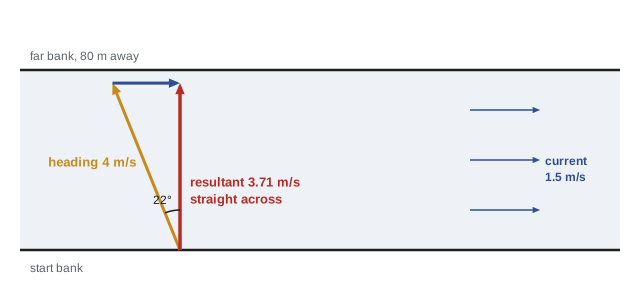
A boat moves at 4.0 m/s relative to the water. The river is 80 m wide and flows at 1.5 m/s. (a) If the boat points straight across, how long does the crossing take and how far downstream does it land? (b) Which way must it point to land directly opposite, and how long does that take?
Show solution
- (a) Across: \(80/4.0 = 20\) s. The current carries the boat \(1.5 \times 20 = 30\) m downstream. Ground speed \(\sqrt{4^2 + 1.5^2} = 4.27\) m/s.
- (b) The upstream part of the boat's velocity must cancel the current: \(4.0\sin\phi = 1.5\), so \(\phi = \arcsin(0.375) = 22.0^\circ\) upstream of straight across.
- Speed across: \(4.0\cos 22.0^\circ = \sqrt{16 - 2.25} = 3.71\) m/s. Time: \(80/3.71 = 21.6\) s.
Answer: (a) 20 s, 30 m downstream. (b) Head 22° upstream; 21.6 s. Pointing straight across is the fastest crossing, but not the most direct
Common mistakes
MistakeMixing km/h and m/s in the same equation.
InsteadConvert to SI first: divide km/h by 3.6 to get m/s.
MistakeUsing the constant-acceleration equations when acceleration varies.
InsteadThey hold only for constant a. Otherwise integrate a(t) and v(t), or split the motion into constant-a phases.
MistakeTaking g as +9.81 with up positive, or flipping signs partway through.
InsteadChoose a positive direction once. With up positive, a = −9.81 m/s² throughout the flight, including at the top.
MistakeSaying the acceleration is zero at the top of a throw.
InsteadVelocity is zero there; acceleration is still g downward. Otherwise the ball would hover.
MistakeUsing R = v₀² sin 2θ / g when the landing height differs from the launch height.
InsteadThat formula is for level ground only. Use the component equations instead.
MistakeAdding relative velocities as plain numbers when they point in different directions.
InsteadRelative velocities add as vectors. Draw the triangle.
Summary and key terms
- Displacement is change in position (signed); distance is path length (positive).
- v = dx/dt is the slope of the x–t graph; a = dv/dt is the slope of the v–t graph. Areas under the graphs give the changes.
- For constant acceleration: v = v₀ + at, x = x₀ + v₀t + ½at², v² = v₀² + 2aΔx, Δx = ½(v₀ + v)t.
- Free fall near the Earth has a = g = 9.81 m/s² downward.
- In two dimensions, the x and y motions are independent and share the time t. A projectile has constant vₓ and vertical free fall.
- On level ground: T = 2v₀ sin θ/g, H = (v₀ sin θ)²/2g, R = v₀² sin 2θ/g, with maximum range at 45°.
- Relative velocities add as vectors: v_BG = v_BW + v_WG.
- Kinematics
- The description of motion without reference to its causes.
- Displacement
- Change in position, a vector.
- Velocity
- Rate of change of position, v = dx/dt.
- Speed
- Magnitude of velocity.
- Acceleration
- Rate of change of velocity, a = dv/dt.
- Free fall
- Motion under gravity alone, with a = g downward.
- Projectile
- An object moving under gravity alone after launch.
- Range
- Horizontal distance traveled by a projectile.
- Relative velocity
- Velocity measured from a moving reference frame.
Practice problems
Work each problem on paper first, then reveal the answer to check.
A cyclist rides 6 km north in 15 min, then 2 km south in 10 min. Find the average speed and average velocity in km/h.
Show answer
Distance 8 km in 25 min: 19.2 km/h. Displacement 4 km north: 9.6 km/h north.
A car accelerates uniformly from 0 to 90 km/h in 8.0 s. Find the acceleration and the distance covered.
Show answer
90 km/h = 25 m/s. a = 25/8 = 3.125 m/s². Distance = ½(25)(8) = 100 m.
A train at 30 m/s must stop within 450 m. What minimum deceleration is needed?
Show answer
a = v₀²/(2d) = 900/900 = 1.0 m/s².
A position is given by \(x(t) = 4t^2 - t^3\) m. When is the object momentarily at rest (for \(t > 0\)), and what is its acceleration then?
Show answer
v = 8t − 3t² = 0 at t = 8/3 ≈ 2.67 s. a = 8 − 6t = −8 m/s².
A stone is dropped down a well and hits the water 2.5 s later. How deep is the well (ignore sound travel time)?
Show answer
d = ½(9.81)(2.5²) = 30.7 m.
A ball is thrown straight up and returns to the thrower's hand 3.0 s later. What was its launch speed and how high did it go?
Show answer
It takes 1.5 s to rise: v₀ = 9.81 × 1.5 = 14.7 m/s. Height = 14.7²/(2 × 9.81) = 11.0 m.
Water leaves a hose nozzle at 12 m/s, 50° above horizontal, at ground level. How far away does it land?
Show answer
R = 144 sin 100°/9.81 = 14.5 m.
A ball rolls off a 1.2 m high table at 3.0 m/s. How far from the table's edge does it land?
Show answer
t = √(2 × 1.2/9.81) = 0.495 s. x = 3.0 × 0.495 = 1.48 m.
At what two launch angles does a projectile fired at 30 m/s land 80 m away on level ground?
Show answer
sin 2θ = 80 × 9.81/900 = 0.872. 2θ = 60.7° or 119.3°, so θ = 30.3° or 59.7°.
An aircraft flies at 220 km/h relative to the air, heading due north, in a wind blowing 60 km/h toward the east. Find its ground speed and direction.
Show answer
√(220² + 60²) = 228 km/h, at arctan(60/220) = 15.3° east of north.
Lesson quiz · 5 questions
Score 60% or more to complete this lesson.
Create a free account to save your progress, take quizzes and earn a certificate.