
PHYS-131 · Lesson 4 of 5 · 34 min
Current, resistance and DC circuits
So far the charges have mostly stayed put. When they move, we have electric current, and with it the ability to carry energy from a power plant to a city, run motors and heaters, and process information in computers. This chapter is the foundation of circuit analysis, which electrical, computer and mechanical engineers use every day.
It defines current, resistance and resistivity, states Ohm's law, computes electrical power and energy costs, and develops the tools for analyzing circuits: series and parallel combinations and Kirchhoff's two laws. It ends with real batteries, voltage dividers and electrical safety.
Electric current
Current is the rate at which charge flows past a point:
By convention, current flows in the direction positive charge would move: out of the positive terminal of a battery, through the external circuit, and back into the negative terminal. In metal wires the moving charges are actually electrons drifting the other way, but for circuit analysis the convention gives identical results.
Typical currents: a phone charging at a few amperes, a household circuit breaker rated at 15 A, a car starter motor drawing 150 A or more, and a lightning stroke peaking around 30 000 A.
Drift velocity
Electrons in a wire move randomly at high speed, but their net drift along the wire is remarkably slow. If the wire has cross-sectional area \(A\) and \(n\) free electrons per cubic meter, the current is \(I = nqv_dA\), so the drift velocity is \(v_d = I/(nqA)\).
Worked problem
How fast do electrons drift?
A copper household wire (14 AWG, area 2.08 mm²) carries 15 A. Copper has \(8.5 \times 10^{28}\) free electrons per m³. Find the drift velocity.
Show solution
- \[v_d = \frac{15}{(8.5 \times 10^{28})(1.602 \times 10^{-19})(2.08 \times 10^{-6})} = 5.3 \times 10^{-4} \text{ m/s}\]
Answer: About 0.5 mm/s. A light still comes on instantly because the electric field travels through the wire at nearly the speed of light, starting all the electrons moving at once
Resistance and Ohm's law
Pushing current through a material takes a voltage, because the moving charges collide with the atoms. The resistance of a component is the ratio of the voltage across it to the current through it:
For many materials, including metals at constant temperature, \(R\) is constant over a wide range of voltage. Such materials are called ohmic, and the relation \(V = IR\) is Ohm's law. Diodes, transistors and lamps with hot filaments are not ohmic: their current is not proportional to voltage.
Resistivity
The resistance of a uniform wire depends on its material, length and thickness:
where \(\rho\) is the resistivity of the material in Ω·m. Copper has \(\rho = 1.68 \times 10^{-8}\) Ω·m and aluminum \(2.65 \times 10^{-8}\) Ω·m; nichrome (used in heating elements) is about \(1.1 \times 10^{-6}\) Ω·m; glass and rubber are \(10^{10}\) Ω·m and higher. A longer wire has more resistance; a thicker one has less.
Worked problem
Voltage drop in a long circuit
A 15 A load is 30 m from the electrical panel, wired with 14 AWG copper (2.08 mm²). Find the resistance of the circuit wiring (out and back) and the voltage lost in it, on a 120 V supply.
Show solution
- One conductor: \(R = (1.68 \times 10^{-8})(30)/(2.08 \times 10^{-6}) = 0.242\ \Omega\).
- Out and back: \(2 \times 0.242 = 0.485\ \Omega\).
- Voltage drop: \(V = IR = 15 \times 0.485 = 7.3\) V, about 6% of 120 V.
Answer: 0.485 Ω; 7.3 V. Electrical codes recommend keeping drops below about 3% to 5%, so a run this long at full load would use thicker wire
Temperature dependence
The resistance of metals rises with temperature, approximately as \(R = R_0[1 + \alpha(T - T_0)]\). For copper, \(\alpha = 0.00393\) per °C, so a winding that heats from 20 °C to 75 °C has 22% more resistance. This effect is used deliberately in resistance temperature detectors (RTDs), platinum sensors common in process plants.
Electrical power and energy
When current flows through a voltage, energy is transferred at the rate
In a resistor all this power becomes heat (Joule heating). That is useful in kettles, toasters and electric furnaces, and wasteful in transmission lines and motor windings. The three forms are equivalent for a resistor; choose the one that uses what you know.
Worked problem
An electric kettle
A 1500 W kettle runs on 120 V. Find the current it draws and the resistance of its element.
Show solution
- \(I = P/V = 1500/120 = 12.5\) A.
- \(R = V^2/P = 120^2/1500 = 9.6\ \Omega\).
Answer: 12.5 A; 9.6 Ω. That is most of a 15 A circuit, which is why running a kettle and a toaster on the same outlet often trips the breaker
Utilities bill energy, not power, in kilowatt-hours: 1 kWh is 1 kW for one hour, or 3.6 MJ. A 100 W lamp left on for 10 hours uses 1 kWh, which costs about 15 cents at a rate of $0.15/kWh.
Series and parallel resistors
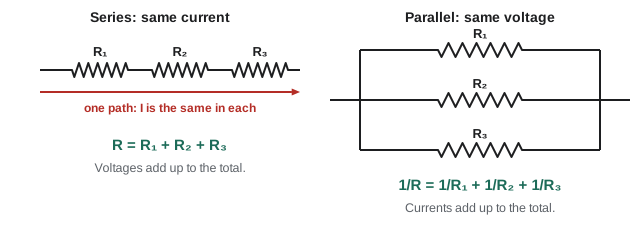
Resistors in series carry the same current, and their voltages add, so their resistances add:
Resistors in parallel share the same voltage, and their currents add, so their conductances (\(1/R\)) add:
Parallel resistance is always less than the smallest resistor, because each extra path makes it easier for current to flow. For two in parallel, \(R = R_1R_2/(R_1 + R_2)\). Household outlets are wired in parallel, so each appliance gets the full voltage and switching one off does not affect the others.
Worked problem
Three resistors in parallel
Resistors of 4 Ω, 6 Ω and 12 Ω are connected in parallel across 12 V. Find the equivalent resistance, the total current and the current in each.
Show solution
- \(1/R = 1/4 + 1/6 + 1/12 = 3/12 + 2/12 + 1/12 = 6/12\), so \(R = 2\ \Omega\).
- Total current: \(12/2 = 6\) A.
- Each resistor has 12 V across it: \(12/4 = 3\) A, \(12/6 = 2\) A, \(12/12 = 1\) A. Check: \(3 + 2 + 1 = 6\) A.
Answer: R = 2 Ω; 6 A total, split 3 A, 2 A and 1 A. The smallest resistor carries the most current
Kirchhoff's laws
Many circuits cannot be reduced to series and parallel combinations, especially those with more than one source. For these, Gustav Kirchhoff's two laws always work:
- The junction (current) law: the total current flowing into any junction equals the total flowing out. This is conservation of charge.
- The loop (voltage) law: around any closed loop, the sum of the voltage rises and drops is zero. This is conservation of energy.
Two systematic methods build on these. In mesh analysis (which you met in Linear Algebra) you assign a current to each loop and write the loop law for each. In node analysis you choose a reference node (ground, 0 V), assign unknown voltages to the other nodes and write the junction law at each. Both give a linear system to solve.
Worked problem
Node analysis with two sources
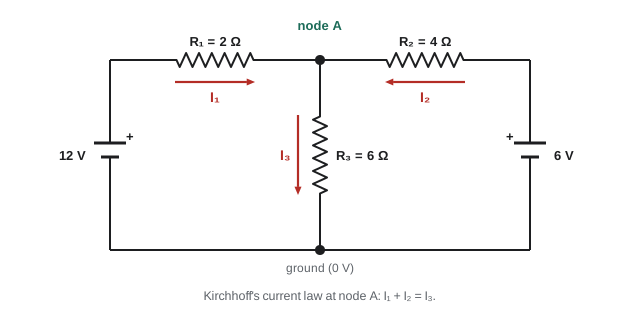
In the circuit shown, find the voltage at node A and the current in each resistor.
Show solution
- Let the node voltage be \(V\). Currents into A: through \(R_1\), \(I_1 = (12 - V)/2\); through \(R_2\), \(I_2 = (6 - V)/4\). Current out of A through \(R_3\): \(I_3 = V/6\).
- Junction law: \(\dfrac{12 - V}{2} + \dfrac{6 - V}{4} = \dfrac{V}{6}\).
- Multiply by 12: \(6(12 - V) + 3(6 - V) = 2V\), so \(90 = 11V\) and \(V = 8.18\) V.
- \(I_1 = (12 - 8.18)/2 = 1.91\) A, \(I_2 = (6 - 8.18)/4 = -0.545\) A, \(I_3 = 8.18/6 = 1.36\) A.
- Check: \(1.91 + (-0.545) = 1.36\) A.
Answer: V_A = 8.18 V; I₁ = 1.91 A, I₃ = 1.36 A, and I₂ = −0.545 A: current actually flows into the 6 V source from its positive terminal, charging it
A negative answer is not an error. It simply means the current flows opposite to the direction you assumed. Choose directions freely, solve, and let the signs tell you the truth.
Real sources and voltage dividers
A real battery is an ideal source of voltage \(\mathcal{E}\) (its emf) in series with a small internal resistance \(r\). When it supplies current \(I\), its terminal voltage drops to \(V = \mathcal{E} - Ir\).
Worked problem
Cranking an engine
A car battery has an emf of 12.6 V and internal resistance 0.020 Ω. What is its terminal voltage when the starter draws 150 A, and how much power is wasted inside the battery?
Show solution
- \(V = 12.6 - (150)(0.020) = 12.6 - 3.0 = 9.6\) V.
- Internal loss: \(I^2r = 150^2 \times 0.020 = 450\) W.
Answer: 9.6 V, with 450 W heating the battery. That is why headlights dim when the engine cranks, and why a cold battery (higher r) may fail to start the car
A voltage divider is two resistors in series across a source, with the output taken across one of them: \(V_{\text{out}} = V_{\text{in}}R_2/(R_1 + R_2)\). Dividers set reference voltages, scale sensor signals for a microcontroller and read potentiometers. But attaching a load changes them: a 12 V divider made of 10 kΩ and 5 kΩ gives 4.0 V unloaded, but only 2.4 V if a 5 kΩ load is connected across the 5 kΩ resistor (the parallel pair becomes 2.5 kΩ). Keep the load resistance much larger than the divider's resistors.
Electrical safety
It is current through the body, not voltage, that causes harm. Around 1 mA can be felt, 10 to 20 mA can make it impossible to let go, and 50 to 100 mA through the chest can trigger ventricular fibrillation. Dry skin has a resistance of tens of kilohms, but wet skin can fall below 1 kΩ, which is why bathrooms and outdoor outlets need special protection.
- Fuses and circuit breakers protect wiring from overheating by cutting off excessive current. They protect the building, not you.
- Ground-fault circuit interrupters (GFCIs) compare the current going out and coming back and trip within milliseconds if more than about 5 mA is missing, because that current may be flowing through a person.
- Grounding the metal case of an appliance means a fault sends current to ground and trips the breaker, rather than leaving the case live.
Common mistakes
MistakeUsing the capacitor rules for resistors.
InsteadResistors in series add; in parallel their reciprocals add.
MistakeThinking current is "used up" as it goes around a circuit.
InsteadCurrent is the same all around a series loop. Energy is transferred, not charge.
MistakeWriting P = VI with the supply voltage when the component has only part of it.
InsteadUse the voltage across that component and the current through it.
MistakeGetting signs wrong around a loop.
InsteadPick a direction; count a battery as a rise going − to +, and a resistor as a drop IR going with the assumed current.
MistakeTreating a negative current in the answer as a mistake.
InsteadIt means the actual current flows opposite to the direction you assumed.
MistakeConfusing kW with kWh.
InsteadkW is power (a rate); kWh is energy (power × time).
Summary and key terms
- Current is charge flow, I = dQ/dt, in amperes; conventional current flows from + to − outside a source.
- Resistance R = V/I; Ohm's law V = IR holds for ohmic materials.
- Wire resistance R = ρL/A increases with length and temperature, and falls with area.
- Power P = VI = I²R = V²/R; energy is billed in kWh (3.6 MJ).
- Series resistances add; parallel resistances combine as reciprocals.
- Kirchhoff's junction law conserves charge; the loop law conserves energy. Node and mesh analysis apply them systematically.
- Real sources have internal resistance: V = ℰ − Ir. Dividers sag under load.
- Body current of tens of mA can be lethal; GFCIs and grounding protect people.
- Current
- Rate of flow of charge, in amperes.
- Drift velocity
- The slow net speed of charge carriers along a conductor.
- Resistance
- Voltage per unit current, in ohms.
- Resistivity
- A material's intrinsic resistance, ρ, in Ω·m.
- Ohm's law
- V = IR, for ohmic materials.
- Kirchhoff's junction law
- Current into a node equals current out.
- Kirchhoff's loop law
- Voltages around a closed loop sum to zero.
- Internal resistance
- The resistance inside a real source.
- GFCI
- A device that cuts power when current leaks to ground.
Practice problems
Work each problem on paper first, then reveal the answer to check.
A charge of 900 C flows through a heater in 5.0 minutes. What is the current?
Show answer
I = 900/300 = 3.0 A.
Find the resistance of 100 m of copper wire 1.0 mm in diameter.
Show answer
A = π(0.0005)² = 7.85 × 10⁻⁷ m². R = (1.68 × 10⁻⁸)(100)/(7.85 × 10⁻⁷) = 2.14 Ω.
A 60 W bulb runs on 120 V. Find its current and its operating resistance.
Show answer
I = 0.50 A; R = 120²/60 = 240 Ω.
What does it cost to run a 1.2 kW space heater for 8 hours a day for 30 days at $0.15/kWh?
Show answer
1.2 × 8 × 30 = 288 kWh, costing $43.20.
Find the equivalent resistance of 10 Ω in series with the parallel combination of 20 Ω and 30 Ω.
Show answer
20 ∥ 30 = 600/50 = 12 Ω. Total 22 Ω.
Three identical 9 Ω resistors can be connected in four different ways. What resistances can you make?
Show answer
All series: 27 Ω. All parallel: 3 Ω. Two parallel plus one in series: 4.5 + 9 = 13.5 Ω. Two series in parallel with one: (18 × 9)/27 = 6 Ω.
A 9.0 V battery with 0.50 Ω internal resistance drives a 4.0 Ω load. Find the current and the terminal voltage.
Show answer
I = 9.0/4.5 = 2.0 A. V = 9.0 − 2.0 × 0.50 = 8.0 V.
Design a divider that gives 3.3 V from a 5.0 V supply using a 10 kΩ resistor on top. What bottom resistor is needed?
Show answer
3.3 = 5.0 R₂/(10k + R₂). R₂ = 3.3 × 10k/1.7 = 19.4 kΩ (use a standard 20 kΩ for about 3.33 V).
In the two-source example, replace the 6 V source with a 12 V source. Find the node voltage.
Show answer
6(12 − V) + 3(12 − V) = 2V gives 108 = 11V, V = 9.82 V.
A person with 1.5 kΩ body resistance (wet hands) touches 120 V. What current flows, and is it dangerous?
Show answer
I = 120/1500 = 80 mA, enough to cause ventricular fibrillation. A GFCI would trip at about 5 mA.
Lesson quiz · 5 questions
Score 60% or more to complete this lesson.
Create a free account to save your progress, take quizzes and earn a certificate.