
PRIN-101 · Lesson 1 of 12 · 27 min
What PRINCE2 is and who uses it
PRINCE2 is one of the best-known project management methods in the world. Its name stands for PRojects IN Controlled Environments, and the "2" marks the second generation of a method that began life in the British civil service. Hundreds of thousands of people take a PRINCE2 exam every year, and the method is used by governments, banks, utilities, health systems, defense organizations, software firms, charities and consultancies on every continent. This course explains how PRINCE2 certification works from start to finish: what the method is, where it came from, who runs the certifications, how the Foundation and Practitioner exams are built and scored, how the principles, practices and processes fit together, how PRINCE2 compares with the PMP and agile approaches, what certification costs, how to keep it current and how to plan your own route. Later courses in this program teach each part of the method in depth. This first lesson sets the scene: what PRINCE2 is, what it means by a project, who uses it and what a certificate does and does not tell an employer.
A note on this program
PRINCE2, PRINCE2 Agile and related names are registered trade marks of the PeopleCert group, used here only to identify the method and its certifications. This program is independent study written from publicly available information. Exam formats, prices and rules change; facts in this course are stated as they stood at the time of writing (October 2026), and you should always confirm current details on PeopleCert's website and with an accredited training organization before you book.
What PRINCE2 is
PRINCE2 is a method: a structured, documented way of directing, managing and delivering projects. It is not a software tool, a law or a body of knowledge that lists every technique a project manager might use. Instead, it tells you who should make which decisions, when they should make them, what information they need and how control is passed from one level of management to the next. It is deliberately generic. The same method is meant to work for building a hospital wing, migrating a payroll system, launching a product, reorganizing a department or running a community festival, because it focuses on the management of a project rather than the specialist work inside it.
In the seventh edition, published in 2023 and now marketed by PeopleCert as PRINCE2 Project Management, the method is described through five integrated elements:
- Principles: seven guiding obligations and good practices that must all be applied for a project to count as a PRINCE2 project.
- People: the human side of projects, including leadership, culture, teams, communication and the change that projects create for the people affected by them.
- Practices: seven aspects of project management that must be addressed continually throughout the project, such as the business case, plans, risk and progress. Earlier editions called these themes.
- Processes: seven groups of activities that take a project from its first idea to its closure, describing who does what at each point in the journey.
- Project context: the environment in which the project operates, which determines how the method is tailored.
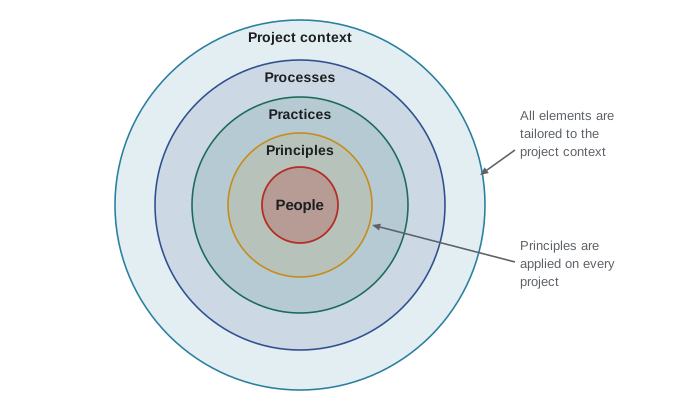
Lessons 6 to 9 of this course give an overview of each element, and the later courses in the program, PRIN-110 to PRIN-150, study them in depth. For now, the important idea is that PRINCE2 is a system. Its parts are designed to be used together, and much of what the exams test is whether you understand how they connect: how a principle such as manage by exception is put into practice through tolerances, how those tolerances are set in a plan, and which process escalates a forecast breach to the right people.
What PRINCE2 means by a project
PRINCE2 defines a project as a temporary organization that is created for the purpose of delivering one or more business products according to an agreed business case. Each part of that definition matters:
- Temporary: a project has a start and an end. When its products have been handed over, the project team disbands.
- Organization: a project is not just a list of tasks. It has its own structure of roles and decision rights that cuts across the permanent line organization.
- Business products: the outputs the project delivers, such as a building, a system, a policy or a trained workforce.
- Business case: the justification for the investment, which must remain valid for the project to continue.
Projects differ from business as usual, the ongoing operation of an organization, in several ways. They introduce change; they are temporary; they are cross-functional, bringing together people with different skills and from different parts of the organization, often from suppliers too; they are unique, since no two projects are quite the same; and they are uncertain, because they are trying something that has not been done in exactly this way before. These characteristics are why projects need a different style of management from routine operations, and they are the reason PRINCE2 places so much weight on clear roles, staged control and a business case that is checked again and again.
| Characteristic | What it means | Why it needs managing |
|---|---|---|
| Change | Projects are how organizations introduce change | People affected by the change must be prepared for it |
| Temporary | A defined start and end | Someone must decide when to stop, including stopping early |
| Cross-functional | People from different teams and organizations | Decision rights and communication must be agreed |
| Unique | No two projects are identical | Lessons must be adapted, not copied blindly |
| Uncertain | Outcomes and estimates are not guaranteed | Risk and tolerances must be managed |
Worked problem
Is it a project?
A regional health authority is considering three pieces of work: (a) processing the monthly payroll for 4,000 staff; (b) replacing its paper referral forms with an online system across 12 clinics over 14 months; (c) a one-off review of whether the payroll team is adequately staffed, to be completed in six weeks. Which are projects in the PRINCE2 sense?
Show solution
- Payroll processing repeats every month with known steps and no end date. It is business as usual.
- The referral system introduces change, has a start and end, needs people from IT, clinics and records, is unique to this authority and carries uncertainty. It is a project and would benefit from a business case and staged control.
- The staffing review is temporary and produces a product (a report with recommendations), so it can be run as a small project. PRINCE2 would be tailored heavily: perhaps one stage, a short business case and light reporting.
Answer: Work (b) is clearly a project and work (c) is a small project; work (a) is business as usual.
Who uses PRINCE2
PRINCE2 was created for UK government information technology projects, but it is now used across sectors and countries. It is strongest in the United Kingdom, Western Europe, Australia, New Zealand, parts of Africa, the Middle East and Asia, and in international organizations, aid agencies and companies that work with them. Its widespread use in public administration reflects its origins: governments value a method that makes accountability visible, documents decisions and gives a senior board clear points at which to continue, change or stop an investment.
In the United States, PRINCE2 is less common than in the UK, Europe or Australia. American employers and federal agencies more often look for PMI's Project Management Professional (PMP) certification, and federal project and program managers are typically developed under the Federal Acquisition Certification for Program and Project Managers and the Program Management Improvement and Accountability Act of 2016, which are not tied to PRINCE2. Even so, PRINCE2 is used by multinational companies, consultancies, defense contractors working with allied governments and organizations that operate in Europe or the Commonwealth, and some US project managers add a PRINCE2 certificate to a PMP to show they can work in those environments.
Within an organization, PRINCE2 is not only for project managers. Its roles include the project board, made up of an executive, a senior user and a senior supplier; the project manager; team managers; project assurance; change authorities; and project support. People who sit on project boards, run project offices or lead specialist teams often take the Foundation exam to understand how the method expects them to behave, even if they never manage a project themselves.
What a PRINCE2 certificate shows
A PRINCE2 certificate is a knowledge-based credential. Foundation shows that you know the method well enough to work as an informed member of a project team that uses it. Practitioner shows that you can apply and tailor the method to a realistic scenario. Neither level requires you to prove a minimum number of months of project experience, which is one of the biggest differences from the PMP (Lesson 10 compares them in detail).
That makes PRINCE2 accessible early in a career, but it also limits what the certificate proves. It does not show that you have successfully led a project, that you understand a particular industry, that you can manage people well under pressure or that you can use specialist techniques such as critical path scheduling or earned value management, which PRINCE2 leaves to other sources. Employers usually read a PRINCE2 certificate as evidence of a shared vocabulary and a disciplined approach, and then look for experience, references and results to judge competence.
| A PRINCE2 certificate shows | It does not show |
|---|---|
| Knowledge of the principles, practices and processes | A track record of delivering projects |
| A shared vocabulary for working with project boards | Industry or technical expertise |
| At Practitioner, ability to apply and tailor the method to a scenario | Leadership skill under real pressure |
| Commitment to structured professional development | Mastery of detailed scheduling or cost techniques |
The road map for this course
The remaining lessons follow the path a candidate takes. Lesson 2 traces the history of PRINCE2 and its editions, so you can recognize out-of-date material. Lesson 3 explains PeopleCert, accredited training organizations, the wider PRINCE2 family and PRINCE2 Agile. Lessons 4 and 5 cover the Foundation and Practitioner exams in detail. Lessons 6 to 9 give an overview of the principles, practices, processes, people and project context, so you can see the whole method before the later courses take it apart. Lesson 10 compares PRINCE2 with the PMP, agile approaches and other frameworks. Lesson 11 covers costs, renewal and choosing a route, and Lesson 12 helps you build a personal study and certification plan as a capstone.
Worked problem
A first estimate of study time
Priya, a business analyst in a provincial ministry, wants to pass Foundation. Training providers commonly suggest roughly 20 to 30 hours of study for Foundation. She can study for 5 hours a week. Estimate how many weeks she needs, allowing a 20 % buffer for busy weeks.
Show solution
- Take the middle of the range: 25 hours.
- Add a 20 % buffer: 25 × 1.2 = 30 hours.
- Divide by her weekly time: 30 / 5 = 6 weeks.
Answer: About 6 weeks, with the exam booked for the end of week 6 or 7.
Treat estimates like this as a starting point. Lesson 12 shows how to refine them using diagnostic practice tests and how to split time between reading, active recall and practice exams.
Common mistakes
MistakeThinking PRINCE2 is a software tool or a set of templates.
InsteadTreat it as a method that defines roles, decisions and controls, tailored to each project.
MistakeCalling any piece of work a project.
InsteadCheck whether the work is temporary, introduces change and needs a business case.
MistakeAssuming a PRINCE2 certificate proves project experience.
InsteadPresent it alongside evidence of projects you have delivered.
MistakeUsing study notes based on the 2017 edition without checking.
InsteadMake sure materials match PRINCE2 7 and the current exam.
MistakeAssuming PRINCE2 is only for project managers.
InsteadRecognize that board members, team managers and support staff also benefit from understanding it.
Summary and key terms
- PRINCE2 stands for PRojects IN Controlled Environments and is a generic, process-based method.
- PRINCE2 7 has five integrated elements: principles, people, practices, processes and project context.
- A project is a temporary organization created to deliver business products according to an agreed business case.
- Projects differ from business as usual: they bring change and are temporary, cross-functional, unique and uncertain.
- PRINCE2 is strongest in the UK, Europe, Australia and the public sector; the PMP is more common in North America.
- Certificates show knowledge and, at Practitioner, the ability to apply the method, not a track record.
- HSM University is independent of PeopleCert and AXELOS; always confirm current exam details.
- PRINCE2
- PRojects IN Controlled Environments, a project management method.
- Method
- A structured way of directing, managing and delivering projects.
- Project
- A temporary organization created to deliver business products according to a business case.
- Business as usual
- The ongoing, repeated operations of an organization.
- Business case
- The justification for a project in terms of costs, benefits and risks.
- Integrated elements
- The five parts of PRINCE2 7 that work together.
- Practice
- An aspect of project management addressed throughout a project; formerly a theme.
- Process
- A set of activities with defined inputs, outputs and responsibilities.
- Project board
- The group of executive, senior user and senior supplier that directs a project.
- Tailoring
- Adapting the method to suit the project and its context.
Practice problems
Work each problem on paper first, then reveal the answer to check.
What does PRINCE2 stand for?
Show answer
PRojects IN Controlled Environments.
Name the five integrated elements of PRINCE2 7.
Show answer
Principles, people, practices, processes and project context.
What did earlier editions call the practices?
Show answer
Themes.
Give the PRINCE2 definition of a project.
Show answer
A temporary organization created to deliver one or more business products according to an agreed business case.
Name three characteristics that make projects different from business as usual.
Show answer
Any three of change, temporary, cross-functional, unique and uncertain.
Is a monthly payroll run a project?
Show answer
No; it is business as usual.
Which three roles make up the project board?
Show answer
Executive, senior user and senior supplier.
Does PRINCE2 Foundation require documented project experience?
Show answer
No.
Name one thing a PRINCE2 certificate does not prove.
Show answer
For example a delivery track record, industry expertise or leadership skill.
Weeks needed for 24 hours of study plus a 25 % buffer at 6 hours a week?
Show answer
24 × 1.25 = 30 hours; 30 / 6 = 5 weeks.
Lesson quiz · 5 questions
Score 60% or more to complete this lesson.
Create a free account to save your progress, take quizzes and earn a certificate.