
SLS-130 · Lesson 4 of 12 · 18 min
Running a service interaction
▶ Video coming soon A video version of this lesson is on the way.
On a Saturday afternoon in October 2026, Aiden was helping a couple choose a dining table when an older man approached the counter holding a folded delivery receipt. He was clearly in a hurry and clearly annoyed. Aiden excused himself from the couple for a moment, walked over, and said, "I'll be with you in about five minutes. Is it something urgent I should get someone else for right now?" The man said it could wait. Five minutes later Aiden was back. The conversation that followed took eleven minutes and ended with the man shaking his hand. Bev, who had watched from across the floor, used it at the next staff meeting as an example of a service interaction done well, and walked through what Aiden had done step by step.
This lesson breaks a single service interaction into stages and describes the skills at each one. The stages apply to a counter in a store, a phone call to a support line, and a business customer emailing an account executive. The words change; the structure does not.
The five stages of a service interaction
Most service interactions, whatever their channel, pass through five stages. Naming them helps staff see where an interaction went wrong and practice each part separately.
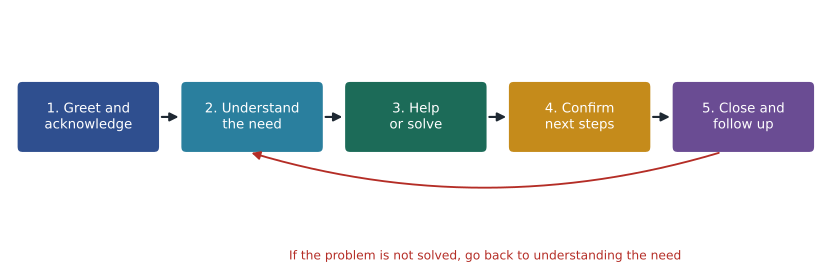
| Stage | Purpose | Signs it is going well |
|---|---|---|
| 1. Greet and acknowledge | Show the customer they have been noticed and will be helped | The customer relaxes; they know who is helping and roughly when |
| 2. Understand the need | Find out what the customer actually wants, which may differ from what they first say | The customer agrees with the summary of their problem |
| 3. Help or solve | Fix the problem, answer the question, or arrange the fix | A realistic solution is offered, with options where possible |
| 4. Confirm and agree next steps | Make sure both sides understand what will happen, by whom and when | The customer can say what happens next without guessing |
| 5. Close and follow up | End the interaction well and check that what was promised happened | The customer leaves satisfied, and the follow-up actually occurs |
Stage 1: Greet and acknowledge
The first seconds of an interaction set its tone. Customers who feel ignored become irritated before they have said what they need, which makes every later stage harder. Acknowledging someone does not require serving them immediately. Aiden could not leave the couple at the dining table, but he could tell the man with the receipt that he had been seen, roughly how long he would wait, and offer an alternative if it was urgent. That short exchange turned waiting from a sign of indifference into a known, bounded delay.
On the phone, acknowledgment means answering with a clear greeting and your name, and, if the customer must be put on hold, asking permission and saying for how long. In email or chat it means a quick first reply, even if the full answer will take longer: "Thanks, Janet. I've got this and will have an answer about the invoice for you by 3 p.m." In business accounts, acknowledgment often includes recognizing the relationship: "Good to hear from you. Is this about the second-floor printer again?" Using what you already know shows the customer they are not starting from zero.
Stage 2: Understand the need
Customers often describe a symptom, a solution they have already chosen, or their frustration, rather than the underlying problem. The man with the receipt began with, "Your delivery people are useless." That is a feeling, not a need. Aiden's job was to find out what had happened and what the man wanted now.
Three skills do most of the work here. The first is active listening: giving full attention, not interrupting, and showing with small responses that you are following. SLS-120 covers listening in depth. The second is questioning: open questions to let the customer explain ("Can you tell me what happened when the crew arrived?"), then closed questions to pin down facts ("Was that on Thursday?" "Is the table damaged, or was it the wrong one?"). The third is summarizing: repeating the problem back in your own words and asking whether you have it right.
Aiden's summary was this: "So the crew delivered the table on Thursday, but they didn't bring the extension leaf, and when you called on Friday you were told someone would call you back, and nobody did. You'd like the leaf delivered, and you'd like to know it will actually happen this time. Have I got that right?" The man said yes, and visibly calmed down. Summaries work because they prove the customer has been heard, and because they catch misunderstandings before effort is wasted solving the wrong problem.
A useful habit at this stage is to find out what the customer wants as an outcome, not just what went wrong. Some customers want a fix, some want an explanation, some want an apology, and some want compensation. Many want a mix. Asking "What would make this right for you?" is often the fastest way to find out, and the answer is frequently more modest than staff fear.
Stage 3: Help or solve
Once the need is clear, the person serving the customer either solves the problem or arranges for it to be solved. Customers value two things above all at this stage: that the solution actually works, and that it is achieved with as little effort on their part as possible. Every transfer to another person, every request to call a different number, and every form to fill in adds effort.
When there is more than one way to solve a problem, offering a choice gives the customer some control, which matters after something has gone wrong. Aiden checked the delivery schedule and found that a truck would pass the man's neighborhood on Tuesday morning. He offered two options: delivery of the leaf on Tuesday between 9 and 11, or pickup from the store that day if the man preferred. The man chose Tuesday.
Sometimes the honest answer is that the problem cannot be solved immediately. Then the job is to explain why in plain terms, say what will happen instead, and give a realistic time. "I can't change the warranty terms, but I can book a technician to inspect it, and if it's a manufacturing fault the repair is covered. The earliest visit is Thursday." Customers accept limits far more readily than vagueness.
In business-to-business service, solving often means coordinating others. When Riverbend Dental Group reported that RoomFlow was showing the wrong times for two meeting rooms, Maya could not fix the software herself. She could open a support ticket with the clinic's details and a clear description, ask the support team for a time estimate, and stay responsible for the outcome. Lesson 1 called this owning the problem.
Stage 4: Confirm and agree next steps
Many service failures happen after a good conversation, because the two sides left with different ideas of what would happen. Confirmation closes that gap. It means stating the next steps clearly, including who will do what and by when, and checking that the customer agrees. Where possible, it means putting them in writing.
Aiden said: "Here's what will happen. The leaf goes on Tuesday's truck, between 9 and 11. You'll get a text from the driver about thirty minutes before. I'm putting a note on your order now so anyone who answers the phone can see it, and I'll call you myself on Tuesday afternoon to make sure it arrived. Is the number on the receipt the best one?" He then sent a text confirming the same details while the man was still at the counter.
Confirmation also includes stating any limits or conditions honestly. If a refund will take five to seven business days to appear on a card, say so now; a customer who expects it tomorrow will call again on Thursday, angrier.
Stage 5: Close and follow up
Closing an interaction well means checking that nothing else is needed ("Is there anything else I can help with today?"), thanking the customer, and ending warmly. It also means doing what was promised. Aiden's Tuesday call took ninety seconds. The leaf had arrived; the man was pleased; and he mentioned that he was thinking about new chairs to go with the extended table. Following up turned a complaint into a sales lead, but the follow-up mattered even if it had not. A customer who is called back as promised learns that the store keeps its word.
Bev uses the phrase closing the loop for this. An open loop is any promise not yet kept or confirmed. Service teams track open loops in their CRM or ticket system so that nothing depends on one person's memory. When a staff member is away, a colleague can see what was promised and keep it.
Worked problem
Scoring a service call against the five stages
Bev reviews ten recorded service calls from the store's phone line using a checklist with one point per stage achieved. The results are: 10 calls acknowledged the customer properly; 9 summarized the need and checked it; 8 offered a working solution; 5 confirmed next steps with a time; and 3 included a follow-up that actually happened. What share of calls achieved each stage, and where should training focus?
Show solution
- Greet and acknowledge: 10 of 10, which is 100 in 100.
- Understand the need: 9 of 10, which is 90 in 100.
- Help or solve: 8 of 10, which is 80 in 100.
- Confirm next steps: 5 of 10, which is 50 in 100.
- Follow up: 3 of 10, which is 30 in 100.
- The largest drops are at confirming (from 8 to 5) and following up (from 5 to 3).
Answer: The team is strong at the start of calls and weak at the end: only half confirmed next steps and less than a third followed up. Training and a simple tracking habit for open loops should focus on stages 4 and 5.
Language that helps and language that hurts
Small differences in wording change how customers feel. Phrases that focus on what can be done work better than phrases that focus on rules. Taking personal responsibility works better than blaming another department. And plain language works better than jargon or policy codes.
| Instead of | Try |
|---|---|
| "That's not my department." | "I'll find the right person and stay with this until it's sorted." |
| "You'll have to call the warehouse." | "I'll contact the warehouse and call you back by 4 p.m." |
| "It's our policy." | "Here's what I can do..." followed by the options, with a brief reason for any limit. |
| "Calm down." | "I can see this has been really frustrating. Let's fix it." |
| "There's nothing I can do." | "I can't change that, but here's what I can do instead." |
| "Your ticket is P2 pending tier two." | "A specialist will look at it today, and I'll update you by noon tomorrow." |
Scripts like these are starting points, not lines to recite. Customers notice when someone is reading from a card. The principle behind each one is what matters: show you have heard, take ownership, say what will happen, and be honest about limits.
Service interactions when you are also selling
For salespeople, service interactions raise a delicate question: when is it appropriate to mention a new product? The answer is almost always after the problem is solved, and only if it genuinely helps the customer. Aiden did not mention chairs during the complaint. On the follow-up call, when the customer raised them himself, he offered to set aside a few styles that matched the table. Pushing a sale during a complaint tells the customer that the store cares about their money more than their problem. Responding to a need the customer raises, after the problem is fixed, is good service.
Common mistakes
MistakeMaking a waiting customer feel invisible.
InsteadAcknowledge them immediately, give a realistic wait time and offer an alternative if it is urgent.
MistakeSolving the first thing the customer says.
InsteadAsk open and closed questions, summarize the need and check it before acting.
MistakeEnding with "someone will get back to you".
InsteadConfirm who will do what and by when, preferably in writing.
MistakeTrusting memory to keep promises.
InsteadRecord open loops in the CRM or ticket system so anyone can see and close them.
MistakeSelling during a complaint.
InsteadSolve the problem first; respond to new needs only when the customer raises them or after the fix.
Summary and key terms
- A service interaction has five stages: greet and acknowledge, understand the need, help or solve, confirm next steps, and close and follow up.
- Acknowledging a customer quickly turns waiting into a known delay.
- Understanding the need relies on active listening, open and closed questions and a summary the customer agrees with, including what outcome they want.
- Solutions should work and take little effort from the customer, with choices where possible and honest explanations of limits.
- Confirming next steps prevents misunderstandings, and following up closes the loop, which is best tracked in a shared system.
- Wording that takes ownership and focuses on what can be done works better than wording that cites rules or blames others.
- Acknowledgment
- Letting a customer know they have been noticed and will be helped, and roughly when.
- Active listening
- Giving full attention and showing you are following, without interrupting.
- Summarizing
- Restating the customer's problem in your own words and checking it is right.
- Next steps
- The agreed actions after an interaction: who does what, and by when.
- Closing the loop
- Making sure every promise made to a customer is kept and confirmed.
- Open loop
- A promise to a customer that has not yet been kept or confirmed.
Practice problems
Work each problem on paper first, then reveal the answer to check.
Why is summarizing the customer's problem useful even when you think you understand it?
Show answer
It proves the customer has been heard and catches misunderstandings before effort is spent on the wrong problem.
Rewrite "You'll need to call head office about that" in a way that takes ownership.
Show answer
For example: "I'll contact head office for you and call you back by 3 p.m. with an answer."
In 20 reviewed calls, 14 confirmed next steps. What share is that, in 100?
Show answer
14 ÷ 20 × 100 = 70 in 100.
Lesson quiz · 5 questions
Score 60% or more to complete this lesson.
Create a free account to save your progress, take quizzes and earn a certificate.