
SLS-252 · Lesson 6 of 12 · 18 min
Loss prevention
▶ Video coming soon A video version of this lesson is on the way.
On Saturday, October 24, 2026, a man walked out of Juniper & Pine's front entrance carrying two table lamps he had not paid for. Aiden saw him go, his heart pounding, and took two steps toward the door before he remembered the rule Marcus had drilled into the team: observe and report, don't chase, don't touch. He noted the man's clothing, the lamps and the direction he walked, and called Marcus on the radio. Marcus checked the camera footage, wrote an incident report and called the police non-emergency line. At the back-room session the following Tuesday, October 27, Aiden admitted that letting the man go had felt wrong. "Two lamps are 178 dollars," Marcus said. "Nobody on this team gets hurt for 178 dollars. And you did the most useful thing: you gave us a description and a time."
What loss prevention is
Loss prevention (LP), called asset protection at some retailers, is the set of practices a store uses to reduce shrink and keep people safe. It covers theft by customers and employees, fraud, damage and errors. Good loss prevention is mostly about prevention: making losses harder to cause and easier to notice. Catching people after the fact is a small part of the work and the most dangerous part.
Loss prevention has to balance three things. It must protect the store's merchandise and money, it must keep employees and customers safe, and it must not make shopping so unpleasant that honest customers go elsewhere. A store that locks every lamp in a case will have little theft and few lamp sales.
Deterrence through layers
Loss prevention specialists often describe their approach as layers. No single measure stops every loss, but each one makes theft or fraud a little harder, and together they change the odds.
| Layer | Examples | What it does |
|---|---|---|
| People and service | Greeting every shopper, staff in every zone, an attentive floor | Tells would-be thieves they have been seen; the cheapest and most effective deterrent |
| Store design | Clear sightlines, high-value items away from exits, no blind corners, a single customer entrance | Makes theft harder to hide |
| Merchandise protection | Cable locks, display tethers, locked cases, electronic article surveillance (EAS) tags | Slows theft and sounds an alarm |
| Technology | Cameras, exception reporting from the point of sale, alarm systems | Records evidence and flags unusual transactions |
| Procedures and controls | Refund approvals, void reports, key control, receiving checks | Prevents internal theft and process losses |
| Response | Incident reports, police reports, banning notices | Deals with incidents and builds evidence |
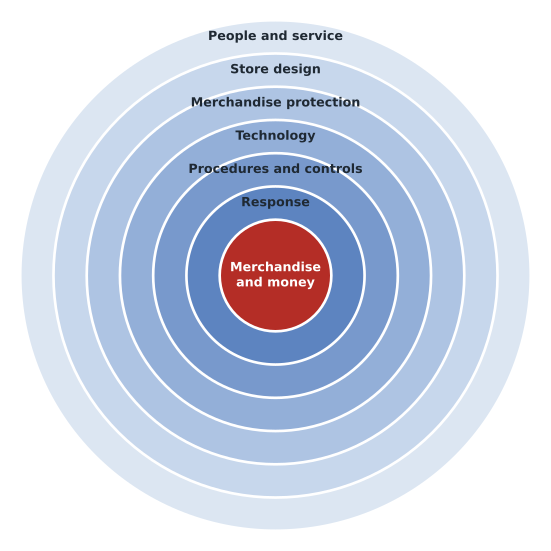
The research on retail theft supports customer service as a deterrent. Offenders interviewed in criminology studies consistently say they avoid stores where staff approach and acknowledge them, and choose stores where they can work unnoticed. Bev's rule that every shopper is greeted within about a minute of entering, which Aiden learned on the sales floor, is a sales practice and a loss prevention practice at the same time.
Protecting décor and small goods
Most of Juniper & Pine's theft risk is in décor: lamps, candles, small mirrors, frames, throws and vases near the front of the store. Marcus and Noura Saleh put a set of changes in place in the spring of 2026, balancing protection against how the department sells; lesson 12 follows the full case.
- Move the most-taken items. Lamps and small mirrors moved from the display nearest the front door to a table in the middle of the décor area, in view of the cash counter.
- Display one, stock the rest. For small high-value items, the floor shows one or two samples and the rest stay in stock behind the counter.
- Tag selectively. EAS tags on items over 50 dollars that are small enough to carry out easily, with pedestals at the front entrance.
- Keep sightlines open. Shelving in décor was lowered so the counter could see over it.
- Staff the zone. On weekends, one associate is always assigned to décor, rather than covering it from the furniture floor.
Worked problem
Is the EAS system worth it?
An EAS system for the front entrance costs about 6,500 dollars to install and about 1,200 dollars a year for tags and service. Décor shrink was 23,400 dollars at retail in 2025, and Marcus estimates that about 60 in 100 of it was theft. If the system cuts that theft by 40 in 100, what is the yearly saving at retail and at cost (décor gross margin 56 in 100), and how long does the system take to pay back?
Show solution
- Estimated décor theft = 0.60 × 23,400 = 14,040 dollars at retail.
- Reduction = 0.40 × 14,040 = 5,616 dollars at retail a year.
- At cost: 5,616 × (1 − 0.56) ≈ 2,471 dollars a year.
- Net yearly saving at cost = 2,471 − 1,200 = 1,271 dollars.
- \[\text{Payback} = \frac{6{,}500}{1{,}271} \approx 5.1 \text{ years}\]
Answer: At cost, the system would take about five years to pay for itself on décor alone. Marcus decided to start with the lower-cost layers (moving items, display samples and staffing) and revisit EAS after the January count. Valuing the loss at cost rather than retail made the decision clearer.
The example shows a general point: loss prevention spending should be judged like any other investment, on what it saves at cost compared with what it costs. Some measures, such as greeting customers and moving a display, are almost free. Others, such as a guard or a camera upgrade, need a clear case.
Internal theft and controls
Theft and fraud by employees is a sensitive subject, and most employees never steal. But because employees have access to stock, cash and systems, a small number of dishonest employees can cause large losses. Common forms include refunding fake returns, giving unauthorized discounts to friends (often called sweethearting), voiding sales after the customer has paid cash, taking goods from the warehouse, and changing inventory records to hide a loss.
The answer is controls that make theft hard and visible without treating everyone as a suspect.
- Separation of duties. The person who handles a transaction is not the only person who approves or reviews it. A refund over 500 dollars needs a manager; an inventory adjustment over 250 dollars needs approval; the cash office counts drawers it did not run.
- Exception reporting. The point-of-sale system produces reports of unusual activity: many voids, refunds without receipts, discounts above normal, sales keyed manually instead of scanned. Marcus reviews them weekly.
- Key and access control. Keys and alarm codes are issued to named people and changed when someone leaves.
- Employee purchases. Employees do not ring up their own purchases or those of family members.
- A way to report concerns. Employees can report concerns to the store manager or the owners' office confidentially, without fear of retaliation.
Exception reports are clues, not proof. A cashier with many voids may be careless, may be covering for a broken scanner, or may be stealing. Any investigation is done carefully, privately and fairly, by a manager rather than a coworker, and Juniper & Pine's policy is to involve the owners' office and its employment lawyer before taking any action based on suspected employee theft.
What to do when you suspect theft
Juniper & Pine, like most retailers its size, does not employ loss prevention officers to stop shoplifters, and its policy forbids sales staff from physically stopping anyone. The procedure is:
- Be visible and offer help. If a shopper's behavior seems suspicious, approach and offer assistance. This deters theft without accusing anyone.
- Observe and report. If you see a theft, do not chase, block the exit, touch the person or try to take the goods back. Note a description, the items, the time and the direction of travel, and tell the manager on duty.
- Let the manager decide on next steps. The manager reviews camera footage, completes an incident report and decides whether to call the police.
- Call emergency services if anyone is in danger. Threats, weapons or violence call for 911, not the non-emergency line.
- Write it down. Every incident gets a written report the same day, with facts rather than opinions.
The reasons for this policy are safety and law. Chasing or grabbing someone risks injury to staff and customers, especially when the person may be armed or part of a group. Retail industry groups report a rise in aggression and threats during theft incidents, and many large retailers have adopted no-chase policies for that reason. And the legal power to detain a suspected shoplifter is narrow, with serious consequences for getting it wrong.
The law on stopping a suspected shoplifter
In the United States, most states give merchants a limited legal protection, often called the shopkeeper's privilege, to detain a person suspected of shoplifting. In South Dakota, SDCL 22-30A-19.2 allows an owner or seller of merchandise who has reasonable grounds to believe a person has committed retail theft to detain the person in a reasonable manner and for a reasonable time, for limited purposes: to request and verify identification, to make reasonable inquiry about unpurchased merchandise, and to inform a law enforcement officer and surrender the person to the officer (or, for a minor, to an officer, parent or guardian). Detention off the premises is allowed only in immediate pursuit.
These powers are narrow. A detention without reasonable grounds, one that lasts too long or is done in an unreasonable manner, or any use of excessive force can expose the store and the employee to lawsuits for false imprisonment, assault or malicious prosecution, and possibly criminal charges. Courts look closely at whether the grounds, the manner and the length of a detention were reasonable. For a store like Juniper & Pine, the practical conclusion is the same as its policy: staff observe and report, and police make arrests.
Stores that do employ trained loss prevention officers set strict rules for them, such as requiring that the officer saw the person select, conceal and leave with the item without paying, and never lost sight of them. Those rules exist because the cost of a wrongful stop, to the customer and to the store, is very high.
Cameras and privacy
Cameras help deter theft and provide evidence, but recording people raises privacy and legal issues. US federal law does not restrict ordinary silent video recording in the public areas of a store, but many states restrict recording in places where people expect privacy, such as washrooms and fitting rooms, and federal and state wiretap laws restrict recording conversations. Good practice is to post signs, keep cameras out of private areas, avoid recording audio unless the law clearly allows it, keep recordings only as long as needed and restrict who can view them. Employees should be told where cameras are and why.
Juniper & Pine's cameras cover the entrances, the cash counter, the décor area, the dock and the cash office, keep recordings for 30 days unless an incident needs them kept longer, and can be viewed only by Bev and Marcus. Signs at each entrance tell shoppers the store uses video surveillance.
Organized retail crime
Organized retail crime (ORC) is theft by groups who steal goods in quantity to resell, often online. It is different from opportunistic shoplifting in scale and in risk: ORC crews may work in teams, return repeatedly, and use intimidation. For a home furnishings store, ORC usually targets small electronics, high-end décor and anything easy to sell on online marketplaces. The response is coordination: sharing information with nearby retailers and police, reporting every incident so patterns can be seen, and never confronting a group. Bev belongs to a local retailers' network that shares alerts about crews working in the city.
Common mistakes
MistakeChasing or grabbing a suspected shoplifter.
InsteadObserve and report; let the manager and police handle it.
MistakeThinking loss prevention means catching thieves.
InsteadMost of the value is in prevention: service, design, protection and controls.
MistakeLocking up everything that has ever been stolen.
InsteadProtect selectively, weighing the loss saved at cost against lost sales and expense.
MistakeTreating an exception report as proof of employee theft.
InsteadUse it as a clue and investigate privately and fairly with management.
MistakePlacing cameras wherever they might help.
InsteadUse them for a clear purpose, post signs, avoid private areas and limit retention and access.
Summary and key terms
- Loss prevention reduces shrink and keeps people safe, and most of its value is in prevention rather than catching thieves.
- It works in layers: people and service, store design, merchandise protection, technology, procedures and controls, and response.
- Customer service is the cheapest and most effective deterrent.
- Spending on loss prevention should be judged on the loss saved at cost against its cost.
- Internal theft is controlled with separation of duties, exception reports, key control and rules on employee purchases, and suspicions are investigated privately and fairly.
- Juniper & Pine's staff observe and report and never chase or touch, because of the safety risk and the narrow legal limits on stopping a suspected shoplifter.
- Cameras must be used for a clear purpose, with signs, no recording in private areas, and limited retention and access.
- Organized retail crime is handled by reporting and coordination, never confrontation.
- Loss prevention
- Practices that reduce shrink and keep people safe; also called asset protection.
- Electronic article surveillance (EAS)
- Tags and pedestals that sound an alarm when an unpaid tagged item passes the exit.
- Sightline
- A clear line of view across the store, letting staff see shoppers and displays.
- Sweethearting
- An employee giving unauthorized discounts or free goods to friends or family.
- Exception report
- A point-of-sale report of unusual transactions such as voids, refunds and manual discounts.
- Separation of duties
- Making sure no one person both carries out and approves or reviews a transaction.
- Observe and report
- A policy that staff watch and report suspected theft but never pursue or detain.
- Organized retail crime
- Theft of goods in quantity by groups, usually for resale.
Practice problems
Work each problem on paper first, then reveal the answer to check.
Why is greeting every shopper a loss prevention practice?
Show answer
Offenders avoid stores where staff notice and approach them, so attentive service deters theft.
A camera upgrade costs 4,000 dollars and is expected to save 1,000 dollars a year at cost. What is the payback period?
Show answer
4,000 ÷ 1,000 = 4 years.
Name two controls that help prevent refund fraud by employees.
Show answer
Manager approval for large refunds and weekly review of refund exception reports; also separation of duties between the counter and the cash office.
Lesson quiz · 5 questions
Score 60% or more to complete this lesson.
Create a free account to save your progress, take quizzes and earn a certificate.