
CINE-410 · Lesson 2 of 12 · 31 min
Large-format sensors and optics
For most of cinema history the standard motion-picture frame was a little under 25 mm wide, the Super 35 frame. Digital cinema adopted the same size so that existing lenses, depth of field habits and framing rules still worked. Over the last fifteen years larger sensors have become common: full-frame sensors about 36 mm wide, and 65 mm digital sensors around 50 to 55 mm wide that echo the 65 mm film formats used for epics in the 1950s and 1960s. This lesson explains what changes when the sensor gets bigger, how to work out equivalent focal lengths and depth of field, which lenses cover which formats, and how large format affects the look, the crew and the schedule.
The main capture sizes
Sensor and film frame sizes vary between manufacturers and recording modes, so always check the exact dimensions for the camera and mode you will use. The table gives typical figures, rounded, to show the scale of the differences.
| Format | Approximate frame | Notes |
|---|---|---|
| Super 35 digital | 24.9 × 14.0 mm (16:9 mode) to about 28 × 19 mm (open gate) | Based on the 35 mm film frame used for most of cinema history |
| Full frame (FF, VistaVision-size) | About 36 × 24 mm | Matches the 8-perforation horizontal VistaVision film frame and the 35 mm still frame |
| 65 mm digital | About 50 to 55 mm wide, 23 to 26 mm tall | Examples include ARRI's ALEXA 65 and ALEXA 265 and Blackmagic's URSA Cine 17K 65 |
| 65 mm film, 5-perforation | About 52.5 × 23 mm | The format of 1950s and 1960s roadshow epics, projected as 70 mm prints |
| IMAX 15/70 film | About 70.4 × 52.6 mm | Film runs horizontally, 15 perforations per frame (Lesson 3) |
The ALEXA 65 sensor measures about 54.1 × 25.6 mm. ARRI announced the much smaller and lighter ALEXA 265 in December 2024, keeping a 6.5K, 65 mm sensor but in a body weighing about 3.3 kg instead of about 10.5 kg. Blackmagic Design's URSA Cine 17K 65 uses a sensor of roughly 50 × 23 mm with about 17,500 horizontal photosites. New models appear every year, so treat any list as a snapshot at the time of writing.
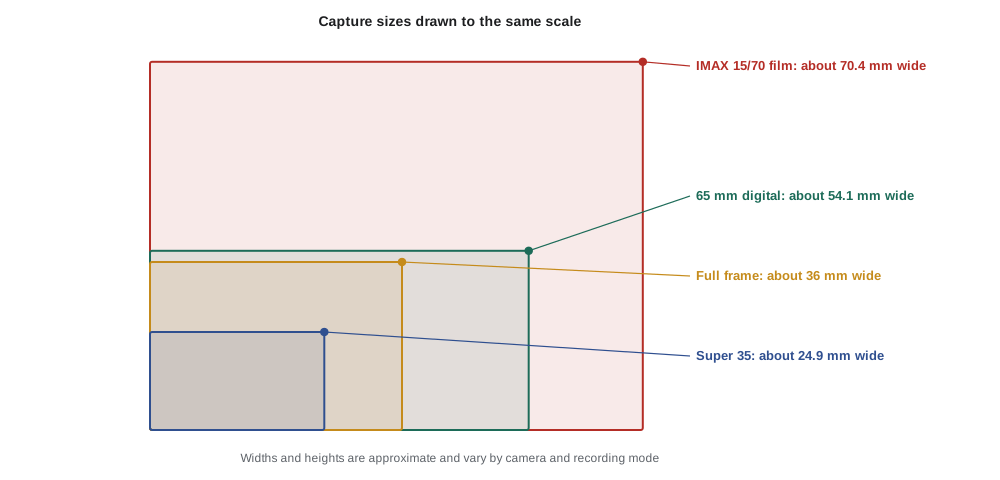
What changes with a larger sensor
A larger sensor does not by itself make an image "cinematic", but it changes several things a DP controls.
- Field of view for a given focal length: the same 50 mm lens shows a much wider view on a 65 mm sensor than on Super 35.
- Depth of field for a given field of view: to frame the same shot from the same position, you use a longer lens, and at the same f-stop the depth of field becomes shallower.
- Perspective and rendering: perspective depends on camera position, not sensor size, but a larger format lets you use a longer, more neutral lens from a closer position for the same framing, which many DPs describe as a more intimate, three-dimensional look.
- Resolution and noise: larger sensors can hold more photosites, larger photosites or both, which improves detail, dynamic range or low-light performance.
- Lens choice: fewer lenses cover a 65 mm image circle, and those that do are often larger, heavier and more expensive.
- Focus pulling: shallower depth of field at typical stops makes the first assistant camera's job harder, especially on moving shots.
Crop factor and equivalent focal length
To compare formats, cinematographers use a crop factor: the ratio of one format's dimension to another's. You can use the width or the diagonal; for motion pictures the width is often more useful because it controls horizontal framing.
If you know the focal length that gives the framing you want on one format, multiply by the ratio of the widths to find the focal length that gives the same horizontal field of view on another format.
Worked problem
Matching a Super 35 framing on a 65 mm sensor
A director likes the framing of a 40 mm lens on a Super 35 sensor 24.9 mm wide. The production is shooting on a 65 mm sensor 54.1 mm wide. Which focal length gives the same horizontal field of view?
Show solution
- Ratio of widths: 54.1 ÷ 24.9 ≈ 2.17.
- Equivalent focal length: 40 × 2.17 ≈ 87 mm.
- In practice the DP would choose the nearest available lens, perhaps an 80 mm or 90 mm, and adjust the camera position slightly.
Answer: About 87 mm on the 65 mm sensor gives the same horizontal framing as 40 mm on Super 35.
Field of view
The horizontal angle of view depends only on the sensor width and the focal length, for a lens focused at a distance much greater than its focal length.
Worked problem
Angle of view of a 50 mm lens on three formats
Find the horizontal angle of view of a 50 mm lens on Super 35 (24.9 mm wide), full frame (36 mm wide) and a 65 mm sensor (54.1 mm wide).
Show solution
- Super 35: 2 arctan(24.9 ÷ 100) = 2 arctan(0.249) ≈ 28.0°.
- Full frame: 2 arctan(0.36) ≈ 39.6°.
- 65 mm: 2 arctan(0.541) ≈ 56.8°.
Answer: The same 50 mm lens gives about 28° on Super 35, about 40° on full frame and about 57° on the 65 mm sensor, which is why a "normal" lens on 65 mm is closer to 80 or 100 mm.
Depth of field and equivalent aperture
When you frame the same shot from the same position on a larger format, the depth of field is shallower at the same f-stop. A useful approximation is that the depth of field matches if you multiply the f-number by the same crop factor you used for the focal length. This is often called the equivalent aperture.
Worked problem
Matching depth of field between formats
A scene on the 65 mm sensor (54.1 mm wide) is shot at T2.8 with an 87 mm lens. Which stop on Super 35 (24.9 mm wide) with a 40 mm lens gives about the same depth of field from the same position, and what does that mean for light levels?
Show solution
- Crop ratio from 65 mm to Super 35: 24.9 ÷ 54.1 ≈ 0.46.
- Equivalent stop on Super 35: 2.8 × 0.46 ≈ 1.3, so about T1.3.
- Going the other way, to get the deeper focus of T2.8 on Super 35, the 65 mm camera would need about 2.8 × 2.17 ≈ T6.1, which needs about two and a quarter stops more light.
Answer: T2.8 on the 65 mm sensor behaves like about T1.3 on Super 35 for depth of field. To match the deeper focus of T2.8 on Super 35 the large-format camera would need roughly T5.6 to T6.3 and much more light, which affects the lighting package and the budget.
That last point matters for planning. Large-format night exteriors or deep-focus interiors can need significantly more light than the same shots on Super 35, unless the camera's higher sensitivity makes up the difference.
Lens coverage and image circles
Every lens projects a circular image. The image circle must be at least as large as the sensor's diagonal, or the corners go dark or soft.
Worked problem
Does a full-frame lens cover a 65 mm sensor?
A set of full-frame cinema lenses has a 46 mm image circle. Will it cover a sensor 54.1 × 25.6 mm?
Show solution
- Sensor diagonal: √(54.1² + 25.6²) = √(2,927 + 655) = √3,582 ≈ 59.9 mm.
- The lens covers 46 mm, which is smaller than 59.9 mm.
Answer: No. The corners would vignette strongly. The camera would need a lens set rated for 65 mm, or a smaller recording mode that fits the 46 mm circle.
Lens families designed for 65 mm include large-format sets from the major lens makers and rehoused medium-format still lenses. Many DPs also use vintage medium-format glass for its character. Always test coverage at the widest focal length and closest focus, because coverage often shrinks at close focus and at full aperture, and check for illumination fall-off and softness at the corners.
The look of large format
Cinematographers describe the large-format look in different ways: a sense of depth and separation, smooth fall-off from sharp to soft, faces that feel present without distortion, landscapes with detail into the far distance. Some of this comes from the optics and the shallow depth of field, some from the high resolution and some from the expectations of the audience. Large format is not automatically better. For gritty handheld drama, intimate documentary-style work or fast action with long zooms, Super 35 may be easier and may suit the story better. The question, as always, is what the format does for the film.
Practical consequences for the crew
Large format affects almost every department around the camera.
- Focus: the first assistant camera needs accurate distance tools (lidar or ultrasonic rangefinders), good monitoring and realistic stops. Many large-format productions work at T4 to T5.6 for deeper focus.
- Weight and balance: large-format bodies and lenses can be heavier, which affects Steadicam, gimbals, cranes, drones and handheld work. Lighter bodies such as the ALEXA 265 have changed what is practical.
- Filters and matte boxes: larger front diameters need larger filters and matte boxes.
- Lighting: if the DP needs deeper stops, the lighting package grows.
- Data: larger sensors at high resolution produce more data, which changes storage, transfer and post budgets (Lesson 4).
- Availability: some large-format cameras are available only from particular rental houses, so book early and plan for limited backup bodies.
When to choose large format
A practical decision checklist helps when a director asks for large format.
- Is there a story or exhibition reason, such as scale, intimacy or a premium release?
- Can the lighting package and schedule support deeper stops if needed?
- Are suitable lenses available, tested and covered by insurance?
- Can the focus team, camera support and specialty platforms handle the weight and depth of field?
- Has post-production budgeted the storage, transfer, review and finishing costs?
If most answers are yes, large format can be a strong choice. If several are no, a full-frame or Super 35 camera may deliver a better film.
Common mistakes
MistakeThinking a larger sensor changes perspective by itself
InsteadPerspective depends on camera position; a larger sensor changes the focal length and depth of field needed for a given framing
MistakeUsing full-frame lenses on a 65 mm sensor without testing coverage
InsteadCalculate the sensor diagonal and test every lens at its widest focal length, full aperture and close focus
MistakeKeeping the same stop when moving from Super 35 to 65 mm and expecting the same depth of field
InsteadMultiply the stop by the crop factor to estimate the equivalent aperture, and plan the extra light needed
MistakeChoosing large format without telling the focus puller and lighting team early
InsteadPlan rangefinding, monitoring, stops and the lighting package together in prep
MistakeTreating large format as automatically more cinematic
InsteadChoose the format for what it does for the story and the release, not for prestige
Summary and key terms
- Common capture sizes range from Super 35 (about 25 mm wide) through full frame (36 mm) to 65 mm digital (about 50 to 55 mm) and IMAX 15/70 film (about 70 × 53 mm).
- A larger sensor widens the view for a given focal length, so equivalent focal lengths are found by multiplying by the ratio of widths.
- For the same framing and stop, depth of field is shallower on larger formats; the equivalent aperture scales by the same ratio.
- Lenses must have an image circle at least as large as the sensor diagonal, tested at the widest focal length, full aperture and close focus.
- Large format affects focus, weight, filters, lighting, data and equipment availability.
- Matching deep focus on large format can need two or more stops of extra light.
- Large format is a creative choice that should serve the story and the release.
- Super 35
- The traditional motion-picture frame size, about 25 mm wide in its common digital modes
- Full frame
- A capture size of about 36 × 24 mm, matching the VistaVision film frame and the 35 mm still frame
- 65 mm digital
- Digital sensors roughly 50 to 55 mm wide, echoing 65 mm film formats
- Crop factor
- The ratio of the dimensions of two formats, used to convert focal lengths and apertures
- Equivalent focal length
- The focal length that gives the same field of view on a different format
- Equivalent aperture
- The f-number that gives about the same depth of field for the same framing on a different format
- Image circle
- The diameter of the usable image projected by a lens
- Vignetting
- Darkening or softening toward the corners of the frame when a lens does not fully cover the sensor
- Angle of view
- The angle of the scene captured across the sensor, set by sensor width and focal length
- VistaVision
- A film format running 35 mm film horizontally with 8 perforations per frame, roughly full-frame size
Practice problems
Work each problem on paper first, then reveal the answer to check.
What focal length on a 36 mm wide full-frame sensor matches 35 mm on a 24.9 mm wide Super 35 sensor?
Show answer
35 × 36 ÷ 24.9 ≈ 51 mm
Find the horizontal angle of view of a 100 mm lens on a 54.1 mm wide sensor.
Show answer
2 arctan(54.1 ÷ 200) = 2 arctan(0.27) ≈ 30.3°
A sensor is 36 × 24 mm. What is its diagonal?
Show answer
√(1,296 + 576) = √1,872 ≈ 43.3 mm
Will a lens with a 60 mm image circle cover a 54.1 × 25.6 mm sensor?
Show answer
Yes, just: the diagonal is about 59.9 mm, but test the corners at close focus and full aperture
A shot at T2 on Super 35 is moved to full frame with the same framing. Which stop gives similar depth of field?
Show answer
2 × 36 ÷ 24.9 ≈ T2.9, so about T2.8
Why might a large-format night exterior need a bigger lighting package?
Show answer
To hold the same depth of field the larger format needs a deeper stop, which needs more light unless the camera's sensitivity compensates
Name two reasons a DP might choose Super 35 over large format.
Show answer
Any two of lighter equipment, deeper focus at practical stops, wider lens choice including long zooms, lower data and cost, or a look that suits gritty or handheld work
Why test lens coverage at close focus?
Show answer
Image circles often shrink at close focus, so corners that look fine at infinity may vignette
What does the first assistant camera need most on large format?
Show answer
Accurate distance measurement, good monitoring and realistic working stops because depth of field is shallower
Why should large-format bodies be booked early?
Show answer
Some are available only from specific rental houses with limited stock and backup bodies
Lesson quiz · 5 questions
Score 60% or more to complete this lesson.
Create a free account to save your progress, take quizzes and earn a certificate.