
CISSP-101 · Lesson 12 of 12 · 28 min
Study strategy and your personal CISSP plan
You now know what the CISSP is, how the experience rules work, how the adaptive exam behaves, what the Code of Ethics requires, what each of the eight domains covers and how to keep the credential once you have it. This final lesson turns that knowledge into action. It explains how to assess your starting point, choose study resources, use evidence-based learning techniques, build a weighted study plan with realistic milestones, judge when you are ready, manage the final weeks and exam day, and pull everything together into a written personal certification plan. The capstone exercise at the end asks you to produce that plan for yourself.
Start with an honest baseline
Every good plan starts from where you are. Because the CISSP is so broad, almost every candidate has strong domains and weak ones. A network engineer may be strong in Domain 4 and weak in Domains 1 and 8; a compliance specialist may be the reverse. Before you build a plan, rate yourself in each domain, ideally using a diagnostic practice test from a reputable source as well as your own judgement. A simple scale works: 1 for little or no knowledge, 2 for some familiarity, 3 for working knowledge and 4 for strong, practical expertise.
Be careful not to confuse familiarity with mastery. Recognizing a term when you see it is much easier than recalling it, explaining it or applying it to a scenario. A diagnostic test that asks you to apply knowledge gives a more reliable picture than reading the outline and nodding along.
Choosing study resources
Resources fall into a few categories. The official ISC2 materials include the CISSP exam outline (free), the official study guide and practice tests published with ISC2's endorsement, and ISC2's own training courses, which are offered self-paced and instructor-led. Independent publishers offer study guides, video courses, flash cards and question banks. Some providers run intensive boot camps over five or more days. Online communities, including the ISC2 community forums and local chapters, offer advice and study groups.
There is no single best resource. Most successful candidates combine one comprehensive text or course for structure, one or two good question banks for practice, and a short summary resource for review. More resources are not always better: buying five books and reading none of them properly is a common trap. Choose resources based on the current outline (anything written before the April 2024 outline may be missing topics), on reviews from recent candidates and on your learning style. Avoid any resource that claims to contain real exam questions; using such material breaches the non-disclosure agreement and the Code of Ethics.
| Resource type | Strengths | Watch out for |
|---|---|---|
| Exam outline | Free, authoritative list of topics | Not a study text |
| Comprehensive study guide | Structure and depth across all domains | Length; out-of-date editions |
| Video or online course | Engaging explanations, pacing | Passive watching without practice |
| Question banks | Retrieval practice, timing, weak-area detection | Questions that test trivia rather than judgement |
| Instructor-led training or boot camp | Expert guidance, accountability | Cost; cramming without follow-up |
| Study groups and forums | Motivation, different perspectives | Unverified advice; leaked content |
Learning techniques that work
Research on learning gives clear guidance about which study techniques are effective. Retrieval practice, actively recalling information by answering questions or explaining concepts from memory, strengthens memory far more than rereading. Spaced repetition, reviewing material at increasing intervals, beats massed review. Interleaving, mixing topics within a study session, improves the ability to choose the right approach for a given problem, which matters for an exam that mixes domains randomly. Elaboration, explaining why something is true and connecting it to what you already know, deepens understanding. Highlighting and rereading feel productive but are among the least effective techniques.
An error log is a simple tool that combines several of these ideas. Each time you get a practice question wrong, or right by guessing, write down the topic, why you chose the wrong answer and the principle that would have led you to the right one. Review the log weekly. Patterns emerge quickly: perhaps you keep choosing technical fixes over process, or confusing two security models. Fixing a pattern improves your score across many future questions.
Building a weighted study plan
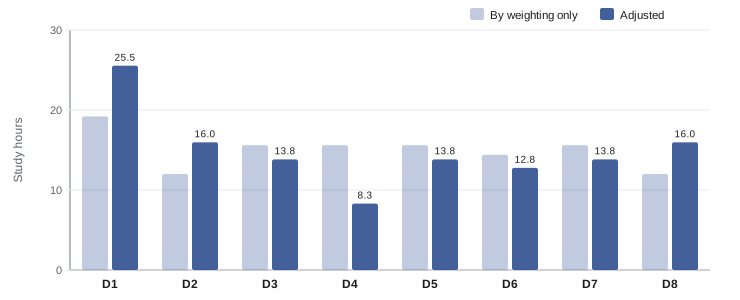
A good plan allocates more time to domains that carry more weight and to domains where you are weaker. A simple way to do this is to multiply each domain's weighting by a weakness factor and share your available hours in proportion.
Here \(H\) is your total content-study hours, \(w_i\) is the weighting of domain \(i\) and \(k_i\) is a weakness factor, for example 1.5 for a weak domain, 1.0 for an average one and 0.6 for a strong one. Reserve a separate block of time for full-length practice exams and final review, rather than including it in \(H\).
Worked problem
Allocating study hours by weight and weakness
Marco has 120 hours for domain study. He rates Domains 1, 2 and 8 as weak (k = 1.5), Domain 4 as strong (k = 0.6) and the rest as average (k = 1.0). How many hours should Domain 1 and Domain 4 receive?
Show solution
- Weighted products: D1 16 × 1.5 = 24; D2 10 × 1.5 = 15; D3 13 × 1.0 = 13; D4 13 × 0.6 = 7.8; D5 13 × 1.0 = 13; D6 12 × 1.0 = 12; D7 13 × 1.0 = 13; D8 10 × 1.5 = 15.
- Sum = 24 + 15 + 13 + 7.8 + 13 + 12 + 13 + 15 = 112.8.
- Domain 1: 120 × 24 ÷ 112.8 ≈ 25.5 hours.
- Domain 4: 120 × 7.8 ÷ 112.8 ≈ 8.3 hours.
Answer: About 25.5 hours for Domain 1 and 8.3 hours for Domain 4, with the remaining hours shared among the other domains in the same way.
How many hours in total? Reports from candidates vary enormously, from under 100 hours for experienced professionals with broad backgrounds to 300 or more for those with narrower experience. Most working professionals spread study over two to six months. Be realistic about how many hours a week you can sustain alongside work and family. Seven to ten hours a week over four months gives roughly 120 to 170 hours, which suits many candidates.
Worked problem
Turning hours into a calendar
Marco can study 8 hours a week. He needs 120 hours for domain study, 18 hours for three full practice exams with review, and 12 hours for final review. How many weeks should his plan run, and when should he book the exam?
Show solution
- Total = 120 + 18 + 12 = 150 hours.
- Weeks = 150 ÷ 8 ≈ 18.75, so about 19 weeks.
- Add a 10 % buffer for illness, work peaks or harder topics: about 21 weeks.
- Booking the exam for week 21 or 22 creates a firm deadline while leaving the buffer intact.
Answer: About 21 weeks including a buffer; book the exam for around week 21 or 22.
Milestones and readiness
Break the plan into milestones: for example, finishing Domains 1 and 2 by week 5, completing the first pass through all domains by week 14, taking full-length practice exams in weeks 15, 17 and 19, and reviewing weak areas in between. Use short end-of-domain quizzes to check retention, and revisit earlier domains with mixed question sets so they do not fade.
Deciding when you are ready is hard, because practice question banks vary in difficulty and none reproduces the real exam. Useful signs include consistently scoring well above your target on reputable full-length practice exams, without having memorized the questions; being able to explain why each wrong option is wrong; no domain remaining dramatically weaker than the others; and finishing full-length practice exams within the time limit at a steady pace. Many candidates aim for consistent scores in the mid-70s to 80s on good-quality practice tests, but treat any single number with caution, since question banks are calibrated differently.
The final weeks and exam day
In the final two weeks, shift from learning new material to consolidating: review your error log, summary notes and the mindset principles from lesson 10, and take one last full-length practice exam about a week out. In the last few days, reduce study, protect your sleep and confirm logistics: test centre location, travel time, parking and the identification you need. Do not cram the night before.
On exam day, arrive early, eat beforehand and bring only what is allowed. During the exam, read each question carefully, note qualifiers such as FIRST and BEST, choose the best answer and move on. Keep to your pacing checkpoints. If you feel the questions are very hard, remember that the adaptive test is designed to feel that way. Take a short break if you need one, remembering that the clock keeps running. Whatever the result, the experience will help you: a pass leads to endorsement, and a fail comes with a domain performance report that shows exactly where to focus a retake.
Capstone: your personal CISSP plan
To complete this course, write a personal CISSP plan of one or two pages. A good plan answers the following questions in writing, using what you have learned in each lesson.
- Goal and fit (lessons 1 and 2): Why do you want the CISSP, and how does it fit your career goals compared with alternatives?
- Eligibility (lesson 3): How many months of qualifying experience do you have, in which domains, and do you qualify for the waiver? Will you be a CISSP or an Associate on passing?
- Exam strategy (lesson 4): What is your target exam date, and what pacing plan will you use?
- Ethics (lesson 5): Which aspects of the Code of Ethics are most relevant to your current role?
- Baseline and allocation (lessons 6 to 10): How do you rate yourself in each domain, and how will you allocate study hours?
- Endorsement and maintenance (lesson 11): Who could endorse you, and how will you earn about 40 CPE credits a year?
- Budget and support (lessons 2 and 4): What will it cost, and will your employer contribute?
- Schedule and milestones (this lesson): What are your weekly hours, milestones, practice exam dates and buffer?
Worked problem
A sample plan summary
Summarize a plan for Aisha, a security analyst with 62 months of experience in Domains 4, 6 and 7, who can study 9 hours a week and whose employer will pay the exam fee.
Show solution
- Goal: move into a security architect role within two years; the CISSP appears in most postings for such roles.
- Eligibility: 62 months across three domains exceeds the 60-month requirement, so she can become a CISSP on passing and endorsement.
- Baseline: weak in Domains 1, 2, 3 and 8; average in 5; strong in 4, 6 and 7. Allocate 130 content hours by weighted formula.
- Schedule: 130 + 18 + 12 = 160 hours at 9 hours a week ≈ 18 weeks, plus a two-week buffer; book the exam for week 20.
- Endorsement: a CISSP colleague who has worked with her for three years; submit within a month of passing.
- Maintenance: two webinars a month and one conference a year for about 40 credits a year; AMF reimbursed by employer.
Answer: Aisha qualifies now, should study about 160 hours over 20 weeks with a weighted plan focused on Domains 1, 2, 3 and 8, and has an endorser and maintenance plan ready.
Common mistakes
MistakeBuying many resources and finishing none.
InsteadChoose one main text or course, one or two question banks and a review summary.
MistakeSpending most study time rereading and highlighting.
InsteadUse retrieval practice, spacing, interleaving and an error log.
MistakeGiving every domain the same time.
InsteadWeight hours by exam weighting and your weaknesses.
MistakeBooking the exam with no buffer.
InsteadAdd about 10 % for setbacks, and set milestones.
MistakeUsing material that claims to contain real exam questions.
InsteadIt breaches the non-disclosure agreement and Code of Ethics; use legitimate practice questions.
Summary and key terms
- Start by rating your knowledge in each domain, ideally with a diagnostic test.
- Combine a comprehensive resource, good question banks and a summary based on the current outline.
- Retrieval practice, spaced repetition, interleaving and error logs are the most effective techniques.
- Allocate hours using domain weighting multiplied by a weakness factor.
- Turn hours into a calendar with milestones, practice exams and a buffer, then book the exam.
- Judge readiness by consistent, well-understood practice performance across all domains.
- Write a personal plan covering goals, eligibility, study, endorsement, maintenance and budget.
- Baseline
- Assessment of current knowledge before planning study.
- Diagnostic test
- Practice test used to find strengths and weaknesses.
- Retrieval practice
- Strengthening memory by actively recalling information.
- Spaced repetition
- Reviewing material at increasing intervals.
- Interleaving
- Mixing topics within a study session.
- Error log
- Record of mistakes, their causes and the correct principles.
- Weakness factor
- Multiplier that increases study time for weaker domains.
- Milestone
- Planned checkpoint used to track progress.
- Buffer
- Spare time added to a schedule for setbacks.
- Personal certification plan
- Written plan covering goals, eligibility, study, endorsement and maintenance.
Practice problems
Work each problem on paper first, then reveal the answer to check.
Why use a diagnostic test rather than self-rating alone?
Show answer
Familiarity can be mistaken for mastery; a test shows ability to apply knowledge.
Name three effective learning techniques.
Show answer
Retrieval practice, spaced repetition and interleaving.
What should an error log record?
Show answer
The topic, why you chose the wrong answer and the correct principle.
With 100 hours, weights 16 and 10, and weakness factors 1.5 and 1.0 for two domains only, how are hours split?
Show answer
24 ÷ 34 × 100 ≈ 70.6 hours and 10 ÷ 34 × 100 ≈ 29.4 hours.
At 6 hours a week, how long do 132 hours take?
Show answer
22 weeks, before any buffer.
Why book the exam once you have a plan?
Show answer
A firm date creates a deadline and helps maintain momentum.
Name two signs of readiness.
Show answer
Consistent strong practice scores and the ability to explain why wrong options are wrong.
What should the last few days before the exam focus on?
Show answer
Light review, sleep and logistics, not cramming.
Why avoid resources written before April 2024?
Show answer
They may not match the current outline.
What does a failing candidate receive that helps planning a retake?
Show answer
A report of relative performance by domain.
Lesson quiz · 5 questions
Score 60% or more to complete this lesson.
Create a free account to save your progress, take quizzes and earn a certificate.