
CMPUT-272 · Lesson 3 of 12 · 33 min
Logical equivalence, normal forms and satisfiability
Two formulas can look different and still say the same thing. Recognizing when that happens lets you simplify conditions in programs, design smaller circuits and transform problems into forms that algorithms can solve. This lesson defines tautologies, contradictions and logical equivalence, lists the standard equivalence laws, shows how to put any formula into a normal form, and introduces the satisfiability problem, one of the most important problems in computing.
Tautologies, contradictions and contingencies
A tautology is a formula that is true in every row of its truth table, whatever the values of its variables. The formula \(p \vee \neg p\) is the simplest example: every proposition is either true or false. A contradiction is false in every row, like \(p \wedge \neg p\). A formula that is true in some rows and false in others is a contingency. A formula is satisfiable if at least one row makes it true, so every tautology and every contingency is satisfiable, and only contradictions are not.
| Kind | Truth table column | Example | Satisfiable? |
|---|---|---|---|
| Tautology | All T | p ∨ ¬p | Yes |
| Contradiction | All F | p ∧ ¬p | No |
| Contingency | Some T, some F | p → q | Yes |
Logical equivalence
Two formulas \(A\) and \(B\) are logically equivalent, written \(A \equiv B\), if they have the same truth value in every row, that is, if \(A \longleftrightarrow B\) is a tautology. Equivalence is the logical version of equality in algebra: you can replace a formula by an equivalent one anywhere without changing the meaning of the whole.
The most direct way to prove an equivalence is to compare truth tables. That works well for two or three variables. A program can do the same check for any number of variables, as long as \(2^n\) rows is manageable.
from itertools import product

def equivalent(f, g, n):
    """True if functions f and g of n Booleans agree on every input."""
    return all(f(*v) == g(*v) for v in product([True, False], repeat=n))

imp = lambda a, b: (not a) or b
print("De Morgan 1:", equivalent(lambda p, q: not (p and q), lambda p, q: (not p) or (not q), 2))
print("De Morgan 2:", equivalent(lambda p, q: not (p or q), lambda p, q: (not p) and (not q), 2))
print("p->q vs ~p v q:", equivalent(imp, lambda p, q: (not p) or q, 2))
print("p->q vs q->p:", equivalent(imp, lambda p, q: imp(q, p), 2))
print("distribution:", equivalent(lambda p, q, r: p and (q or r),
lambda p, q, r: (p and q) or (p and r), 3))De Morgan 1: True De Morgan 2: True p->q vs ~p v q: True p->q vs q->p: False distribution: True
The standard equivalence laws
A small set of laws, each checkable by truth table, lets you transform formulas by algebra instead of tables. They mirror the laws of set operations you will meet in lesson 7, and the laws of Boolean algebra used in circuit design.
| Law | Form |
|---|---|
| Identity | p ∧ T ≡ p; p ∨ F ≡ p |
| Domination | p ∨ T ≡ T; p ∧ F ≡ F |
| Idempotent | p ∨ p ≡ p; p ∧ p ≡ p |
| Double negation | ¬(¬p) ≡ p |
| Commutative | p ∨ q ≡ q ∨ p; p ∧ q ≡ q ∧ p |
| Associative | (p ∨ q) ∨ r ≡ p ∨ (q ∨ r); same for ∧ |
| Distributive | p ∧ (q ∨ r) ≡ (p ∧ q) ∨ (p ∧ r); p ∨ (q ∧ r) ≡ (p ∨ q) ∧ (p ∨ r) |
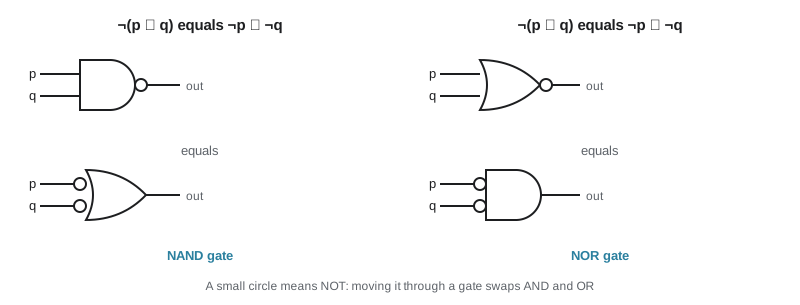
| De Morgan | ¬(p ∧ q) ≡ ¬p ∨ ¬q; ¬(p ∨ q) ≡ ¬p ∧ ¬q |
| Absorption | p ∨ (p ∧ q) ≡ p; p ∧ (p ∨ q) ≡ p |
| Negation | p ∨ ¬p ≡ T; p ∧ ¬p ≡ F |
| Conditional | p → q ≡ ¬p ∨ q |
| Contrapositive | p → q ≡ ¬q → ¬p |
| Biconditional | p ↔ q ≡ (p → q) ∧ (q → p) |
De Morgan's laws deserve special practice because they appear constantly in programming. The negation of a conjunction is the disjunction of the negations, and vice versa. In code, not (a and b) becomes (not a) or (not b). A loop that should continue while neither the end of the file has been reached nor an error has occurred can be written as while not (eof or error), or equivalently while not eof and not error.
Worked problem
Simplifying with laws
Show that ¬(p ∨ (¬p ∧ q)) ≡ ¬p ∧ ¬q using equivalence laws.
Show solution
- ¬(p ∨ (¬p ∧ q)) ≡ ¬p ∧ ¬(¬p ∧ q), by De Morgan.
- ≡ ¬p ∧ (¬¬p ∨ ¬q), by De Morgan again.
- ≡ ¬p ∧ (p ∨ ¬q), by double negation.
- ≡ (¬p ∧ p) ∨ (¬p ∧ ¬q), by distribution.
- ≡ F ∨ (¬p ∧ ¬q), by the negation law.
- ≡ ¬p ∧ ¬q, by identity.
Answer: The two formulas are equivalent; each step uses one named law, so the chain is a proof.
A chain of equivalences like this is a proof. Each step must be justified by a law, and the laws themselves were proved by truth tables. For formulas with many variables, algebraic reasoning is far shorter than a truth table: a formula in 20 variables has over a million rows, but an equivalence proof might take five lines.
Worked problem
Simplifying a program condition
A function contains: if not (user.active and not user.banned) or user.admin: deny(). Simplify the condition.
Show solution
- Let a = user.active, b = user.banned, d = user.admin. The condition is ¬(a ∧ ¬b) ∨ d.
- By De Morgan, ¬(a ∧ ¬b) ≡ ¬a ∨ b.
- So the condition is ¬a ∨ b ∨ d.
- In Python: if not user.active or user.banned or user.admin: deny().
Answer: not user.active or user.banned or user.admin. Reading the simplified form reveals something odd: admins are always denied. Simplification often exposes logic errors.
Normal forms
A normal form is a standard shape for formulas. Two are central. A literal is a variable or its negation, such as \(p\) or \(\neg q\). A clause is a disjunction of literals, such as \(p \vee \neg q \vee r\). A formula is in conjunctive normal form (CNF) if it is a conjunction of clauses: an AND of ORs. It is in disjunctive normal form (DNF) if it is a disjunction of conjunctions of literals: an OR of ANDs.
Every formula has an equivalent CNF and an equivalent DNF. DNF can be read straight off a truth table: for each row where the formula is true, write the conjunction of literals that describes that row, then join those conjunctions with OR. CNF comes from the false rows: for each false row, write the clause that rules out exactly that row, then join with AND.
Worked problem
Reading DNF and CNF from a truth table
The formula f(p, q) is true exactly in rows (T, F) and (F, T). Write it in DNF and CNF.
Show solution
- True rows: (T, F) gives p ∧ ¬q; (F, T) gives ¬p ∧ q.
- DNF: (p ∧ ¬q) ∨ (¬p ∧ q).
- False rows: (T, T) and (F, F). The clause ruling out (T, T) is ¬p ∨ ¬q; the clause ruling out (F, F) is p ∨ q.
- CNF: (p ∨ q) ∧ (¬p ∨ ¬q).
Answer: Both describe exclusive or, p ⊕ q: at least one is true, and not both.
from itertools import product

def dnf_from_table(f, names):
    terms = []
    for vals in product([True, False], repeat=len(names)):
        if f(*vals):
            lits = [n if v else "~" + n for n, v in zip(names, vals)]
            terms.append("(" + " & ".join(lits) + ")")
    return " | ".join(terms) if terms else "F"

def cnf_from_table(f, names):
    clauses = []
    for vals in product([True, False], repeat=len(names)):
        if not f(*vals):
            lits = ["~" + n if v else n for n, v in zip(names, vals)]
            clauses.append("(" + " | ".join(lits) + ")")
    return " & ".join(clauses) if clauses else "T"

majority = lambda p, q, r: (p + q + r) >= 2
print("DNF:", dnf_from_table(majority, "pqr"))
print("CNF:", cnf_from_table(majority, "pqr"))DNF: (p & q & r) | (p & q & ~r) | (p & ~q & r) | (~p & q & r) CNF: (~p | q | r) & (p | ~q | r) & (p | q | ~r) & (p | q | r)
Normal forms read straight from a table can be long, because they have one term per row. Simplification can shorten them: the majority function above is also \((p \wedge q) \vee (p \wedge r) \vee (q \wedge r)\). Finding the smallest equivalent formula is a hard problem in general; circuit designers use tools such as Karnaugh maps for small cases and specialized software for large ones.
You can also convert to CNF by algebra: replace \(\to\) and \(\longleftrightarrow\) using their definitions, push negations inward with De Morgan's laws and double negation until they sit only on variables, and then distribute \(\vee\) over \(\wedge\). The last step can make the formula grow exponentially, which is why practical tools use a cleverer method, the Tseitin transformation, that adds new variables and keeps the size linear.
Satisfiability
The satisfiability problem, called SAT, asks: given a formula, is there an assignment of truth values that makes it true? For a formula in \(n\) variables, the obvious method tries all \(2^n\) assignments. That is fine for 20 variables (about a million assignments) and impossible for 300, since \(2^{300}\) exceeds the number of atoms in the observable universe.
from itertools import product

# Clauses in CNF: each literal is +i for variable i, -i for its negation
clauses = [[1, 2], [-1, 3], [-2, -3], [-1, -2, 3], [2, 3]]
n = 3

def satisfies(assign, clauses):
    return all(any(assign[abs(l)] == (l > 0) for l in c) for c in clauses)

solutions = []
for vals in product([False, True], repeat=n):
    assign = {i + 1: v for i, v in enumerate(vals)}
    if satisfies(assign, clauses):
        solutions.append(vals)
print("assignments tried:", 2 ** n)
print("satisfying assignments (x1, x2, x3):", solutions)assignments tried: 8 satisfying assignments (x1, x2, x3): [(False, True, False), (True, False, True)]
SAT matters far beyond logic puzzles. Scheduling exams so that no student has two at once, checking that a hardware design never reaches a bad state, finding a configuration of software packages whose version constraints are compatible, and solving Sudoku can all be written as SAT problems. Modern SAT solvers use clever search with conflict-driven clause learning and routinely solve industrial instances with millions of variables, even though no algorithm is known that solves every instance quickly.
In 1971, Stephen Cook of the University of Toronto proved that SAT is NP-complete: every problem whose solutions can be checked quickly can be translated into SAT. Leonid Levin proved a similar result independently in the Soviet Union. Whether SAT can always be solved in polynomial time is the famous P versus NP question, one of the Millennium Prize Problems. You will study NP-completeness in CMPUT-304 and CMPUT-474; for now, the key idea is that checking a proposed solution is easy (just evaluate the formula) while finding one may be hard.
Worked problem
Encoding a scheduling constraint
Three exams A, B, C must each go in one of two time slots. Exams A and B share students, as do B and C. Encode this as SAT using variables a, b, c meaning "the exam is in slot 1" (false means slot 2).
Show solution
- A and B must be in different slots: a ⊕ b, which in CNF is (a ∨ b) ∧ (¬a ∨ ¬b).
- B and C must differ: (b ∨ c) ∧ (¬b ∨ ¬c).
- The formula is the conjunction of these four clauses.
- One satisfying assignment: a = T, b = F, c = T, meaning A and C in slot 1, B in slot 2.
Answer: Satisfiable; the solution puts A and C together and B alone. Adding a conflict between A and C would make it unsatisfiable, which is how SAT detects that no schedule exists.
Valid arguments
Equivalence also clarifies what makes an argument valid. An argument with premises \(P_1, \ldots, P_k\) and conclusion \(C\) is valid if \((P_1 \wedge \cdots \wedge P_k) \to C\) is a tautology: whenever all premises are true, the conclusion must be true. Validity is about form, not content. The argument if it is raining the ground is wet; it is raining; so the ground is wet has the valid form called modus ponens. The argument if it is raining the ground is wet; the ground is wet; so it is raining is invalid, because the ground could be wet for another reason. That error is called affirming the consequent.
| Rule | Premises | Conclusion | Valid? |
|---|---|---|---|
| Modus ponens | p → q, p | q | Yes |
| Modus tollens | p → q, ¬q | ¬p | Yes |
| Hypothetical syllogism | p → q, q → r | p → r | Yes |
| Disjunctive syllogism | p ∨ q, ¬p | q | Yes |
| Affirming the consequent | p → q, q | p | No (fallacy) |
| Denying the antecedent | p → q, ¬p | ¬q | No (fallacy) |
Common mistakes
MistakeApplying De Morgan as ¬(p ∧ q) ≡ ¬p ∧ ¬q.
InsteadNegation flips the connective: ¬(p ∧ q) ≡ ¬p ∨ ¬q.
MistakeDistributing ∧ over ∧ or ∨ over ∨ as if it changed something.
InsteadDistribution applies ∧ over ∨ or ∨ over ∧; the same connective just regroups by associativity.
MistakeConfusing CNF (AND of ORs) with DNF (OR of ANDs).
InsteadRemember CNF as clauses joined by AND; DNF as terms joined by OR.
MistakeThinking a contingent formula is unsatisfiable.
InsteadOnly contradictions are unsatisfiable; any formula with at least one true row is satisfiable.
MistakeConcluding p from p → q and q.
InsteadThat is affirming the consequent, a fallacy; q might be true for another reason.
MistakeBelieving SAT is solved quickly in every case because solvers are fast in practice.
InsteadSolvers are fast on many real instances, but no algorithm is known that is fast on every instance.
Summary and key terms
- A tautology is always true, a contradiction always false, a contingency sometimes each.
- A ≡ B means A and B agree in every row; equivalent formulas can replace each other.
- De Morgan's laws flip ∧ and ∨ when a negation moves inside parentheses.
- Chains of named equivalence laws are proofs and scale better than truth tables.
- CNF is an AND of clauses (ORs of literals); DNF is an OR of conjunctions of literals.
- DNF comes from true rows of a truth table, CNF from false rows.
- SAT asks whether a formula can be made true; it is NP-complete and central to computing.
- Tautology
- A formula true under every assignment.
- Contradiction
- A formula false under every assignment.
- Logical equivalence
- Two formulas having the same truth value under every assignment.
- De Morgan's laws
- ¬(p ∧ q) ≡ ¬p ∨ ¬q and ¬(p ∨ q) ≡ ¬p ∧ ¬q.
- Literal
- A propositional variable or its negation.
- Clause
- A disjunction of literals.
- Conjunctive normal form
- A conjunction of clauses.
- Disjunctive normal form
- A disjunction of conjunctions of literals.
- Satisfiable
- Having at least one assignment that makes the formula true.
- Modus ponens
- The valid rule: from p → q and p, conclude q.
Practice problems
Work each problem on paper first, then reveal the answer to check.
Is (p → q) ∨ (q → p) a tautology?
Show answer
Yes; if q is true the first disjunct holds, if q is false the second holds.
Use De Morgan to negate 'x > 0 and y > 0'.
Show answer
x <= 0 or y <= 0.
Simplify p ∨ (p ∧ q).
Show answer
p, by absorption.
Write p → q in CNF.
Show answer
¬p ∨ q, a single clause.
Write p ↔ q in DNF.
Show answer
(p ∧ q) ∨ (¬p ∧ ¬q).
Is (p ∨ q) ∧ ¬p ∧ ¬q satisfiable?
Show answer
No; it requires p or q while both are false.
Which rule justifies: if the cache is warm the request is fast; the request is not fast; so the cache is not warm?
Show answer
Modus tollens.
How many assignments does brute-force SAT check for 30 variables?
Show answer
2 to the 30, about 1.07 billion.
Rewrite while not (done or failed): in a form without parentheses.
Show answer
while not done and not failed:
Why can conversion to CNF by distribution be expensive?
Show answer
Distributing ∨ over ∧ can double the formula size repeatedly, giving exponential growth.
Lesson quiz · 5 questions
Score 60% or more to complete this lesson.
Create a free account to save your progress, take quizzes and earn a certificate.