
CON-300 · Lesson 4 of 12 · 31 min
Self-performed trades in depth
CON-200 showed how to take off concrete, formwork, reinforcing, masonry, framing and structural steel and how to apply unit prices to the quantities. That is enough to price a small foundation package. On a complete bid for a building, the general contractor's self-performed work is usually the largest single source of risk in the estimate, and pricing it well depends less on the quantities than on the method: how many form sets, how the concrete gets from the truck to the forms, how the work is sequenced around the crane, what happens in winter and how much the firm's own crews actually produce. This lesson works through method-based pricing for the trades general contractors most often self-perform: cast-in-place concrete, structural steel erection and rough carpentry, with notes on miscellaneous installation work.
Method before price
A method statement is a short description of how the work will be done: the sequence, the equipment, the crews, the form systems and the duration. Writing one before pricing forces the estimator to think the work through and makes the estimate reviewable, because a reviewer can challenge the method rather than guessing what a unit price assumed. It also connects the estimate to the schedule. If the method assumes two wall form sets cycling every three days, the schedule must allow the corresponding duration, and the general conditions must carry the crane and supervision for that duration.
| Method decision | Options | Price drivers |
|---|---|---|
| Formwork system | Job-built plywood, rented modular panels, gang forms, climbing forms, flying tables | Material cost per use, labour per square metre, crane time |
| Number of form sets | One set reused many times, or several sets for speed | Material or rental cost versus schedule and crane cost |
| Concrete placement | Direct chute, pump, crane and bucket, buggies, conveyor | Placement rate, equipment cost, crew size |
| Pour size and sequence | Large pours with fewer joints, or small pours with more cycles | Construction joints, finishing crew, truck supply |
| Winter protection | Heated enclosures, insulated blankets, ground thawing, accelerators | Fuel, hoarding, labour, schedule |
| Steel erection | Tower crane, mobile crane, piece-by-piece or pre-assembled | Crane hours, crew size, connections per day |
Formwork: the biggest lever
Formwork often costs as much as the concrete it shapes, and most of that cost is labour. Two quantities control it: the contact area (the area of form in contact with concrete, measured in CON-200) and the number of times each form can be reused. Job-built plywood forms might be used three to six times before they are too damaged to give an acceptable finish; engineered aluminium or steel panel systems can be used hundreds of times and are usually rented. The cost per use falls as reuse increases, but the contractor must have enough sets to keep the crews and the schedule moving.
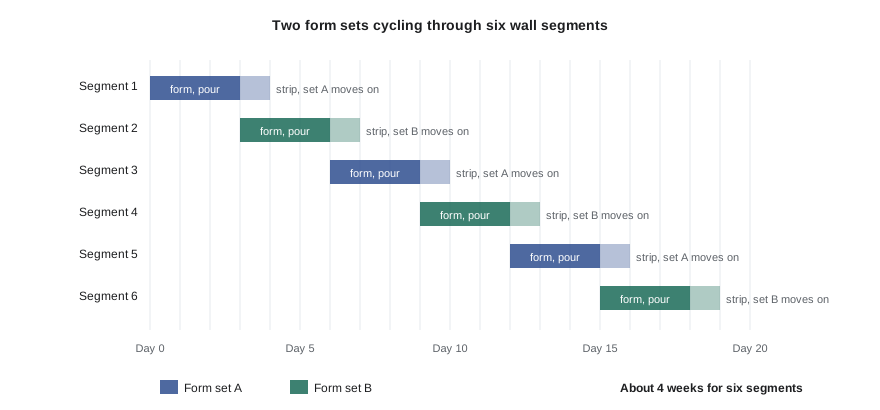
# Cost per square metre of contact area for different numbers of form sets (illustrative)
contact_total = 2_400        # m2 of wall contact area on the project
set_area = 200               # m2 of forms in one set
material = 95                # $ per m2 to build or buy job-built forms
labour = 48                  # $ per m2 per use to erect, align and strip
repair = 4                   # $ per m2 per use
crane_week = 14_000          # $ per week of crane time tied to the walls
for sets in (1, 2, 3):
    uses = contact_total / (set_area * sets)        # uses of each set
    weeks = contact_total / (set_area * sets) * 0.6 # 3 working days per cycle per set (assumed)
    weeks = max(weeks, contact_total / 800)         # crew can form at most 800 m2 per week
    cost = (material * set_area * sets + (labour + repair) * contact_total
            + crane_week * weeks)
    print(f"{sets} set(s): {uses:4.1f} uses each, {weeks:4.1f} weeks, "
f"${cost:,.0f} total, ${cost / contact_total:,.2f} per m2")1 set(s): 12.0 uses each, 7.2 weeks, $244,600 total, $101.92 per m2 2 set(s): 6.0 uses each, 3.6 weeks, $213,200 total, $88.83 per m2 3 set(s): 4.0 uses each, 3.0 weeks, $223,800 total, $93.25 per m2
With one set, each form is reused twelve times and material cost per use is low, but the walls take more than seven weeks and the crane is tied up the whole time. With two sets the walls finish in under four weeks; the extra material is more than repaid by the crane time saved. A third set saves less than a week of crane time, because the crew, not the forms, now limits progress, and its material costs more than it saves. The general lesson is that formwork must be priced with the schedule and the crane, not as a unit rate in isolation. (The crew's own cost is the same in each case because its total hours depend on the contact area, which is why it does not appear in the comparison.)
Placing and finishing concrete
Placing concrete looks simple: trucks arrive, concrete goes into the forms, finishers do their work. The cost depends on how fast concrete can be delivered and placed, which determines the crew hours and equipment time. The placing rate is limited by the slowest link: the ready-mix plant's ability to supply trucks, the travel time, the pump or crane's output, and the finishers' ability to keep up. A slab pour that is too large for the finishing crew leads to cold joints or poor finishes; one that is too small wastes the fixed costs of mobilizing the pump and crew.
Worked problem
Planning and pricing a slab pour
An elevated slab section is 640 m² at 225 mm thick. Trucks carry 9 m³. A boom pump places about 30 m³ per hour effectively and costs $260 per hour with a 4-hour minimum plus a $350 travel charge. The placing crew of 1 foreman, 5 labourers and 1 pump hose operator costs $520 per hour; the finishing crew of 4 finishers costs $350 per hour and works 4 hours longer than the placing crew. Add 3 % waste. How many trucks, and what are the placing and finishing labour and pump costs?
Show solution
- Volume = 640 × 0.225 = 144 m³; with waste 144 × 1.03 ≈ 148.3 m³; trucks = 148.3 ÷ 9 ≈ 16.5, so 17 loads.
- Pour duration = 148.3 ÷ 30 ≈ 4.9 hours, plus 1 hour setup and washout ≈ 6 hours.
- Pump = 6 × 260 + 350 = $1,910.
- Placing crew = 6 × 520 = $3,120. Finishing crew = (6 + 4) × 350 = $3,500.
- Total = 1,910 + 3,120 + 3,500 = $8,530 for placing, finishing and pumping (concrete material extra).
Answer: About $8,500, or roughly $59 per m³ placed. Pouring the whole floor in one day would reduce the per-unit cost of the pump minimum and setup, if the plant and finishers can support it.
Concrete material itself is priced from supplier quotes per unit volume, with extras for high strength, air entrainment, special cements, fibres, accelerators or retarders, hot water or chilled water, short loads (loads below a minimum size), waiting time beyond the free unloading period, and weekend or night delivery. CON-200 covered the main items; on a complete bid the estimator also checks the specified testing regime, because the cost of cylinders, slump and air tests and any third-party inspection usually falls to the contractor or must be coordinated with an owner-paid testing firm.
Winter concreting
In most of Canada, a building with concrete work between November and March will need cold-weather protection. CSA A23.1 requires that freshly placed concrete be protected from freezing and kept above specified temperatures for a curing period, and that concrete not be placed against frozen ground. The costs include hoarding (tarpaulin or poly enclosures on scaffold or frames), indirect-fired heaters and fuel, ground-thawing equipment, insulated blankets, heated aggregates and hot water from the ready-mix supplier, accelerating admixtures, temperature monitoring, and the lower productivity of crews working in heavy clothing in short days.
Worked problem
Pricing winter protection for a slab
A ground-floor slab will be poured in January inside a hoarded enclosure. The enclosure covers the slab area for 3 weeks. Hoarding materials and labour cost $14,500 to erect and $5,200 to remove; two indirect-fired heaters rent for $1,150 per week each and burn fuel costing $2,400 per week each; blankets and monitoring cost $3,800; the ready-mix winter surcharge is $12 per unit volume on 420 units; and productivity losses add 15 % to $46,000 of concrete labour. What does winter add?
Show solution
- Hoarding = 14,500 + 5,200 = $19,700.
- Heaters = 2 × 3 × (1,150 + 2,400) = $21,300.
- Blankets and monitoring = $3,800. Winter surcharge = 12 × 420 = $5,040.
- Productivity = 0.15 × 46,000 = $6,900.
- Total = 19,700 + 21,300 + 3,800 + 5,040 + 6,900 = $56,740.
Answer: Winter adds about $57,000 to this slab. Whether it is carried in the concrete package or in general conditions, it must appear somewhere, and the bid should state the assumed schedule.
Structural steel erection
Many general contractors subcontract structural steel as a supply-and-erect package, but some self-perform erection or erect pre-engineered buildings. Erection is priced on pieces and connections rather than on tonnage alone, because a crew's daily output is limited by the number of lifts and bolted or welded connections. Light, numerous members can cost more per tonne to erect than heavy members.
| Item | Basis | Illustrative productivity |
|---|---|---|
| Columns and beams | Pieces per crane-day | 30 to 50 pieces per day for a crew of 5 or 6 ironworkers |
| Bolted connections | Bolts per worker-hour | Depends on bolt type and tensioning method |
| Field welding | Length of weld per hour | Depends on position and size of weld |
| Metal deck | Area per crew-day | Several hundred square metres per day on simple layouts |
| Plumbing and bolting up | Percentage of erection labour | Often 15 to 25 % |
Worked problem
Estimating erection days
A two-storey steel frame has 410 pieces (columns, beams, braces) and 1,950 m² of metal deck. The erection crew (crane and 6 ironworkers) costs $6,400 per day and sets 38 pieces per day; the deck crew of 4 lays 380 m² per day at $2,900 per day. Plumbing and bolting add 20 % to the erection crew days. What are the erection and decking costs?
Show solution
- Erection days = 410 ÷ 38 ≈ 10.8, plus 20 % ≈ 12.9, say 13 days.
- Erection cost = 13 × 6,400 = $83,200.
- Deck days = 1,950 ÷ 380 ≈ 5.1, say 5.5 days with cleanup; cost = 5.5 × 2,900 = $15,950.
- Total ≈ $99,150 for erection and decking labour and crane.
Answer: About $99,000. Pieces per day, not tonnage, drove the duration.
Rough carpentry and the general contractor's own work
The general contractor's carpenters and labourers often carry a long list of small items that no subcontractor wants: wood blocking and backing in walls, rough hardware, temporary stairs and guardrails, hoarding and covered walkways, floor and finish protection, installation of owner-supplied items, doors, frames and hardware installation, washroom accessories and other specialties, and miscellaneous patching. Each is small, but together they can be a significant cost and a common source of scope gaps between trades.
Good practice is to keep a checklist of these items, assign each to a package or to the general contractor explicitly, and price the general contractor's share with crew-days and materials. Doors, frames and hardware installation, for example, is priced per opening, with adjustments for frame type (knock-down or welded), hardware complexity (simple passage sets versus electrified hardware with access control) and fire-rated assemblies.
Worked problem
Pricing door installation
A project has 86 openings: 62 standard (installed at 2.5 carpenter-hours each including hardware), 18 with closers and panic hardware (4.0 hours each) and 6 with electrified hardware coordinated with the security contractor (6.5 hours each). The carpenter loaded rate is $80 per hour; add 10 % for distribution and protection. What is the labour cost?
Show solution
- Hours = 62 × 2.5 + 18 × 4.0 + 6 × 6.5 = 155 + 72 + 39 = 266 hours.
- With 10 % = 292.6 hours.
- Cost = 292.6 × 80 ≈ $23,400.
Answer: About $23,400, an average of $272 per opening, with the complex openings costing far more than the simple ones.
Common mistakes
MistakePricing formwork as a unit rate without considering the number of sets and the schedule.
InsteadPrice form sets, reuse, crew output and crane time together; the cheapest material plan may be the most expensive overall.
MistakeAssuming the pump or crane sets the pour rate.
InsteadCheck truck supply, travel time, placing equipment and the finishing crew; the slowest link governs.
MistakeLeaving winter protection out because the schedule might slip into spring.
InsteadPrice winter conditions for the schedule as bid and state the assumption.
MistakePricing steel erection by the tonne only.
InsteadCount pieces and connections; light, numerous members take more crane time per tonne.
MistakeIgnoring the small items that no trade carries.
InsteadKeep a checklist of blocking, protection, temporary work and installation items and assign each explicitly.
MistakeWriting a unit price without recording the method behind it.
InsteadWrite a short method statement so reviewers can test the assumptions.
Summary and key terms
- Method statements connect self-performed pricing to sequence, equipment, crews and schedule.
- Formwork cost per use depends on reuse; the number of form sets trades material against schedule and crane time.
- Concrete placing rates are limited by the slowest of supply, placement equipment and finishing.
- Winter concreting adds hoarding, heat, fuel, blankets, surcharges and productivity losses.
- Steel erection is priced on pieces and connections per crane-day, not tonnage alone.
- General contractor carpentry and labour carry many small items that must be listed and assigned.
- Method statement
- A short description of how the work will be done, used to price and review it.
- Contact area
- The area of formwork in contact with the concrete.
- Form set
- One complete group of forms that can be erected, poured and stripped together.
- Formwork reuse
- The number of times a form can be used before replacement.
- Placing rate
- Volume of concrete placed per hour.
- Short load
- A ready-mix load below the supplier's minimum, charged extra.
- Hoarding
- A temporary enclosure, often heated, protecting work from weather.
- Cold-weather concreting
- Measures that protect fresh concrete from freezing and low temperatures.
- Pieces per day
- The number of steel members an erection crew sets per day.
- Opening
- A door location including frame, door and hardware, the unit for door installation pricing.
Practice problems
Work each problem on paper first, then reveal the answer to check.
Why write a method statement before pricing self-performed work?
Show answer
It forces the work to be thought through and makes the price reviewable and linked to the schedule.
Forms cost $90 per m² to build and are used 5 times. What is the material cost per use?
Show answer
$18 per m².
Why might adding a second form set lower the total cost?
Show answer
It shortens the duration, saving crane and supervision time that outweighs the extra material.
Name three limits on a concrete placing rate.
Show answer
Truck supply, travel time, pump or crane output, finishing crew capacity.
A slab of 500 m² at 200 mm needs how many 9 m³ trucks with 3 % waste?
Show answer
100 m³ × 1.03 = 103 m³; 11.4, so 12 trucks.
List five winter concreting costs.
Show answer
Hoarding, heaters, fuel, blankets, ground thawing, winter surcharge, accelerators, monitoring, lost productivity (any five).
Why is steel erection priced on pieces?
Show answer
Crew output is limited by lifts and connections, not weight.
A crew sets 40 pieces a day. How many days for 300 pieces plus 20 % for plumbing and bolting?
Show answer
300 ÷ 40 = 7.5; × 1.2 = 9 days.
Name five small items general contractor carpenters often carry.
Show answer
Blocking, rough hardware, temporary guardrails, hoarding, protection, door installation, accessories, patching (any five).
Why price door installation by opening type?
Show answer
Hours vary widely between simple and electrified or fire-rated openings.
Lesson quiz · 5 questions
Score 60% or more to complete this lesson.
Create a free account to save your progress, take quizzes and earn a certificate.