
CRE-420 · Lesson 8 of 12 · 27 min
Food, cooking and drinks
Food content is universal. Recipes, cooking tutorials, restaurant reviews, food travel, baking, meal prep, nutrition, street food, mukbang and drink content attract every kind of audience. Food photographs and videos perform strongly on visual platforms, and the niche has broad sponsorship potential from grocery chains, kitchen equipment, appliances, meal kits, delivery apps, food brands and tourism boards. This lesson covers the craft and business of food content and the rules that apply to food claims, allergens, health messages and, especially, alcohol and cannabis, which have some of the strictest advertising codes of any product.
Formats and production
Food creators work in many formats: step-by-step recipe videos, overhead hands-only shorts, long-form cooking shows, restaurant and street food reviews, taste tests, cultural and family food stories, nutrition explainers and challenge content. Recipe creators often run blogs alongside their video channels, because written recipes rank well in search and earn display ad revenue and affiliate commissions on ingredients and tools.
Production quality matters a great deal in food content. Good light, clean framing, close-up texture shots and well-paced editing make food look appealing. Food styling techniques are common, but there is an honesty question when content advertises a product. If a creator is promoting a specific food product, the food shown should be the real product prepared as directed, not a substitute or something altered to look better than viewers will get. The same principle as beauty demonstrations applies.
| Format | Strengths | Typical revenue |
|---|---|---|
| Recipe videos with blog | Search traffic, evergreen content | Ads on video and blog, affiliates |
| Short recipe clips | Fast discovery and reach | Brand deals, creator funds |
| Restaurant and street food reviews | Local audiences, travel crossover | Sponsorships, tourism partnerships |
| Nutrition and meal prep | High intent audiences | Programs, apps, affiliates |
| Drink content | Strong brand interest | Sponsorships with strict age and code rules |
Seasonal planning
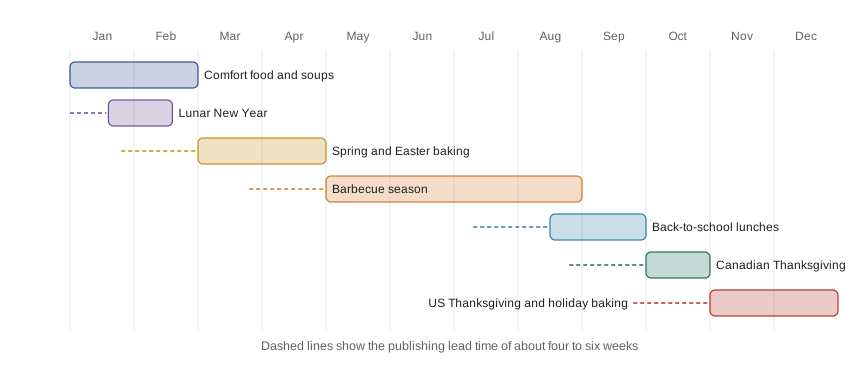
Food interest follows the calendar closely. Holiday baking, barbecue season, back-to-school lunches, Thanksgiving, which falls in October in Canada and November in the United States, Lunar New Year, Ramadan, Diwali, Passover, Easter and harvest seasons all drive predictable spikes. Recipe searches typically rise weeks before an occasion as people plan. Successful food creators publish seasonal recipes ahead of these peaks and refresh popular seasonal posts each year.
Worked problem
Planning publication dates
A creator wants a holiday cookie video to be fully indexed and gathering views by the time searches peak in mid-December. They know their videos take about two weeks to pick up search traffic, and searches start rising about four weeks before the peak. When should they publish?
Show solution
- Searches start rising about four weeks before mid-December: around mid-November.
- The video needs two weeks to pick up traffic before that rise: about early November.
- Allow a week for editing and thumbnails: film by late October.
Answer: Publish in early November and film by late October. Publishing in mid-December, when interest peaks, would mean the video gains traction just as interest falls away.
Food claims, labels and allergens
Food is heavily regulated, and creators who promote food products or launch their own need to understand the basics. Claims about nutrition and health, such as high in protein, low fat, gluten-free, or supports heart health, are defined by regulation and can only be made if the product meets specific conditions. Allergen information matters for viewer safety in recipes as well as in product promotion.
In Canada, food is regulated under the Food and Drugs Act and the Safe Food for Canadians Act, with labelling and advertising rules enforced by the Canadian Food Inspection Agency (CFIA) and standards set by Health Canada. Nutrient content claims and health claims must meet regulatory conditions. Front-of-package nutrition symbols for foods high in saturated fat, sugars or sodium became mandatory on most prepackaged foods on January 1, 2026. Canada lists priority food allergens, including peanuts, tree nuts, sesame, milk, eggs, fish, crustaceans and shellfish, soy, wheat and triticale, and mustard, and requires them to be declared on labels.
For recipe creators, good practice includes listing common allergens in a recipe, suggesting safe substitutions, being clear when a recipe is not suitable for certain diets, and avoiding health claims such as anti-inflammatory, detox or boosts immunity that imply medical benefits. Food safety is also part of the job: safe internal temperatures for meat, safe canning methods and safe storage protect viewers. Home canning and fermentation content in particular should follow tested guidance, because errors can cause botulism.
Restaurant reviews and local content
Restaurant and food truck reviews are a strong local niche, and they bring the same independence questions as other reviews. Free meals, paid visits, invitations to media nights and tourism board trips are material connections that must be disclosed. Some creators also face pressure from businesses to post only positive content, or receive offers to remove negative reviews in exchange for money, which raises ethical and legal concerns. Fake or incentivized reviews are prohibited by consumer protection law in both countries.
Reviews of small local businesses deserve care. A harsh video can have a large effect on a family business. Honest criticism is legitimate and useful, but it should be fair, focused on the experience and based on facts. Avoid filming staff or other diners without consent in ways that could embarrass them, and follow restaurant policies on filming.
Alcohol content and age rules
Alcohol content includes cocktail recipes, wine and beer reviews, brewery tours and bar culture. Alcohol brands are active sponsors, but alcohol advertising is restricted by law and by industry codes designed to keep marketing away from minors and to avoid promoting irresponsible drinking. Influencer marketing for alcohol is a particular focus of regulators because creators' audiences are often young.
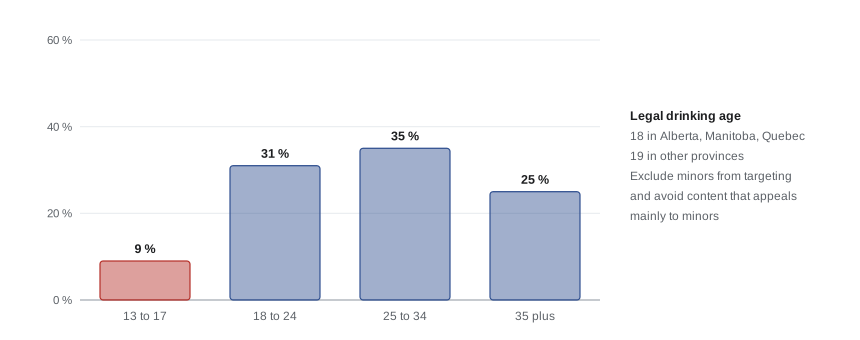
In Canada, the legal drinking age is set by each province and territory: 18 in Alberta, Manitoba and Quebec, and 19 elsewhere. Alcohol advertising is governed by provincial liquor laws and regulators, such as Ontario's AGCO, and by the CRTC's Code for Broadcast Advertising of Alcoholic Beverages, whose principles many provinces also apply to advertising in other media, including social media. These rules prohibit advertising directed at minors, using people who appear to be under the legal drinking age or who appeal mainly to minors, associating alcohol with driving or risky activities, implying that drinking brings social, sexual or professional success, and encouraging excessive consumption. Some provinces add rules on contests, prices and inducements, and Quebec has its own requirements.
Worked problem
Checking an audience against the 73.6 % standard
A creator's analytics show their audience is 9 % aged 13–17, 14 % aged 18–20, 52 % aged 21–34 and 25 % aged 35 and over. Does the audience meet the US industry code standard of at least 73.6 % aged 21 and over?
Show solution
- Share aged 21 and over: 52 % + 25 % = 77 %.
- Compare with the standard: 77 % ≥ 73.6 %.
- The share under 21 is 9 % + 14 % = 23 %, which also checks: 100 % − 77 % = 23 %.
Answer: Yes, 77 % meets the 73.6 % standard. The creator should still use age-gating on alcohol posts, avoid content that appeals mainly to younger viewers, and recheck analytics regularly because audiences change.
Platforms also restrict alcohol content. Most require branded alcohol content to be age-restricted, prohibit alcohol promotion to minors, and do not allow alcohol sales through creator links in some regions. Creators should use age-gating features, mark branded content properly and avoid showing heavy drinking or drinking challenges, which can also breach community guidelines.
Cannabis
Cannabis has been legal for adults in Canada since 2018, but the Cannabis Act sets some of the strictest promotion rules of any product. Promotion is prohibited except in narrow circumstances, and it is specifically prohibited to promote cannabis through testimonials or endorsements, by depicting a person, character or animal, by associating cannabis with a way of life such as glamour, recreation or excitement, or in a way that could appeal to young people. As a result, brand-paid influencer promotion of cannabis products is effectively prohibited in Canada. Creators may discuss cannabis in educational or news content, but paid promotion, giveaways and lifestyle content for cannabis brands carry serious legal risk, including large fines.
Hemp-derived products and CBD sit in a complex legal space in both countries. In Canada, CBD is regulated as cannabis under the Cannabis Act. In the United States, hemp-derived products have been treated differently from marijuana under federal law, but the FDA has warned companies about unapproved health claims, and in late 2025 Congress narrowed the federal definition of hemp to curb intoxicating hemp-derived products, with the change taking effect in late 2026. Health claims for CBD, such as treating anxiety or pain, are generally not allowed.
Nutrition content and diet culture
Nutrition content overlaps with the fitness lesson. Creators who are not registered dietitians should avoid giving individualized diet advice, diagnosing conditions such as food intolerances, or promoting extreme diets. Diet culture content, such as labelling foods as clean or toxic, promoting detoxes or showing very low-calorie days, can harm viewers with eating disorders. Food creators can promote healthy eating by focusing on enjoyment, variety, culture, skill and affordability rather than weight loss or restriction.
Cultural food content brings its own responsibility. Recipes from cultures other than your own deserve credit, context and respect for their origins. Audiences increasingly notice when creators rename traditional dishes, present them as new inventions or mock unfamiliar foods. Collaborating with cooks from the culture, explaining history and naming dishes correctly builds trust.
Mukbang, challenges and eating content
Some food formats raise particular concerns. Mukbang, in which creators eat large quantities of food on camera, and speed-eating or extreme spicy food challenges have drawn criticism for health risks to creators and for encouraging unhealthy eating among viewers. Challenges involving very spicy products have led to hospital visits, and some products have been withdrawn after young people were harmed copying online challenges. Platforms may remove or restrict dangerous challenge content.
Creators who make eating content can reduce harm by avoiding dangerous challenges, discouraging viewers from copying risky stunts, being open about their own health choices, and not presenting extreme eating as normal or aspirational. Brands that sponsor such content should consider whether it suits their products and audiences.
Food giveaways and contests
Giveaways of food products, kitchen equipment or restaurant gift cards are popular. Contests must follow the rules covered in CRE-320, such as skill-testing questions and Quebec requirements in Canada, or state sweepstakes rules in the United States. Alcohol giveaways face extra restrictions and are banned or limited in many provinces and states, so check the rules before running one.
Common mistakes
MistakePublishing seasonal recipes at the peak of interest.
InsteadPublish four to six weeks ahead so content gains traction before the peak.
MistakeMaking health claims such as detox or anti-inflammatory for recipes.
InsteadAvoid medical-sounding claims and follow food claim rules for products.
MistakeAccepting alcohol sponsorships without checking audience age.
InsteadVerify audience age against legal and code thresholds and use age-gating.
MistakeTaking paid cannabis promotions in Canada.
InsteadRecognize that the Cannabis Act effectively prohibits endorsement-based cannabis promotion.
MistakeNot disclosing free meals or tourism-paid trips in reviews.
InsteadDisclose all material connections, including comped meals and trips.
Summary and key terms
- Food content earns from ads, blogs, affiliates, brand deals and tourism partnerships.
- Seasonal planning means publishing ahead of predictable interest peaks.
- Food claims and allergen labelling are regulated; recipes should flag allergens and follow food safety guidance.
- Restaurant reviews must disclose comped meals and remain fair to local businesses.
- Alcohol advertising is restricted by provincial laws and codes in Canada and by TTB rules, state laws and industry codes in the United States.
- Canada's Cannabis Act effectively bans endorsement-based cannabis promotion; US cannabis rules vary by state and are federally constrained.
- Nutrition and cultural food content should avoid diet culture harms and credit culinary traditions.
- Food styling
- Techniques for making food look appealing on camera.
- Nutrient content claim
- A regulated claim about the level of a nutrient, such as high in protein.
- Health claim
- A claim linking a food to health or disease risk.
- Priority allergen
- An allergen that must be declared on Canadian food labels.
- Major food allergen
- One of the nine allergens that must be declared on US food labels.
- Front-of-package nutrition symbol
- A Canadian label symbol for foods high in saturated fat, sugars or sodium.
- Legal drinking age
- The minimum age to buy and drink alcohol: 18 or 19 in Canada, 21 in the US.
- TTB
- The US Alcohol and Tobacco Tax and Trade Bureau.
- 73.6 % standard
- The industry code threshold for the share of an audience that must be of legal drinking age.
- Age-gating
- A feature that restricts content to viewers above a certain age.
Practice problems
Work each problem on paper first, then reveal the answer to check.
When should a holiday recipe be published if interest peaks in mid-December?
Show answer
About four to six weeks before, in early November.
Name four Canadian priority allergens.
Show answer
Peanuts, tree nuts, sesame, milk, eggs, fish, shellfish, soy, wheat, mustard.
How many major food allergens does US law recognize?
Show answer
Nine, including sesame.
What is the legal drinking age in Alberta and in the United States?
Show answer
18 in Alberta; 21 in the United States.
An audience is 48 % aged 21–34 and 22 % 35+. Does it meet 73.6 %?
Show answer
No: 70 % is below 73.6 %.
Can a Canadian influencer post a paid testimonial for a cannabis brand?
Show answer
No, the Cannabis Act prohibits testimonials and endorsements.
Why is home canning content risky?
Show answer
Incorrect methods can cause botulism; follow tested guidance.
Is a free tasting menu at a restaurant a material connection?
Show answer
Yes, it must be disclosed in the review.
Give one rule from alcohol advertising codes.
Show answer
No appeal to minors; no link to driving; no promotion of excessive drinking.
Why credit cultural origins of recipes?
Show answer
It respects traditions, provides context and builds audience trust.
Lesson quiz · 5 questions
Score 60% or more to complete this lesson.
Create a free account to save your progress, take quizzes and earn a certificate.