
DCE-200 · Lesson 5 of 5 · 30 min
From site search to operations: the project life cycle
A data centre project begins long before anyone pours concrete, and its engineering continues for decades after the ribbon is cut. The earliest decisions, where to build and how to get power there, often matter more than any later design choice, and they depend as much on utilities, municipalities and communities as on engineering. Once the building is running, its design must support years of maintenance, upgrades and changes in the equipment it houses.
This chapter follows a project through its whole life: site selection, securing power, permits and approvals, negotiating with the municipality, design and procurement, construction, commissioning and operations. It closes the course by showing how the pieces from Lessons 1 to 4 come together.
Site selection
A site search usually starts with a long list of regions and narrows to a few candidate parcels. The main criteria are:
- Power: how many megawatts the utility can deliver, how soon, at what price and with what carbon intensity. This is now the deciding factor in many markets.
- Fibre: proximity to long-haul fibre routes and to carrier networks, ideally with diverse routes from two or more carriers, and latency to the users or other data centres it must serve.
- Land and zoning: a parcel large enough for buildings, substation, generators and setbacks; land use rules that permit a data centre, or a realistic path to rezoning.
- Water: availability and cost, if evaporative cooling is planned; sewer capacity for cooling tower discharge.
- Natural hazards: flood plains, seismic hazard, tornadoes, hurricanes, wildfire, and proximity to hazards such as airports, rail lines carrying dangerous goods or chemical plants.
- Climate: cooler, drier climates allow more free cooling.
- Taxes and incentives: property tax, sales tax on equipment, special levies and any incentive programs.
- Workforce and community: construction trades and operations staff nearby, and a community that will accept a large industrial building.
Teams often compare sites with a weighted scoring matrix: each criterion receives a weight that reflects its importance, each site a score, and the weighted sum ranks the sites. The matrix organizes the discussion but does not replace judgement: a site that fails one essential criterion (no power for five years, say) should be eliminated before scoring.
Worked problem
A weighted site comparison
Three sites are scored from 1 (poor) to 5 (excellent). Weights: power 0.30, fibre 0.15, land and zoning 0.15, water 0.10, hazards 0.10, taxes 0.10, workforce 0.10. Scores: Site X 5, 3, 4, 2, 4, 3, 3; Site Y 3, 5, 3, 4, 3, 4, 5; Site Z 4, 4, 5, 5, 3, 2, 3. Rank the sites. Then check how the ranking changes if power is weighted 0.40 (with land 0.10 and taxes 0.05).
Show solution
- X: 0.30(5) + 0.15(3) + 0.15(4) + 0.10(2) + 0.10(4) + 0.10(3) + 0.10(3) = 1.50 + 0.45 + 0.60 + 0.20 + 0.40 + 0.30 + 0.30 = 3.75.
- Y: 0.90 + 0.75 + 0.45 + 0.40 + 0.30 + 0.40 + 0.50 = 3.70.
- Z: 1.20 + 0.60 + 0.75 + 0.50 + 0.30 + 0.20 + 0.30 = 3.85.
- With the new weights: X = 3.90, Y = 3.65, Z = 3.90.
Answer: Z ranks first (3.85), with X close behind (3.75). With more weight on power, X ties Z. The scores are too close to decide on arithmetic alone: the team should investigate the uncertain items, especially how firm each site's power offer is, before committing
Securing power
Getting power is usually the longest step. The developer submits a load request to the utility or system operator, describing the size of the load, its ramp-up over time and the desired in-service date. The utility then studies whether the grid can supply it: load flow, short-circuit and stability studies, and the transmission lines, substations and generation that would be needed. Large requests may need new transmission lines that take years to approve and build. The developer typically pays deposits for studies and contributes to the cost of the connection, and signs an agreement committing to take and pay for the power.
In Alberta, large-load connections are managed by the Alberta Electric System Operator. Faced with requests for more than 16 GW against a grid whose record demand was about 12.8 GW (set in December 2025), the AESO limited new large-load connections to an interim 1,200 MW in 2025, allocated pro rata to projects of 75 MW or more that had municipal support, financial security and completed power flow studies; that capacity is now fully allocated. Projects outside the allocation are increasingly planned to bring their own power, as Meta's Sturgeon County campus is doing with a 932 MW gas-fired plant built with Pembina. The province has also announced a levy of 2% on the computer hardware in grid-connected data centres of 75 MW or more, effective December 31, 2026, which can be credited against Alberta corporate income tax. Other provinces handle large loads through their own utilities and regulators, such as Hydro-Québec and the Independent Electricity System Operator in Ontario.
Because power drives the schedule, many developers now buy sites that already have power commitments, or work backward from the utility's in-service date. Fibre is usually less difficult, but diverse routes into the site, entering the building at separate points, must be planned early (DCE-210 and DCE-320).
Permits and approvals
In Canada, land use is controlled by municipalities under provincial planning law. A typical sequence in Alberta is:
- Land use: confirm that the municipal land use bylaw allows a data centre, or apply for redesignation (rezoning). Large rural projects may need a new area structure plan, adopted by council after a public hearing.
- Development permit: approval of the specific site plan, building massing, setbacks, landscaping, noise, lighting and access.
- Building, electrical, plumbing and gas permits under the Safety Codes Act, with plan review and inspections.
- Provincial approvals as needed: an Alberta Utilities Commission approval for a power plant or substation, Environmental Protection and Enhancement Act approvals for air emissions from on-site generation, water licences or transfers, and wetland or historical resources approvals. Projects on or affecting Crown land may trigger the Crown's duty to consult First Nations and Métis communities.
Approval is not guaranteed. In September 2025, Rocky View County council, next to Calgary, refused to adopt an area structure plan for a proposed 1,100-acre AI data centre campus, citing its location and its effect on local farmers, so the project could not proceed. In July 2026 the same council voted to pause new applications to redesignate land for data centres until it adopts a regulatory framework.
Negotiating with the municipality and the community
A data centre brings a municipality large tax revenues and construction activity but relatively few permanent jobs, and it can bring heavy truck traffic during construction, generator noise and exhaust, transmission lines, water demand and a very large building. Approval often comes through negotiation, recorded in a development agreement. Typical subjects are:
- Off-site infrastructure: road upgrades, water and sewer extensions, and who pays for them. Meta, for example, has committed about $60 million for local road and water infrastructure in Sturgeon County.
- Taxes and fees: property tax assessment of the land and buildings (Sturgeon County's mayor has estimated more than $40 million a year from the Meta campus), offsite levies and permit fees.
- Operating limits: noise limits at the property line, generator testing hours, lighting, visual screening with berms and landscaping, and setbacks from homes.
- Community benefits: local hiring, training programs with colleges, heat reuse, donations to community facilities.
Effective negotiation rests on preparation and honesty. Engineers support it with facts: noise models of generators and cooling equipment, traffic studies, visual simulations, water balances and emissions estimates. Learning what the municipality needs (its tax base, its infrastructure plans, its residents' concerns) and offering design solutions to real problems works better than pressure. DCE-410 and DCE-470 cover the process and negotiation skills in depth.
Design and procurement
Design proceeds in stages: a basis of design that records the requirements (capacity, density, redundancy, efficiency targets, codes), schematic design, design development and construction documents. Electrical, mechanical, structural, civil, fire protection, architectural and telecommunications designs must fit together, and many owners use building information modelling (BIM) to coordinate them in 3D.
Major equipment is ordered early. Large power transformers, medium-voltage switchgear, generators and chillers often have lead times of one to three years, longer than the time to construct the building. Owners with many projects reserve manufacturing capacity in advance. To save time, much equipment now arrives prefabricated: power skids with switchgear and UPS factory-wired and tested, modular electrical rooms, and prefabricated cooling plants.
Worked problem
Finding the critical path
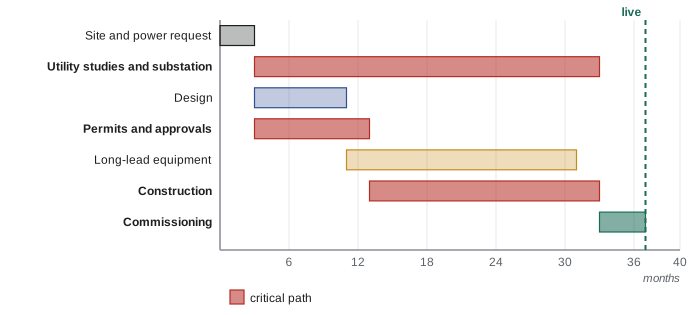
For a new campus (times in months): site acquisition and power request take 3; then, in parallel, utility studies and substation construction take 30, design takes 8, and permits take 10. Long-lead equipment (20 months) is ordered when design is complete. Construction (20) starts when permits are issued. Commissioning (4) starts when the substation, the equipment and the building are all finished. When can the facility go live, and what is critical?
Show solution
- Substation: finishes at 3 + 30 = 33.
- Design finishes at 11; equipment arrives 11 + 20 = 31.
- Permits finish at 13; construction finishes 13 + 20 = 33.
- Commissioning starts at the latest of 33, 31 and 33, so at month 33, and finishes at 37.
Answer: Live at month 37. Both the utility path and the permits-then-construction path are critical (33 months each); equipment has 2 months of float. Any delay in power or permits delays the opening month for month
Construction and commissioning
Construction moves from site work and foundations to the building shell, then to the mechanical and electrical installation, which is most of the cost and most of the work. Quality control on site, inspections by the authorities and the owner's own reviews continue throughout.
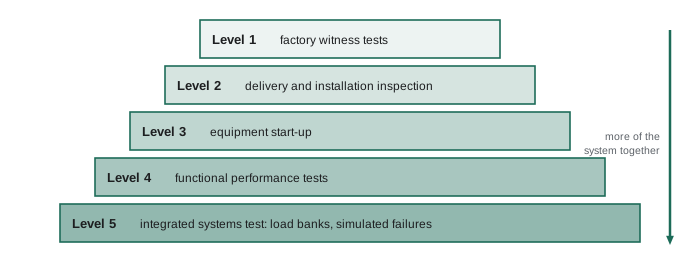
Commissioning proves that everything works, alone and together, before IT equipment arrives. It is usually organized in levels:
- Level 1: factory witness testing of major equipment such as switchgear, UPS systems and generators.
- Level 2: inspection of equipment as delivered and installed.
- Level 3: start-up of each piece of equipment by the vendor.
- Level 4: functional performance testing of each system under all its operating modes.
- Level 5: integrated systems testing (IST), in which load banks simulate the IT heat and power load and the team fails the utility, generators, UPS modules, chillers and pumps one at a time to prove that the facility rides through as designed.
Commissioning finds problems that design reviews miss: wrong settings, wiring errors, controls sequences that behave unexpectedly. It is far cheaper to find them with load banks than with customers' servers. Lesson 4 noted that Uptime Institute recommends certifying the constructed facility, not just the design, for this reason.
Operations
Once live, the facility enters its longest phase. A small team of facility engineers and technicians runs it around the clock, supported by vendors. Operations rest on documents and discipline:
- Standard operating procedures (SOPs) for routine tasks, methods of procedure (MOPs) that script every step of maintenance on critical equipment, and emergency operating procedures (EOPs) for failures.
- Preventive maintenance on a schedule, and predictive maintenance using monitoring data such as infrared scans, oil analysis and battery tests.
- Change management: every change to critical systems is reviewed, approved and scheduled.
- Monitoring: building management and electrical power monitoring systems, and data centre infrastructure management (DCIM) software that tracks capacity, power, temperature and assets.
- Capacity management: tracking how much power, cooling and space remain, and planning upgrades before they run out.
Over a life of 20 years or more, IT equipment is replaced every few years, rack density rises, and cooling and power systems are upgraded while the facility runs. Designs that leave room for growth, such as space for more cooling equipment, pipe connections for future liquid cooling, structural capacity for heavier racks and a power connection that can be expanded, last longer.
Bringing it together
A single decision touches every discipline. Choosing to build an AI hall at 120 kW per rack sets the electrical design (busway and high-current feeds), the mechanical design (direct-to-chip liquid cooling with CDUs), the structure (heavier floor loads), the fire protection (lithium-ion UPS batteries, liquid near electronics), the network (high-bandwidth fibre between racks), the site (a bigger substation, perhaps on-site generation), the permits (air permits for that generation) and the operations team's skills. The rest of this program covers each of these in depth: power in DCE-310 and DCE-340, cooling in DCE-330, cabling in DCE-210 and DCE-320, site, permits and power in DCE-410 and DCE-420, structures in DCE-430, fire and security in DCE-440, and operations in DCE-450.
Common mistakes
MistakeChoosing a site, then asking the utility for power.
InsteadConfirm early how much power the utility can deliver and when. Power availability often eliminates sites before anything else.
MistakeTreating a weighted scoring matrix as the decision.
InsteadEliminate sites that fail essential criteria first, test the weights for sensitivity, and investigate close results.
MistakeAssuming zoning approval because the land is industrial.
InsteadCheck whether a data centre is a permitted use; many municipalities now require special approvals, public hearings or new plans.
MistakeOrdering major equipment after design is finished.
InsteadIdentify long-lead equipment (transformers, switchgear, generators, chillers) early and reserve production slots.
MistakeSkipping integrated systems testing to save time.
InsteadLevel 5 testing with load banks and simulated failures is where hidden faults appear; finding them after go-live is far more costly.
Summary and key terms
- A project runs from site selection through power, permits, design, procurement, construction and commissioning to decades of operations.
- Site criteria: power above all, then fibre, land and zoning, water, hazards, climate, taxes and workforce. Weighted scoring matrices help but need judgement and sensitivity checks.
- Power requests go to the utility or system operator (in Alberta, the AESO), which may take years and may be limited; many projects now plan on-site generation.
- Approvals: municipal land use (redesignation, area structure plans), development and building permits, and provincial approvals for power plants, emissions, water and wetlands, with consultation duties where Crown land is affected.
- Development agreements settle infrastructure, taxes, operating limits and community benefits. Engineers support negotiation with studies and honest data.
- Long-lead equipment and utility power often control the schedule. Commissioning proceeds through five levels to integrated systems testing.
- Operations depend on SOPs, MOPs, EOPs, maintenance, change management, monitoring and capacity planning.
- Load request
- An application to a utility or system operator for a new or larger electrical connection.
- Weighted scoring matrix
- A table that ranks options by the weighted sum of their scores on several criteria.
- Development agreement
- A contract between a developer and a municipality setting out infrastructure, fees and conditions of a development.
- Long-lead equipment
- Equipment whose manufacturing and delivery time must be planned well ahead of construction.
- Critical path
- The longest chain of dependent activities, which sets the project duration.
- Commissioning
- The process of verifying that systems are installed and perform as designed.
- Integrated systems test (IST)
- The final level of commissioning, testing all systems together under simulated load and failures.
- Method of procedure (MOP)
- A step-by-step script for work on critical equipment.
- DCIM
- Data centre infrastructure management: software for monitoring and managing power, cooling, space and assets.
- Redesignation
- In Alberta, a change to the land use district of a parcel (rezoning) so that a new use is permitted.
- Area structure plan
- In Alberta, a statutory plan adopted by council that sets out land uses and infrastructure for a new development area.
Practice problems
Work each problem on paper first, then reveal the answer to check.
Name three reasons a site with excellent land and fibre could still be eliminated early.
Show answer
Examples: the utility cannot provide enough power for years; the parcel is in a flood plain; zoning prohibits data centres with no realistic path to approval; no water for the planned cooling.
With weights 0.5 (power), 0.3 (fibre) and 0.2 (land), site A scores 4, 2, 5 and site B scores 3, 5, 3. Which ranks higher?
Show answer
A: 2.0 + 0.6 + 1.0 = 3.6. B: 1.5 + 1.5 + 0.6 = 3.6. A tie: investigate further.
Why might a developer pay for utility studies before buying the land?
Show answer
Because the power answer (how much, when and at what cost) determines whether the site is viable; buying land without it is a large risk.
What did the AESO require for a project to share in its interim 1,200 MW large-load allocation?
Show answer
A load of 75 MW or more, municipal support, financial security and completed power flow studies; capacity was shared pro rata among qualified projects.
List four subjects commonly covered in a development agreement for a data centre.
Show answer
Off-site infrastructure and who pays; taxes, levies or incentives; operating limits such as noise and generator testing hours; landscaping and screening; community benefits.
In the critical path example, permits take 14 months instead of 10. When does the facility go live?
Show answer
Construction finishes at 3 + 14 + 20 = 37, commissioning at 41. The facility goes live at month 41.
In the same example, by how much could equipment delivery slip before it delays the project (with the original 10-month permits)?
Show answer
2 months: it arrives at month 31 and is needed at month 33.
What is the difference between Level 4 and Level 5 commissioning?
Show answer
Level 4 tests each system's functions on its own; Level 5 (IST) tests all systems together under simulated load, including failures of the utility and major equipment.
Why do operators write a method of procedure for maintenance on a UPS?
Show answer
To script every step, including switching sequences, checks and back-out steps, so that the work does not interrupt the IT load through error or omission.
Give three design features that help a data centre adapt to higher rack densities later.
Show answer
Spare space and connections for more cooling equipment; piping provisions for liquid cooling to the racks; structural capacity for heavier racks; electrical capacity or space for larger feeds and busway; an expandable utility connection.
Lesson quiz · 5 questions
Score 60% or more to complete this lesson.
Create a free account to save your progress, take quizzes and earn a certificate.