
ENGG-160 · Lesson 4 of 5 · 38 min
Technical writing
Engineers write far more than most students expect: surveys of practising engineers regularly find them spending a large share of the working week on reports, memos, emails, specifications and proposals. An excellent design that is badly explained may never be approved, funded or built correctly. A clear report, on the other hand, gets decisions made quickly and protects everyone if questions are asked later.
Technical writing is not literary writing. Its goal is not to impress but to transfer information accurately with the least effort for the reader. This chapter covers how to plan for your reader, structure the common document types, write plain and precise sentences, present numbers, units, figures and tables correctly, cite sources, and revise. We finish the entrance project by writing its recommendation.
Start with the reader
Before writing anything, answer three questions.
- Who will read it? The community centre board, a city plans examiner and a contractor all need different things from the same project.
- What do they need to do after reading? Approve, decide, build, check, file?
- How will they read it? Most busy readers skim: they read the title, the first paragraph, the headings and the figures, and dive into detail only where they must.
Write for the least specialist reader who must act on the document, and put detail where specialists can find it (appendices, attached calculations). A board member does not need the drainage calculation, but the plans examiner does.
Put the answer first
Academic writing often builds to a conclusion: background, method, results, and finally the answer. Professional readers want the reverse. Lead with the conclusion or request, then give the support. The military calls this BLUF, "bottom line up front", and it works everywhere.
Worked problem
Answer-first email
Rewrite this opening so the reader knows the point at once: "As you know, our team has been looking at options for the front entrance for some weeks now, and we have considered a number of different approaches, including ramps, lifts and regrading. Having reviewed costs and talked to members, we would now like to set up a meeting."
Show solution
- Find the request: a meeting. Find the key result: a recommendation.
- Rewrite: "Subject: Entrance recommendation — please confirm a meeting the week of Nov. 9. We recommend regrading the front walk, which gives level access at the main door for an estimated $215,800, within the $220,000 budget. Could the board meet for 45 minutes that week to review it? A two-page summary is attached."
Answer: The subject line and first sentence carry the request and the answer. Background moves to the attachment, where readers who want it can find it
Common document types
- Email: one topic per message, request or answer in the first two lines, short paragraphs. Assume it may be forwarded to anyone.
- Memo: a short internal document (one to three pages) with To, From, Date and Subject lines, used for progress updates, decisions and short technical findings.
- Design report: the full record of a design: the problem, requirements, concepts considered, the recommended design, its analysis and verification, cost and schedule. It is often the document that is sealed and kept for decades.
- Proposal: a persuasive document asking for approval or money to do work, setting out what will be done, how, by whom, when and for how much.
- Lab or test report: what was tested, how, what was measured, and what it means, with enough detail for someone else to repeat the test.
- Specification: the contractual statement of what must be supplied and to what standard. Its language is deliberately precise ("shall"), as in Lesson 2.
Structure of a design report
A design report usually follows this order, with the front matter written last:
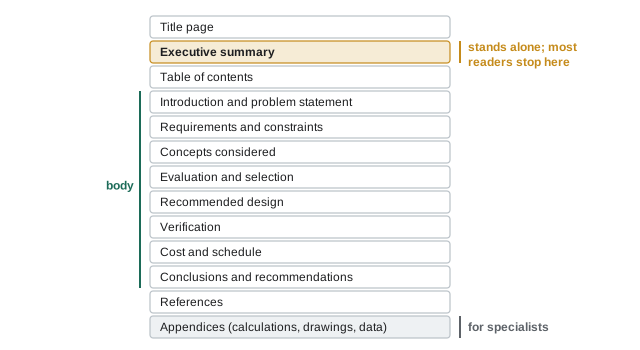
The executive summary is the most important page you will write. It must stand alone, because many decision-makers will read nothing else. In half a page to a page, it states the problem, the recommendation, the key reasons, the cost and schedule, and any decision or action needed. It contains no new information that is not in the report, and no references to figures the reader cannot see.
Worked problem
Writing an executive summary
Write a short executive summary for the entrance project using what we have developed in Lessons 1 to 3.
Show solution
- Problem: "People who cannot climb steps cannot enter the community centre's main entrance independently."
- Recommendation and reasons: "We recommend regrading the front walk to a slope of 1 in 20 over 12 m, with a canopy at the door and re-routed roof drainage. This option gives level, ramp-free access at the main entrance, ranked first on usability and appearance, and avoids the mechanical upkeep of a lift."
- Cost and risk: "The estimated cost is $215,800, including a 15% contingency, against a budget of $220,000. The margin is small; if costs rise, the canopy ($24,000) could be deferred."
- Decision needed: "We ask the board to approve the concept by November 20 so that detailed design can be completed for a spring construction start."
Answer: Four short paragraphs: problem, recommendation with reasons, cost and risk, decision needed. A reader who stops here knows what is proposed, why, what it costs and what they must do
Write plainly and precisely
Plain language is not dumbing down. It is respect for the reader's time. A few habits make most of the difference.
- Prefer short sentences. Aim for an average of 15 to 20 words, with variety. One idea per sentence.
- Use concrete words. "The beam is overstressed by 15%" beats "There may be some concerns regarding the adequacy of the beam."
- Cut empty phrases: "in order to" (to), "due to the fact that" (because), "at this point in time" (now), "it should be noted that" (delete).
- Use the active voice when the actor matters: "The contractor shall remove the old steps" makes responsibility clear; "The old steps shall be removed" does not say by whom. The passive is fine when the actor is unknown or irrelevant, as in describing a test method.
- Turn hidden verbs back into verbs: "make a decision" (decide), "carry out an analysis of" (analyse).
- Define abbreviations on first use, and use each term consistently. If you call it the "walkway" in section 2, do not call it the "path" in section 5; the reader may think it is something else.
Worked problem
Tightening a sentence
Rewrite: "It was determined through the analysis that was carried out that the beam may possibly not be adequate for the loads that are anticipated."
Show solution
- Find the actor and action: the analysis showed something.
- Remove the hedges ("may possibly") and replace vague words with a result.
- Rewrite: "The analysis shows the beam cannot carry the design load." Better still, with the number: "Under the design load, the beam is stressed to 115% of its capacity."
Answer: 24 words become 10 (or 12 with a number). The rewrite says what was found and how serious it is
Measuring readability
Readability formulas estimate how hard text is to read from sentence and word length. The Flesch Reading Ease score is one of the oldest:
Higher is easier: 60 to 70 is plain English, below 30 is very difficult. Technical text scores lower because technical words are long, and that is acceptable. But a low score is a prompt to look for long sentences and needlessly long words.
Worked problem
Before and after
A 120-word paragraph has 5 sentences and 190 syllables. After editing, it still has 120 words but 8 sentences and 170 syllables. Find both scores.
Show solution
- Before: \(206.835 - 1.015(24) - 84.6(1.583) = 206.835 - 24.36 - 133.95 = 48.5\).
- After: \(206.835 - 1.015(15) - 84.6(1.417) = 206.835 - 15.23 - 119.85 = 71.8\).
Answer: The score rises from 48.5 (fairly difficult) to 71.8 (fairly easy), from shorter sentences and simpler words. Use such scores as a check, not a goal; a formula cannot tell whether the text is correct or well organized
Numbers and units
In engineering documents, numbers are the content. Small formatting errors make readers doubt the larger ones. Follow the SI conventions:
- Leave a space between a number and its unit symbol: 25 mm, 4.5 kN, 20 °C. (The percent sign is often closed up in North American usage: 15%.)
- Unit symbols are case-sensitive and never pluralized or followed by a period: kg not Kg or kgs; kN not KN; m not M (which is the prefix mega); s not sec.
- Use a space, not a comma, to group digits in long numbers in technical work: 12 500 N. In Canada the comma is the decimal marker in French, so commas in numbers can be misread.
- Do not mix symbols and words: "kilonewtons per metre" or "kN/m", not "kN per metre".
- Put a zero before a decimal point: 0.73 L/s, not .73 L/s.
- Write dates unambiguously. 03/04/2026 means March 4 in some places and April 3 in others. Use 2026-04-03 (ISO 8601) or write the month as a word.
Worked problem
Fixing unit errors
Correct: (a) "The beam spans 7.2M and carries 15KN/M." (b) "Flow is .73 l/sec." (c) "Temp: 20 Deg C." (d) "The load of 12,500 newtons per m²."
Show solution
- (a) "The beam spans 7.2 m and carries 15 kN/m."
- (b) "Flow is 0.73 L/s." (Capital L is accepted for litre to avoid confusion with the digit 1.)
- (c) "Temperature: 20 °C."
- (d) "The load of 12 500 N/m² (12.5 kPa)."
Answer: Lower-case m for metres, kN for kilonewtons, a leading zero, L/s, °C with a space before it, spaces for digit grouping, and symbols used consistently
Significant figures and precision
Report results to a precision that reflects the inputs. If the rainfall intensity is known to two or three significant figures, a calculated flow of 0.7333 L/s implies a precision that does not exist; report 0.73 L/s. Excess digits are not more accurate; they are less honest. Carry extra digits through calculations and round only the final reported result, as in ENGG-130.
Figures and tables
A good figure can replace a page of text, and a bad one can mislead. Every figure and table should:
- Be numbered and have a caption that says what it shows, and ideally what the reader should notice ("Figure 3. Weighted score against cost weight; the walkway leads only below 0.39.").
- Be referred to in the text before it appears ("as Figure 3 shows…"). Never include a figure the text does not discuss.
- Have labelled axes with units, readable fonts, and a legend only when needed (direct labels are usually clearer).
- Avoid decoration: no 3D bars, shadows, or colour that carries no meaning. Do not rely on colour alone, since some readers have colour vision deficiency and many documents are printed in greyscale.
Use a table when readers need exact values; use a graph when they need to see a trend or comparison. In the common IEEE style, table captions go above the table and figure captions below the figure.
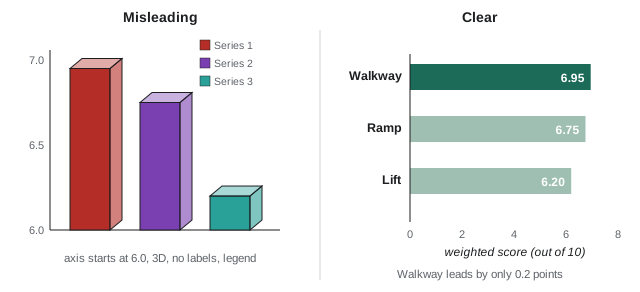
Watch for truncated axes in particular. A bar chart whose axis starts at 6.0 instead of 0 makes a 6.95 bar look several times taller than a 6.75 bar. For bar charts, start the axis at zero; for line graphs of a trend, a non-zero axis can be fine if it is clearly marked.
Citing sources
Every fact, figure, method or code requirement you did not create yourself needs a citation. Citations let readers check your work, give credit, and show that your design rests on authoritative sources. Engineering commonly uses IEEE style: numbered references in square brackets in the order they are first cited, with a numbered list at the end.
Worked problem
IEEE-style references
Format the text citation and reference list entries for the accessibility standard and the Winnipeg ramp guide used in this course.
Show solution
- In text: "Ramps shall not exceed a slope of 1 in 12 [1], and the design follows the accessible route provisions of CSA/ASC B651 [2]."
- [1] City of Winnipeg, "Ramps," Planning, Property and Development brochure, based on the Manitoba Building Code 2024. [Online]. Available: legacy.winnipeg.ca
- [2] CSA Group and Accessibility Standards Canada, Accessible Design for the Built Environment, CSA/ASC B651:23. Toronto, ON, Canada: CSA Group, 2023.
Answer: Numbered in order of first use, with author or organization, title, publisher or source, date, and a link for online material. For codes and standards, always give the edition, since requirements change between editions
Using someone else's words, figures or ideas without citation is plagiarism, at university and at work. In professional practice it can also be a breach of the code of ethics and of copyright. The same applies to text produced with AI writing tools: you are responsible for every statement in a document with your name (or seal) on it, so check facts, numbers and citations yourself, and follow your school's or employer's policy on their use.
Revising
Nobody writes a clear document in one pass. Separate drafting from editing, and edit in layers, from big to small:
- Structure: is the answer first? Does each section do one job? Would a skimmer get the point from the headings and first sentences?
- Content: is every claim supported? Are numbers consistent between the summary, text, tables and appendices? (Inconsistent numbers are the most common error in student and professional reports alike.)
- Sentences: cut, simplify, activate.
- Details: units, figure numbers, references, spelling, page numbers.
Leave time between drafting and editing, read the document aloud to catch awkward sentences, and ask a colleague to read it as the intended reader would. In engineering firms, reports are checked by a second engineer before they are issued, for the same reason calculations are.
Common mistakes
MistakeBuilding up to the conclusion at the end.
InsteadPut the answer, recommendation or request first; support it afterwards.
MistakeWriting an executive summary that refers to figures, sections or terms the reader has not seen.
InsteadMake it stand alone: problem, recommendation, reasons, cost, decision needed.
MistakeLong sentences full of hedges and hidden verbs.
InsteadOne idea per sentence, concrete words, active voice where the actor matters.
MistakeUnit errors such as 15KN, 7.2M, .73 l/sec.
InsteadFollow SI style: 15 kN, 7.2 m, 0.73 L/s, with a space before the unit.
MistakeReporting results to too many digits.
InsteadMatch precision to the inputs; carry digits in calculations, round the final result.
MistakeFigures without numbers, captions, axis labels or a mention in the text.
InsteadNumber, caption and label every figure, refer to it in the text, and start bar-chart axes at zero.
Summary and key terms
- Plan for the reader: who they are, what they must do, and how they will read.
- Put the answer first; make subject lines specific.
- Match the document type to the job: email, memo, design report, proposal, test report, specification.
- A design report's executive summary must stand alone; detail goes in the body and appendices.
- Write plainly: short sentences, concrete words, no empty phrases, active voice where responsibility matters, consistent terms.
- Follow SI conventions for units and digit grouping, use unambiguous dates, and report sensible precision.
- Number, caption and label figures and tables, avoid misleading charts, cite sources (IEEE style is common), and revise in layers from structure to detail.
- Audience
- The people who will read a document and act on it.
- BLUF
- Bottom line up front: leading with the conclusion or request.
- Executive summary
- A stand-alone summary of a report's problem, recommendation, reasons, cost and requested decision.
- Memo
- A short internal document with To, From, Date and Subject lines.
- Plain language
- Writing that the intended reader can understand and use on first reading.
- Active voice
- A sentence where the subject performs the action.
- Readability formula
- An estimate of reading difficulty from sentence and word length.
- Significant figures
- The digits in a number that carry meaningful precision.
- Caption
- The numbered title and explanation attached to a figure or table.
- IEEE style
- A numbered citation style common in engineering.
- Plagiarism
- Presenting others' words, data or ideas as your own without credit.
Practice problems
Work each problem on paper first, then reveal the answer to check.
Rewrite: "Due to the fact that the pump failed, it is recommended that a review be carried out at this point in time."
Show answer
"Because the pump failed, we recommend a review now." Better: say who should review what, by when.
Write a specific subject line for an email asking a supplier to confirm delivery of handrail brackets by Dec. 1.
Show answer
Example: "Handrail brackets PO 2231 — please confirm delivery by Dec. 1."
Convert to active voice and name the actor: "The concrete shall be cured for seven days."
Show answer
"The contractor shall cure the concrete for at least seven days."
Correct: "The tank holds 12,000 Litres at 4 Bar and 60 deg. F."
Show answer
"The tank holds 12 000 L at 400 kPa (4 bar) and 15.6 °C (60 °F)." In SI documents, give the SI value; bar is accepted with SI but kPa is preferred.
A calculation gives 3.45678 kN from loads known to three significant figures. How should it be reported?
Show answer
3.46 kN.
A 200-word passage has 8 sentences and 320 syllables. Find its Flesch Reading Ease score.
Show answer
206.835 − 1.015(25) − 84.6(1.6) = 206.835 − 25.375 − 135.36 = 46.1.
Is a table or a graph better for: (a) the exact dimensions of six bracket sizes; (b) how pump efficiency changes with flow?
Show answer
(a) Table; (b) graph.
Write the date of Canada Day 2027 in ISO 8601 format.
Show answer
2027-07-01.
List four things an executive summary must contain.
Show answer
The problem, the recommendation, the key reasons, the cost (and schedule), and the decision or action needed.
A report says the cost is $215,800 in the summary and $213,500 in Table 4. What should the writer do?
Show answer
Find which is correct, trace the source of the difference, fix every occurrence, and check all other repeated numbers. Inconsistent numbers undermine trust in the whole report.
Lesson quiz · 5 questions
Score 60% or more to complete this lesson.
Create a free account to save your progress, take quizzes and earn a certificate.