
ITIL-130 · Lesson 10 of 12 · 31 min
The four dimensions in the value system
A value system that works well on paper can still fail in practice if one aspect of it is neglected. A new service with excellent technology but untrained staff, or a well-designed process that depends on a supplier who cannot deliver, will not create the intended value. ITIL addresses this risk with the four dimensions of service management: perspectives that must all be considered for every product, service, value stream and the value system as a whole. ITIL-110 introduced the dimensions briefly. This lesson examines each in depth, shows how they apply to the value chain and value streams, and explains the external factors that influence them.
The four dimensions
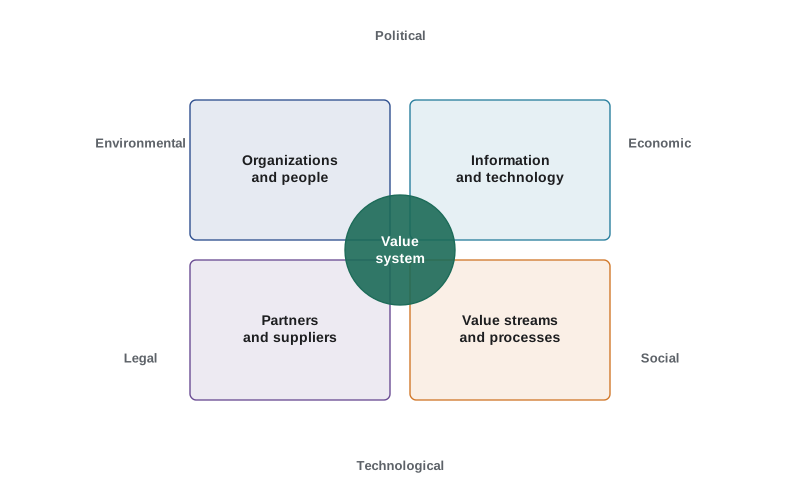
The four dimensions are organizations and people; information and technology; partners and suppliers; and value streams and processes. They are not components of the value system; they are perspectives from which every part of it should be viewed. Neglecting any one creates a blind spot. Both ITIL 4 and ITIL (Version 5) use the four dimensions, and published Version 5 course outlines also highlight the internal and external factors that influence them.
Organizations and people
This dimension covers the organization's structure, culture, roles, responsibilities, skills and competencies, and the systems of authority and communication through which work is done. It recognizes that services are delivered by people working in organizations, and that culture shapes behaviour at least as much as formal processes do.
Questions for this dimension include: Do people have the skills needed for this service? Are roles and responsibilities clear? Does the organizational structure support the flow of work or create silos? Does the culture encourage collaboration, learning and openness about mistakes? Leadership and management styles, staffing levels and workload also belong here.
Worked problem
A skills gap analysis
A team of 10 is moving a service to a cloud platform. It assesses skills on a scale of 0 to 3 (3 = expert). Needs: cloud networking at level 2 for 4 people; infrastructure as code at level 2 for 5 people; cloud security at level 2 for 3 people. Currently, 1 person has cloud networking at level 2 or above, 2 have infrastructure as code and 1 has cloud security. How many skill gaps must be closed?
Show solution
- Cloud networking: needed 4, have 1, gap 3.
- Infrastructure as code: needed 5, have 2, gap 3.
- Cloud security: needed 3, have 1, gap 2.
- Total gaps: 3 + 3 + 2 = 8 person-skill gaps, to be closed by training, hiring or partner support before migration.
Answer: Eight person-skill gaps must be closed. Ignoring them would put the migration at risk however good the technology plan is.
Information and technology
This dimension covers the information and knowledge needed to manage services, and the technologies that support service management and the services themselves. Information includes data about customers, configuration items, incidents and performance; knowledge includes procedures and expertise. Technology includes infrastructure, applications, communication tools, workflow systems, monitoring, automation and artificial intelligence.
Questions include: What information does this service create, use and store? How is it protected, and for how long is it retained? Is it accurate and accessible to those who need it? Which technologies support the service, and are they compatible with the organization's architecture? What are the risks of relying on a particular technology, such as vendor lock-in or end of support? Regulatory requirements on data, such as privacy laws and data residency, also fall here.
In Canada, information decisions must account for PIPEDA for private-sector personal information, provincial laws such as Quebec's Law 25, and Government of Canada direction on data residency for certain government data. These requirements shape where and how information can be stored and processed.
Partners and suppliers
This dimension covers the organization's relationships with other organizations involved in the design, development, deployment, delivery, support and improvement of services. It includes contracts and agreements, the organization's strategy for using suppliers, and the way it integrates and manages them. Almost every service today depends on partners and suppliers: cloud providers, software vendors, telecommunications carriers, outsourced service desks, consultants.
Questions include: Which parts of the service depend on suppliers? What do the contracts commit them to, and do those commitments match what we have promised our own customers? How would we cope if a key supplier failed or changed its terms? Should we build capability internally or rely on partners? Lesson 11 examines partners and suppliers in depth.
Value streams and processes
This dimension covers how the various parts of the organization work together to create value: the value streams that deliver products and services, and the processes and procedures that make up their steps. It asks how work flows, which activities are performed, in what order, by whom, and how they are coordinated.
Questions include: What are the key value streams for this service? Where are the delays, handoffs and rework? Which processes support each step, and are they designed for flow or for local control? Lessons 8 and 9 covered value streams in depth; this dimension makes sure they are considered whenever a service or change is planned.
| Dimension | Key questions | Typical neglect and its consequence |
|---|---|---|
| Organizations and people | Skills? Roles? Culture? | Staff not trained before launch, causing long incidents |
| Information and technology | Data? Tools? Security? Retention? | Data stored in the wrong jurisdiction, creating legal risk |
| Partners and suppliers | Dependencies? Contracts? Exit plans? | Supplier commitment weaker than customer promise |
| Value streams and processes | Flow? Handoffs? Coordination? | Service works technically but requests take weeks |
External factors: PESTLE
The four dimensions are shaped by factors outside the organization's control. ITIL uses the PESTLE model to group them: political, economic, social, technological, legal and environmental. These factors can create opportunities and constraints across all four dimensions.
| Factor | Example | Dimensions most affected |
|---|---|---|
| Political | A government changes its policy on cloud services for public bodies | Partners and suppliers; information and technology |
| Economic | Inflation raises software subscription prices | Partners and suppliers |
| Social | Users expect mobile access and instant responses | Value streams and processes; information and technology |
| Technological | Generative AI tools become widely available | Information and technology; organizations and people |
| Legal | A new privacy law requires breach reporting within strict time limits | Information and technology; value streams and processes |
| Environmental | Customers require reporting of data centre energy use | Partners and suppliers; information and technology |
Applying the dimensions to the value chain
Every value chain activity needs all four dimensions. Engage needs people with relationship skills, information about stakeholders, partners who share customer-facing work, and processes for intake and communication. Obtain/build needs procurement skills, technology for building and configuring components, suppliers who deliver to specification and processes for verification. A useful exercise is to take one activity and check it against each dimension, looking for gaps.
Worked problem
Four-dimension analysis of a change
A bank plans to introduce a chatbot to answer common customer questions. Identify one consideration in each dimension.
Show solution
- Organizations and people: train contact centre agents to handle conversations escalated from the chatbot; agree who owns chatbot content.
- Information and technology: protect customer data in conversations; integrate with the knowledge base and account systems; monitor accuracy.
- Partners and suppliers: review the chatbot vendor's contract for data handling, availability and exit terms.
- Value streams and processes: design how questions flow from chatbot to agent without customers repeating themselves; define how content is updated.
Answer: A sound plan addresses all four dimensions. Considering only the technology would leave staff, vendor and flow issues unresolved.
Worked problem
Scoring readiness across the dimensions
Before launching a service, a team scores readiness from 1 to 5 in each dimension: organizations and people 2, information and technology 5, partners and suppliers 4, value streams and processes 3. The organization requires at least 3 in every dimension before launch. Is the service ready, and what does the average hide?
Show solution
- Average score: (2 + 5 + 4 + 3) ÷ 4 = 3.5, which looks acceptable.
- But organizations and people scores 2, below the minimum of 3.
- The service is not ready: staff readiness must be addressed before launch.
- The average hides the weakest dimension, which is the one most likely to cause failure.
Answer: Not ready. The average of 3.5 hides a score of 2 for people; every dimension must meet the minimum.
Balancing the dimensions
The dimensions interact. A new technology may require new skills (people), new contracts (suppliers) and new workflows (value streams). Changing one dimension without adjusting the others creates imbalance. Organizations often over-invest in technology, because it is tangible and can be bought, and under-invest in people and processes, which take time to develop. The four-dimension view is a reminder that value depends on all of them together.
The dimensions in ITIL (Version 5)
ITIL (Version 5) keeps the four dimensions. Published course outlines describe them alongside internal and external influencing factors, which corresponds to the PESTLE idea in ITIL 4. Version 5 also gives more emphasis to experience, AI and sustainability, which affect every dimension: AI changes the information and technology dimension and the skills people need; sustainability expectations influence supplier choices and technology decisions.
The dimensions and the value chain together
One practical way to combine the four dimensions with the value chain is a simple grid: the six activities down one side and the four dimensions across the top. Each cell asks what the activity needs from that dimension. For example, the cell where deliver and support meets organizations and people asks whether there are enough trained staff on every shift; the cell where obtain/build meets partners and suppliers asks whether contracts specify what components must meet. Filling in the grid for a new service quickly reveals gaps that a technology-focused plan would miss.
| Activity | Organizations and people | Information and technology | Partners and suppliers | Value streams and processes |
|---|---|---|---|---|
| Engage | Relationship skills | Customer records, portal | Partner-facing agreements | Intake and communication flow |
| Obtain/build | Procurement and build skills | Build and configuration tools | Contracts and specifications | Verification steps |
| Deliver and support | Trained staff on every shift | Monitoring and knowledge base | Supplier support commitments | Incident and request flows |
Worked problem
Counting gaps in the grid
A team fills in a 6 × 4 activity-by-dimension grid for a new service and marks each cell green (ready), amber (partly ready) or red (not ready). It finds 15 green, 6 amber and 3 red cells. What share of cells is fully ready, and what should happen before launch?
Show solution
- Total cells: 6 × 4 = 24.
- Green share: 15 ÷ 24 ≈ 62.5 %.
- The three red cells must be resolved before launch; the six amber cells need owners and dates.
Answer: About 62.5 % of cells are ready. Red cells block launch; amber cells need a plan.
Common mistakes
MistakeTreating the four dimensions as a fifth and sixth component of the value system.
InsteadTreat them as perspectives applied to every component, product, service and value stream.
MistakePlanning a change by considering technology alone.
InsteadConsider people, information and technology, partners and suppliers, and value streams and processes together.
MistakeAveraging readiness across dimensions.
InsteadCheck each dimension separately; the weakest one is often the cause of failure.
MistakeIgnoring external factors until they become urgent.
InsteadScan PESTLE factors regularly and plan for their effects on each dimension.
MistakeAssuming suppliers will match the organization's promises.
InsteadCheck that contracts support what has been promised to customers.
Summary and key terms
- The four dimensions are organizations and people; information and technology; partners and suppliers; and value streams and processes.
- They are perspectives applied to the whole value system, not components of it.
- Organizations and people covers structure, culture, roles and skills.
- Information and technology covers data, knowledge and the technologies that support services.
- Partners and suppliers covers relationships with other organizations and the contracts that govern them.
- Value streams and processes covers how work flows and is coordinated.
- External PESTLE factors influence all four dimensions; ITIL (Version 5) keeps the dimensions and their influencing factors.
- Four dimensions
- Perspectives that must all be considered for effective service management.
- Organizations and people
- The dimension covering structure, culture, roles, skills and competencies.
- Information and technology
- The dimension covering information, knowledge and supporting technologies.
- Partners and suppliers
- The dimension covering relationships with other organizations involved in services.
- Value streams and processes
- The dimension covering how work flows and is coordinated to create value.
- PESTLE
- Political, economic, social, technological, legal and environmental external factors.
- Skills gap
- The difference between the skills needed and those available.
- Vendor lock-in
- Dependence on a supplier that makes switching costly or difficult.
- Data residency
- Requirements about the geographic location where data is stored.
- Readiness assessment
- An evaluation of whether a service is prepared for launch across all dimensions.
Practice problems
Work each problem on paper first, then reveal the answer to check.
Name the four dimensions of service management.
Show answer
Organizations and people; information and technology; partners and suppliers; value streams and processes.
Are the four dimensions components of the value system?
Show answer
No. They are perspectives applied to the system and everything in it.
What does PESTLE stand for?
Show answer
Political, economic, social, technological, legal and environmental.
A team needs 6 people with a skill and has 2. What is the gap?
Show answer
4 people.
Which dimension covers culture?
Show answer
Organizations and people.
Which dimension covers data retention requirements?
Show answer
Information and technology.
Readiness scores are 4, 4, 2 and 5. Is a launch requiring at least 3 in each dimension ready?
Show answer
No; one dimension scores 2.
Give an example of a legal factor affecting services.
Show answer
A privacy law requiring breach reporting within strict time limits.
Why do organizations often under-invest in people and processes?
Show answer
Technology is tangible and can be bought; people and processes take time to develop.
Does ITIL (Version 5) keep the four dimensions?
Show answer
Yes, with internal and external influencing factors.
Lesson quiz · 5 questions
Score 60% or more to complete this lesson.
Create a free account to save your progress, take quizzes and earn a certificate.