
MATH-101 · Lesson 7 of 12 · 37 min
Parametric curves and polar coordinates
Up to now, curves have been graphs of functions, \(y = f(x)\). Many curves that engineers care about are not graphs of functions at all: the path of a point on a rotating wheel, the profile of a cam, the outline of a gear tooth, the trajectory of a projectile described as a function of time, the radiation pattern of an antenna, the orbit of a satellite. Such curves are more naturally described in other ways. Parametric equations give the coordinates as functions of a third variable, usually time or an angle; polar coordinates describe a point by its distance and direction from an origin. This lesson shows how to describe curves both ways and how to apply calculus to them: slopes and tangent lines, arc lengths, speeds along a path, and areas enclosed by polar curves.
Parametric equations
A parametric curve is described by a pair of functions:
As the parameter \(t\) runs through its interval, the point \((x, y)\) traces out the curve, with a definite direction. The parameter often has a physical meaning: time for a moving object, an angle for a rotating part, distance along a road. Different parametrizations can trace the same curve at different speeds or in different directions: \(x = \cos t, y = \sin t\) and \(x = \cos 2t, y = \sin 2t\) both trace the unit circle, the second twice as fast.
Eliminating the parameter, by solving one equation for \(t\) and substituting into the other, sometimes gives an ordinary equation in \(x\) and \(y\). For example, \(x = 3\cos t\), \(y = 2\sin t\) gives \(\frac{x^2}{9} + \frac{y^2}{4} = \cos^2 t + \sin^2 t = 1\), an ellipse. Often, though, the parametric form is simpler and more informative than any equation in \(x\) and \(y\).
Worked problem
Projectile motion
A ball is launched from the ground at 20 m/s at 40° above the horizontal. Ignoring air resistance, its position is \(x = 20\cos 40° \, t\), \(y = 20\sin 40° \, t - 4.905t^2\). Find the flight time, the range and the shape of the path.
Show solution
- Components: \(20\cos 40° = 15.32\) m/s, \(20\sin 40° = 12.86\) m/s.
- Landing: \(y = 0\) when \(t(12.86 - 4.905t) = 0\), so \(t = 2.62\) s.
- Range: \(x = 15.32 \times 2.62 = 40.2\) m.
- Eliminating \(t = x/15.32\): \(y = 0.839x - 0.0209x^2\), a parabola.
Answer: A flight of 2.62 s and a range of 40.2 m along a parabolic path. The parametric form tells you where the ball is at each instant, which the parabola alone does not.
The cycloid
A point on the rim of a wheel of radius \(r\) rolling along a straight line traces a cycloid. If the wheel has turned through angle \(\theta\), its centre has moved \(r\theta\), and the point is:
The cycloid has cusps where the point touches the ground and momentarily stops. It has remarkable properties: it is the curve of fastest descent between two points under gravity (the brachistochrone), and a bead sliding on an inverted cycloid reaches the bottom in the same time from any starting point (the tautochrone), which seventeenth-century clockmakers used to design pendulums whose period does not depend on amplitude. Related curves, epicycloids and hypocycloids, generated by circles rolling on circles, describe gear tooth profiles and the motion of planetary gear trains.

Slopes and tangent lines
If \(x = f(t)\) and \(y = g(t)\) are differentiable and \(dx/dt \ne 0\), the chain rule gives the slope of the curve:
The curve has a horizontal tangent where \(dy/dt = 0\) (and \(dx/dt \ne 0\)), and a vertical tangent where \(dx/dt = 0\) (and \(dy/dt \ne 0\)). Where both are zero, the curve may have a cusp, as the cycloid does. The second derivative, needed for concavity, is the derivative of \(dy/dx\) with respect to \(t\), divided again by \(dx/dt\): \(\dfrac{d^2y}{dx^2} = \dfrac{d}{dt}\left(\dfrac{dy}{dx}\right) \Big/ \dfrac{dx}{dt}\).
Worked problem
Tangents to an ellipse
For the ellipse \(x = 3\cos t\), \(y = 2\sin t\), find the slope at \(t = \pi/4\) and the points with horizontal and vertical tangents.
Show solution
- \(dx/dt = -3\sin t\), \(dy/dt = 2\cos t\), so \(dy/dx = -\dfrac{2\cos t}{3\sin t} = -\tfrac{2}{3}\cot t\).
- At \(t = \pi/4\): slope \(= -2/3\), at the point \((2.12, 1.41)\).
- Horizontal tangents: \(\cos t = 0\), at \((0, \pm 2)\). Vertical tangents: \(\sin t = 0\), at \((\pm 3, 0)\).
Answer: Slope −2/3 at t = π/4; horizontal tangents at the top and bottom, vertical at the left and right ends, as expected for an ellipse.
Worked problem
Velocity of a point on a wheel
A car wheel of radius 0.3 m rolls at 20 m/s, so \(\theta = (20/0.3)t\). Find the velocity of a point on the tyre at the top and at the bottom of the wheel.
Show solution
- With \(\omega = 66.7\) rad/s: \(\dfrac{dx}{dt} = r\omega(1 - \cos\theta)\), \(\dfrac{dy}{dt} = r\omega\sin\theta\), where \(r\omega = 20\) m/s.
- Top (\(\theta = \pi\)): \(dx/dt = 20(1 + 1) = 40\) m/s, \(dy/dt = 0\).
- Bottom (\(\theta = 0\)): \(dx/dt = 0\), \(dy/dt = 0\).
Answer: The top of the tyre moves forward at 40 m/s, twice the car's speed, while the contact point is momentarily at rest, which is why rolling tyres do not skid and why mud flung from the top of a wheel moves so fast.
Arc length and speed
The length of a parametric curve follows from the Pythagorean theorem applied to small steps: in time \(dt\), the point moves \(dx\) horizontally and \(dy\) vertically, a distance \(\sqrt{dx^2 + dy^2}\). Adding these:
When \(t\) is time, the integrand is the speed of the moving point, so the arc length is the distance travelled, the integral of speed. The arc length formula for a graph \(y = f(x)\) in Lesson 3 is the special case \(x = t\), \(y = f(t)\).
Worked problem
Length of a cycloid arch
Find the length of one arch of the cycloid \(x = r(\theta - \sin\theta)\), \(y = r(1 - \cos\theta)\), \(0 \le \theta \le 2\pi\).
Show solution
- \((dx/d\theta)^2 + (dy/d\theta)^2 = r^2[(1 - \cos\theta)^2 + \sin^2\theta] = 2r^2(1 - \cos\theta) = 4r^2\sin^2(\theta/2)\).
- For \(0 \le \theta \le 2\pi\), \(\sin(\theta/2) \ge 0\), so the integrand is \(2r\sin(\theta/2)\).
- \(L = \int_0^{2\pi} 2r\sin(\theta/2)\,d\theta = \left[-4r\cos(\theta/2)\right]_0^{2\pi} = 8r\).
Answer: Exactly 8r, a result found by Christopher Wren in 1658. For a 0.3 m wheel, a point on the tyre travels 2.4 m per revolution, while the car moves 2πr ≈ 1.88 m.
Most arc length integrals cannot be done in closed form (the ellipse in Lesson 2 is an example) and are evaluated numerically. In computer-aided design and machining, curves are usually represented by parametric polynomials (Bézier curves and splines), and their lengths, needed to plan cutting paths and feed rates, are computed numerically.
Polar coordinates
In polar coordinates, a point is located by its distance \(r\) from the origin (the pole) and the angle \(\theta\) from the positive \(x\)-axis. The conversions to and from Cartesian coordinates are:
Unlike Cartesian coordinates, polar coordinates are not unique: \((r, \theta)\), \((r, \theta + 2\pi)\) and \((-r, \theta + \pi)\) describe the same point. When converting from Cartesian to polar, choose the angle in the correct quadrant (the two-argument arctangent of MATH-100 does this).
Polar coordinates suit problems with a centre: rotating machines, radar and sonar, antenna patterns, orbits, stress around a hole in a plate, and flow around a cylinder. A polar curve \(r = f(\theta)\) gives the distance in each direction:
- \(r = a\) is a circle of radius \(a\) centred at the pole.
- \(r = 2a\cos\theta\) is a circle of radius \(a\) through the pole, centred at \((a, 0)\).
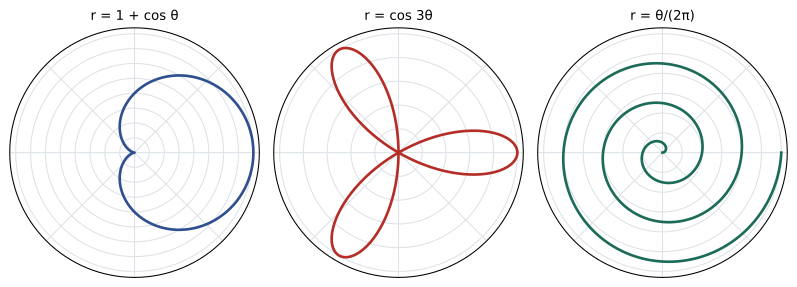
- \(r = a(1 + \cos\theta)\) is a cardioid, a heart-shaped curve.
- \(r = a\cos(n\theta)\) is a rose with \(n\) petals if \(n\) is odd and \(2n\) petals if \(n\) is even.
- \(r = a\theta\) is an Archimedean spiral, with equally spaced turns, the shape of a rolled-up tape, a groove on a vinyl record and many scroll compressors.
Worked problem
An antenna pattern
The field strength of a simple directional microphone or antenna is often modelled by the cardioid \(r = \tfrac{1}{2}(1 + \cos\theta)\), with \(\theta\) measured from the forward direction. Compare the response at 0°, 90° and 180°, and express the 90° response in decibels.
Show solution
- \(r(0) = 1\), \(r(90°) = 0.5\), \(r(180°) = 0\).
- At 90°: \(20\log_{10}(0.5) = -6.0\) dB relative to the forward direction.
Answer: Full response forward, half (−6 dB) to the sides and none behind, which is why cardioid microphones reject sound from the rear. Engineers display radiation and sensitivity patterns as polar plots for exactly this reason.
Slopes and areas in polar coordinates
A polar curve \(r = f(\theta)\) is a parametric curve with parameter \(\theta\): \(x = f(\theta)\cos\theta\), \(y = f(\theta)\sin\theta\). Its slope therefore follows from the parametric formula, \(dy/dx = (dy/d\theta)/(dx/d\theta)\), and its arc length is:
Areas are found with thin wedges instead of rectangles. A wedge of angle \(d\theta\) and radius \(r\) is approximately a sector with area \(\tfrac{1}{2}r^2\,d\theta\), so the area swept as \(\theta\) runs from \(\alpha\) to \(\beta\) is:
Worked problem
Area of a cardioid
Find the area enclosed by \(r = a(1 + \cos\theta)\).
Show solution
- \(A = \tfrac{1}{2}\int_0^{2\pi} a^2(1 + \cos\theta)^2\,d\theta = \tfrac{a^2}{2}\int_0^{2\pi}(1 + 2\cos\theta + \cos^2\theta)\,d\theta\).
- Over a full period, \(\int \cos\theta\,d\theta = 0\) and \(\int \cos^2\theta\,d\theta = \pi\).
- \(A = \tfrac{a^2}{2}(2\pi + 0 + \pi) = \tfrac{3\pi a^2}{2}\).
Answer: 3πa²/2, one and a half times the area of a circle of radius a.
Worked problem
Length of tape on a reel
Tape of thickness 0.02 mm is wound on a hub of radius 20 mm until the outer radius is 50 mm. Model the winding as the spiral \(r = 20 + \dfrac{0.02}{2\pi}\theta\) (mm) and estimate the length of tape.
Show solution
- The number of turns is \((50 - 20)/0.02 = 1{,}500\).
- Because \(dr/d\theta\) is tiny, the arc length integrand is almost exactly \(r\), so \(L \approx \int r\,d\theta = \) (average radius) × (total angle) \(= 35 \times 2\pi \times 1500\) mm.
- \(L \approx 330{,}000\) mm = 330 m.
Answer: About 330 m of tape. The same result follows from the area of the annulus divided by the tape thickness, π(50² − 20²)/0.02 mm ≈ 330 m, a useful check. Paper, steel strip and cable manufacturers use this calculation to estimate the length remaining on a roll from its diameter.
Orbits and conic sections
In polar coordinates with the pole at a focus, every conic section (ellipse, parabola or hyperbola) has the form \(r = \dfrac{p}{1 + e\cos\theta}\), where \(e\) is the eccentricity: \(e < 1\) for an ellipse, \(e = 1\) for a parabola, \(e > 1\) for a hyperbola. Newton showed that this is exactly the shape of an orbit under an inverse-square force, which is why satellite and planetary orbits are conic sections with the central body at a focus. Kepler's second law, that the line from the Sun to a planet sweeps out equal areas in equal times, is a statement about the polar area integral, \(dA/dt = \tfrac{1}{2}r^2\,d\theta/dt\) = constant, and follows from conservation of angular momentum.
Common mistakes
MistakeWriting dy/dx = (dx/dt)/(dy/dt).
Insteaddy/dx = (dy/dt)/(dx/dt).
MistakeConcluding there is a horizontal tangent wherever dy/dt = 0.
InsteadAlso require dx/dt ≠ 0; where both vanish there may be a cusp.
MistakeDropping the absolute value in √(sin²) when finding arc length.
InsteadCheck the sign over the interval, as with sin(θ/2) on [0, 2π].
MistakeUsing the arctangent alone to find θ from (x, y).
InsteadChoose the quadrant from the signs of x and y.
MistakeIntegrating r dθ for polar area.
InsteadPolar area is ½∫r² dθ.
Summary and key terms
- Parametric curves x = f(t), y = g(t) describe paths with direction and timing.
- Eliminating the parameter sometimes gives a Cartesian equation, such as an ellipse.
- The cycloid, traced by a rolling wheel, has cusps, length 8r per arch, and special descent properties.
- Slopes are dy/dx = (dy/dt)/(dx/dt); horizontal tangents where dy/dt = 0, vertical where dx/dt = 0.
- Arc length is ∫√(ẋ² + ẏ²) dt, the integral of speed.
- Polar coordinates (r, θ) suit problems with a centre: circles, cardioids, roses, spirals and antenna patterns.
- Polar area is ½∫r² dθ; conic sections with a focus at the pole describe orbits.
- Parametric equations
- Equations giving coordinates as functions of a parameter.
- Parameter
- The independent variable, often time or angle, of a parametric curve.
- Cycloid
- The curve traced by a point on the rim of a rolling circle.
- Cusp
- A sharp point on a curve where the direction reverses.
- Arc length
- The length of a curve between two points.
- Polar coordinates
- Coordinates giving distance from the origin and angle from an axis.
- Cardioid
- The heart-shaped polar curve r = a(1 + cos θ).
- Archimedean spiral
- The polar curve r = aθ with equally spaced turns.
- Eccentricity
- The parameter determining the type of conic section.
- Polar area formula
- A = ½∫r² dθ.
Practice problems
Work each problem on paper first, then reveal the answer to check.
Eliminate the parameter: \(x = t + 1\), \(y = t^2\).
Show answer
y = (x − 1)².
Find dy/dx for \(x = t^2\), \(y = t^3\) at \(t = 2\).
Show answer
3t²/(2t) = 3t/2 = 3.
Where does \(x = t^2 - 4\), \(y = t^3 - 3t\) have horizontal tangents?
Show answer
t = ±1: points (−3, −2) and (−3, 2).
Length of \(x = \cos t\), \(y = \sin t\) for \(0 \le t \le \pi\)?
Show answer
π.
A projectile has \(x = 10t\), \(y = 10t - 4.9t^2\). Speed at t = 1?
Show answer
√(100 + 0.04) ≈ 10.0 m/s.
Convert (x, y) = (−1, 1) to polar.
Show answer
r = √2, θ = 3π/4.
Convert \(r = 4\sin\theta\) to Cartesian form.
Show answer
x² + y² = 4y, a circle of radius 2 centred at (0, 2).
How many petals does \(r = \cos 4\theta\) have?
Show answer
8.
Area inside \(r = 2\) (as a polar integral)?
Show answer
½∫₀²π 4 dθ = 4π.
Area of one petal of \(r = \cos 3\theta\)?
Show answer
½∫ from −π/6 to π/6 of cos²3θ dθ = π/12.
Lesson quiz · 5 questions
Score 60% or more to complete this lesson.
Create a free account to save your progress, take quizzes and earn a certificate.