
PHYS-130 · Lesson 3 of 5 · 39 min
Work and energy
Newton's second law tells you the acceleration at each instant. Often you do not need that much detail. You want to know how fast a roller coaster is moving at the bottom of a drop, how high a spring will launch a part, how much power a pump needs, or how far a truck will roll before stopping. Energy methods answer these questions directly, by comparing the start and end of the motion and skipping everything in between.
This chapter defines work, kinetic energy and potential energy, proves the work–energy theorem, and builds the conservation of energy into a practical tool that includes friction losses. It finishes with power and efficiency, the quantities that size motors, pumps and engines.
Work done by a constant force
When a constant force \(\mathbf{F}\) acts on an object that moves through a displacement \(\mathbf{d}\), the work done by the force is the dot product from Linear Algebra:
where \(\theta\) is the angle between the force and the displacement. Work is a scalar, measured in joules: \(1 \text{ J} = 1 \text{ N·m}\). Only the component of force along the motion does work.
- \(\theta < 90^\circ\): positive work. The force helps the motion (a tow rope pulling a car forward).
- \(\theta = 90^\circ\): zero work. The normal force on a car on a level road, and the tension in a string whirling a ball in a circle, do no work.
- \(\theta > 90^\circ\): negative work. The force opposes the motion (friction, brakes).
Holding a heavy box still does no work in this sense, however tiring it is, because there is no displacement. Your muscles use energy internally, but none is transferred to the box.
Worked problem
Pushing a crate
A worker pushes a crate 8.0 m across a floor with a force of 150 N directed 25° below horizontal. How much work does the worker do?
Show solution
- The displacement is horizontal; the angle between force and displacement is 25°.
- \(W = Fd\cos\theta = 150 \times 8.0 \times \cos 25^\circ = 150 \times 8.0 \times 0.906\).
Answer: 1088 J. The downward part of the push does no work; it only presses the crate into the floor and increases friction
When several forces act, the net work is the sum of the work done by each, which equals the work done by the net force.
Work done by a varying force
If the force changes with position, split the motion into tiny steps \(dx\), over each of which the force is nearly constant, and add up. That sum becomes an integral:
Graphically, work is the area under the force–displacement curve. For a constant force the area is a rectangle; for a spring, whose force grows linearly with stretch, it is a triangle.
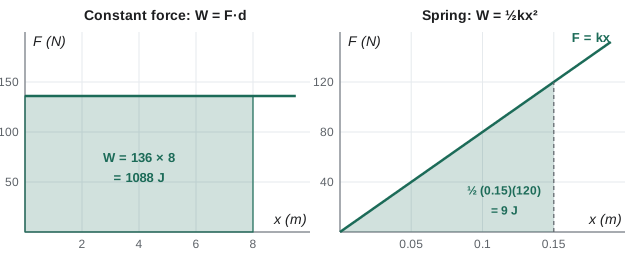
For a spring obeying Hooke's law, the force needed to stretch it by \(x\) is \(F = kx\), where \(k\) is the spring constant in N/m. The work to stretch it from its natural length to \(x\) is
Worked problem
Compressing a spring
A spring with \(k = 800\) N/m is compressed 0.15 m. How much work is needed, and what is the maximum force?
Show solution
- \(W = \tfrac12(800)(0.15)^2 = \tfrac12(800)(0.0225) = 9.0\) J.
- Maximum force at full compression: \(F = kx = 800 \times 0.15 = 120\) N.
- Check with the graph: the triangle has base 0.15 m and height 120 N, so area \(= \tfrac12(0.15)(120) = 9.0\) J.
Answer: 9.0 J; 120 N. Note that W is not F × x = 18 J, because the force builds up from zero
Kinetic energy and the work–energy theorem
Combine Newton's second law with the kinematics equation \(v^2 = v_0^2 + 2a\Delta x\). For a net force \(F\) acting along the motion, \(F\Delta x = ma\Delta x = \tfrac12 mv^2 - \tfrac12 mv_0^2\). This suggests defining the kinetic energy
and gives the work–energy theorem, which holds generally (for varying forces and curved paths too):
The net work done on an object equals its change in kinetic energy. Positive net work speeds it up; negative net work slows it down. Kinetic energy depends on \(v^2\), so doubling speed quadruples it, which is why highway collisions are so much more destructive than parking-lot ones.
Worked problem
Stopping a car
A 1200 kg car travels at 20 m/s (72 km/h). How much kinetic energy must the brakes remove, and how far does it skid on locked wheels if \(\mu_k = 0.70\)?
Show solution
- \(K = \tfrac12(1200)(20^2) = 240\,000\) J = 240 kJ.
- Friction force: \(\mu_k mg = 0.70 \times 1200 \times 9.81 = 8240\) N, acting backward.
- Work–energy: \(-8240\,d = 0 - 240\,000\), so \(d = 29.1\) m.
Answer: 240 kJ; 29.1 m. The 240 kJ ends up as heat in the tires and road, or, without skidding, in the brake discs
Potential energy
Some forces give back the work done against them. Lift a box onto a shelf and the work you did can be recovered when it falls. Compress a spring and it pushes back. Such forces are called conservative, and for them we define a potential energy \(U\): stored energy that depends only on position.
- Gravitational potential energy near the Earth: \(U_g = mgh\), where \(h\) is height above any reference level you choose.
- Elastic potential energy of a spring: \(U_s = \tfrac12 kx^2\), where \(x\) is the stretch or compression.
The work done by a conservative force is the decrease in its potential energy, \(W = -\Delta U\), and it depends only on the start and end points, not the path. Gravity does the same work on a skier who drops 100 m whether she takes the steep run or the gentle one.
Friction and air drag are not conservative. The work they do depends on the path length, and the energy they remove becomes heat that you cannot get back mechanically.
Only changes in potential energy matter, so choose the zero level wherever it is convenient: usually the lowest point in the problem.
Conservation of mechanical energy
If only conservative forces do work (other forces may act, but do no work, like a normal force on a smooth track), the total mechanical energy stays constant:
Energy moves back and forth between kinetic and potential forms, but the sum is fixed.
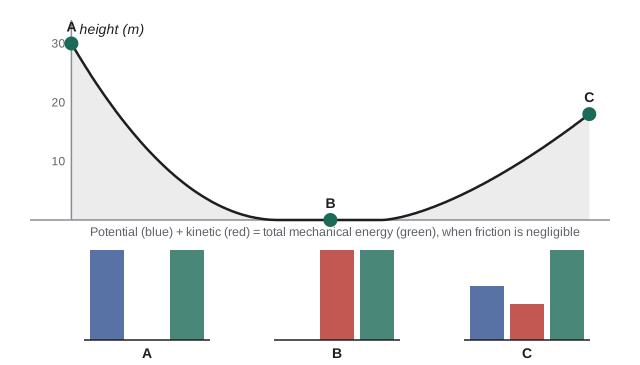
Worked problem
A frictionless drop
A roller coaster car starts from rest at point A, 30 m above the lowest point B. How fast is it moving at B, and at C, 18 m above B? Ignore friction.
Show solution
- Zero level at B. At A: \(K = 0\), \(U = mg(30)\).
- At B: \(\tfrac12 mv_B^2 = mg(30)\), so \(v_B = \sqrt{2(9.81)(30)} = 24.3\) m/s.
- At C: \(\tfrac12 mv_C^2 = mg(30 - 18)\), so \(v_C = \sqrt{2(9.81)(12)} = 15.3\) m/s.
Answer: v_B = 24.3 m/s (87 km/h), v_C = 15.3 m/s. The mass cancels, and the shape of the track does not matter, only the heights
Notice how much easier this is than Newton's laws. On a curved track, the normal force changes direction and size continuously; solving \(\mathbf{F} = m\mathbf{a}\) would require calculus along the whole path. Energy needs only the two endpoints.
Worked problem
A spring launcher
The spring from the earlier example (\(k = 800\) N/m, compressed 0.15 m) launches a 50 g ball straight up. How high does the ball rise above its launch point?
Show solution
- Energy stored in the spring: 9.0 J.
- At the top, all of it has become gravitational potential energy: \(mgh = 9.0\).
- \(h = 9.0/(0.050 \times 9.81) = 18.3\) m.
Answer: About 18 m. Air resistance would reduce this noticeably for a light ball
When friction does work
With non-conservative forces such as friction, the mechanical energy changes by the work they do:
Friction makes \(W_{\text{nc}}\) negative: the mechanical energy decreases, and the lost energy appears as heat. Total energy, counting thermal energy, is still conserved. This is the first law of thermodynamics, which you will study in its full form later in the program.
Worked problem
A skier with friction
A 70 kg skier starts from rest and slides 40 m down a straight 25° slope with \(\mu_k = 0.08\). Find her speed at the bottom.
Show solution
- Height lost: \(h = 40\sin 25^\circ = 16.9\) m, so gravity releases \(mgh = 70 \times 9.81 \times 16.9 = 11\,610\) J.
- Normal force: \(N = mg\cos 25^\circ = 622.4\) N. Friction work: \(-\mu_k N d = -0.08 \times 622.4 \times 40 = -1990\) J.
- Kinetic energy at the bottom: \(11\,610 - 1990 = 9620\) J.
- \(v = \sqrt{2 \times 9620/70} = 16.6\) m/s.
Answer: 16.6 m/s, compared with 18.2 m/s without friction. Friction took about 17% of the energy
Power
Power is the rate of doing work, or the rate of transferring energy:
The SI unit is the watt: \(1 \text{ W} = 1 \text{ J/s}\). Engineers also meet the kilowatt and, in North American practice, the horsepower (1 hp = 746 W). Energy bills use the kilowatt-hour: 1 kWh = 3.6 MJ, the energy delivered by 1 kW for one hour.
Two machines can do the same work, but the more powerful one does it faster. Raising an elevator 30 m takes the same energy whether it takes 15 s or 60 s; the faster lift needs a motor four times as powerful.
Efficiency
No real machine delivers all the energy it takes in. Some is lost to friction, electrical resistance or turbulence. The efficiency is
always less than 1. Typical values: large electric motors 0.90–0.97, gearboxes 0.95–0.98 per stage, centrifugal pumps 0.60–0.85, car engines 0.25–0.40. Efficiencies multiply through a chain of machines.
Worked problem
Sizing an elevator motor
An elevator car and its load have a total mass of 1000 kg (after the counterweight is accounted for) and rise at a steady 2.0 m/s. What power must the motor deliver if the drive is 85% efficient?
Show solution
- At steady speed, the cable tension equals the weight: \(T = 1000 \times 9.81 = 9810\) N.
- Output power: \(P = Tv = 9810 \times 2.0 = 19\,620\) W = 19.6 kW.
- Input power: \(19.6/0.85 = 23.1\) kW.
Answer: About 23 kW (31 hp) of electrical input. The 3.5 kW difference becomes heat in the motor and gearing
Worked problem
Pump power
A pump lifts water at 0.020 m³/s (20 L/s) through a height of 25 m. The pump is 70% efficient. What power does it need?
Show solution
- Mass flow: \(1000 \text{ kg/m}^3 \times 0.020 = 20\) kg/s.
- Useful power: energy per second \(= \dot m g h = 20 \times 9.81 \times 25 = 4905\) W.
- Shaft power: \(4905/0.70 = 7010\) W.
Answer: About 7.0 kW. Fluid mechanics adds the pipe friction losses, which raise the required head above 25 m
Common mistakes
MistakeUsing W = Fd when the force is at an angle to the motion.
InsteadUse W = Fd cos θ; only the component along the displacement does work.
MistakeComputing spring work as kx × x = kx².
InsteadThe force grows from zero, so W = ½kx²: the area of a triangle.
MistakeIncluding both "work done by gravity" and "change in gravitational potential energy" in the same equation.
InsteadCount gravity once: either as work in W_net = ΔK, or as potential energy in the conservation equation.
MistakeAssuming mechanical energy is conserved when friction acts.
InsteadAdd the (negative) work of friction: K₁ + U₁ + W_nc = K₂ + U₂.
MistakeConfusing power (W) with energy (J or kWh).
InsteadPower is a rate. Energy = power × time.
MistakeMultiplying by the efficiency when going from output to input.
InsteadInput = output ÷ efficiency. The input is always the larger number.
Summary and key terms
- Work W = Fd cos θ; for a varying force W = ∫F dx, the area under the F–x graph. Spring work is ½kx².
- Kinetic energy K = ½mv². The work–energy theorem: W_net = ΔK.
- Conservative forces store potential energy: U = mgh for gravity, ½kx² for springs. Their work depends only on endpoints.
- With only conservative forces doing work, K + U is constant.
- Friction and other non-conservative forces change mechanical energy: K₁ + U₁ + W_nc = K₂ + U₂.
- Power P = dW/dt = Fv, in watts. Efficiency η = P_out/P_in is always below 1.
- Work
- Energy transferred by a force acting through a displacement, W = F·d.
- Joule (J)
- The SI unit of work and energy, 1 N·m.
- Kinetic energy
- Energy of motion, ½mv².
- Potential energy
- Stored energy that depends on position.
- Conservative force
- A force whose work depends only on the start and end points.
- Mechanical energy
- The sum of kinetic and potential energy.
- Power
- Rate of doing work, measured in watts.
- Efficiency
- Useful output power divided by input power.
Practice problems
Work each problem on paper first, then reveal the answer to check.
A 25 kg box is lifted 1.8 m onto a truck at constant speed. How much work is done by the lifter and by gravity?
Show answer
Lifter: mgh = 25 × 9.81 × 1.8 = 441 J. Gravity: −441 J.
A force \(F(x) = 50 + 20x\) N acts on an object as it moves from \(x = 0\) to \(x = 3\) m. Find the work done.
Show answer
∫(50 + 20x)dx from 0 to 3 = 150 + 90 = 240 J.
How much work is needed to stretch a spring (k = 2500 N/m) from 0.02 m to 0.06 m beyond its natural length?
Show answer
½(2500)(0.06² − 0.02²) = 1250 × 0.0032 = 4.0 J.
A 0.15 kg ball moving at 30 m/s is caught. How much work does the catcher's glove do on it?
Show answer
ΔK = 0 − ½(0.15)(900) = −67.5 J.
A pendulum bob is released from rest 0.60 m above its lowest point. What is its speed at the bottom?
Show answer
v = √(2 × 9.81 × 0.60) = 3.43 m/s.
A 2 kg block slides from rest down a frictionless curved ramp 1.5 m high, then onto a level floor with \(\mu_k = 0.25\). How far along the floor does it slide?
Show answer
mgh = μk mg d, so d = h/μk = 1.5/0.25 = 6.0 m.
A 1500 kg car accelerates from 0 to 27 m/s in 9.0 s. What average power does the engine deliver to the wheels (ignore losses)?
Show answer
ΔK = ½(1500)(27²) = 546.8 kJ. P = 546.8/9.0 = 60.8 kW (81 hp).
A conveyor lifts 30 t of gravel per hour through 12 m. What is the minimum power required?
Show answer
Mass flow 30 000/3600 = 8.33 kg/s. P = 8.33 × 9.81 × 12 = 981 W ≈ 1 kW.
A motor (92% efficient) drives a gearbox (96%) that drives a pump (75%). If the pump delivers 10 kW to the water, how much electrical power is drawn?
Show answer
Overall efficiency 0.92 × 0.96 × 0.75 = 0.662. Input = 10/0.662 = 15.1 kW.
A 500 kg load is lifted 12 m in 30 s at constant speed. Find the work done and the average power.
Show answer
W = 500 × 9.81 × 12 = 58.9 kJ. P = 58 860/30 = 1.96 kW.
Lesson quiz · 5 questions
Score 60% or more to complete this lesson.
Create a free account to save your progress, take quizzes and earn a certificate.