
PHYS-131 · Lesson 5 of 5 · 37 min
Magnetic fields and induction
Electricity and magnetism are two faces of one phenomenon. Moving charges create magnetic fields, magnetic fields push on moving charges, and a changing magnetic field creates an electric field. These three facts run the modern world: every electric motor, generator, transformer, loudspeaker, MRI scanner and induction cooktop is built on them.
This chapter covers the magnetic force on moving charges and currents, the torque that drives motors, the magnetic fields made by wires and coils, and Faraday's law of induction, which explains generators and transformers. It finishes with why power is transmitted at high voltage.
Magnetic fields and the force on a moving charge
A magnetic field \(\mathbf{B}\) is measured in teslas (T). The Earth's field is about 50 μT; a fridge magnet about 5 mT; an MRI scanner 1.5 to 3 T. Unlike the electric field, the magnetic field pushes only on charges that are moving, and the force is perpendicular to both the velocity and the field:
This is the cross product from Linear Algebra, with its right-hand rule: point your fingers along \(\mathbf{v}\), curl them toward \(\mathbf{B}\), and your thumb gives the force on a positive charge. For a negative charge, reverse it.
Because the force is always perpendicular to the velocity, a magnetic field does no work. It changes a charge's direction but never its speed or kinetic energy.
In diagrams, a field pointing out of the page is drawn as dots (⊙, the tip of an arrow coming toward you) and into the page as crosses (⊗, the tail feathers going away).
Circular motion
A charge moving perpendicular to a uniform field feels a constant-size force toward the centre of a circle. Setting \(qvB = mv^2/r\) gives the radius and the period:
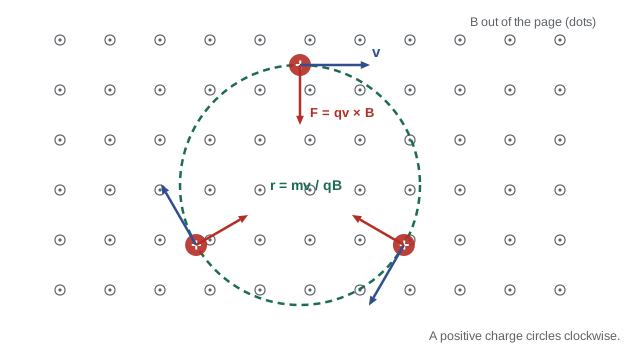
Remarkably, the period does not depend on the speed: faster particles move in bigger circles and take the same time. That is the principle of the cyclotron, which accelerates protons to make medical isotopes. Mass spectrometers use the radius to measure the mass of ions.
Worked problem
A proton in a magnetic field
A proton moving at \(2.0 \times 10^6\) m/s enters a 0.50 T field at right angles. Find the radius and period of its circular path.
Show solution
- \(r = \dfrac{(1.673 \times 10^{-27})(2.0 \times 10^6)}{(1.602 \times 10^{-19})(0.50)} = 0.042\) m.
- \(T = \dfrac{2\pi(1.673 \times 10^{-27})}{(1.602 \times 10^{-19})(0.50)} = 1.3 \times 10^{-7}\) s.
Answer: r ≈ 4.2 cm; T ≈ 131 ns, whatever the proton's speed
Force on a current-carrying wire
A current is a stream of moving charges, so a wire carrying current in a magnetic field feels a force. For a straight length \(L\) of wire at angle \(\theta\) to the field:
directed by the right-hand rule with the fingers along the current.
Worked problem
Force on a busbar
A 2.0 m length of wire carries 5.0 A at right angles to a 0.30 T field. Find the force on it.
Show solution
- \(F = ILB = (5.0)(2.0)(0.30) = 3.0\) N.
Answer: 3.0 N, perpendicular to both the wire and the field
Torque on a coil: the electric motor
A rectangular loop of current in a field feels equal and opposite forces on its two sides, which form a couple. For a coil of \(N\) turns and area \(A\), the torque is
where \(\theta\) is the angle between the field and the coil's axis (its normal). An electric motor uses this torque, with a commutator or electronic switching to reverse the current every half turn so the torque always acts in the same rotational direction.
Worked problem
Motor torque
A 100-turn coil of area 0.010 m² carries 2.0 A in a 0.50 T field. Find the maximum torque.
Show solution
- \(\tau_{\max} = NIAB = (100)(2.0)(0.010)(0.50) = 1.0\) N·m.
Answer: 1.0 N·m, at the position where the plane of the coil is parallel to the field
Magnetic fields from currents
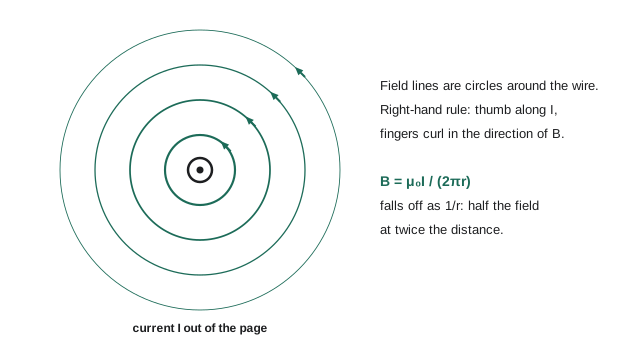
Currents produce magnetic fields. Around a long, straight wire, the field lines are circles centred on the wire, with direction given by a second right-hand rule: thumb along the current, fingers curl in the direction of \(\mathbf{B}\). The size of the field falls off as \(1/r\):
Worked problem
Fields near cables
Find the magnetic field (a) 5.0 cm from a cable carrying 100 A, and (b) 10 m from a transmission line conductor carrying 1000 A. Compare with the Earth's field of about 50 μT.
Show solution
- (a) \(B = (4\pi \times 10^{-7})(100)/(2\pi \times 0.050) = 4.0 \times 10^{-4}\) T = 400 μT.
- (b) \(B = (4\pi \times 10^{-7})(1000)/(2\pi \times 10) = 2.0 \times 10^{-5}\) T = 20 μT.
Answer: 400 μT, eight times the Earth's field, enough to disturb a compass; and 20 μT, less than half the Earth's field. Real lines carry alternating current in several conductors whose fields partly cancel
Two parallel wires carrying current exert forces on each other: each sits in the other's field. The force per unit length is \(F/L = \mu_0 I_1I_2/(2\pi d)\), attractive for currents in the same direction and repulsive for opposite currents. In a short circuit, currents of tens of thousands of amperes make these forces large enough to bend busbars, so switchgear is braced to withstand them.
Solenoids
A long coil of wire, a solenoid, produces a nearly uniform field inside, \(B = \mu_0 nI\), where \(n\) is the number of turns per metre. A 0.50 m solenoid with 1000 turns carrying 2.0 A has \(n = 2000\) per metre and \(B = (4\pi \times 10^{-7})(2000)(2.0) = 5.0\) mT. An iron core multiplies the field by hundreds or thousands, which is how electromagnets, relays and solenoid valves get their strength.
Electromagnetic induction
In 1831 Michael Faraday discovered the reverse effect: a changing magnetic field produces a voltage. To state it precisely, define the magnetic flux through a loop of area \(A\) as \(\Phi = BA\cos\theta\) (in webers, Wb), where \(\theta\) is the angle between the field and the loop's normal. Faraday's law says the emf induced in a coil of \(N\) turns is
Any change in flux induces an emf: a changing field strength, a changing area, or a changing angle. The minus sign expresses Lenz's law: the induced current flows in the direction that opposes the change in flux that produced it. Lenz's law is conservation of energy in disguise; if the induced current helped the change, you would get energy for nothing.
Worked problem
Induced emf in a coil
The magnetic flux through each turn of a 50-turn coil falls steadily from 0.10 Wb to zero in 0.50 s. Find the average induced emf.
Show solution
- \(|\mathcal{E}| = N\dfrac{\Delta\Phi}{\Delta t} = 50 \times \dfrac{0.10}{0.50}\).
Answer: 10 V
Motional emf
A conductor moving through a field has its free charges pushed along it by the magnetic force, producing an emf \(\mathcal{E} = BLv\) for a rod of length \(L\) moving at speed \(v\) perpendicular to the field. A 0.50 m rod moving at 4.0 m/s through a 0.80 T field generates \(0.80 \times 0.50 \times 4.0 = 1.6\) V. This is the simplest generator, and it is also the principle of electromagnetic flowmeters, which measure the speed of a conducting fluid in a pipe from the voltage across it.
Lenz's law also explains eddy currents: changing fields induce swirling currents in solid metal, which oppose the motion. They are the basis of magnetic braking in trains and roller coasters, of induction cooktops (which heat the pan directly), and of the metal detectors at airports. In transformers and motors they waste energy, so cores are made of thin insulated laminations to block them.
Generators and alternating current
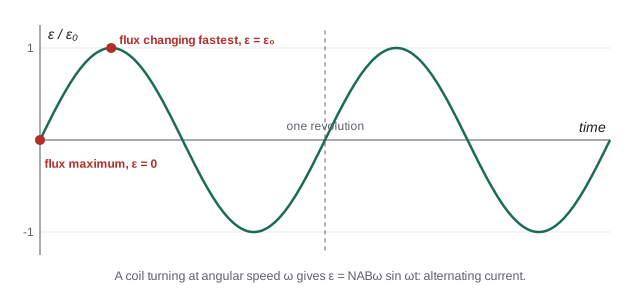
A coil of \(N\) turns and area \(A\) rotating at angular speed \(\omega\) in a field \(B\) has flux \(\Phi = BA\cos\omega t\). By Faraday's law, the emf is
This is alternating current (AC): a sinusoidal voltage that reverses direction twice each cycle. The emf is largest when the coil's plane is parallel to the field, where the flux is zero but changing fastest, and zero when the coil faces the field, where the flux is greatest but momentarily not changing.
Worked problem
A simple generator
A 200-turn coil of area 0.020 m² turns at 60 revolutions per second in a 0.40 T field. Find the peak emf and the rms emf.
Show solution
- \(\omega = 2\pi \times 60 = 377\) rad/s.
- \(\mathcal{E}_0 = NAB\omega = (200)(0.020)(0.40)(377) = 603\) V.
- The rms value of a sine wave is the peak divided by \(\sqrt2\) (Calculus II): \(603/1.414 = 427\) V.
Answer: Peak 603 V; rms 427 V
Power-station generators work exactly this way, usually with the magnet rotating inside stationary windings, driven by steam, gas, water or wind turbines. Household voltage of 120 V is an rms value; its peak is about 170 V.
Transformers and power transmission
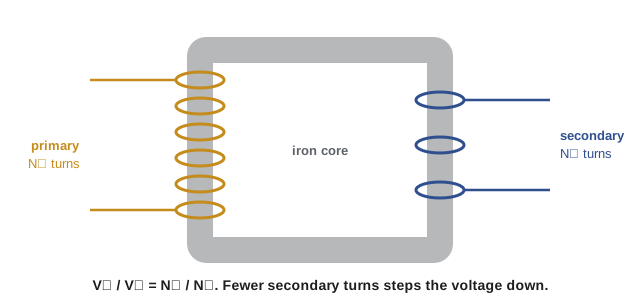
A transformer has two coils wound on a shared iron core. Alternating current in the primary coil creates a changing flux in the core, which induces an emf in the secondary. Since the same flux passes through every turn, the voltages are in the ratio of the turns:
An ideal transformer conserves power, so stepping the voltage up steps the current down by the same factor. Real transformers are 95% to over 99% efficient. Transformers need changing flux, which is the main reason the grid uses AC rather than DC.
Worked problem
Why transmit at high voltage?
A line with 5.0 Ω of resistance must deliver 10 MW. Compare the power lost in the line at 25 kV and at 240 kV.
Show solution
- At 25 kV: \(I = P/V = 10 \times 10^6/25 \times 10^3 = 400\) A. Loss \(= I^2R = 400^2 \times 5.0 = 800\) kW, 8% of the power.
- At 240 kV: \(I = 41.7\) A. Loss \(= 41.7^2 \times 5.0 = 8.7\) kW, under 0.1%.
Answer: About 800 kW versus 8.7 kW. Raising the voltage tenfold cuts the current tenfold and the losses a hundredfold
This is why electricity leaves power stations at hundreds of kilovolts, is stepped down at substations to distribution voltages (25 kV is common in Alberta), and is stepped down again by pole-top or pad-mounted transformers to the 120/240 V supplied to homes. A 25 kV to 240 V transformer has a turns ratio of about 104 to 1.
Common mistakes
MistakeExpecting a magnetic field to push on a stationary charge, or to speed a charge up.
InsteadF = qv × B: no velocity, no force; and the force is perpendicular to v, so it does no work.
MistakeUsing the right-hand rule for an electron without reversing the result.
InsteadThe rule gives the force on a positive charge. Reverse it for negative charges.
MistakeThinking a steady magnetic field through a coil induces a voltage.
InsteadOnly a changing flux induces an emf. Constant flux, however large, gives none.
MistakeForgetting the number of turns N in Faraday's law.
InsteadEach turn contributes; the total emf is N dΦ/dt.
MistakeThinking a step-up transformer creates energy.
InsteadPower in ≈ power out. Higher voltage means proportionally lower current.
MistakeUsing B = μ₀I/(2πr) for a coil, or B = μ₀nI for a straight wire.
InsteadThe first is a long straight wire; the second is the inside of a long solenoid.
Summary and key terms
- Magnetic fields are measured in teslas and push only on moving charges: F = qv × B.
- A charge moving perpendicular to a uniform field circles with r = mv/qB and period 2πm/qB.
- A current-carrying wire feels F = ILB sin θ; a coil feels τ = NIAB sin θ, the basis of motors.
- A long straight wire makes B = μ₀I/(2πr) in circles around it; a solenoid makes B = μ₀nI inside.
- Faraday's law: ℰ = −N dΦ/dt. Lenz's law: induced currents oppose the change in flux.
- A rotating coil generates AC: ℰ = NABω sin ωt. Rms values are peak/√2.
- Transformers change voltage in the ratio of turns, conserving power; high-voltage transmission slashes I²R losses.
- Magnetic field
- The field that exerts forces on moving charges, in teslas.
- Tesla (T)
- The SI unit of magnetic field, 1 N/(A·m).
- Right-hand rule
- The rule for the direction of a cross product such as qv × B.
- Solenoid
- A long coil producing a nearly uniform field inside.
- Magnetic flux
- Φ = BA cos θ, in webers.
- Faraday's law
- An emf is induced by a changing magnetic flux: ℰ = −N dΦ/dt.
- Lenz's law
- Induced currents oppose the change that causes them.
- Eddy currents
- Currents induced in solid conductors by changing fields.
- Transformer
- Two coils on a shared core that change AC voltage in the ratio of their turns.
Practice problems
Work each problem on paper first, then reveal the answer to check.
An electron moves at \(1.0 \times 10^7\) m/s perpendicular to a 1.0 mT field. Find the force on it and the radius of its path.
Show answer
F = evB = (1.602 × 10⁻¹⁹)(10⁷)(10⁻³) = 1.6 × 10⁻¹⁵ N. r = mv/eB = (9.109 × 10⁻³¹)(10⁷)/(1.602 × 10⁻²²) = 5.7 cm.
A proton moving east enters a magnetic field pointing up (out of the ground). Which way is the force on it?
Show answer
Take x east, y north, z up. F = qv × B points along x̂ × ẑ = −ŷ: the force is to the south.
A 0.25 m wire carrying 12 A lies at 30° to a 0.60 T field. Find the force.
Show answer
F = ILB sin θ = 12 × 0.25 × 0.60 × 0.5 = 0.90 N.
A motor coil has 250 turns, area 0.0040 m², carries 3.0 A in a 0.80 T field. Find the maximum torque.
Show answer
τ = NIAB = 250 × 3.0 × 0.0040 × 0.80 = 2.4 N·m.
At what distance from a wire carrying 25 A does its field equal the Earth's field (50 μT)?
Show answer
r = μ₀I/(2πB) = (2 × 10⁻⁷)(25)/(5 × 10⁻⁵) = 0.10 m.
Two parallel wires 1.0 cm apart each carry 100 A in the same direction. Find the force per metre between them.
Show answer
F/L = μ₀I²/(2πd) = (2 × 10⁻⁷)(10⁴)/0.01 = 0.20 N/m, attractive.
A 0.040 m² loop sits in a field that rises from 0 to 1.5 T in 0.20 s, perpendicular to the loop. Find the average emf.
Show answer
ΔΦ = 1.5 × 0.040 = 0.060 Wb. ℰ = 0.060/0.20 = 0.30 V.
A bar magnet is pushed north pole first into a coil. Use Lenz's law to say which pole the coil presents to the approaching magnet.
Show answer
A north pole, which repels the approaching magnet and opposes the increase in flux.
A transformer steps 120 V down to 12 V for a lamp drawing 2.0 A. Find the turns ratio and the primary current (ideal).
Show answer
Np/Ns = 10. Power 24 W, so Ip = 24/120 = 0.20 A.
Doubling the speed of a generator's rotation does what to its peak emf and its frequency?
Show answer
Both double, since ℰ₀ = NABω and f = ω/2π.
Lesson quiz · 5 questions
Score 60% or more to complete this lesson.
Create a free account to save your progress, take quizzes and earn a certificate.