
BAR-223 · Lesson 5 of 12 · 21 min
Exam changes ahead: NextGen in July 2028
▶ Video coming soon A video version of this lesson is on the way.
Nolan's younger cousin Ada started law school in Detroit in August 2026, and over Sunday dinner at their grandmother's house in Bay City she asked him which exam she would take. 'Everyone in my section says something different,' she told him. 'Some say the UBE, some say a new exam, some say it is not decided.' Nolan brought her question to Marchetti, who had spent the fall running the group's NextGen Sunday sessions with Marcus Bell, the member who took the first NextGen exam in Missouri in July 2026 and passed.
'Your cousin will take NextGen,' Marchetti said. 'Michigan has announced that its first NextGen exam will be in July 2028. If she graduates on the usual schedule in May 2029, she will sit it in July 2029. You will not, of course. Your exam in February 2027 is the legacy UBE, and so is every Michigan exam through February 2028. But a Michigan lawyer should understand the change, because you will be supervising summer associates who take it, and because the transfer rules will shift.'
This lesson explains the move from the UBE to NCBE's NextGen bar exam, what Michigan has announced, what remains open, and what the change means for candidates on each side of the line.
The timeline
Michigan's path has three fixed dates. The October 13, 2021 order adopted the Uniform Bar Examination, and the first UBE was given in July 2022. On November 4, 2025, Michigan announced that it would move to NCBE's NextGen bar exam, with the first administration in July 2028. That makes February 2028 the last legacy UBE in Michigan.
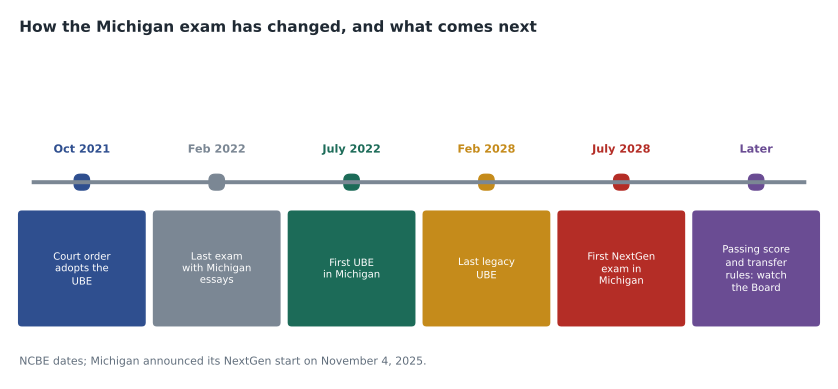
NCBE's own schedule runs in parallel. The first NextGen exam anywhere was given in July 2026 in a small group of early-adopting jurisdictions, and more jurisdictions join each year from 2027 to 2028. NCBE has said it will continue to offer the legacy UBE components through February 2028, so Michigan's timing lines up with the end of the old exam. Michigan therefore joins the group of jurisdictions starting in July 2028 rather than earlier.
What NextGen is
NextGen is a new exam, not a revision of the UBE. NCBE built it after a multi-year study of what newly licensed lawyers do in practice. The study concluded that the exam should test fewer subjects in less depth, test lawyering skills more directly, and integrate knowledge and skills in the same questions rather than separating them into a multiple-choice day and an essay day.
The content falls into two parts. The foundational concepts and principles cover the core subjects tested on the current exam, such as civil procedure, contract law, evidence, torts, constitutional law, criminal law, real property and business associations, with some family law and trusts and estates content. Several subjects tested on the current MEE, such as conflict of laws and secured transactions, are not part of NextGen. The foundational skills include legal research, legal writing, issue spotting and analysis, investigation and evaluation, client counseling and advising, negotiation and dispute resolution, and client relationship and management.
The question formats change too. NextGen uses standalone multiple-choice questions, some with more than one correct answer to select; integrated question sets built around a single fact pattern with a mix of multiple-choice and short written answers; and longer performance tasks that ask candidates to complete realistic work from a file and a library, including some legal research inside the exam materials. The exam is given on computer in a test center or a jurisdiction-run site, over a day and a half.
| Feature | Legacy UBE (through February 2028) | NextGen (Michigan from July 2028) |
|---|---|---|
| Structure | MPT and MEE on day one; MBE on day two | Integrated sessions over about a day and a half |
| Subjects | Seven MBE subjects plus six more on the MEE | Fewer subjects tested in less depth |
| Skills | Tested mostly through the MPT | Tested throughout, including research and counseling |
| Questions | Single-answer MBE questions; long essays | Multiple formats, including integrated sets and short answers |
| Score scale | 400 points; Michigan passes 268 | A new NextGen scale; Michigan passing score to be set |
What Michigan has not decided yet
Several Michigan questions were still open as of November 22, 2026, and candidates should watch the Board's announcements rather than relying on predictions.
The first is the passing score. NextGen scores are reported on a new scale, not the 400-point UBE scale, so Michigan will need to set a new passing score. NCBE has published guidance on how jurisdictions can relate their old passing scores to the new scale, and early-adopting states have announced their own cut scores, but Michigan's number is a Michigan decision.
The second is transfer. Michigan will need to decide whether and on what terms it accepts NextGen scores earned elsewhere, and how long legacy UBE scores earned before July 2028 remain transferable into Michigan. Lesson 11 explains the current rule, which accepts UBE scores up to three years old. During the transition the Board will need rules for both kinds of score.
The third is the Michigan Law Component. Michigan Law Basics is tied to the current rules, and it is reasonable to expect a Michigan law requirement to continue alongside NextGen, but the details, such as whether the course changes, have not been announced. Candidates in the class of 2029 and later should check the Board's pages each year.
Who takes which exam
The dividing line is simple to state: a candidate who sits in February 2028 or earlier takes the legacy UBE; a candidate who sits in July 2028 or later takes NextGen. The harder question is what happens to a candidate who fails the last legacy exam. NCBE's legacy components end with February 2028, so a candidate who fails then and retakes in July 2028 will take NextGen, with a different subject list and different question types.
Worked problem
Planning around the line
Three candidates ask Marchetti for advice. Nolan sits in February 2027. Teodora, a 3L, graduates in May 2027 and plans to sit in July 2027. Nolan's cousin Ada graduates in May 2029. Which exam does each face, and what should each watch?
Show solution
- Nolan takes the legacy UBE in February 2027. If he needed a retake, the July 2027 and February 2028 exams would also be legacy UBE administrations.
- Teodora takes the legacy UBE in July 2027. If she needs a retake, February 2028 is the last legacy chance; after that she would face NextGen, so she should plan her first attempt with no assumption of a second legacy sitting.
- Ada takes NextGen in July 2029. She should choose law school courses with NextGen's skills in mind, such as a legal research course, a clinic or a negotiation course, and watch for Michigan's passing score announcement.
Answer: Only candidates sitting in July 2028 or later take NextGen in Michigan. Candidates near the line should plan their first attempt seriously, because a retake may mean a different exam.
What the change means for preparation
For a legacy UBE candidate like Nolan, nothing about the February 2027 exam changes. The study materials, the MEE subject list and the 268 passing score all apply. Marchetti's warning is about materials: as commercial courses shift to NextGen, a February 2027 candidate should make sure every practice set is a legacy UBE set. NextGen practice questions use different formats and may cover topics in a way that does not match the MEE.
For future candidates, the change rewards practical training. Clinics, externships, drafting courses and research courses map directly onto NextGen's skills. The reduced subject list also means less memorization of narrow rules, but more need to apply core rules to realistic facts quickly. Marcus Bell's advice to the group after his July 2026 NextGen exam was blunt: 'Do not try to memorize your way through it. Practice the tasks, under time, until the file and library feel routine.'
For Michigan practitioners, the change matters in hiring and supervision. A summer associate who will sit NextGen in Michigan in 2029 needs different study time and different support than one who sat the UBE. Firms that once gave every new hire the same study leave may need to revisit their policies once the Board announces the details.
Common mistakes
MistakeMichigan's first NextGen exam is July 2026.
InsteadMichigan's first NextGen exam is July 2028; July 2026 was the first NextGen exam in the earliest-adopting jurisdictions.
MistakeA candidate who fails the February 2028 exam retakes the same legacy UBE in July 2028.
InsteadFebruary 2028 is the last legacy UBE; a July 2028 retake would be NextGen.
MistakeNextGen uses the same 268 passing score.
InsteadNextGen uses a new scale; Michigan has not yet announced its NextGen passing score.
MistakeNextGen tests more subjects than the UBE.
InsteadNextGen tests fewer subjects in less depth and puts more weight on lawyering skills.
Why NCBE changed the exam
The reasons for NextGen help explain its design. NCBE's practice analysis surveyed thousands of newly licensed lawyers about the tasks they perform and the knowledge they use. The results showed that new lawyers spend much of their time on research, writing, client communication and fact investigation, and that the knowledge they rely on most is a core of foundational doctrine rather than the narrow rules that bar exams have traditionally rewarded. The legacy exam tested a wide range of doctrine in a format that separated knowledge from skills: the MBE tested knowledge in isolation, the MEE tested knowledge through essays, and only the MPT tested practical skills directly.
NextGen tries to close that gap. Its integrated question sets ask candidates to apply doctrine to a developing fact pattern, to choose what information to gather next, to draft a short piece of writing, and to advise a client on options. Its performance tasks ask candidates to research within a closed universe of materials, much like the MPT, but with more emphasis on finding and evaluating the right authority. The aim is an exam that measures readiness for practice more directly.
What early NextGen candidates report
Marcus Bell's account of the first NextGen exam in July 2026 is useful because it is concrete. He reported that the integrated question sets felt like short case files: a client meeting summary, a few documents, and then a series of questions that asked him to spot issues, choose the best next step and draft a short response. The performance task took most of a session and required him to find the controlling authority in the materials before he could write. He said the multiple-choice questions with more than one correct answer were the hardest adjustment, because partial knowledge was not enough.
His study advice for future NextGen candidates had three parts. First, learn the foundational doctrine in each subject thoroughly enough to apply it without notes, but do not spend time on the narrow rules that NextGen dropped. Second, practice with NCBE's official sample questions and study aids so that the formats feel routine. Third, practice research inside closed materials under time, because the performance tasks reward candidates who can locate the right rule quickly.
What Michigan candidates should watch
Several announcements will shape the transition, and Marchetti keeps a short list for the Michigan candidates she coaches.
The Board's passing score announcement for NextGen will be the most important. NCBE has said NextGen scores will be reported on a scale designed so that jurisdictions can set a passing standard comparable to their legacy UBE standards, and early-adopting jurisdictions have published their own NextGen cut scores. Michigan's announcement will tell future candidates how high the bar is on the new scale.
The Board's transfer rules will matter for anyone who moves. Michigan currently accepts UBE scores of 268 or more earned within three years. Once Michigan gives NextGen, the Board must decide whether to accept NextGen scores from other jurisdictions, at what level, and for how long it will keep accepting legacy UBE scores earned before July 2028. A candidate who passes the legacy UBE in another state in 2027 and plans to move to Michigan in 2029 should watch this closely.
The future of Michigan Law Basics is the third item. The current course was built for UBE candidates. Michigan has not announced any change, but a candidate starting law school now should expect a Michigan law requirement of some kind and should check the Board's pages before graduation.
Advice for law students in Michigan now
Ada asked Nolan one more question after that Sunday dinner: what should she do differently in law school because of NextGen? Marchetti's answer, which Nolan passed along, had four parts.
First, take the core doctrinal courses seriously and take them early. NextGen's foundational concepts overlap heavily with the first-year curriculum and the standard upper-level bar courses, and doctrine learned well in class is far easier to review than doctrine learned for the first time in a commercial course. Second, choose at least one course that builds research skill beyond the first-year writing course, because NextGen tests research inside the exam. Third, take a clinic, an externship or a skills course in counseling or negotiation. NextGen asks candidates to choose the best way to advise a client or to respond to an opposing party, and experience with real clients makes those questions feel natural. Fourth, write under time whenever a course offers the chance, because every NextGen session is timed and much of it involves writing.
Marchetti added a caution about materials. During the transition, commercial courses and study aids will offer both legacy and NextGen products, and older outlines will remain in circulation for years. A NextGen candidate who studies from a legacy outline will waste time on dropped subjects; a legacy candidate who studies from NextGen materials will miss MEE subjects. Check the label on every book and question bank, and when in doubt, start with NCBE's own published materials for the exam you will actually take.
Using this lesson in February 2027
For Nolan, the NextGen change is background, not a task. Marchetti's last word on the subject was practical. 'You are a legacy candidate,' she told him. 'Use legacy materials, practice legacy formats, aim for 268, and finish Michigan Law Basics. Learn enough about NextGen to answer your cousin's questions and to supervise a summer associate in 2028. Then put it away until after February.'
Summary and key terms
- Michigan announced on November 4, 2025 that its first NextGen exam will be in July 2028.
- February 2028 is the last legacy UBE in Michigan; candidates sitting through then take the UBE with the 268 passing score.
- NextGen tests foundational concepts in fewer subjects and seven foundational skills, using integrated question sets and performance tasks.
- Michigan has not yet announced its NextGen passing score, its NextGen transfer rules or any change to the Michigan Law Component.
- Candidates near the transition should plan their first attempt seriously, because a retake may be a different exam.
- 0
- NextGen bar exam
- 1
- legacy UBE
- 2
- foundational concepts and principles
- 3
- foundational skills
- 4
- integrated question set
- 5
- performance task
Practice problems
Work each problem on paper first, then reveal the answer to check.
What is the last legacy UBE administration in Michigan?
Show answer
February 2028.
A student graduating in May 2028 plans to sit in July 2028. Which exam will she take?
Show answer
NextGen, because Michigan's first NextGen exam is July 2028.
Name two Michigan decisions about NextGen that remain open.
Show answer
Any two of: the passing score, transfer rules for NextGen and legacy scores, and how the Michigan Law Component will work.
Name three foundational skills NextGen tests.
Show answer
Any three of: legal research, legal writing, issue spotting and analysis, investigation and evaluation, client counseling and advising, negotiation and dispute resolution, client relationship and management.
Lesson quiz · 5 questions
Score 60% or more to complete this lesson.
Create a free account to save your progress, take quizzes and earn a certificate.