
BAR-223 · Lesson 8 of 12 · 20 min
Michigan torts: comparative fault, governmental immunity and no-fault
▶ Video coming soon A video version of this lesson is on the way.
Most of the files on Nolan's desk at the Grand Rapids firm are tort files, and almost none of them would be decided the way the MBE decides a negligence question. One is a car crash in which the client was hurt in a rear-end collision on US-131. Another is a claim against a city for a pothole that sent a cyclist over her handlebars. A third is a slip-and-fall at a big-box store. 'Every one of these has a Michigan twist,' Nolan told Marchetti. 'No-fault for the crash, the governmental immunity act for the pothole, and some new rule about open and obvious hazards for the store. I need the Michigan framework, and I need to keep it out of my February essays.'
Marchetti agreed. 'Torts is the subject where Michigan law and the exam diverge most. So learn it once, carefully, with a clear label: Michigan practice only. On the MEE, write the general rule the question asks for.'
This lesson covers Michigan's approach to comparative fault and damages, the 2023 change to the open and obvious doctrine, the Governmental Tort Liability Act, and the no-fault automobile insurance system, including the 2019 reform and the Andary decision on retroactivity.
Comparative fault and the noneconomic damages bar
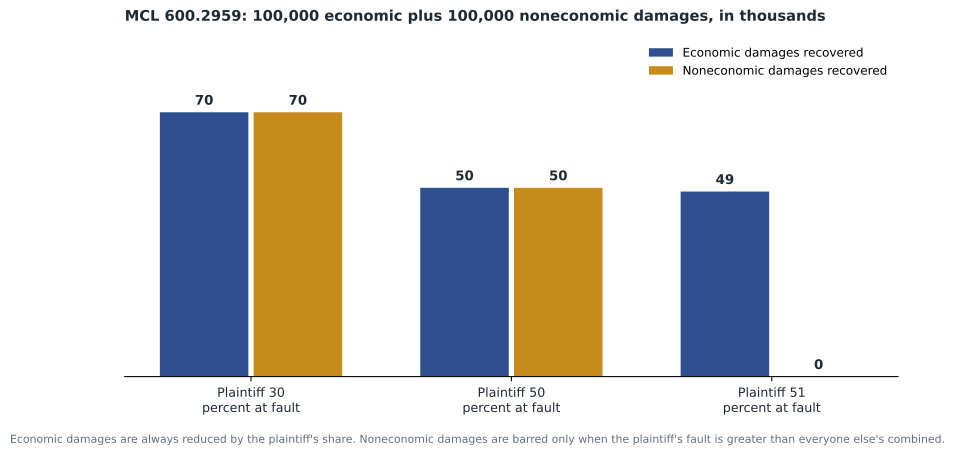
Michigan follows a form of modified comparative fault, set out in MCL 600.2959, that treats economic and noneconomic damages differently. In any action for personal injury, property damage or wrongful death, the court reduces the plaintiff's damages by the plaintiff's percentage of fault. That reduction applies to both kinds of damages. But if the plaintiff's fault is greater than the aggregate fault of the other people whose fault contributed to the injury, whether or not they are parties, the plaintiff recovers no noneconomic damages at all, and economic damages are still reduced by the plaintiff's share.
The result is a hybrid. For economic damages, such as medical expenses and lost wages, Michigan is effectively a pure comparative fault state: a plaintiff 70 percent at fault still recovers 30 percent of economic damages. For noneconomic damages, such as pain and suffering, Michigan uses a 50 percent bar in which the plaintiff must not be more at fault than everyone else combined. A plaintiff exactly 50 percent at fault is not barred, because her fault is not greater than the others'.
Michigan also largely abolished joint and several liability in its 1995 tort reform. In most cases each defendant is liable only for its own percentage of fault, and fault can be allocated to nonparties who were properly identified. There are exceptions, most notably in some medical malpractice cases where the plaintiff is without fault, so a new lawyer should check the statute for each claim.
Damages caps are the other piece. Michigan caps noneconomic damages in medical malpractice cases under MCL 600.1483, with a lower and a higher tier depending on the severity of the injury, and it caps noneconomic damages in product liability cases. Both caps are adjusted annually for inflation by the state treasurer, so the current figures must be checked rather than remembered.
Open and obvious hazards after Kandil-Elsayed
Premises liability in Michigan changed significantly in 2023. For years, Michigan courts treated the open and obvious character of a hazard as part of the duty analysis: a landowner owed no duty to protect an invitee from an open and obvious danger unless special aspects made it unreasonably dangerous or effectively unavoidable. Many premises cases were dismissed on summary disposition on that basis.
In Kandil-Elsayed v. F & E Oil, Inc., decided in 2023, the Michigan Supreme Court overruled that line of cases. It held that a land possessor owes its invitees a duty of reasonable care, and that whether a hazard was open and obvious is relevant to breach and to the plaintiff's comparative fault, not to whether a duty exists. In practice, that makes summary disposition on open and obvious grounds much harder for defendants and sends more premises cases to the jury, where the obviousness of the hazard is weighed in allocating fault.
The Governmental Tort Liability Act
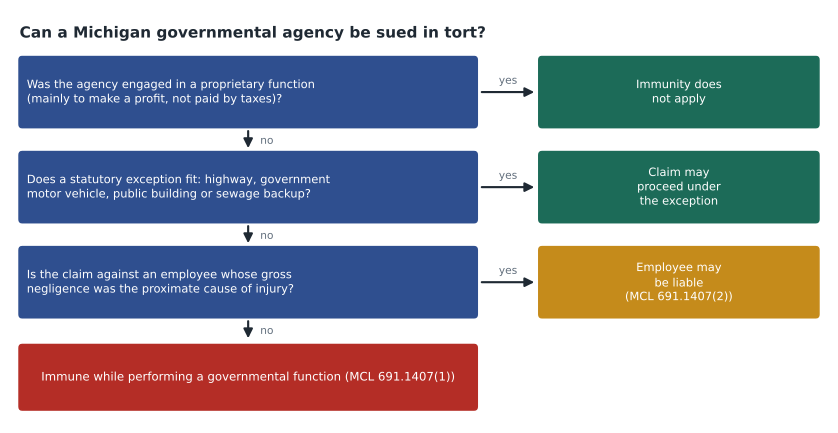
The Governmental Tort Liability Act, MCL 691.1401 and following, is the starting point for any claim against the state, a county, a city, a township, a school district or another governmental agency. Section 7 of the act, MCL 691.1407, states the general rule: a governmental agency is immune from tort liability when it is engaged in the exercise or discharge of a governmental function, except as the act provides.
The act then provides a short list of exceptions. The highway exception makes agencies with jurisdiction over a highway liable for failing to keep it in reasonable repair, subject to notice requirements and limits on what counts as the improved portion of the highway. The motor vehicle exception makes agencies liable for negligent operation of a government-owned motor vehicle by an employee. The public building exception covers dangerous or defective conditions of public buildings. The proprietary function exception applies when the agency was engaged in an activity conducted primarily to produce a profit, other than one normally supported by taxes or fees. There is also an exception for sewage disposal system events, and a separate rule for government hospitals and medical care.
Individual officers and employees have a separate immunity under MCL 691.1407(2). An employee acting within the scope of authority while the agency is engaged in a governmental function is immune from tort liability unless the employee's conduct amounts to gross negligence that is the proximate cause of the injury. The statute defines gross negligence as conduct so reckless that it demonstrates a substantial lack of concern for whether an injury results, and the Michigan Supreme Court has read 'the proximate cause' to mean the most immediate, efficient and direct cause, not merely one of several causes. Intentional torts are governed by the law as it stood before the 1986 amendments. Judges, legislators and the highest elective or appointive executive officials are absolutely immune when acting within their authority.
The act also has strict notice rules. A claim under the highway exception requires written notice to the agency within 120 days after the injury, describing the exact location and nature of the defect, the injury and the names of known witnesses. Failure to give proper notice can defeat an otherwise valid claim, which is why the cyclist's file on Nolan's desk needed attention the day it came in.
No-fault automobile insurance
Michigan has had a no-fault automobile insurance system since 1973, and it remains one of the most distinctive features of Michigan law. Every owner of a registered vehicle must carry personal protection insurance, called PIP, property protection insurance, and residual liability insurance. When a person is injured in a motor vehicle accident, PIP benefits are paid by the injured person's own insurer, or by another insurer under a priority system, regardless of fault.
PIP benefits cover allowable expenses for reasonably necessary care, recovery and rehabilitation; work loss for up to three years, subject to a monthly maximum; and replacement services. In exchange, the no-fault act limits tort suits. An injured person can sue a negligent driver for noneconomic damages only if the injury caused death, serious impairment of body function or permanent serious disfigurement, and for economic losses only to the extent they exceed PIP benefits and statutory limits. The Michigan Supreme Court's 2010 decision in McCormick v. Carrier interpreted serious impairment of body function to mean an objectively manifested impairment of an important body function that affects the person's general ability to lead his or her normal life.
The 2019 reform
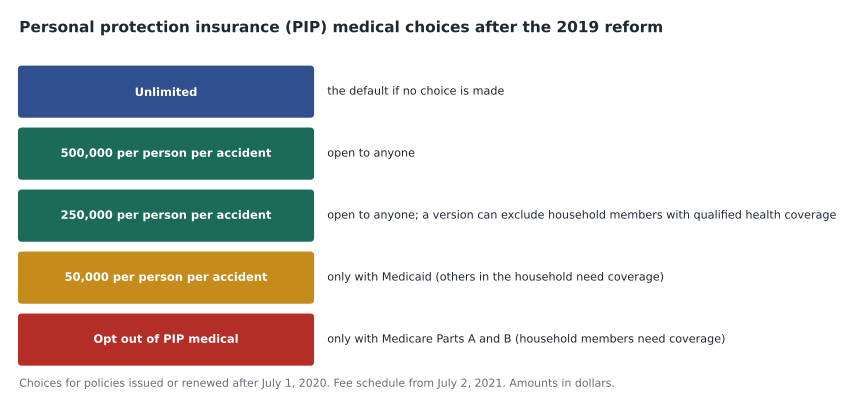
On May 30, 2019, Governor Whitmer signed Public Acts 21 and 22 of 2019, the most significant changes to the no-fault system since its creation. The central change is choice. Before the reform, every policy provided unlimited lifetime PIP medical benefits. For policies issued or renewed after July 1, 2020, drivers choose a PIP medical limit. The choices are unlimited coverage, which remains the default if no choice is made; 500,000 dollars per person per accident; 250,000 dollars per person per accident, with an option to exclude household members who have qualifying health coverage; 50,000 dollars, available only to people enrolled in Medicaid; and a complete opt-out of PIP medical coverage, available only to people with Medicare Parts A and B, where other household members have qualifying coverage.
The reform also changed what providers can charge and how much care is covered. A statutory fee schedule took effect for treatment rendered after July 1, 2021, tying many charges to a percentage of what Medicare pays. Family-provided attendant care, the care given at home by relatives, was capped at 56 hours per week. The reform raised the mini-tort limit, the amount an owner can recover from an at-fault driver for vehicle damage not covered by insurance, to 3,000 dollars for accidents after July 1, 2020, and it changed default residual liability limits, utilization review and anti-fraud rules.
Andary: the reform is not retroactive
The fee schedule and attendant care limits raised an obvious question for people injured before the reform, some of whom had relied on unlimited care for years. In Andary v. USAA Casualty Insurance Co., decided July 31, 2023, the Michigan Supreme Court held by a 5-2 vote that the 2019 amendments do not apply retroactively to people injured before the reform took effect on June 11, 2019. Those claimants keep the benefits that applied under the law in force when they were injured. The court also rejected a constitutional challenge to the fee schedule as applied to people injured after the reform. Two justices dissented.
Worked problem
Three files, three frameworks
Nolan reviews the firm's three new files. The car crash client was injured in October 2026 and has a 250,000-dollar PIP policy. The cyclist hit a pothole on a city street in September 2026. The shopper fell over a pallet in a store aisle in August 2026. What is the first Michigan question in each file?
Show solution
- Car crash: PIP pays medical expenses up to the 250,000-dollar limit chosen under the 2019 reform, under the fee schedule. A tort suit for noneconomic damages requires a threshold injury, such as serious impairment of body function under McCormick. Andary does not help, because the injury is after June 11, 2019.
- Cyclist: the city is immune unless an exception applies. The highway exception may fit a pothole in the improved portion of a city street, but written notice is due within 120 days of the September 2026 injury, so the firm must confirm notice went out by January 2027.
- Shopper: after Kandil-Elsayed, the store owed a duty of reasonable care even if the pallet was open and obvious. Obviousness goes to breach and comparative fault. If the jury finds her more at fault than the store, she loses noneconomic damages under MCL 600.2959 but still recovers reduced economic damages.
Answer: No-fault thresholds and PIP limits, governmental immunity and notice, and comparative fault after Kandil-Elsayed: three Michigan frameworks that the MBE never tests.
Common mistakes
MistakeMichigan bars all recovery when the plaintiff is more than 50 percent at fault.
InsteadOnly noneconomic damages are barred; economic damages are reduced by the plaintiff's share.
MistakeAn open and obvious hazard means the landowner owed no duty.
InsteadSince Kandil-Elsayed (2023), obviousness goes to breach and comparative fault, not duty.
MistakeGovernmental employees are always immune for anything done at work.
InsteadEmployees lose immunity for gross negligence that is the proximate cause of the injury.
MistakeAll Michigan drivers still have unlimited PIP medical coverage.
InsteadSince July 2, 2020, drivers choose a limit; unlimited is only the default.
MistakeThe 2019 fee schedule and attendant care cap apply to everyone injured in a car crash.
InsteadAndary (2023) held they do not apply to people injured before June 11, 2019.
No-fault deadlines and priority
Two more no-fault rules show up in almost every Michigan PIP file. The first is the one-year rule in MCL 500.3145. A claim for PIP benefits must generally be started within one year after the accident unless written notice of injury was given to the insurer within that year or the insurer has already paid benefits. Even then, the claimant can recover benefits only for losses incurred within one year before the suit was filed, a limit known as the one-year-back rule. The 2019 reform added tolling: the one-year-back period is tolled from the time a specific claim is made until the insurer formally denies it. A new lawyer who opens a PIP file should send written notice to the insurer at once and calendar the one-year dates.
The second is priority. Michigan's no-fault act sets an order for which insurer pays. In general, an injured person first looks to a policy in his or her own name, then to a policy of a spouse or a relative living in the same household, then to policies covering the vehicle involved, and finally, if no policy applies, to the Michigan Assigned Claims Plan, which assigns the claim to an insurer. Priority disputes between insurers are common, and the order matters because each insurer's policy carries its own PIP medical limit after the 2019 reform. An injured passenger whose own household has a 250,000-dollar policy may be limited to that amount even if the driver's policy is unlimited.
Marchetti closed the session with her usual warning. 'All of this is Michigan practice,' she said. 'If an MEE question asks about a car accident, apply the general negligence principles the question calls for, discuss comparative fault the way the question frames it, and leave no-fault, PIP and the governmental immunity act for your Monday morning at the firm.'
Summary and key terms
- MCL 600.2959 reduces all damages by the plaintiff's fault and bars noneconomic damages only when the plaintiff's fault exceeds everyone else's combined.
- Joint and several liability was largely abolished in 1995; noneconomic damages caps apply in medical malpractice and product liability and are adjusted annually.
- Kandil-Elsayed (2023) moved the open and obvious doctrine from duty to breach and comparative fault.
- The GTLA grants immunity for governmental functions, with highway, motor vehicle, public building, proprietary function and sewage exceptions; employees are liable for gross negligence that is the proximate cause.
- No-fault PIP pays regardless of fault; tort suits for noneconomic damages require death, serious impairment of body function or permanent serious disfigurement.
- The 2019 reform created PIP medical choices, a fee schedule from July 2, 2021, a 56-hour weekly cap on family attendant care and a 3,000-dollar mini-tort; Andary (July 31, 2023, 5-2) held it is not retroactive.
- 0
- modified comparative fault
- 1
- noneconomic damages
- 2
- open and obvious
- 3
- governmental function
- 4
- gross negligence
- 5
- PIP
- 6
- serious impairment of body function
- 7
- mini-tort
Practice problems
Work each problem on paper first, then reveal the answer to check.
A plaintiff is found 60 percent at fault, with 50,000 dollars in economic and 50,000 dollars in noneconomic damages. What does she recover?
Show answer
20,000 dollars: economic damages reduced by 60 percent, and no noneconomic damages because her fault exceeds the others' combined.
Within what period must notice of a highway defect claim be given?
Show answer
120 days after the injury.
What did Andary v. USAA decide?
Show answer
That the 2019 no-fault amendments, including the fee schedule and attendant care cap, do not apply to people injured before June 11, 2019.
Which PIP medical choice is available only to people with Medicare Parts A and B?
Show answer
The opt-out of PIP medical coverage.
Lesson quiz · 5 questions
Score 60% or more to complete this lesson.
Create a free account to save your progress, take quizzes and earn a certificate.