
BAR-247 · Lesson 6 of 12 · 20 min
The Virginia law component: what the Virginia Essay tests
▶ Video coming soon A video version of this lesson is on the way.
Linwood Ruffin keeps a binder of old Virginia bar essays on a shelf behind his desk, some of them older than Peyton. When she asked to borrow it, he handed it over with a warning. 'Half of these are on subjects they don't test anymore, and some of the law has changed,' he said. 'But read them anyway. You'll see the same thing over and over: a fact pattern that looks like an ordinary case, and the answer turns on a Virginia rule that the national outlines get wrong.' Marchetti, when Peyton told her about the binder, agreed and added a filter. 'Use the Board's current subject list,' she said. 'Then for every subject, make a short list of the places where Virginia parts ways with the MBE. That list is worth more than any outline.'
This lesson sets out the subjects the Virginia Essay currently tests, explains how Virginia essays are built and graded, and highlights the most important places where Virginia law differs from the general rules tested on the MBE. Lessons 7 through 10 then go deeper into four areas that appear on almost every Virginia exam.
The current subject list
Section I.B of the Rules of the Board lists the subjects that may be tested on the Virginia Essay. As of the July 2025 amendments, they are contracts; creditors' rights; criminal law; domestic relations; evidence; local government law; real property; sales under UCC Article 2; secured transactions under UCC Article 9A; torts; Virginia civil and criminal procedure, including appellate practice; wills, trusts and estates; and professional responsibility. The Board removed four subjects effective with the July 2025 exam: business organizations, federal practice and procedure, negotiable instruments under UCC Article 3, and personal property.
Three features of the list stand out. First, it includes subjects that the MEE no longer tests, such as secured transactions and wills, trusts and estates, so a Virginia candidate cannot rely on national MEE materials to decide what to study. Second, it includes subjects that few other jurisdictions test at all, such as local government law and creditors' rights. Third, Virginia civil and criminal procedure is a subject in its own right, and it shows up as a secondary issue in many essays on other subjects. A tort essay often ends with a question about the right response to a defective pleading or the effect of a nonsuit.
| Virginia Essay subject | Typical Virginia focus | Also on the planned NextGen Virginia component? |
|---|---|---|
| Contracts | Formation, defenses, remedies, with Virginia statutes such as the statute of frauds | No |
| Creditors' rights | Judgments, liens, garnishment, exemptions | No |
| Criminal law | Virginia crimes and defenses; larceny thresholds | Yes, as Virginia criminal law and procedure |
| Domestic relations | Divorce grounds, equitable distribution, support, custody | Yes |
| Evidence | The Virginia Rules of Evidence and their differences from the federal rules | Yes |
| Local government law | The Dillon Rule, powers of counties, cities and towns | No |
| Real property | Conveyancing, recording, tenancy by the entirety, landlord and tenant | No |
| Sales (UCC Article 2) | Formation, warranties, risk of loss, remedies | No |
| Secured transactions (UCC Article 9A) | Attachment, perfection, priority, default | No |
| Torts | Contributory negligence, immunities, damages caps | Yes |
| Virginia civil and criminal procedure | Pleadings, demurrers, pleas in bar, nonsuits, appeals | Yes |
| Wills, trusts and estates | Execution, holographic wills, intestacy, the augmented estate | Yes |
| Professional responsibility | The Virginia Rules of Professional Conduct | No |
How a Virginia essay is built
A typical Virginia essay is a page or less of facts followed by one or more numbered questions. The facts are concrete: names, dates, dollar amounts, the county or city where something happened, and what a party did or failed to do. The questions are often precise, such as 'What defenses can the defendant raise, and how should the court rule on each?' or 'Is the will valid, and who takes the estate?' Some questions ask for the proper procedural step: 'What pleading should the defendant file, and how should the court rule?'
Because the questions are precise, a good Virginia answer is precise too. It answers each question in order, under a short heading that repeats the question. It names the Virginia rule in a sentence and, where it matters, signals that the rule is Virginia's: 'Virginia follows the doctrine of contributory negligence, under which...' It applies the rule to the facts with specific references to the facts, and it reaches a conclusion. Graders look for the issue, the rule, the analysis and the conclusion. They do not reward long recitations of general principles that the question did not ask about.
The two-day trap
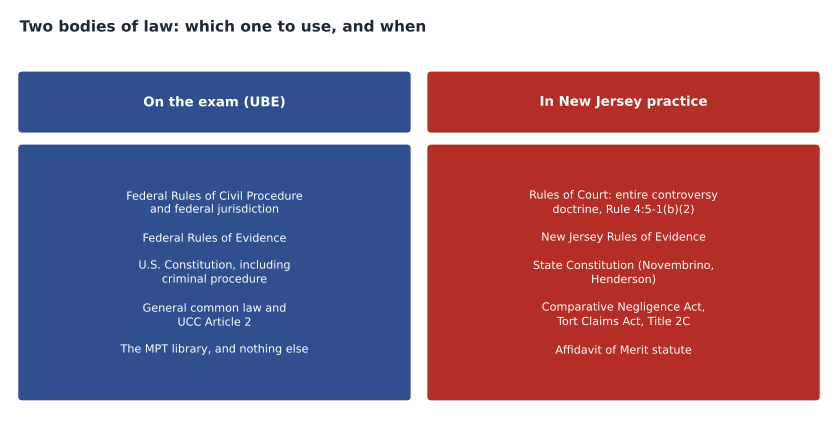
The biggest risk on the Virginia exam is answering one day with the other day's law. The MBE tests general principles and the federal rules. The Virginia Essay tests Virginia law. In many areas they agree. Where they do not, a candidate who has spent weeks drilling MBE questions will tend to write the MBE rule on Tuesday, and a candidate who has just spent a day on Virginia law may hesitate over a Wednesday question.
Marchetti's solution is a one-page list of Virginia differences that Peyton reviews the evening before the exam and again on Tuesday morning. It is not a full outline. It is a list of traps. The table below shows the kind of entries it contains; lessons 7 through 10 explain each one in more detail.
| Area | Virginia rule (Virginia Essay) | General rule (MBE) |
|---|---|---|
| Negligence defense | Contributory negligence is a complete bar, subject to last clear chance | Comparative negligence unless the question says otherwise |
| Evidence source | The Virginia Rules of Evidence in Part Two of the Rules of the Supreme Court, plus Virginia statutes | The Federal Rules of Evidence |
| Civil procedure | Virginia pleadings: complaint, demurrer, plea in bar, motion to strike, the statutory nonsuit | The Federal Rules of Civil Procedure |
| Claims against the state | Virginia Tort Claims Act with a 100,000 dollar cap or the insurance limit, and strict notice rules | Not tested as Virginia law |
| Charities | Charitable immunity protects charities from negligence claims by beneficiaries | Charitable immunity generally abolished |
| Wills | Holographic wills valid if wholly handwritten and signed, proved by two disinterested witnesses | Depends on the jurisdiction; not a Virginia question |
| Surviving spouse | Elective share of 50 percent of the marital-property portion of the augmented estate | Not tested on the MBE |
| Local government | Dillon Rule: localities have only the powers granted or necessarily implied | Not tested on the MBE |
The Virginia Rules of Evidence
Evidence is a good example of the two-day trap. Virginia's evidence law is collected in the Virginia Rules of Evidence, which appear in Part Two of the Rules of the Supreme Court of Virginia, together with evidence statutes in the Code of Virginia. Many Virginia rules track the federal rules closely, and the numbering follows a similar pattern, but there are differences in hearsay exceptions, character evidence and expert testimony, and some rules codify earlier Virginia case law rather than the federal approach. On the MBE, answer with the Federal Rules of Evidence. On the Virginia Essay, answer with the Virginia Rules and say so.
Local government law and the Dillon Rule
Local government law is a distinctively Virginia subject. Virginia follows the Dillon Rule, a principle of construction under which counties, cities and towns have only the powers that the General Assembly has expressly granted them, those necessarily or fairly implied from express powers, and those essential to their declared purposes. When a locality's power to act is doubtful, the doubt is resolved against the locality. A typical essay asks whether a county had authority to adopt an ordinance, impose a fee or enter a contract. The answer starts with the Dillon Rule and then looks for an express grant in the Code of Virginia or the locality's charter.
Virginia's independent cities are another local feature. In Virginia, a city is not part of a county; it is a separate political subdivision. Towns, by contrast, sit within counties. That structure affects which courts hear a case, which locality must receive notice of a claim and which government body can be sued.
Creditors' rights
Creditors' rights covers how a judgment creditor collects and what a debtor can protect. Typical issues include docketing a judgment so that it becomes a lien on the debtor's real estate in the locality where it is docketed, garnishment of wages and bank accounts, the exemptions available to individual debtors, and the interaction between Virginia remedies and federal bankruptcy. Exact exemption amounts change over time; on the exam, state the rule accurately and apply it, and in practice check the current statute.
Criminal law and procedure
Virginia criminal law questions test Virginia's own crimes and defenses. Two recent changes come up often. Virginia abolished the death penalty in legislation signed on March 24, 2021. And Virginia changed its long-standing practice of jury sentencing: under legislation approved in November 2020 and effective July 1, 2021, the court fixes the punishment in a criminal case unless the accused asks for the jury to do so; if a jury that has been asked cannot agree, the court sentences. Virginia also raised the threshold for grand larceny to 1,000 dollars in 2020. Virginia criminal procedure covers matters such as preliminary hearings in general district court, indictment in circuit court and appeals.
Professional responsibility
Professional responsibility appears on the Virginia Essay as Virginia law. That means the Virginia Rules of Professional Conduct, which differ from the ABA Model Rules that the MPRE tests. The most important differences, covered in lesson 10, include Virginia's mandatory disclosure rule for a client's stated intention to commit certain crimes, including crimes that will cause substantial financial injury, and Virginia's express ban on threatening criminal or disciplinary charges solely to gain an advantage in a civil matter. Ethics issues often appear as a final question in an essay on another subject: after the facts of a car accident, the last question asks whether the lawyer may accept the case or how the lawyer should handle a settlement check.
Studying for the essay day
Marchetti gave Peyton a weekly pattern for the ten weeks before the February exam. Each week she writes at least four full Virginia essays under timed conditions, compares each with a model answer, and adds any missed rule to her trap list. She rotates subjects so that every subject on the current list appears at least twice before the exam, with extra time for the subjects that appear most often: torts, domestic relations, wills, trusts and estates, real property and Virginia procedure. She also reads Virginia rules aloud, because the essay day rewards stating the rule in one clean sentence.
Worked problem
Spotting the Virginia issue
A driver, Arliss Mattox, ran a red light in Lynchburg and struck a pedestrian, Delmar Langhorne, who was crossing against a 'Don't Walk' signal while looking at his phone. Langhorne sued for 200,000 dollars in the Circuit Court of the City of Lynchburg. Mattox's lawyer wants to know the best defense. Outline the Virginia answer.
Show solution
- Issue: whether Langhorne's own negligence bars recovery.
- Rule: Virginia follows contributory negligence; a plaintiff whose negligence was a proximate cause of the injury cannot recover, subject to the last clear chance doctrine.
- Apply: crossing against the signal while looking at a phone is likely negligence that contributed to the collision.
- Counter: Langhorne may argue last clear chance if Mattox saw, or should have seen, that he was inattentive and had time to avoid him. Mattox ran the light, which cuts against any argument that he had a clear opportunity to stop.
- Procedure: contributory negligence is an affirmative defense that the defendant must plead and prove; the issue usually goes to the jury unless reasonable people could not differ.
Answer: The Virginia answer leads with contributory negligence. An MBE-trained candidate who writes about reducing Langhorne's damages by his percentage of fault has missed the point of the question.
Common mistakes
MistakeOld Virginia essays on business organizations are good practice.
InsteadBusiness organizations, federal practice and procedure, UCC Article 3 and personal property were removed effective July 2025.
MistakeSecured transactions are off the Virginia exam because the MEE dropped them.
InsteadSecured transactions under UCC Article 9A remain on the Virginia Essay subject list.
MistakeWrite the Federal Rules of Evidence on Tuesday.
InsteadThe Virginia Essay tests the Virginia Rules of Evidence; the MBE tests the federal rules.
MistakeA county can do anything not forbidden by state law.
InsteadUnder the Dillon Rule, a locality has only the powers granted, necessarily implied or essential; doubts are resolved against the locality.
MistakeA Virginia city is part of the surrounding county.
InsteadVirginia cities are independent of counties; towns sit within counties.
Summary and key terms
- The Virginia Essay tests contracts, creditors' rights, criminal law, domestic relations, evidence, local government law, real property, UCC Articles 2 and 9A, torts, Virginia civil and criminal procedure, wills, trusts and estates, and professional responsibility.
- Business organizations, federal practice and procedure, UCC Article 3 and personal property were removed effective July 2025.
- Good Virginia answers are precise: each question answered in order, with the Virginia rule stated and applied.
- The two-day trap: answer Tuesday with Virginia law and Wednesday with general and federal law; keep a one-page list of Virginia differences.
- Virginia follows the Dillon Rule for local governments and has independent cities.
- Recent criminal law changes include the 2021 abolition of the death penalty, jury sentencing only on the accused's request, and a 1,000 dollar grand larceny threshold.
- 0
- Virginia Essay
- 1
- Dillon Rule
- 2
- independent city
- 3
- Virginia Rules of Evidence
- 4
- creditors' rights
- 5
- docketed judgment
- 6
- jury sentencing
- 7
- two-day trap
Practice problems
Work each problem on paper first, then reveal the answer to check.
Name four subjects removed from the Virginia Essay in July 2025.
Show answer
Business organizations, federal practice and procedure, UCC Article 3 (negotiable instruments) and personal property.
What is the Dillon Rule?
Show answer
A rule of construction under which Virginia localities have only the powers expressly granted, necessarily or fairly implied, or essential to their purposes; doubts are resolved against the locality.
Which evidence rules apply on the Virginia Essay?
Show answer
The Virginia Rules of Evidence, in Part Two of the Rules of the Supreme Court of Virginia, plus Virginia statutes.
Does a Virginia jury still fix the sentence after every jury trial?
Show answer
No. Since July 1, 2021, the court sentences unless the accused asks for jury sentencing.
Lesson quiz · 5 questions
Score 60% or more to complete this lesson.
Create a free account to save your progress, take quizzes and earn a certificate.