
BAR-247 · Lesson 9 of 12 · 24 min
Virginia family law, wills and estates
▶ Video coming soon A video version of this lesson is on the way.
Two files landed on Peyton's desk at Ruffin & Gatewood on the same Monday. One was a divorce: Jessamine Thornell, married eleven years, separated since spring, with two children and a house titled in both names that her husband says is his because he paid the down payment with money he inherited. The other was an estate: an elderly client of the firm, Ocie Dunnavant, had died in October, and her family found a two-page document in her kitchen drawer, entirely in her handwriting, signed at the bottom, leaving her farm to a neighbor. The family wanted to know whether a handwritten paper could possibly override the typed will she had signed at the firm years earlier. 'Both of these are classic Virginia essay facts,' Marchetti said when Peyton described them. 'Learn them as if the exam depends on it, because it might.'
This lesson covers the Virginia family and estates rules that the Virginia Essay tests most often: the grounds for divorce, equitable distribution under section 20-107.3, support and custody in outline, the execution of wills including holographic wills, intestate succession, and the surviving spouse's elective share of the augmented estate. Domestic relations and wills, trusts and estates are both on the current Virginia Essay and on the planned Virginia component of the NextGen exam.
Grounds for divorce
Virginia distinguishes between a divorce from the bond of matrimony, which ends the marriage, and a divorce from bed and board, which is a legal separation. The grounds for a divorce from the bond of matrimony are in section 20-91(A) of the Code of Virginia. Several older subdivisions have been repealed, and the ones that remain are:
Adultery, or sodomy or buggery committed outside the marriage, under subdivision 1. The adultery must have occurred before the last separation. Conviction of a felony after the marriage, with a sentence of more than one year of confinement and actual confinement, under subdivision 3, provided cohabitation was not resumed after knowledge of the confinement. Cruelty, causing reasonable apprehension of bodily hurt, or willful desertion or abandonment, under subdivision 6, in which case the innocent party may obtain a divorce one year after the act. And separation, under subdivision 9(a): either party may apply after the parties have lived separate and apart without cohabitation and without interruption for one year. The period is six months if the parties have entered into a separation agreement and have no minor children, meaning no minor children born of the parties, born to either and adopted by the other, or adopted by both.
Virginia requires the grounds for divorce to be corroborated, so even an uncontested no-fault divorce needs evidence beyond the parties' own testimony, often an affidavit or testimony from a friend or relative who knows that the parties have lived apart. On an essay about Jessamine Thornell's case, the separation ground is available after one year of separation because the couple has minor children; the six-month period is not available to them even with a signed agreement.

Equitable distribution: classification
Virginia is an equitable distribution state. Under section 20-107.3, on the request of either party, the court determines the legal title, ownership and value of the parties' property and the nature of their debts, classifies the property as separate, marital or part separate and part marital, and then decides whether and how to divide or transfer jointly owned marital property and whether to grant a monetary award.
Separate property is property a party owned before the marriage; property acquired during the marriage by inheritance or by gift from someone other than the spouse; property acquired during the marriage in exchange for separate property, if kept separate; and the separate part of hybrid property. Income from separate property and increases in its value are separate, except to the extent that marital property or the significant personal efforts of either party contributed to them.
Marital property is property titled in both parties' names, unless the hybrid rules apply; the marital part of hybrid property; and all other property acquired by either party during the marriage that is not separate. Property acquired during the marriage and before the last separation is presumed to be marital unless there is satisfactory evidence that it is separate. Debts follow similar rules: a debt incurred in either name during the marriage and before the last separation is presumed marital, while a debt incurred before the marriage, or by one party after the last separation when at least one party intended the separation to be permanent, is presumed separate.
Hybrid property is part separate and part marital. Examples in the statute include separate property whose value increased because of marital contributions or significant personal effort, retirement and pension benefits to the extent of the marital share, and personal injury or workers' compensation recoveries to the extent they compensate for lost wages and medical expenses during the marriage. The burden shifts in a hybrid claim. The non-owning spouse must prove that marital contributions or personal effort were made and that the separate property increased in value; the owning spouse must then prove that some or all of the increase was not caused by those contributions.
Tracing, commingling and retitling
The statute's tracing rules decide many cases. When property of one classification is contributed to property of another and loses its identity, it generally takes the classification of the receiving property. When marital and separate property are commingled into new property and identity is lost, the result is generally marital. When separate property is retitled in the joint names of the parties, it generally becomes marital. But contributed property keeps its original classification to the extent it can be traced by a preponderance of the evidence and was not a gift. And the statute says that no presumption of gift arises from commingling with jointly owned property, from conveying new property into joint ownership or from retitling existing property into joint ownership.
Apply that to the Thornell house. The house is titled in both names, so it is presumed marital. Mr. Thornell can try to retrace his inherited down payment. If he can trace the inherited money into the house by a preponderance of the evidence, and the down payment was not a gift to the marriage, the traceable separate contribution keeps its separate character, making the house hybrid property, and the statute provides for reimbursement of traceable separate contributions. The appreciation and the mortgage paid down with marital earnings during eleven years of marriage are marital. The outcome turns on records: bank statements showing the inheritance going into the closing.
Equitable distribution: division and the monetary award
Once property is classified and valued, the court may divide or transfer jointly owned marital property and apportion jointly owed marital debt, and it may grant a monetary award to either party, payable in a lump sum or installments. Property is valued as of the date of the evidentiary hearing and debts as of the date of separation, with adjustments, unless the court sets a different date on a motion filed at least 21 days before the hearing for good cause. A monetary award is a judgment that can be enforced like any money judgment.
Pensions, deferred compensation and retirement benefits get special treatment. The court may direct payment of a percentage of the marital share, but the payment may not exceed 50 percent of the marital share of the cash benefits actually received by the party against whom the award is made.
In deciding how to divide, the court considers the factors in subsection E. There are eleven: each party's monetary and nonmonetary contributions to the well-being of the family; each party's contributions to acquiring, caring for and maintaining marital property; the duration of the marriage; the parties' ages and physical and mental condition; the circumstances that contributed to the dissolution, including specified fault grounds; how and when specific items of marital property were acquired; each party's debts and liabilities and the property securing them; the liquid or nonliquid character of the marital property; the tax consequences to each party; any use of marital property for a nonmarital purpose or its dissipation in anticipation of divorce or after separation; and any other factors the court considers necessary for a fair and equitable result. Virginia does not start from a presumption of equal division.
| Item in the Thornell case | Likely classification | Why |
|---|---|---|
| House titled jointly, bought during the marriage | Hybrid if the inherited down payment can be traced; otherwise marital | Joint title creates a marital presumption; traceable separate contributions keep their character |
| Husband's inheritance still in his own account | Separate | Inheritance kept separate |
| Wife's 401(k) contributions during the marriage | Marital share | Retirement benefits are hybrid to the extent of the marital share |
| Credit card debt in husband's name for family expenses | Presumed marital | Incurred in either name during the marriage before separation |
| Car bought by wife after separation with her post-separation pay | Likely separate | Acquired after the last separation, outside the marital presumption |
Support and custody in outline
Spousal support is governed by section 20-107.1. The court considers a list of statutory factors, including the parties' needs and resources, the standard of living during the marriage, the duration of the marriage, contributions to the family and the circumstances that led to the divorce, and it may award periodic support for a defined or undefined duration, a lump sum, or both. Adultery by the spouse seeking support is generally a bar, subject to a statutory exception where denial would be a manifest injustice. Child support is calculated under the guidelines in section 20-108.2, which use the parents' combined incomes, and a court that departs from the guideline amount must explain why. Custody and visitation are decided by the best interests of the child under the factors in section 20-124.3. Exact figures and thresholds change; an essay answer should state the framework and apply the facts.
Executing a will
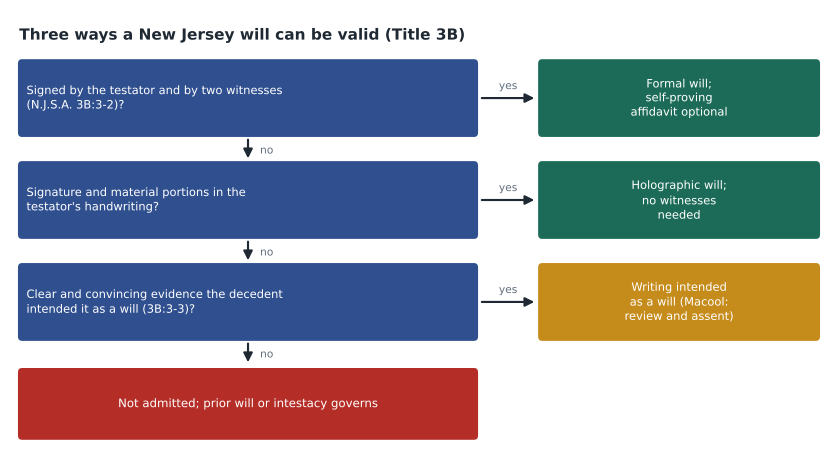
The formal requirements for a Virginia will are in section 64.2-403. A will must be in writing and signed by the testator, or by another person in the testator's presence and at the testator's direction, in a manner that makes it clear that the name is intended as a signature. The statute does not say where on the document the signature must appear.
A will that is not wholly in the testator's handwriting is valid only if the testator signs or acknowledges it in the presence of at least two competent witnesses, present at the same time, who then sign in the testator's presence. No particular form of attestation clause is required. A self-proving affidavit, signed before a notary, makes probate easier but is not a validity requirement.
A holographic will is different. Under section 64.2-403(B), a will wholly in the testator's handwriting and signed by the testator is valid without further requirements, such as witnesses, but at probate its handwriting and signature must be proved by at least two disinterested witnesses. The witnesses at probate are not attesting witnesses; they are people who can identify the testator's handwriting.
Virginia also has a harmless error statute, section 64.2-404, under which a writing that was not executed in compliance with section 64.2-403 may still be treated as valid if the proponent establishes by clear and convincing evidence that the decedent intended the document to be the decedent's will. The statute is applied cautiously, and it is a fallback, not a substitute for proper execution.
For Ocie Dunnavant's kitchen-drawer document, the analysis runs in order. Is it wholly in her handwriting and signed? If so, it is a valid holographic will if two disinterested witnesses can prove her handwriting and signature. Was it intended as a will, rather than notes or a draft? A document that says 'I leave my farm to' and is signed reads as testamentary. Does it revoke the earlier typed will? A later will revokes an earlier one to the extent of inconsistency, so the farm passes under the holographic will and the rest of the estate passes under the typed will, unless the later document revokes the earlier one entirely.
Intestate succession
When a Virginia decedent dies without a valid will, section 64.2-200 directs the estate. The surviving spouse takes the whole estate if the decedent left no children or descendants, or if all of the decedent's children and descendants are also children or descendants of the surviving spouse. If the decedent left children or descendants who are not also the surviving spouse's, the surviving spouse takes one-third and the children and descendants take two-thirds. If there is no surviving spouse, the estate passes to the decedent's children and their descendants, then to parents, then to siblings and their descendants, and then to more remote relatives under the statute.
The augmented estate and the elective share
A surviving spouse who is unhappy with what the will provides may claim an elective share. Virginia overhauled its elective share law in 2017 and now uses an augmented estate modeled on the Uniform Probate Code. Under section 64.2-308.3, the surviving spouse of a decedent domiciled in Virginia may elect to take an amount equal to 50 percent of the value of the marital-property portion of the augmented estate. The homestead allowance, exempt property and family allowance are paid in addition.
The augmented estate, under section 64.2-308.4, includes the decedent's net probate estate, the decedent's nonprobate transfers to others, the decedent's nonprobate transfers to the surviving spouse, and the surviving spouse's own property and nonprobate transfers to others. The marital-property portion is a percentage of the augmented estate that depends on the length of the marriage. It starts at 3 percent for a marriage of less than one year, rises by steps of 6 percent a year for the first ten years and 8 percent a year after that, and reaches 100 percent for a marriage of fifteen years or more. The structure means that a spouse in a short second marriage gets much less than a spouse of many decades.
The deadlines are short. The election must be made in a writing recorded with the court no later than six months after the later of the will's admission to probate or the qualification of an administrator, and a complaint must be filed no later than six months after the election. Nonprobate transfers are excluded from the calculation if the complaint is filed more than twelve months after the decedent's death.
| Years of marriage | Marital-property portion of the augmented estate | Elective share as a share of the augmented estate |
|---|---|---|
| Less than 1 | 3 percent | 1.5 percent |
| 5 to 6 | 30 percent | 15 percent |
| 10 to 11 | 60 percent | 30 percent |
| 14 to 15 | 92 percent | 46 percent |
| 15 or more | 100 percent | 50 percent |
Worked problem
A widow's election
Yancey Wrenn died in Roanoke on August 3, 2026, after twelve and a half years of marriage to his second wife, Coleta. His will, admitted to probate on September 1, 2026, leaves everything to his children from his first marriage. Suppose the augmented estate is worth 1,000,000 dollars. What can Coleta claim, and by when?
Show solution
- Schedule: a marriage of twelve to thirteen years gives a marital-property portion of 76 percent of the augmented estate.
- Marital-property portion: 76 percent of 1,000,000 dollars is 760,000 dollars.
- Elective share: 50 percent of 760,000 dollars is 380,000 dollars, plus any homestead allowance, exempt property and family allowance.
- Deadline to elect: six months after the will was admitted to probate, so by March 1, 2027.
- Deadline to sue: a complaint within six months after the election, and within twelve months of death (by August 3, 2027) if nonprobate transfers are to count.
Answer: Coleta can claim about 380,000 dollars, but only if she records her election by March 1, 2027, and files her complaint in time. Missing the deadline forfeits the claim.
Common mistakes
MistakeA couple with minor children can divorce after six months of separation if they sign an agreement.
InsteadThe six-month period requires a separation agreement and no minor children; with minor children the period is one year.
MistakeJointly titled property is always marital.
InsteadJoint title creates a presumption, but traceable separate contributions keep their character, and no presumption of gift arises from retitling.
MistakeVirginia divides marital property equally.
InsteadVirginia has no presumption of equal division; the court applies the eleven factors in section 20-107.3(E).
MistakeA holographic will needs two attesting witnesses.
InsteadA will wholly in the testator's handwriting and signed needs no attesting witnesses; two disinterested witnesses must prove the handwriting at probate.
MistakeA surviving spouse always gets one-third of the estate.
InsteadThe elective share is 50 percent of the marital-property portion of the augmented estate, which depends on the length of the marriage.
Summary and key terms
- Section 20-91(A) grounds: adultery before the last separation; a felony with more than a year of confinement; cruelty or desertion (after one year); or separation for one year, or six months with a separation agreement and no minor children. Grounds must be corroborated.
- Section 20-107.3 classifies property as separate, marital or hybrid, with a marital presumption for property acquired during the marriage and tracing rules for commingling and retitling.
- The court may divide jointly owned marital property and grant a monetary award under eleven factors; pension payments may not exceed 50 percent of the marital share.
- A will must be signed; a non-holographic will needs two witnesses present at the same time; a holographic will needs only the testator's handwriting and signature, proved by two disinterested witnesses (section 64.2-403).
- Section 64.2-200 gives a surviving spouse the whole intestate estate unless the decedent had descendants who are not the spouse's, in which case the spouse takes one-third.
- The elective share is 50 percent of the marital-property portion of the augmented estate, which ranges from 3 to 100 percent by length of marriage; elect within six months of probate.
- 0
- divorce from the bond of matrimony
- 1
- divorce from bed and board
- 2
- corroboration
- 3
- equitable distribution
- 4
- hybrid property
- 5
- tracing
- 6
- monetary award
- 7
- holographic will
- 8
- harmless error
- 9
- augmented estate
- 10
- elective share
Practice problems
Work each problem on paper first, then reveal the answer to check.
When can a couple with no minor children and a signed separation agreement file for a no-fault divorce in Virginia?
Show answer
After six months of living separate and apart without cohabitation and without interruption.
What happens when separate property is retitled in joint names?
Show answer
It generally becomes marital, but it keeps its classification to the extent it can be traced and was not a gift; no presumption of gift arises from retitling.
How is a holographic will proved in Virginia?
Show answer
By at least two disinterested witnesses who prove the testator's handwriting and signature.
What is the elective share for a spouse married twenty years?
Show answer
50 percent of the augmented estate, because the marital-property portion is 100 percent after fifteen years.
Lesson quiz · 5 questions
Score 60% or more to complete this lesson.
Create a free account to save your progress, take quizzes and earn a certificate.