
BUS-110 · Lesson 10 of 12 · 34 min
Investment decisions: NPV, IRR and bonds
Businesses constantly decide whether to spend money now in the hope of more money later: buying a machine, opening a store, launching a product, upgrading software or buying another company. These are capital investment decisions, and they are among the most important a business makes, because they commit large sums for years. The compound interest and annuity tools from earlier lessons give a disciplined way to evaluate them: convert every future cash flow to its present value at a rate that reflects the cost of the money and the risk, and see whether the investment creates value. This lesson covers net present value, internal rate of return, payback, and the valuation of bonds, which applies the same ideas to one of the most widely traded investments in the world.
Cash flows and the discount rate
An investment is described by its cash flows: the money paid out and received at each date. By convention, the initial outlay is at time 0 and later cash flows are placed at the end of each year. Only cash matters, not accounting profit, and only incremental cash flows count: the extra cash that happens because the investment is made. Typical cash flows include the purchase price and installation, extra revenue or cost savings, extra operating costs, any extra working capital (which is usually recovered at the end), and the salvage value when the asset is sold or scrapped.
The discount rate is the return the business requires on an investment of that risk, often its cost of capital: the blended rate it pays for its debt and the return its owners expect on their equity. Riskier projects deserve higher discount rates. Choosing the discount rate is a judgment, and it has a large effect on the answer.
Net present value
The net present value (NPV) of an investment is the sum of the present values of all its cash flows, including the negative initial outlay. It measures, in today's dollars, how much value the investment adds above the required return.
The decision rule is simple. If NPV is positive, the investment earns more than the required return and should be accepted. If it is negative, it earns less and should be rejected. If it is zero, it earns exactly the required return.
Worked problem
NPV of a delivery van
A bakery is considering a $60,000 delivery van. It expects the van to save $18,000 in courier fees in year 1, $20,000 in year 2, $22,000 in year 3 and $20,000 in year 4. In year 5 it expects savings of $15,000 plus $8,000 from selling the van, for $23,000 in total. The bakery's required return is 10 %. What is the NPV?
Show solution
- Year 0: −$60,000.
- Year 1: $18,000 ÷ 1.10 = $16,363.64.
- Year 2: $20,000 ÷ 1.10^2 = $16,528.93.
- Year 3: $22,000 ÷ 1.10^3 = $16,528.93.
- Year 4: $20,000 ÷ 1.10^4 = $13,660.27.
- Year 5: $23,000 ÷ 1.10^5 = $14,281.19.
- NPV = −$60,000 + $16,363.64 + $16,528.93 + $16,528.93 + $13,660.27 + $14,281.19 = $17,362.95.
Answer: The NPV is $17,362.95, so the van more than pays for itself at a 10 % required return and should be bought.
| Year | Cash flow | Discount factor at 10 % | Present value | Cumulative cash flow | Cumulative PV |
|---|---|---|---|---|---|
| 0 | −$60,000 | 1.0000 | −$60,000.00 | −$60,000 | −$60,000.00 |
| 1 | $18,000 | 0.9091 | $16,363.64 | −$42,000 | −$43,636.36 |
| 2 | $20,000 | 0.8264 | $16,528.93 | −$22,000 | −$27,107.44 |
| 3 | $22,000 | 0.7513 | $16,528.93 | $0 | −$10,578.51 |
| 4 | $20,000 | 0.6830 | $13,660.27 | $20,000 | $3,081.76 |
| 5 | $23,000 | 0.6209 | $14,281.19 | $43,000 | $17,362.95 |
Internal rate of return
The internal rate of return (IRR) is the discount rate that makes the NPV exactly zero. It is the investment's own rate of return, the compound annual rate that its cash flows earn. If the IRR is above the required return, the NPV is positive and the investment is acceptable.
There is no formula for the IRR when there are more than two cash flows. It is found by trial and error, narrowing in on the rate where NPV changes sign, or with the spreadsheet IRR function or a financial calculator.
Worked problem
IRR of the delivery van
Find the IRR of the delivery van.
Show solution
- At 10 %, NPV = $17,362.95 (positive), so the IRR is higher.
- At 20 %, NPV = −$60,000 + $15,000.00 + $13,888.89 + $12,731.48 + $9,645.06 + $9,243.18 = $508.61 (still slightly positive).
- At 21 %, NPV is slightly negative, so the IRR lies between 20 % and 21 %.
- A spreadsheet gives =IRR(−60000, 18000, 20000, 22000, 20000, 23000) = 20.37 %.
Answer: The van earns about 20.37 % a year, well above the 10 % required return.
When NPV and IRR disagree
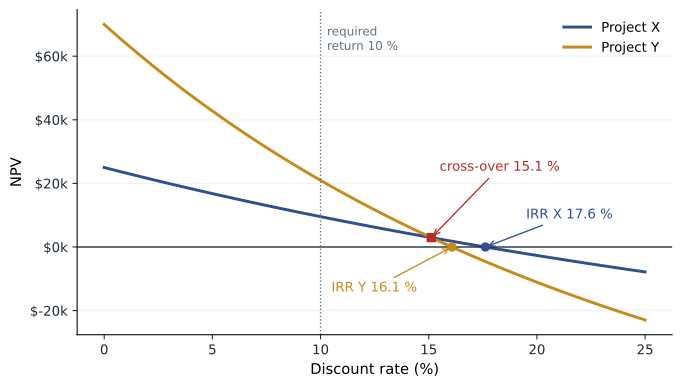
For a single, ordinary investment (an outlay followed by inflows), NPV and IRR always give the same accept or reject decision. They can rank mutually exclusive projects differently, however, when the projects differ in size or in the timing of their cash flows. When they conflict, NPV is the better guide, because it measures the value added in dollars at the business's actual required return. IRR implicitly assumes that cash flows can be reinvested at the IRR itself, which may be unrealistic.
Worked problem
Two mutually exclusive projects
A firm can choose only one of two $100,000 projects. Project X returns $80,000, $40,000 and $5,000 in years 1 to 3. Project Y returns nothing in year 1, then $10,000, $50,000 and $110,000 in years 2 to 4. The required return is 10 %. Which should it choose?
Show solution
- NPV of X at 10 % = $9,541.70; IRR of X = 17.62 %.
- NPV of Y at 10 % = $20,961.68; IRR of Y = 16.07 %.
- X has the higher IRR, but Y adds more than twice as much value at 10 %.
- The NPV profiles cross at about 15.1 %; below that rate Y is better, above it X is better.
Answer: At a 10 % required return the firm should choose Project Y, despite its lower IRR. If its required return were above about 15.1 %, Project X would be preferred.
Payback and the profitability index
The payback period is the time it takes for the cumulative cash flows to recover the initial outlay. It is easy to understand and is a rough measure of risk and liquidity, but it ignores the time value of money and everything that happens after payback. The discounted payback period fixes the first flaw by using present values. The profitability index (PI), the present value of future cash flows divided by the initial outlay, shows the value created per dollar invested and is useful when capital is limited.
Worked problem
Payback, discounted payback and PI for the van
Using the table above, find the van's payback period, discounted payback period and profitability index.
Show solution
- Payback: cumulative cash flow reaches exactly $0 at the end of year 3, so payback is 3 years.
- Discounted payback: cumulative PV is −$10,578.51 after year 3 and the year 4 PV is $13,660.27, so payback ≈ 3 + 10,578.51 ÷ 13,660.27 = 3.77 years.
- PI = 1 + $17,362.95 ÷ $60,000 = 1.29.
Answer: The van pays back in 3 years (3.77 years on a discounted basis) and creates $1.29 of present value for every dollar invested.
Bonds
A bond is a long-term loan sold to investors. The issuer, a government or corporation, promises to pay interest, called coupons, at a fixed rate on the face value (usually $1,000) at regular intervals, typically every six months, and to repay the face value at maturity. Once issued, bonds trade in the market, and their prices move as interest rates change.
US Treasury notes and bonds, municipal bonds and most corporate bonds pay semi-annual coupons. Bond prices are quoted as a percentage of face value; a price of 98.50 means $985.00 per $1,000 of face value. Treasury prices are traditionally quoted in 32nds of a point.
The price of a bond is the present value of its cash flows at the market's required yield: an ordinary annuity of coupons plus a single payment of the face value at maturity.
Here C is the coupon per period (face value × coupon rate ÷ 2 for semi-annual coupons), i the market yield per period, n the number of periods to maturity and F the face value. When the market yield is above the coupon rate, the bond sells at a discount (below face value); when it is below, the bond sells at a premium; when they are equal, it sells at par.
Worked problem
Pricing a bond
A 10-year bond with a face value of $1,000 pays a 4 % coupon semi-annually. What is its price if the market yield is 5 % compounded semi-annually? What if the yield is 3 %?
Show solution
- Coupon C = $1,000 × 0.04 ÷ 2 = $20; n = 20.
- At 5 %: i = 0.025. Price = $20 × (1 − 1.025^−20) ÷ 0.025 + $1,000 ÷ 1.025^20 = $311.78 + $610.27 = $922.05.
- At 3 %: i = 0.015. Price = $20 × (1 − 1.015^−20) ÷ 0.015 + $1,000 ÷ 1.015^20 = $343.37 + $742.47 = $1,085.84.
Answer: The bond sells at a discount, $922.05, when yields are 5 % and at a premium, $1,085.84, when yields are 3 %. Bond prices move opposite to interest rates.
Longer bonds are more sensitive to changes in interest rates. A 2-year bond with the same 4 % coupon would be priced at $981.19 at 5 % and $1,019.27 at 3 %, a much smaller swing than the 10-year bond. This interest rate risk is one reason long-term bonds usually offer higher yields.
Worked problem
Finding the yield to maturity
An investor can buy an 8-year bond with a 5 % semi-annual coupon for $1,080. What yield to maturity does that price imply?
Show solution
- The price is above $1,000, so the yield is below the 5 % coupon rate.
- Try 4 %: i = 0.02, n = 16: price = $25 × (1 − 1.02^−16) ÷ 0.02 + $1,000 ÷ 1.02^16 = $1,067.89, too low, so the yield is a little under 4 %.
- Narrowing in (or using =RATE(16, 25, −1080, 1000) × 2) gives a yield of about 3.83 % compounded semi-annually.
Answer: Buying at $1,080 gives a yield to maturity of about 3.83 %. Paying a premium lowers the return below the coupon rate.
# NPV, IRR (by bisection) and bond prices
def npv(r, cfs): return sum(c / (1 + r) ** t for t, c in enumerate(cfs))
def irr(cfs, lo=-0.9, hi=1.0):
    for _ in range(100):
        mid = (lo + hi) / 2
        lo, hi = (mid, hi) if npv(mid, cfs) > 0 else (lo, mid)
    return mid
van = [-60000, 18000, 20000, 22000, 20000, 23000]
print(f"Van: NPV at 10% {npv(.10, van):,.2f}, IRR {irr(van):.2%}")
X = [-100000, 80000, 40000, 5000, 0]
Y = [-100000, 0, 10000, 50000, 110000]
print(f"X: NPV {npv(.10, X):,.2f}, IRR {irr(X):.2%};  Y: NPV {npv(.10, Y):,.2f}, IRR {irr(Y):.2%}")
def bond(face, coupon, y, years):
    c, i, n = face * coupon / 2, y / 2, years * 2
    return c * (1 - (1 + i) ** -n) / i + face * (1 + i) ** -n
for y in (0.03, 0.04, 0.05):
print(f"10-year 4% bond at {y:.0%}: {bond(1000, .04, y, 10):,.2f}")Van: NPV at 10% 17,362.95, IRR 20.37% X: NPV 9,541.70, IRR 17.62%; Y: NPV 20,961.68, IRR 16.07% 10-year 4% bond at 3%: 1,085.84 10-year 4% bond at 4%: 1,000.00 10-year 4% bond at 5%: 922.05
Common mistakes
MistakeTreating accounting profit as the cash flow.
InsteadUse incremental cash flows, including working capital and salvage value.
MistakeChoosing the project with the higher IRR when projects are mutually exclusive.
InsteadChoose the project with the higher NPV at the required return.
MistakeRelying on payback alone.
InsteadPayback ignores the time value of money and cash flows after payback; use NPV.
MistakeUsing the spreadsheet NPV function on the whole range including year 0.
InsteadNPV() discounts its first value one period; add the year 0 flow separately.
MistakeExpecting bond prices to rise when interest rates rise.
InsteadBond prices move opposite to market yields.
Summary and key terms
- Evaluate investments with incremental cash flows and a risk-appropriate discount rate.
- NPV is the sum of present values of all cash flows; accept if positive.
- IRR is the rate that makes NPV zero; accept if it exceeds the required return.
- For mutually exclusive projects, prefer the higher NPV.
- Payback is simple but ignores the time value of money; PI = 1 + NPV ÷ investment.
- A bond's price is the PV of its coupons plus the PV of its face value.
- Bonds trade at a discount when yields exceed the coupon rate and at a premium when yields are lower.
- Capital investment
- Spending now on long-lived assets in expectation of future cash flows.
- Incremental cash flow
- Cash that occurs only because an investment is made.
- Discount rate
- The required rate of return used to compute present values.
- Cost of capital
- The blended return required by a firm's lenders and owners.
- Net present value
- The present value of all cash flows, including the initial outlay.
- Internal rate of return
- The discount rate that makes NPV zero.
- Payback period
- The time needed to recover the initial investment.
- Profitability index
- PV of future cash flows divided by the initial investment.
- Coupon
- The periodic interest payment on a bond.
- Yield to maturity
- The return earned by buying a bond at its price and holding it to maturity.
Practice problems
Work each problem on paper first, then reveal the answer to check.
A $10,000 investment returns $6,000 at the end of each of 2 years. What is the NPV at 8 %?
Show answer
$699.59.
Is that investment acceptable at a 15 % required return?
Show answer
No; the NPV is −$245.75.
A $5,000 investment returns $5,800 after one year. What is the IRR?
Show answer
16 %.
An investment of $40,000 returns $12,000 a year for 5 years. What is the payback period?
Show answer
3.33 years.
What is the NPV of that investment at 10 %?
Show answer
$5,489.44.
What is its profitability index at 10 %?
Show answer
About 1.14.
A 5-year bond pays a 6 % semi-annual coupon. What is its price at a 6 % yield?
Show answer
$1,000.
What is the price of that bond at a 7 % yield?
Show answer
$958.42.
If market yields fall, what happens to existing bond prices?
Show answer
They rise.
Project A has NPV $20,000 and IRR 14 %; Project B has NPV $15,000 and IRR 22 %. Which is better if they are mutually exclusive?
Show answer
Project A, because it adds more value.
Lesson quiz · 5 questions
Score 60% or more to complete this lesson.
Create a free account to save your progress, take quizzes and earn a certificate.