
CHEM-103 · Lesson 10 of 12 · 33 min
Chemistry of engineering materials
Every structure, machine and device is made of materials whose properties come from their chemistry. Lesson 2 showed how metallic, ionic and covalent bonds give metals their ductility, ceramics their hardness and polymers their flexibility. This lesson follows that thread into the materials engineers specify every day: metals and alloys, including steel and stainless steel; ceramics and glass; Portland cement and concrete, the most widely used manufactured material on Earth; polymers; and composites. For each, the aim is to connect structure at the atomic scale to the properties, processing and failure modes that matter in design, and to the environmental cost of making them.
| Class | Main bonding | Typical properties | Examples |
|---|---|---|---|
| Metals | Metallic | Strong, ductile, conductive, can corrode | Steel, aluminum, copper, titanium |
| Ceramics and glass | Ionic and covalent | Hard, brittle, heat- and corrosion-resistant, insulating | Alumina, silicon carbide, glass, brick |
| Cement and concrete | Ionic and covalent (hydrates) | Strong in compression, weak in tension, cheap | Portland cement concrete, mortar |
| Polymers | Covalent chains, weak forces between chains | Light, flexible, insulating, low melting, can creep | Polyethylene, PVC, nylon, epoxy |
| Composites | Combinations | Tailored: high strength-to-weight | Fiberglass, carbon fiber, reinforced concrete |
Crystal structures of metals
Metal atoms pack into regular, repeating three-dimensional arrangements. The smallest repeating unit is the unit cell, and three structures account for most engineering metals:
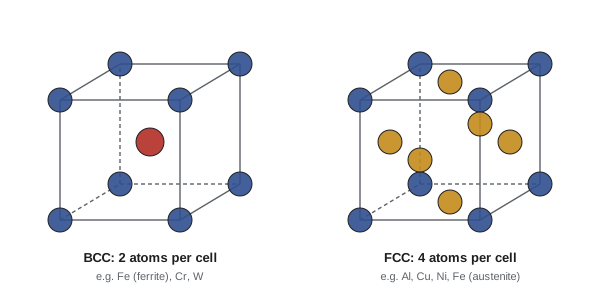
- Body-centered cubic (BCC): an atom at each corner of a cube and one in the center, 2 atoms per cell, 68 % of space filled. Iron at room temperature (ferrite), chromium, tungsten.
- Face-centered cubic (FCC): atoms at the corners and the center of each face, 4 atoms per cell, 74 % filled, the densest possible packing. Aluminum, copper, nickel, gold, and iron above 912 °C (austenite). FCC metals have many planes along which atoms can slip, so they stay ductile even at very low temperatures, which is why aluminum and austenitic stainless steels are used for cryogenic tanks.
- Hexagonal close-packed (HCP): also 74 % filled but with fewer slip systems, so less ductile at room temperature. Titanium, magnesium, zinc.
Knowing the structure and the size of the unit cell lets you calculate density from first principles, a good check that the atomic picture is right.
Worked problem
The density of iron
Iron is BCC at room temperature with a cubic cell edge a = 0.2866 nm. Calculate its density (molar mass 55.85 g/mol).
Show solution
- Mass of the 2 atoms in a cell: 2 × 55.85 / 6.022 × 10²³ = 1.855 × 10⁻²² g.
- Cell volume: (0.2866 × 10⁻⁷ cm)³ = 2.354 × 10⁻²³ cm³.
- Density: 1.855 × 10⁻²² / 2.354 × 10⁻²³ = 7.88 g/cm³.
Answer: 7.88 g/cm³, matching the measured 7.87 g/cm³. When iron changes from BCC to FCC at 912 °C, its atoms rearrange into a denser packing; that change, and its reversal on cooling, is what makes the heat treatment of steel possible.
Alloys and steel
Pure metals are usually too soft for structural use. Real crystals contain defects, especially dislocations, lines of misfit atoms whose movement lets planes slip at stresses far below what a perfect crystal could bear. Anything that obstructs dislocations makes a metal stronger: foreign atoms, grain boundaries, fine particles of a second phase, or a tangle of other dislocations produced by cold working.
An alloy is a metal with other elements deliberately added. In a substitutional alloy, the added atoms replace host atoms of similar size: zinc in copper makes brass, nickel in copper makes the cupronickel used in coins and seawater piping. In an interstitial alloy, small atoms such as carbon, nitrogen or hydrogen squeeze into the gaps between host atoms.
Steel is iron with up to about 2 % carbon, usually much less: structural steels have 0.15 to 0.3 %, tool steels near 1 %. Carbon dissolves readily in FCC austenite but hardly at all in BCC ferrite, so as hot steel cools slowly, the excess carbon forms hard particles of iron carbide, Fe₃C (cementite). Cooling quickly, by quenching in water or oil, traps the carbon and produces martensite, very hard but brittle; reheating to a moderate temperature (tempering) restores toughness. The same chemistry, controlled by temperature and time, gives one alloy a range of properties from soft wire to springs and cutting tools.
Stainless steels contain at least 10.5 % chromium, which reacts with oxygen to form an invisible chromium oxide film a few nanometers thick. The film is passive: it stops further corrosion and heals itself if scratched, as Lesson 9 explained. Adding nickel stabilizes the FCC structure, giving the common austenitic grades 304 and 316; 316 also contains molybdenum, which resists the chloride ions that break down the film in seawater and road salt. Other alloy elements serve other purposes: manganese for toughness, vanadium and niobium for fine grain size and strength in modern structural steels, copper in weathering steel to form a protective rust layer.
Ceramics and glass
Ceramics are compounds of metals with non-metals, usually oxygen (alumina, Al₂O₃; zirconia, ZrO₂), carbon (silicon carbide), nitrogen (silicon nitride) or silicon and oxygen (clays, brick, porcelain). Their strong, directional ionic and covalent bonds make them hard, stiff, high-melting and chemically resistant, but they cannot deform plastically by slip. A crack therefore grows unchecked, and ceramics are brittle: their strength depends on the size of their largest flaw and varies widely from piece to piece. Engineers design ceramics in compression, and use them where heat, wear or corrosion would defeat metals: furnace linings, cutting tools, spark plug insulators, turbine coatings, artificial hip joints and armor.
Glass is a non-crystalline solid, a "frozen liquid" with no long-range order. Pure silica glass, a random network of SiO₄ tetrahedra, melts above 1,700 °C. Ordinary soda-lime window glass, about 73 % SiO₂, 14 % Na₂O and 9 % CaO, melts near 1,000 °C because the sodium oxide breaks up the network; the lime keeps it from dissolving in water. Borosilicate glass, with boron oxide, expands less on heating and resists thermal shock in laboratory ware and cookware. Tempered glass is cooled rapidly with air jets so its surfaces solidify in compression; because cracks cannot open in compressed surfaces, it is four to five times stronger than ordinary glass and shatters into small blunt pieces, as building codes require for doors and glazing near floors.
Portland cement and concrete
Portland cement is made by heating limestone and clay or shale to about 1,450 °C in a rotary kiln. Calcination (Lessons 5 and 6) drives off CO₂, and the lime combines with silica, alumina and iron oxide to form clinker, which is ground with a little gypsum. Cement chemists use a shorthand for its main compounds: C₃S (tricalcium silicate, Ca₃SiO₅, about 55 to 65 %), C₂S (dicalcium silicate, 15 to 25 %), C₃A (tricalcium aluminate) and C₄AF (an aluminoferrite).
When mixed with water, these compounds hydrate. The key reaction is:
The calcium silicate hydrate, called C-S-H, is a poorly crystalline gel of nanometer-scale sheets that binds the sand and stone together and provides most of the strength. C₃S hydrates within days and gives early strength; C₂S reacts over weeks and months. The calcium hydroxide keeps the pore water strongly alkaline, at pH 12.5 to 13.5, which passivates the steel reinforcement. Hydration consumes water and releases heat, so concrete must be kept moist and at a suitable temperature while it cures (Lesson 7).
Worked problem
Heat of hydration in a thick footing
A mass concrete footing contains 350 kg of cement per cubic meter. The cement releases about 350 kJ/kg in the first week. The concrete has density 2400 kg/m³ and specific heat 0.95 kJ/(kg·K). Estimate the temperature rise in the core if no heat escapes.
Show solution
- Heat released: 350 kg × 350 kJ/kg = 122 500 kJ per cubic meter.
- Heat capacity: 2400 × 0.95 = 2280 kJ/K per cubic meter.
- Temperature rise: 122 500/2280 = 54 K.
Answer: About 54 °C, so concrete placed at 15 °C could reach nearly 70 °C in the core while the surface stays cool. The temperature difference makes the surface contract relative to the core and crack. Specifications therefore limit the core-to-surface difference (commonly to 20 °C) and the peak temperature, and designers cut the heat by replacing part of the cement with fly ash or slag, using low-heat cement, chilling the mix or embedding cooling pipes, as was done in the Hoover Dam.
Concrete's durability is a chemistry problem. Carbon dioxide from the air slowly reacts with calcium hydroxide (carbonation), lowering the pH near the surface to about 9, where steel is no longer passive. Chloride ions from de-icing salt or seawater break down the passive film even at high pH. Either way, the reinforcement corrodes, and because rust occupies several times the volume of steel, it cracks and spalls the cover, the main cause of deterioration in parking garages and bridges (Lesson 9). Sulfates in soil and groundwater react with hydrated aluminates to form expansive crystals; some aggregates contain reactive silica that swells in the alkaline pore solution (alkali–silica reaction). Durable concrete uses a low water-to-cement ratio, adequate cover, supplementary materials and, where needed, sulfate-resistant cement and air entrainment for freeze–thaw resistance.
Worked problem
The carbon footprint of cement
Clinker contains about 65 % CaO by mass, all from calcined CaCO₃. How much CO₂ does the calcination chemistry release per metric ton of clinker?
Show solution
- CaO in 1 t of clinker: 0.65 t.
- CaCO₃ → CaO + CO₂ gives 44.01 t CO₂ per 56.08 t CaO.
- CO₂ = 0.65 × 44.01/56.08 = 0.51 t.
Answer: About 0.5 t of CO₂ per metric ton of clinker from the chemistry alone, before any fuel is burned; with kiln fuel and electricity the total is about 0.8 to 0.9 t. Cement accounts for roughly 7 to 8 % of global CO₂ emissions. Because the process emissions cannot be removed by changing fuel, the industry is turning to blended cements with less clinker (such as Portland-limestone cement), supplementary materials and carbon capture.
Polymers
Polymers are giant molecules made by linking thousands of small molecules, monomers, into chains. In addition polymerization, monomers with a carbon–carbon double bond open it and join end to end: ethylene (C₂H₄) becomes polyethylene, vinyl chloride becomes PVC, propylene becomes polypropylene. In condensation polymerization, two different monomers join and release a small molecule, usually water: nylons for fibers, gears and bearings, and polyesters such as PET for bottles and fibers.
The size of the chains is described by the degree of polymerization, the number of repeat units per chain. Longer chains tangle more and give a stronger, tougher material that is harder to melt and mold.
Worked problem
Degree of polymerization
A grade of high-density polyethylene used for gas distribution pipe has an average molar mass of 280 000 g/mol. How many ethylene units are in an average chain?
Show solution
- Repeat unit: –CH₂–CH₂–, molar mass 2(12.01) + 4(1.008) = 28.05 g/mol.
- n = 280 000/28.05 ≈ 10 000.
Answer: About 10 000 repeat units, a chain roughly 2.5 µm long if stretched out, though in the solid it is coiled and folded. Such long chains give polyethylene pipe the toughness and slow crack resistance needed for 50 years of service underground.
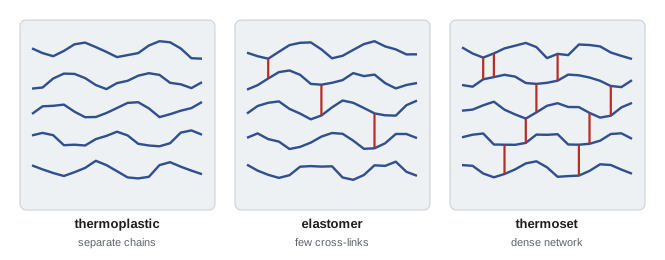
Polymers fall into three families by how their chains are connected:
- Thermoplastics (polyethylene, polypropylene, PVC, nylon, polycarbonate) have separate chains held together only by intermolecular forces. They soften when heated and can be melted, molded, extruded and recycled.
- Thermosets (epoxy, phenolics, polyester resins, many polyurethanes) are cured into a single three-dimensional network by covalent cross-links. Once set, they do not melt but char, and cannot be remoulded. They make strong, heat-resistant adhesives, coatings and composite matrices.
- Elastomers (natural and synthetic rubbers, silicones) are lightly cross-linked, so the coiled chains can stretch and spring back. Vulcanizing rubber with sulfur forms the cross-links.
Polymer properties depend strongly on temperature. Below its glass transition temperature, T_g, a polymer is rigid and glassy; above it, the chains can move and it becomes leathery or rubbery. PVC (T_g about 80 °C) is rigid at room temperature, but adding plasticizers lowers T_g to make flexible cable jackets and hoses. Polyethylene's T_g is far below room temperature, but its partly crystalline regions keep it solid. Many polymers also creep, slowly deforming under steady load, so plastic pipes and structural parts are designed for long-term strength at service temperature. Sunlight and oxygen break polymer chains over time (Lesson 7); carbon black and stabilizers are added to products that must last outdoors.
Composites
A composite combines two or more materials to get properties neither has alone. Fibers carry load; a matrix holds them in place, transfers stress between them and protects them. Glass-fiber-reinforced plastic (fiberglass) makes boat hulls, tanks and wind turbine blades; carbon-fiber composites, stronger and stiffer per unit weight than steel, make aircraft structures, racing bicycles and strengthening wraps for bridge columns. Reinforced concrete is itself a composite: concrete carries compression, steel carries tension, and they work together because they expand almost equally with temperature and because the alkaline concrete protects the steel. Wood is a natural composite of cellulose fibers in a lignin matrix.
Lesson 11 turns from materials to the chemistry of fuels, emissions, the atmosphere and water, and Lesson 12 applies the course to integrated case studies, including a reinforced concrete structure exposed to de-icing salt.
Common mistakes
MistakeAssuming stronger always means better.
InsteadStrength often trades off against ductility and toughness, as in quenched steel or ceramics.
MistakeThinking stainless steel cannot corrode.
InsteadChlorides can break down its passive film, especially in low grades such as 304.
MistakeBelieving concrete dries to harden.
InsteadConcrete hardens by hydration, which needs water; it must be kept moist while curing.
MistakeTreating all plastics as recyclable by melting.
InsteadThermosets are cross-linked and cannot be remelted.
MistakeIgnoring creep in polymer parts.
InsteadDesign polymers for long-term strength at service temperature.
Summary and key terms
- Metals pack into BCC, FCC or HCP structures; FCC metals stay ductile at low temperature.
- Alloying, grain boundaries and cold work strengthen metals by blocking dislocations.
- Steel properties come from carbon and heat treatment; stainless steel relies on a passive chromium oxide film.
- Ceramics are hard and heat-resistant but brittle; glass is a non-crystalline network.
- Cement hydration forms C-S-H and Ca(OH)₂, releases heat and protects steel with high pH.
- Carbonation, chlorides, sulfates and alkali–silica reaction threaten concrete durability.
- Polymers are thermoplastics, thermosets or elastomers; T_g and creep govern their use.
- Unit cell
- The smallest repeating unit of a crystal structure.
- Dislocation
- A line defect whose motion allows metals to deform plastically.
- Alloy
- A metal containing deliberately added elements.
- Martensite
- A hard, brittle phase formed by quenching steel.
- Passive film
- A thin protective oxide layer that stops further corrosion.
- Clinker
- The nodules produced in a cement kiln, ground to make cement.
- C-S-H
- Calcium silicate hydrate, the main binding phase in concrete.
- Carbonation
- Reaction of atmospheric CO₂ with concrete that lowers its pH.
- Thermoset
- A cross-linked polymer that does not melt when heated.
- Glass transition temperature
- The temperature above which a polymer changes from glassy to rubbery.
Practice problems
Work each problem on paper first, then reveal the answer to check.
How many atoms belong to an FCC unit cell?
Show answer
Four: 8 corners × 1/8 + 6 faces × 1/2.
Copper is FCC with a = 0.3615 nm and M = 63.55 g/mol. Find its density.
Show answer
4 × 63.55/(6.022 × 10²³ × 4.724 × 10⁻²³ cm³) = 8.94 g/cm³.
Why are aluminum alloys preferred to carbon steel for liquefied natural gas tanks?
Show answer
FCC aluminum stays ductile at cryogenic temperatures; BCC carbon steel becomes brittle.
What is the difference between substitutional and interstitial alloys?
Show answer
Substitutional atoms replace host atoms; interstitial atoms fit into gaps between them.
Why is quenched steel tempered?
Show answer
To relieve the brittleness of martensite and restore toughness.
Why is grade 316 preferred to 304 in marine environments?
Show answer
Its molybdenum improves resistance to chloride pitting.
Why is tempered glass stronger than ordinary glass?
Show answer
Its surfaces are in compression, so cracks cannot open.
With 280 kg/m³ of cement releasing 350 kJ/kg, estimate the adiabatic temperature rise.
Show answer
98 000/2280 ≈ 43 °C.
Why does carbonation lead to rebar corrosion?
Show answer
It lowers the pore-water pH to about 9, below which steel loses its passive film.
Find the degree of polymerization of PVC (repeat unit C₂H₃Cl, 62.5 g/mol) with M = 125 000 g/mol.
Show answer
125 000/62.5 = 2000.
Lesson quiz · 5 questions
Score 60% or more to complete this lesson.
Create a free account to save your progress, take quizzes and earn a certificate.