
CHEM-103 · Lesson 7 of 12 · 30 min
Reaction rates and kinetics
Lesson 6 showed how to tell whether a reaction can happen. This lesson asks how fast it happens, which is often the more pressing engineering question. A steel bridge is thermodynamically doomed to rust, but whether that takes five years or a hundred depends on rates. Concrete gains strength over days and weeks at a pace set by temperature; a catalytic converter must clean exhaust within milliseconds; disinfectant chlorine must survive for days in a water main; a sealant must last twenty years on a building, and an engineer must predict that from tests that take a few months. Chemical kinetics, the study of reaction rates, provides the tools: rate laws, integrated rate laws and half-lives, the Arrhenius equation for temperature, reaction mechanisms and catalysts. It also explains some of the most serious industrial hazards, including thermal runaway and dust explosions.
What reaction rate means
The rate of a reaction is how fast reactants are used up or products appear, usually expressed as a change in concentration per unit time, in mol/(L·s). For a reaction aA → bB, the rate is −(1/a) d[A]/dt = (1/b) d[B]/dt; dividing by the coefficients gives one rate for the whole reaction regardless of which substance is measured. Rates generally slow as reactants are consumed.
Four factors control the rate:
- Concentration (or partial pressure): more reactant molecules means more collisions.
- Temperature: a small rise often speeds reactions dramatically.
- Surface area: for reactions involving solids, finely divided material reacts much faster. A log burns slowly; sawdust suspended in air can explode.
- Catalysts: substances that provide a faster pathway without being consumed.
Rate laws
Experiment shows that the rate usually depends on reactant concentrations raised to powers:
Here k is the rate constant, which depends on temperature but not on concentration, and m and n are the reaction orders with respect to A and B; their sum is the overall order. Orders must be measured; they are not, in general, the coefficients in the balanced equation. A common way to find them is the method of initial rates: run the reaction several times, changing one starting concentration at a time, and see how the initial rate responds. If doubling [A] doubles the rate, the reaction is first order in A; if it quadruples the rate, second order; if the rate does not change, zero order.
Worked problem
Oxidation of nitric oxide
For 2NO + O₂ → 2NO₂, initial rates were measured: [NO] = 0.010 M, [O₂] = 0.010 M, rate 2.5 × 10⁻⁵ M/s; [NO] = 0.020 M, [O₂] = 0.010 M, rate 1.0 × 10⁻⁴ M/s; [NO] = 0.010 M, [O₂] = 0.020 M, rate 5.0 × 10⁻⁵ M/s. Find the rate law and k.
Show solution
- Doubling [NO] at fixed [O₂] multiplies the rate by 4: second order in NO.
- Doubling [O₂] at fixed [NO] doubles the rate: first order in O₂.
- Rate = k[NO]²[O₂]; k = 2.5 × 10⁻⁵ / (0.010² × 0.010) = 25 M⁻² s⁻¹.
Answer: Rate = 25[NO]²[O₂], third order overall. Because the rate depends on the square of [NO], nitric oxide from engine exhaust, diluted in city air to parts per million, oxidizes to brown nitrogen dioxide only slowly by this route; in smog, faster routes involving sunlight and other pollutants take over (Lesson 11).
Integrated rate laws and half-life
A rate law gives the rate at a given moment. Integrating it gives concentration as a function of time, which is usually what an engineer needs. For a first-order reaction, rate = k[A], and:
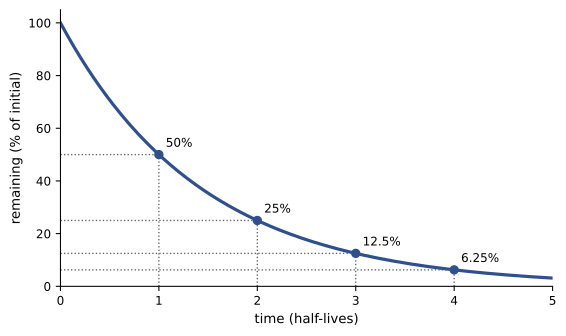
A plot of ln[A] against time is a straight line of slope −k, the usual test for first-order behavior. The half-life, the time for the concentration to fall to half, is constant for a first-order reaction, whatever the starting concentration:
After one half-life 50 % remains, after two 25 %, after ten about 0.1 %. Radioactive decay is first order: cesium-137, released by nuclear accidents, has a half-life of 30 years, so it takes about three centuries to fall to a thousandth. Many decomposition, decay and drug-elimination processes are first order, or close to it.
For a second-order reaction, rate = k[A]², the integrated law is 1/[A] = 1/[A]₀ + kt, and the half-life, 1/(k[A]₀), grows as the concentration falls. For a zero-order reaction the rate is constant until the reactant runs out, as happens when a catalyst surface is saturated or when the body eliminates alcohol at a fixed rate.
Worked problem
Chlorine residual in a water main
Water leaves a treatment plant with 1.5 mg/L of free chlorine, which decays in the pipes with a first-order rate constant of 0.50 per day. Regulations call for at least 0.2 mg/L at every tap. What is the residual after 2 days, and how long can water stay in the system?
Show solution
- After 2 days: C = 1.5 e^(−0.50 × 2) = 1.5 × 0.368 = 0.55 mg/L.
- Time to reach 0.2 mg/L: t = ln(1.5/0.2)/0.50 = 2.01/0.50 = 4.0 days.
- Half-life: 0.693/0.50 = 1.4 days.
Answer: About 0.55 mg/L after 2 days; water must reach consumers within about 4 days. Long dead-end mains and oversized storage tanks risk losing the residual, so utilities flush lines, add booster chlorination stations or switch to chloramine, which decays more slowly.
Collision theory and activation energy
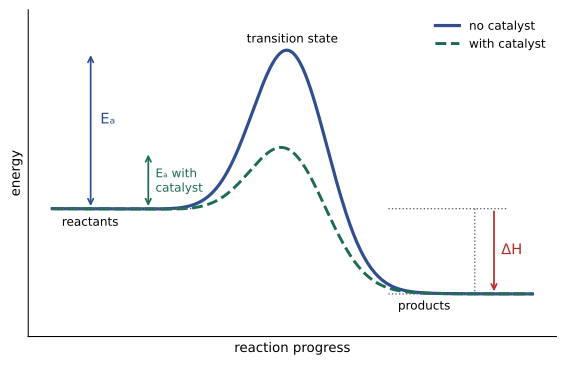
For molecules to react, they must collide with enough energy and the right orientation to break existing bonds and form new ones. The minimum energy is the activation energy, E_a. An energy profile plots the energy of the reacting system along the reaction path: reactants climb over an energy barrier, through a short-lived arrangement called the transition state, and descend to products. The height of the barrier above the reactants is E_a; the overall drop from reactants to products is ΔH, which, as Lesson 6 showed, has nothing to do with the rate.
At any temperature, molecular energies are spread over a range, and only the small fraction in the high-energy tail can cross the barrier. Raising the temperature enlarges that fraction sharply, which is why rates are so sensitive to temperature.
The Arrhenius equation
The Swedish chemist Svante Arrhenius found that rate constants follow:
where A, the pre-exponential factor, reflects collision frequency and orientation. Taking logarithms, ln k = ln A − E_a/(RT), so a plot of ln k against 1/T is a straight line of slope −E_a/R. Comparing two temperatures gives the two-point form:
A useful rule of thumb follows: for an activation energy of about 50 kJ/mol, typical of many reactions, the rate roughly doubles for every 10 °C rise near room temperature. This is why food lasts longer in the refrigerator, why batteries age faster in a hot car, and why a fever is dangerous.
Worked problem
Curing concrete in cold weather
The hydration of cement has an apparent activation energy of about 40 kJ/mol. How much slower does concrete gain strength at 5 °C than at 20 °C?
Show solution
- ln(k₂₀/k₅) = (40 000/8.314)(1/278.15 − 1/293.15) = 4811 × 1.840 × 10⁻⁴ = 0.885.
- k₂₀/k₅ = e^0.885 = 2.4.
Answer: Concrete at 5 °C gains strength about 2.4 times more slowly, so forms must stay on longer and loads must wait. This is the basis of the maturity method in ASTM C1074, which tracks a slab's temperature history with embedded sensors to estimate its in-place strength, and of ACI 306 cold-weather rules requiring heated enclosures, insulated blankets or accelerating admixtures. Below about 14 °F hydration effectively stops, and fresh concrete that freezes can be permanently damaged.
Predicting service life from accelerated tests
Materials such as sealants, coatings, plastics, adhesives and battery electrolytes degrade by slow chemical reactions, typically oxidation. Nobody can wait twenty years to find out whether a product will last twenty years, so manufacturers age samples in ovens at several elevated temperatures, measure the degradation rate at each, fit the Arrhenius equation and extrapolate to service temperature.
import math

R = 8.314
# Accelerated aging of a sealant: first-order rate constants (per day) at oven temperatures
data = [(60, 0.00366), (70, 0.00834), (80, 0.0200), (90, 0.0457)]
x = [1 / (t + 273.15) for t, k in data]          # 1/T in 1/K
y = [math.log(k) for t, k in data]               # ln k
n = len(data)
xm, ym = sum(x) / n, sum(y) / n
slope = sum((a - xm) * (b - ym) for a, b in zip(x, y)) / sum((a - xm) ** 2 for a in x)
lnA = ym - slope * xm
Ea = -slope * R
print(f"Activation energy {Ea / 1000:.1f} kJ/mol, A = {math.exp(lnA):.3g} per day")

for t in [25, 40, 60, 90]:
    T = t + 273.15
    k = math.exp(lnA - Ea / (R * T))
    half = math.log(2) / k                        # days to lose half the property
print(f"{t:3d} C: k = {k:.2e} per day, half-life {half:8.0f} days = {half / 365:5.1f} years")Activation energy 84.9 kJ/mol, A = 7.39e+10 per day 25 C: k = 9.71e-05 per day, half-life 7135 days = 19.5 years 40 C: k = 5.01e-04 per day, half-life 1382 days = 3.8 years 60 C: k = 3.55e-03 per day, half-life 195 days = 0.5 years 90 C: k = 4.48e-02 per day, half-life 15 days = 0.0 years
The fitted activation energy, 85 kJ/mol, predicts a half-life of about 20 years at 25 °C but under 4 years at 40 °C, a reminder that a sealant on a sun-baked south-facing roof can run much hotter than the air. Extrapolation assumes the same reaction controls degradation at every temperature; if a different process takes over at high temperature (a polymer softening, a plasticizer evaporating), the prediction can be badly wrong, so good test programs use the lowest oven temperatures practical and confirm with real-world exposure.
Reaction mechanisms
Most reactions do not happen in a single collision but through a sequence of elementary steps, the mechanism. Each elementary step's rate law does follow its own molecularity: a step in which two molecules collide is second order. The slowest step, the rate-determining step, acts like the narrowest point in a pipe and controls the overall rate, which is why experimental rate laws often differ from the overall balanced equation. Combustion, for example, proceeds through dozens of steps involving highly reactive fragments called free radicals; flame retardants work by capturing those radicals and breaking the chain.
Catalysts
A catalyst speeds a reaction by providing an alternative pathway with lower activation energy, and is regenerated at the end. Because it lowers the barrier for the forward and reverse reactions equally, a catalyst does not change ΔH, ΔG or the equilibrium constant: it gets the reaction to equilibrium faster but does not shift where equilibrium lies (Lesson 8).
- Heterogeneous catalysts are in a different phase, usually a solid on which gas or liquid reactants adsorb. A car's three-way catalytic converter uses platinum, palladium and rhodium spread over a ceramic honeycomb with an enormous surface area to convert carbon monoxide, unburned hydrocarbons and nitrogen oxides into CO₂, water and N₂. It works only above its light-off temperature of about 250 to 300 °C, so most of a modern car's emissions come in the first minute after a cold start.
- Homogeneous catalysts are dissolved in the same phase as the reactants, as in many processes that make plastics.
- Enzymes are biological catalysts, proteins that speed specific reactions in living cells by factors of a million or more, and are used industrially in detergents, biofuels and wastewater treatment.
Catalysts can be poisoned: lead in old gasoline coated converter catalysts and destroyed them, which is one reason leaded gasoline was phased out; sulfur in fuel poisons them too.
Rates and safety: runaway reactions and explosions
The exponential dependence of rate on temperature can turn deadly. In an exothermic reaction, heat raises the temperature, which speeds the reaction, which releases heat faster. If the heat is removed fast enough, the reaction settles at a steady temperature; but heat generation rises exponentially with temperature while cooling rises only roughly linearly, so beyond a critical point the reaction runs away. Thermal runaway has caused chemical reactor explosions, fires in stockpiles of coal and oily rags that self-heat, and lithium-ion battery fires, in which internal decomposition reactions accelerate one another once a cell passes roughly 150 °C.
Surface area matters equally. Grain, sugar, flour, coal, wood and metal dusts suspended in air can burn so fast that they explode. Dust explosions have leveled grain elevators and factories; preventing them requires good housekeeping, dust collection, controlling ignition sources and explosion venting. Gas mixtures burn only between their lower and upper flammability limits (5 % and 15 % for methane in air), which is why gas detectors alarm at a fraction of the lower limit.
Common mistakes
MistakeTaking reaction orders from the coefficients of the balanced equation.
InsteadOrders are determined by experiment, except for single elementary steps.
MistakeThinking a catalyst shifts equilibrium.
InsteadA catalyst speeds both directions equally; K is unchanged.
MistakeAssuming a large negative ΔH means a fast reaction.
InsteadRate depends on activation energy, not on ΔH.
MistakeUsing °C in the Arrhenius equation.
InsteadUse kelvin.
MistakeExtrapolating accelerated test results without checking the mechanism.
InsteadA different reaction may dominate at high temperature; verify with lower-temperature or field data.
Summary and key terms
- Rates depend on concentration, temperature, surface area and catalysts.
- Rate laws, rate = k[A]^m[B]^n, are found by experiment, for example by initial rates.
- First-order reactions decay exponentially with a constant half-life of 0.693/k.
- Reactions must cross an activation energy barrier through a transition state.
- The Arrhenius equation, k = Ae^(−E_a/RT), describes temperature dependence; ln k versus 1/T is linear.
- Catalysts lower activation energy without changing ΔH, ΔG or K.
- Exponential temperature dependence drives thermal runaway; fine dusts and gases within flammability limits can explode.
- Reaction rate
- The change in concentration of a reactant or product per unit time.
- Rate constant
- The proportionality constant in a rate law, dependent on temperature.
- Reaction order
- The power to which a concentration is raised in the rate law.
- Half-life
- The time for a reactant concentration to fall to half its value.
- Activation energy
- The minimum energy needed for a reaction to occur.
- Transition state
- The highest-energy arrangement along the reaction path.
- Arrhenius equation
- k = A e^(−E_a/RT), relating rate constant to temperature.
- Rate-determining step
- The slowest step in a mechanism, controlling the overall rate.
- Catalyst
- A substance that speeds a reaction without being consumed.
- Thermal runaway
- A self-accelerating rise in temperature and reaction rate.
Practice problems
Work each problem on paper first, then reveal the answer to check.
Doubling [A] multiplies the rate by 8. What is the order in A?
Show answer
Third order (2³ = 8).
A first-order reaction has k = 0.0231 min⁻¹. Find its half-life.
Show answer
0.693/0.0231 = 30 min.
What fraction of a first-order reactant remains after four half-lives?
Show answer
1/16, about 6.3 %.
A pesticide decays with a half-life of 15 days. How long until 10 % remains?
Show answer
k = 0.0462/day; t = ln 10/0.0462 = 50 days.
What are the units of k for a second-order reaction?
Show answer
M⁻¹ s⁻¹ (L/(mol·s)).
A rate constant triples from 25 °C to 45 °C. Estimate E_a.
Show answer
ln 3 = (E_a/8.314)(1/298.15 − 1/318.15); E_a ≈ 43 kJ/mol.
Using the rule of thumb, how much faster is a reaction at 60 °C than at 30 °C?
Show answer
About 2³ = 8 times.
From the code output, how much longer does the sealant last at 25 °C than at 60 °C?
Show answer
About 7135/195 ≈ 37 times.
Why does a catalytic converter not work right after a cold start?
Show answer
It is below its light-off temperature, where the catalyzed rates become fast.
Why can flour dust explode while a bag of flour merely burns?
Show answer
Suspended fine particles have enormous surface area in contact with air, so combustion is extremely fast.
Lesson quiz · 5 questions
Score 60% or more to complete this lesson.
Create a free account to save your progress, take quizzes and earn a certificate.