
CINE-340 · Lesson 11 of 12 · 28 min
Fatigue, hours of work and crew wellbeing
Long hours are part of film culture. Twelve-hour days are normal, fourteen- and sixteen-hour days are common when a shoot falls behind, night shoots flip sleep schedules, and "Fraturdays", Friday calls that run into Saturday morning, leave crews driving home at dawn. For decades, exhaustion was treated as a badge of honor. It is in fact a serious safety hazard. Fatigue slows reactions, impairs judgment and memory, and makes people miss hazards they would normally see, on the catwalk, at the distribution box, behind the wheel of a camera car and on the drive home. This lesson explains how fatigue works, how hours and turnaround are regulated by law and union agreements in Canada and the United States, how to assess fatigue risk, and how productions and individuals can reduce it. It also looks at the wider wellbeing of crews, including mental health, harassment and support.
Why fatigue is a hazard
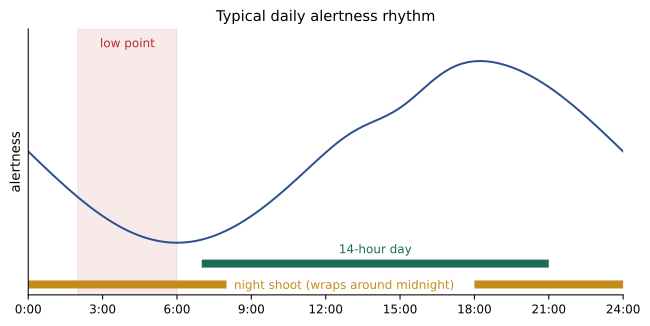
The body runs on a roughly 24-hour circadian rhythm that makes us most alert in the day and sleepiest in the early morning hours, about 2 to 6 a.m. Fatigue builds from three sources.
- Time awake: alertness falls the longer a person has been awake.
- Sleep debt: getting less sleep than needed over several nights creates a debt that a single night does not repay.
- Circadian timing: working at night or in the early morning hours fights the body clock.
Research has compared fatigue to alcohol. A widely cited study found that being awake for about 17 hours impairs performance about as much as a blood alcohol concentration of 0.05 %, and about 24 hours awake about as much as 0.10 %, above the legal driving limit in Canada and the US. Fatigued people also suffer microsleeps, brief episodes of sleep lasting seconds, often without knowing it.
- Slower reactions: a fatigued grip may not react in time to a falling stand.
- Poorer judgment: a tired electrician may skip checking a ground or overload a circuit.
- Memory lapses: forgetting to secure a safety cable or reset a breaker.
- Reduced attention: missing a hazard such as an approaching vehicle.
- Mood and communication: irritability and poor teamwork increase conflict and errors.
A death that changed the conversation
In March 1997, camera assistant Brent Hershman fell asleep at the wheel and died driving home after a 19-hour day on the film Pleasantville. His death prompted a petition for limits on working hours and led cinematographer Haskell Wexler to make the documentary Who Needs Sleep? (2006) about long hours in the industry. The conversation continued for decades and was one of the central issues in the 2021 negotiations between IATSE and the producers, when crews shared stories of exhaustion and near misses on social media and voted to authorize a strike before a deal was reached.
Hours and rest: what the rules say
Hours of work in film are governed by employment law, union agreements and production policies. The details differ by jurisdiction, union, local and agreement, so crews should check the agreement that covers their production.
In the United States, federal law does not limit the hours adult workers can work, though the Fair Labor Standards Act and some states, such as California with its daily overtime after 8 hours, require overtime pay. Hours and rest for most film crews are set by collective agreements. The IATSE Basic Agreement and Area Standards Agreement negotiated in 2021 introduced a 10-hour turnaround between shifts for covered crafts, weekend rest periods of 54 hours after a five-day week and 32 hours after a six-day week, and stronger meal break penalties; the 2024 agreements, running to 2027, kept these protections. Penalties for "invading" turnaround make short rest expensive, but they do not by themselves make it safe.
Turnaround and the real rest window
Turnaround is the time between wrap on one day and call the next. It is not the same as rest. Travel time, wrap-out of equipment, meals, family duties and getting ready all come out of the turnaround, leaving less time for sleep.
Worked problem
How much sleep does a 10-hour turnaround allow?
A grip wraps at 11:00 p.m., spends 45 minutes wrapping out equipment, drives 50 minutes home, needs 45 minutes to wind down, eat and wash, needs 30 minutes to get ready in the morning and drives 50 minutes back to a 9:00 a.m. call. How much time is left for sleep within the 10-hour turnaround?
Show solution
- Turnaround: 11:00 p.m. to 9:00 a.m. = 10 hours = 600 minutes.
- Time used: 45 (wrap-out) + 50 (drive home) + 45 (wind down) + 30 (get ready) + 50 (drive in) = 220 minutes.
- Remaining for sleep: 600 − 220 = 380 minutes, about 6 hours 20 minutes, at best.
Answer: About 6 hours 20 minutes of possible sleep, less than the 7 to 9 hours most adults need. Repeated over a week, this builds a large sleep debt. Turnaround rules set a minimum, not an ideal.
Assessing fatigue risk
Fatigue risk can be assessed like any other hazard. Many industries use simple prior sleep and wakefulness checks.
- In the 24 hours before a shift, has the worker had at least 5 hours of sleep?
- In the 48 hours before a shift, has the worker had at least 12 hours of sleep?
- Will the worker's hours awake by the end of the shift exceed the hours of sleep in the previous 48 hours?
If the answers show a shortfall, the risk is higher and extra controls are needed, such as assigning lower-risk tasks, adding breaks, pairing workers, providing transport or rescheduling.
Worked problem
A simple fatigue check
On the fifth day of a night shoot, an electrician slept 4 hours in the last 24 hours and 9 hours in the last 48 hours. They woke at 3:00 p.m. and the shift will end at 7:00 a.m. Apply the three checks.
Show solution
- Sleep in last 24 hours: 4 h, below 5 h, so the first check fails.
- Sleep in last 48 hours: 9 h, below 12 h, so the second check fails.
- Hours awake at the end of the shift: 3:00 p.m. to 7:00 a.m. = 16 h, more than the 9 h slept in 48 hours, so the third check fails.
Answer: All three checks fail, indicating high fatigue risk. The electrician should not do high-risk tasks such as working at height or tie-ins without controls, and should not drive home; production should arrange transport or rest.
What productions can do
The most effective fatigue controls are in the producer's hands, because they shape the schedule.
- Schedule realistic days with achievable page counts and avoid routinely extending days.
- Respect turnaround, and do not "invade" it except in genuine emergencies.
- Limit consecutive long days and night shoots, and plan transitions between day and night work with rest.
- Avoid Friday calls that run into Saturday morning.
- Provide transport, ride shares or hotel rooms after very long days or for distant locations.
- Provide meals, water and break areas, including quiet places to rest during long set-ups.
- Rotate high-risk tasks and add crew for heavy days.
- Make fatigue a topic in safety meetings and encourage crew to report it without penalty.
- Track hours for every department, not just those covered by penalties.
Worked problem
Counting weekly hours
A lighting technician works days of 12, 13, 14, 12 and 15 hours, plus a 10-hour prep day on Saturday. How many hours is that, and how does it compare with a standard 40-hour week?
Show solution
- Total: 12 + 13 + 14 + 12 + 15 + 10 = 76 hours.
- 76 ÷ 40 = 1.9, nearly double a standard week.
- With 10-hour turnarounds after each day and travel, little time remains for sleep, family or recovery.
Answer: 76 hours, about 1.9 times a standard 40-hour week. Weeks like this, repeated, build sleep debt and raise risk. A schedule that keeps most days at 12 hours and gives a full weekend would cut hours by about 20 %.
What individuals can do
Individuals cannot fix a bad schedule, but they can protect themselves and their colleagues.
- Prioritize sleep on days off and before night shoots; nap before a night call if possible.
- Use caffeine strategically early in a shift, not near the end when you need to sleep.
- Stay hydrated and eat regular meals, which helps alertness.
- Recognize warning signs: heavy eyelids, yawning, drifting thoughts, missed cues.
- Tell your head of department if you are too tired to do a high-risk task safely.
- Do not drive drowsy; use offered transport, nap first, or carpool.
- Look out for colleagues and speak up if someone seems dangerously tired.
Wellbeing beyond fatigue
Crew wellbeing includes physical health, mental health and a respectful workplace.
- Mental health: long hours, job insecurity between shows, time away from family and high pressure contribute to stress, anxiety and depression. Many unions and industry bodies offer confidential support programs.
- Harassment and bullying: workplace harassment, including sexual harassment, is prohibited by law and harms safety by silencing people. Productions must have policies, reporting channels and investigations (HSE-108 covers this in detail).
- Physical strain: heavy lifting, repetitive work and awkward postures cause musculoskeletal injuries; use carts, team lifts and proper technique (HSE-107).
- Substance use: impairment from alcohol, cannabis or drugs at work is a safety hazard; productions have policies, and support is available.
- Support for those affected by incidents: crew who witness serious accidents may need time, debriefing and professional support.
In the United States, crew can find support through union assistance programs, the Motion Picture and Television Fund, the Entertainment Community Fund and the 988 Suicide and Crisis Lifeline, which anyone can call or text at any time.
| Level | Example | Who controls it |
|---|---|---|
| Elimination | Schedule fewer long days; avoid unnecessary nights | Producer, line producer |
| Engineering | Hotels near locations; shuttles | Production |
| Administrative | Turnaround rules, hour limits, task rotation | Production, unions, HODs |
| Individual | Sleep, naps, caffeine timing, speaking up | Each crew member |
Night shoots and switching schedules
Night shoots deserve special care. When a schedule switches from days to nights, crews should get extra rest before the first night, ideally sleeping late and napping in the afternoon. During the night, bright light, movement and social interaction help alertness, while heavy meals late in the night can make sleepiness worse. After a night shift, crew should sleep in a dark, quiet room and avoid driving long distances. Switching back to days needs a rest period too. Productions that group night work together, rather than scattering single nights through the schedule, reduce the number of difficult transitions and the fatigue they cause.
Fatigue and shared responsibility
Fatigue management works best as a shared responsibility. The producer sets the schedule, heads of department watch their crews and assign tasks sensibly, and each crew member arrives as rested as possible and speaks up when they are not. A crew member who says "I am too tired to go up in the condor" is giving valuable safety information, not making an excuse.
Common mistakes
MistakeTreating long hours as proof of dedication.
InsteadTreat fatigue as a hazard that raises risk for everyone.
MistakeAssuming a 10-hour turnaround gives 10 hours of rest.
InsteadSubtract travel and daily tasks; real sleep may be 6 hours or less.
MistakeDriving home drowsy because it is only a short distance.
InsteadUse transport, nap first or carpool; drowsy driving kills.
MistakeDoing high-risk work after a failed fatigue check.
InsteadReassign tasks, add breaks or rest before high-risk work.
MistakeStaying silent about harassment or distress.
InsteadUse reporting channels and support programs; they exist to protect safety.
Summary and key terms
- Fatigue comes from time awake, sleep debt and working against the body clock.
- About 17 hours awake impairs performance like a 0.05 % blood alcohol level.
- Brent Hershman's 1997 death and the 2021 IATSE negotiations made hours a central safety issue.
- Canadian rest rules come from provincial employment standards and union agreements; US rules come mostly from union agreements.
- Turnaround minus travel and daily tasks leaves much less time for sleep.
- Prior sleep and wake checks help identify high fatigue risk.
- Productions control schedules; individuals manage sleep, speak up and avoid drowsy driving.
- Fatigue
- A state of reduced alertness from lack of sleep, long hours or circadian disruption.
- Circadian rhythm
- The body's roughly 24-hour cycle of alertness and sleepiness.
- Sleep debt
- The accumulated shortfall of sleep over several days.
- Microsleep
- A brief, often unnoticed episode of sleep lasting seconds.
- Turnaround
- The time between wrap and the next call.
- Fraturday
- A Friday call that runs into Saturday morning.
- Weekend rest period
- A minimum rest period between work weeks set by an agreement.
- Fatigue risk assessment
- An evaluation of sleep, wake and schedule factors that predict fatigue.
- Meal penalty
- A payment owed when meal breaks are late or missed.
- Crisis line
- A free service that offers support to people in distress, such as 9-8-8 or 988.
Practice problems
Work each problem on paper first, then reveal the answer to check.
What time of day is alertness usually lowest?
Show answer
About 2 to 6 a.m.
Hours awake that impair like 0.05 % BAC?
Show answer
About 17 hours.
Sleep left in a 10-hour turnaround with 4 hours of travel and tasks?
Show answer
About 6 hours.
Name the three prior sleep and wake checks.
Show answer
5 h in 24 h, 12 h in 48 h, hours awake not more than sleep in 48 h.
Weekly hours for days of 12, 12, 12, 12 and 12?
Show answer
60 hours.
What turnaround did the 2021 IATSE agreements set?
Show answer
10 hours for covered crafts.
Name one production control for fatigue.
Show answer
Realistic schedules, respected turnaround, transport or hotels.
Name one individual control for fatigue.
Show answer
Prioritize sleep, nap, time caffeine, speak up.
Whose death after a 19-hour day prompted calls for limits?
Show answer
Camera assistant Brent Hershman in 1997.
What crisis line serves Canada?
Show answer
9-8-8.
Lesson quiz · 5 questions
Score 60% or more to complete this lesson.
Create a free account to save your progress, take quizzes and earn a certificate.