
CINE-340 · Lesson 12 of 12 · 35 min
Emergency planning, incident reporting and capstone safety plan
Good planning prevents most incidents, but not all. When something goes wrong on a set, such as an electrical shock, a fall from a ladder, a heart attack in the heat, a fire in set dressing or a vehicle striking a crew member, the speed and quality of the response decide whether someone survives. Afterwards, the law requires incidents to be reported and investigated, and the crew must learn from them. This lesson covers emergency planning for locations, first aid and medical response, evacuation, incident and near-miss reporting in Canada and the United States, investigation, and how to put the whole course together in a safety plan for a location shoot. The capstone works through a night exterior with a generator, HMIs, a condor, a frame, rain towers and a camera car, drawing on every lesson in the course.
Emergency planning for a location
Every location needs an emergency plan before the crew arrives. It is part of the location scout and the production's safety program.
- Address and access: the exact address, GPS coordinates and the best access route for ambulances and fire trucks, kept clear of production vehicles.
- Nearest hospital and urgent care: name, address, route and travel time, printed on the call sheet and posted on set.
- Emergency contacts: emergency services (911 in Canada and the US), production office, location manager, set medic and safety officer.
- First aid: qualified first aid attendants or set medics, first aid kits, and an automated external defibrillator (AED) on set.
- Fire: extinguishers of the right types near generators, lights, effects and catering, and knowledge of fire alarm and exit locations in buildings.
- Evacuation: exits, routes, an assembly (muster) point and a head count method using the call sheet or sign-in sheet.
- Severe weather: shelter locations and criteria for stopping work (Lesson 8).
- Communication: radio channels for emergencies, and a backup if cell coverage is poor at remote locations.
- Specialized hazards: rescue plans for work at heights, water, confined spaces and stunts.
Worked problem
Planning emergency response time
A remote location is 24 miles from the nearest hospital by road, and ambulances average 45 mph on the route. The local ambulance base is 16 miles from the location. Estimate the time for an ambulance to reach the set and then reach the hospital.
Show solution
- Ambulance to set: 16 ÷ 45 ≈ 0.36 h ≈ 21 minutes, plus a few minutes for dispatch.
- Set to hospital: 24 ÷ 45 ≈ 0.53 h ≈ 32 minutes, plus time on scene.
- Total from call to hospital is likely to exceed an hour.
Answer: Roughly 21 minutes for the ambulance to arrive and over an hour from call to hospital. For remote locations, the production should provide an advanced-level medic, an AED, a clear landing zone or meeting point, and possibly a dedicated vehicle. Cardiac arrest needs CPR and defibrillation within minutes, long before the ambulance arrives.
First aid and medical response
First aid is required by law on every workplace, and the level depends on the number of workers, the hazards and the distance from medical help.
In the United States, OSHA requires employers to provide first aid trained personnel where there is no infirmary, clinic or hospital in near proximity, generally interpreted as 3 to 4 minutes for life-threatening injuries, and suitable first aid supplies, often based on ANSI/ISEA Z308.1. Many production agreements and permits also require set medics.
- The set medic or first aid attendant leads the response; others help as directed and keep the area clear.
- Call emergency services early for serious injuries or illness; do not wait to "see how it goes".
- For an electrical shock, never touch the person until the power is off. Have a qualified electrician cut the power at the source, then start first aid and CPR if needed.
- For a fall, do not move the casualty unless they are in danger; spinal injuries are possible.
- For suspected heat stroke, cool the person immediately and call emergency services.
- For cardiac arrest, start CPR and use the AED as soon as possible.
- Send someone to meet the ambulance at the road and guide it to the scene.
HSE-110 and HSE-111 cover first aid, CPR and AED use in more detail.
Reporting incidents
After the immediate response, incidents must be reported internally and, for serious cases, to regulators and insurers.
In the United States, OSHA requires employers to report a work-related fatality within 8 hours and an in-patient hospitalization, amputation or loss of an eye within 24 hours (29 CFR 1904.39). Most employers must also record injuries on OSHA 300 logs, and state plans may have extra rules; Cal/OSHA, for example, requires serious injuries to be reported within 8 hours. Workers' compensation claims are reported to the insurer under state law.
- Report near misses and minor injuries internally too. They reveal hazards and patterns before someone is badly hurt.
- Write down facts promptly: what happened, when, where, who was involved, witnesses, conditions and immediate actions.
- Photograph the scene and equipment, but do not disturb it if the law requires preservation.
- Notify the production's safety officer, producer and insurer.
Investigating and learning
Investigations aim to find root causes and prevent recurrence, not to blame individuals.
- Gather facts from people, the scene, equipment, documents (call sheets, plans, permits, inspection records) and photos or video.
- Build a timeline of events.
- Ask "why" repeatedly to get past the immediate cause (for example, a stand fell) to underlying causes (no sandbag, high wind, no wind limit, rushed set-up, crew fatigue).
- Identify corrective actions at the highest practical level of the hierarchy of controls.
- Assign owners and deadlines, and check that actions are done.
- Share lessons with the crew, and, where useful, with the industry through unions, guilds and safety committees.
Worked problem
Asking why: a toppled light stand
During a night exterior, a 12 kW HMI on a high roller stand blew over, narrowly missing a camera assistant. Use the "five whys" to look for root causes.
Show solution
- Why did the stand fall? A gust caught the fixture and its attached diffusion frame.
- Why did the gust tip it over? The stand had one sandbag and was extended to full height.
- Why only one sandbag? The crew ran out of bags after rigging other units and did not stop to get more.
- Why did they not stop? The company was behind schedule and racing to beat a forecast change.
- Why was there no wind limit or extra bags? The night's safety plan did not include wind limits for tall stands, and the equipment order had been cut to save money.
Answer: The root causes include planning (no wind limits), resourcing (too few sandbags) and schedule pressure, not just one grip's choice. Corrective actions include wind limits in the plan, a sandbag count per unit in the equipment order, a person monitoring wind and a culture where crews stop to get the right gear.
Building a safety plan
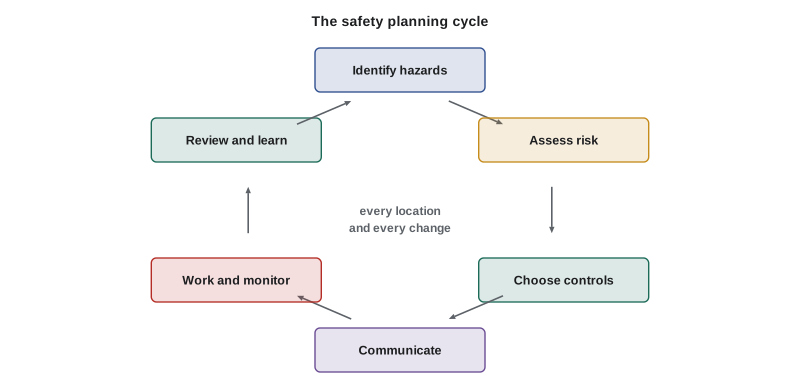
A location safety plan brings together the hazards and controls for a specific shoot. It is usually written by the production's safety officer with heads of department and approved by the producer.
- Shoot description: scenes, dates, location, hours and crew size.
- Hazard identification by department and activity: electrical, lighting, rigging, heights, weather, water, vehicles, effects, firearms, fatigue, public and traffic.
- Controls for each hazard, using the hierarchy of controls, with responsible people.
- Specialists and certifications required: electricians, riggers, lift operators, stunt and effects coordinators, armorer, medics, flaggers.
- Permits and notifications: film permits, fire, police, railways, utilities, landowners.
- Equipment requirements: generator size and location, distribution, GFCI protection, sandbags, wind monitoring, PPE.
- Emergency plan: hospital, access, medic, AED, evacuation, severe weather and rescue plans.
- Communication: call sheet notes, safety meetings, radio protocols, sign-off.
- Review and update: changes on the day trigger a stop and a new safety meeting.
Capstone: a night exterior safety plan
The capstone applies the course to a single scene. A two-night exterior shoot is planned on a residential street at the edge of a river park in late summer. The scene: a car pulls up in the rain, a character runs across the street to the riverbank and the camera booms up to reveal the city. The lighting plan includes an 18 kW HMI and a 12 kW HMI on condors as moonlight, LED panels for the car interior, practicals in two houses and an 8 × 8 frame of diffusion. Special effects will run rain towers over the street. A camera car with a small crane will track the arriving car on a closed section of road. The call is 6:00 p.m. and wrap is planned for 6:00 a.m.
Worked problem
Capstone part 1: power, generator and distribution
The load list is: 18 kW HMI (about 19 kVA), 12 kW HMI (about 13 kVA), six LED panels at about 1.3 kVA each, practicals and house lighting at 4 kW, video village and chargers at 4 kVA, and rain tower pumps on a separate effects generator. What generator size is needed at 80 % continuous loading, where should it go and what electrical controls are needed near the rain?
Show solution
- Load: 19 + 13 + 7.8 + 4 + 4 = 47.8 kVA. At 80 %: 47.8 ÷ 0.8 ≈ 60 kVA; choose a 70 to 100 kVA film generator with margin.
- Per leg at 120/208 V, balanced: 47,800 ÷ (1.732 × 208) ≈ 133 A, within a 200 A distribution.
- Generator placement: on the street side away from houses' windows and air intakes, downwind of base camp and the set, with exhaust pointed away and fuel stored safely.
- Wet area controls: GFCI protection on all circuits within the rain zone, connectors raised and covered, line-voltage fixtures kept out of the rain fall zone, ballasts on risers and HMIs fitted with rain hats.
Answer: A 70 to 100 kVA generator carrying about 133 A per leg, placed for carbon monoxide safety, with GFCI protection, raised connectors and coordination with special effects on the rain zone.
Worked problem
Capstone part 2: heights and wind
The 18 kW HMI flies from a condor basket at 60 ft. The condor's maximum wind speed is 12.5 m/s (28 mph) with a stated sail area that does not include the fixture, and forecast gusts are 9 m/s (20 mph). The 8 × 8 frame (about 6 m²) sits on two high stands at street level. What wind limits and fall protection should the plan set?
Show solution
- Because the fixture adds sail area not in the rating, the plan should set a lower operational limit, for example lowering the condor at sustained winds of 8 m/s or gusts approaching 10 m/s, as agreed with the operator and manufacturer guidance.
- An anemometer at height (or on the basket) and an assigned person monitor wind and call the lowering.
- Force on the frame at 9 m/s: 0.5 × 1.2 × 81 × 6 × 1.2 ≈ 350 N, about 36 kg; the stands need heavy sandbagging or ground anchors, and the frame should be struck if gusts exceed the plan's limit.
- Condor operators are trained and familiarized; workers in the basket wear harnesses with short lanyards on the basket anchor; the operator has a rescue plan using ground controls.
- The condor is positioned with minimum approach distances from overhead lines along the street, checked on the scout, with a spotter during set-up.
Answer: Set conservative wind limits below the manufacturer's maximum, monitor wind at height, sandbag or anchor the frame and strike it early, use restraint in the basket and plan rescue and power line clearance.
Worked problem
Capstone part 3: vehicles, river, weather and fatigue
List the main controls for the camera car sequence, the riverbank, thunderstorms and fatigue across two 12-hour nights.
Show solution
- Camera car: closed road with permit and trained flaggers or police at each end, safety meeting, rehearsals at low speed, speeds limited to give stopping distances within the closed section (about 48 m at 60 km/h or 174 ft at 40 mph), crew seated or secured, radio links, the actor's car driven slowly or towed.
- Riverbank: flotation devices for crew within reach of the water, a water safety person, lighting on the bank, no line-voltage equipment near the water's edge, and the actor's run rehearsed on dry, marked ground.
- Weather: thunderstorm criteria in the plan; lower condors and stop work at the first thunder, shelter in vehicles or houses, resume 30 minutes after the last thunder.
- Fatigue: 6:00 p.m. to 6:00 a.m. crosses the 2 to 6 a.m. low; provide meals, breaks, hot drinks, a shuttle or hotel for crew who live far away, avoid extending past wrap, and keep high-risk tasks like condor work and tie-ins early in the night where possible.
- Emergency: hospital route and time on the call sheet, set medic with AED, ambulance access kept clear, muster point, radio emergency channel.
Answer: The plan combines road closure and stopping distance limits, water safety, lightning criteria, fatigue controls and a clear emergency plan, each assigned to a responsible person and briefed in the safety meetings each night.
| Hazard | Key controls | Responsible |
|---|---|---|
| Electrical in rain | GFCI, raised connectors, separate effects generator | Gaffer, effects coordinator |
| Carbon monoxide | Generator placement and exhaust direction | Gaffer, generator operator |
| Condor and wind | Lower operational limit, anemometer, restraint, rescue plan | Key grip, condor operator |
| Frame in wind | Sandbags or anchors, strike at limit | Key grip |
| Power lines | Scouted, minimum distances, spotter | Key grip, gaffer |
| Camera car | Closed road, flaggers, rehearsals, speed limits | 1st AD, picture car coordinator |
| River | PFDs, water safety person, lighting | Safety officer, location manager |
| Lightning | Stop at first thunder, shelter, 30-minute rule | 1st AD, weather monitor |
| Fatigue | Breaks, meals, transport, limited hours | Producer, line producer |
| Emergencies | Medic, AED, hospital route, muster point | Safety officer, set medic |
Common mistakes
MistakeAssuming emergency services will arrive quickly at a remote location.
InsteadCalculate response times and provide medics, AEDs and access plans.
MistakeTouching a person who is being electrocuted.
InsteadCut the power at the source first, then give first aid.
MistakeCleaning up an incident scene before reporting a critical injury.
InsteadPreserve the scene as the law requires, except to save life or prevent further harm.
MistakeStopping an investigation at "the grip made a mistake".
InsteadAsk why repeatedly to find planning, resourcing and schedule causes.
MistakeWriting a safety plan and never updating it.
InsteadReview the plan with every change and hold a new safety meeting.
Summary and key terms
- Every location needs an emergency plan with access, hospital route, medic, AED, fire, evacuation and rescue details.
- First aid requirements depend on workforce, hazards and distance from medical care.
- Cut power before touching an electrical shock casualty, and send someone to guide the ambulance.
- Critical injuries must be reported immediately in Canadian provinces; OSHA requires fatalities within 8 hours and hospitalizations within 24.
- Investigations look for root causes and corrective actions high in the hierarchy of controls.
- A safety plan lists hazards, controls, specialists, permits, equipment, emergency response and communication.
- The capstone combines electrical load, generator placement, wind, heights, vehicles, water, weather and fatigue.
- Emergency plan
- A plan for responding to injuries, fire, weather and other emergencies at a location.
- AED
- Automated external defibrillator, a device that can restart a heart in cardiac arrest.
- Muster point
- An assembly area where people gather after an evacuation.
- Critical injury
- A serious injury that must be reported to the regulator immediately in Canadian provinces.
- OSHA 300 log
- The US record of work-related injuries and illnesses.
- Root cause
- An underlying reason that allowed an incident to happen.
- Five whys
- A method of asking why repeatedly to reach root causes.
- Corrective action
- A change made to prevent an incident from happening again.
- Safety plan
- A written plan of hazards and controls for a shoot or location.
- Set medic
- A medical professional or trained attendant providing first aid on set.
Practice problems
Work each problem on paper first, then reveal the answer to check.
Time for an ambulance 30 km away at 60 km/h?
Show answer
About 30 minutes.
What must happen before touching a shock casualty?
Show answer
The power must be cut at the source.
OSHA deadline to report a fatality?
Show answer
8 hours.
OSHA deadline to report an in-patient hospitalization?
Show answer
24 hours.
What does Ontario's OHSA section 51 require?
Show answer
Immediate notice of a death or critical injury and a written report within 48 hours.
Why report near misses?
Show answer
They reveal hazards before someone is hurt.
Name three items in a location emergency plan.
Show answer
Hospital route, medic and AED, evacuation and muster point.
Load of 19, 13, 7.8, 4 and 4 kVA at 80 %?
Show answer
About 60 kVA rating needed.
Force on a 6 m² frame at 9 m/s?
Show answer
About 350 N.
What should happen when a plan changes on the day?
Show answer
Stop and hold a new safety meeting.
Lesson quiz · 5 questions
Score 60% or more to complete this lesson.
Create a free account to save your progress, take quizzes and earn a certificate.